Today, diplomacy can no longer be seen as a male-dominated field. In Ukraine, as in many other countries, women are taking on leadership roles within the Ministry of Foreign Affairs, heading embassies and consular offices, and making a significant impact in diplomatic work. On 20 June 2022, the United Nations formally recognised the vital contributions of women to diplomacy within the multilateral system. Through a resolution passed by the General Assembly (A/RES/76/269), 24 June was designated as the International Day of Women in Diplomacy. At that time, Ukraine was entrenched in the full-scale war unleashed by Russia, yet women in diplomacy stood resilient, combating Russia’s aggression and harnessing the power of public diplomacy to rally international support for Ukraine’s cause.
Ukrainian women who devoted themselves to diplomacy in the early years of the nation faced challenges similar to those of their predecessors, navigating the struggle for statehood between 1917 and 1921 and resisting Bolshevik Russia, which sought to suppress an independent Ukraine. The contributions of women in the foreign affairs ministry and Ukraine’s first diplomatic missions have often remained in the shadows. Yet figures like Nadiia Surovtsova, Oksana Lototska, Irena Dobrodiieva, Oksana Khrapko-Dragomanova, Hanna Chykalenko-Keller, Mariia Dontsova, Sofia Volska, and other female diplomats left a lasting legacy. They played a pivotal role in shaping the organisational structure and traditions of Ukrainian diplomacy, laying the groundwork for the country’s public diplomacy efforts.
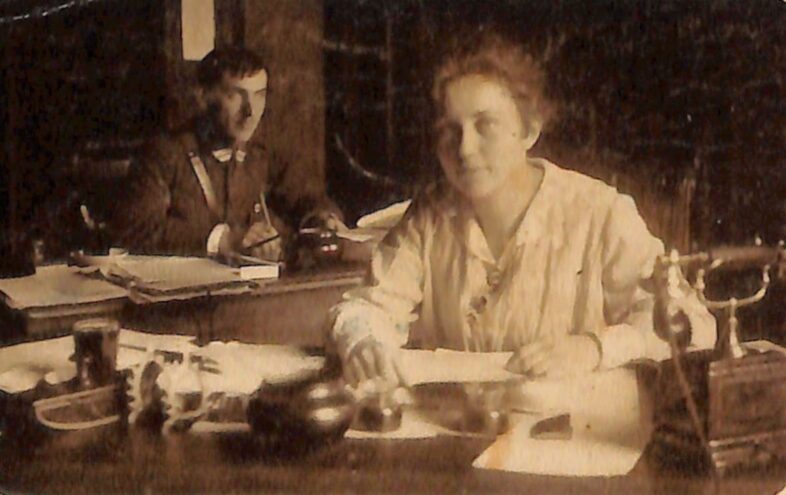
Photo: Nadiya Surovtseva in her office at the Ministry of Foreign Affairs of the UPR.
In the early days of Ukraine’s foreign affairs ministry, women were scarce, mainly holding technical roles. Nadiia Surovtsova, however, was a trailblazer in the ministry’s otherwise male-dominated leadership. Initially employed as a clerk, she completed the “Consular Academy” while working. With her patriotism, fluency in foreign languages, expertise in typing, communication skills, resilience under pressure, and dedication, Surovtsova became the first woman to lead an independent structural unit. She pioneered the role of spokesperson for the foreign ministry and was instrumental in introducing public diplomacy tools. For example, she organised an exhibition of Ukrainian embroidery and a collection of Ukrainian books at the Paris Peace Conference. While abroad, she also used charity concerts and Ukrainian fashion shows to raise funds for the starving population in Ukraine.
Hanna Chykalenko-Keller, who worked at the Ukrainian People’s Republic Extraordinary Diplomatic Mission in Switzerland, became the first female diplomat to give an official speech at an international congress. Oksana Lototska (Tokarzhevska-Karashevych) was the first female diplomat and the wife of a diplomat to give a detailed interview to a major Turkish newspaper. She also organised social gatherings for diplomats’ wives in Istanbul. Valeria O’Connor-Vilinska, the wife of engineer Oleksandr Vilinsky, who served as Consul General in Zurich, wrote the first novel about Ukrainian diplomats.
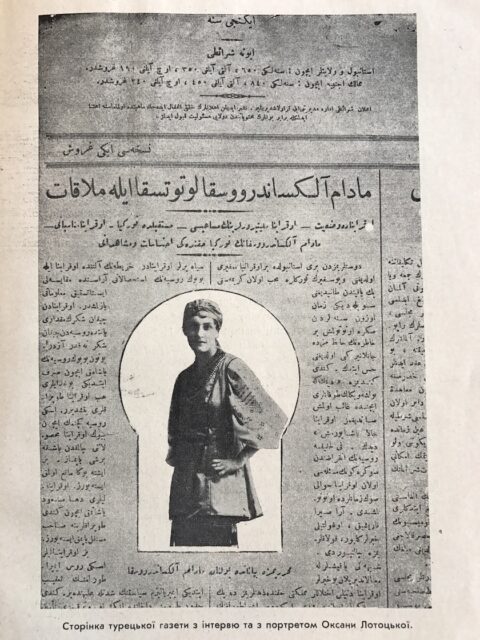
Photo: A page from the Turkish İfham newspaper featuring an interview with Oksana Lototska.
These women crossed paths not only at Ukraine’s foreign affairs office in Kyiv, on Tereshchenkivska Street 9, but also in Bern, where they played a key role in building the women’s movement. Maria Hrushevska, wife of the Head of the Central Council, led an organisation that connected Ukrainian women’s groups with international networks.
Through their efforts, the Ukrainian Section of the International Women’s League for Peace and Freedom was established in Bern. It grew into a national organisation with branches around the country, and its founding members included Valeria O’Connor-Vilinska, Oksana Khrapko-Dragomanova, Nadiia Surovtsova, Hanna Chykalenko, and others.
This was a groundbreaking form of civic diplomacy in which Ukrainian women worked to share the truth about Ukraine with the world. The organisation played a key role in developing tools that are now integral to public diplomacy. As her daughter Kateryna noted, Maria Sylvestrivna was elected “general chairwoman” of the National Council of Women in Paris. Maria Hrushevska temporarily took on the role, explaining, “The chair’s signature was needed on delegates’ mandates for the international congress.”
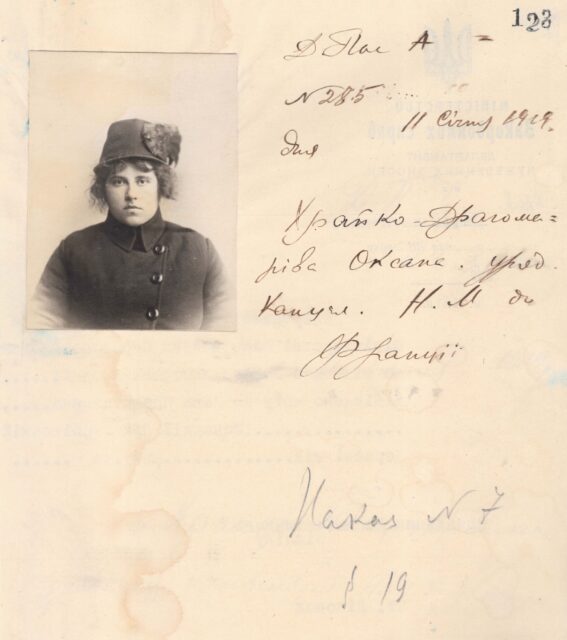
Photo: Diplomatic passport of Oksana Khrapko-Dragomanova.
Hanna Chykalenko-Keller was a key figure in this important initiative. In addition to her diplomatic duties with the Extraordinary Diplomatic Mission of the Ukrainian People’s Republic (UPR) in Switzerland, she was actively involved in public work and was one of the founding members of the Ukrainian Women’s National Council in Kamianets-Podilskyi. She served as its secretary and helped draft its charter.
The council’s primary aim was to gain international recognition for the UPR’s independence by collaborating with global women’s organisations. The mission seized every opportunity and platform to advance the Ukrainian cause, with Switzerland’s hosting of various international events proving especially helpful in these efforts.
A key moment came when Hanna Chykalenko-Keller delivered a speech at the International Congress of the International Woman Suffrage Alliance, held from June 6 to 12, 1920, in Geneva. The Ukrainian government and the Union of Ukrainian Women in Lviv had authorised her to speak via telegram, but due to postal delays, the messages arrived too late. Another hurdle was that Ukrainian organisations were not yet members of the International Woman Suffrage Alliance.
Despite these challenges, Hanna was accepted as a delegate of a “fraternal organisation,” meaning she didn’t have voting rights but was allowed to speak during the plenary session on 7 June. She became the first Ukrainian woman to present a report in English at such a prestigious event, drawing attention to the status of women in Ukraine, their participation in governance, and their involvement in parliamentary and municipal elections.
She also took part in a session alongside women from countries where women already had voting rights, including the United Kingdom, Australia, Canada, New Zealand, Denmark, Iceland, Sweden, Finland, the Netherlands, Germany, and Ukraine. During this session, Hanna expressed the Union of Ukrainian Women’s desire to join the International Woman Suffrage Alliance and attend the next congress in Paris in 1922.
From 8–13 September 1920, Hanna engaged in significant informational efforts at the Congress. She met with prominent figures in the international women’s movement, conducted important visits, and built valuable connections that would further Ukraine’s cause.
At the Women’s International League for Peace and Freedom Congress in Vienna in June 1921, a notable Ukrainian delegation of 20 members was present. This group included Milena Rudnytska, diplomats like Oksana Khrapko-Dragomanova, Nadiya Surovtseva, and Oksana Lototska, as well as the wives of diplomats, such as Valeriya O’Connor-Vilinska and her husband’s niece Khrystya Kononenko (whom the couple raised after her parents’ death), Oleksandra Pisnyachevska, Ivanna Levytska, Olena Zaliznyak-Okhrymovych, Olha Levytska, Olha Halahan, and others.
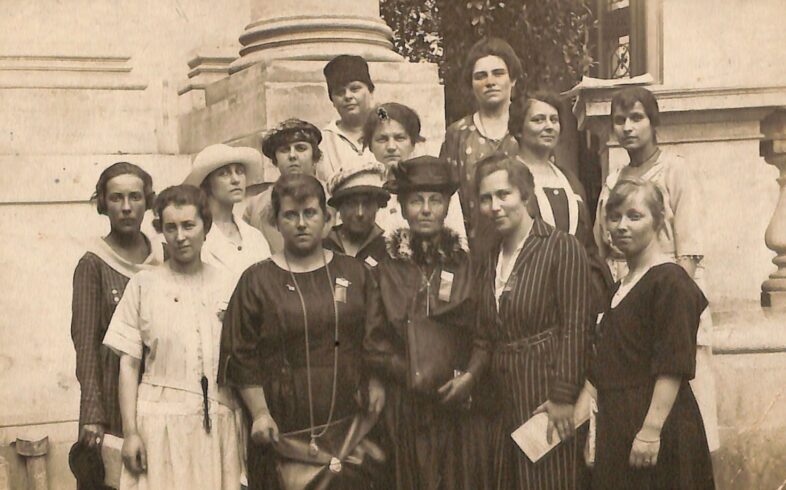
Photo: Participants of the International Women’s Congress in Vienna, June 11, 1921.
During the congress, the Ukrainian section was granted full membership in the International League. Nadiya Surovtseva, who had ended up in Vienna after being unable to reach her intended destination in Paris, worked closely with this international women’s organisation. She attended the League’s congresses in Dresden (1923) and Washington (1924).
Meanwhile, Ukrainians in Vienna came together to provide aid to those suffering from famine back home. On the initiative of the Ukrainian section of the League, and with active participation from Nadiya Surovtseva, the Committee for Aid to Ukraine’s Starving was founded. Key organisers, including Olha Halahan, Nadiya Surovtseva, and Oksana Khrapko-Dragomanova, sent appeals to all League member sections, urging them to assist Ukraine’s famine-stricken population.
Soon, donations began pouring in from the German, Norwegian, Hungarian, and Swedish sections. The Austrian section hosted a charitable theatre performance featuring the legendary author Bertha von Suttner, with proceeds directed to help starving Ukrainians. Thanks to their support, the committee also organised a Ukrainian exhibition and concert at the Hofburg Palace. The event showcased performances by opera singers and Vienna Music Academy graduates Sofiya Korenets and Oleksandr Nyzhankivskyi, with the highlight being a stunning display of traditional Ukrainian attire.
These efforts, now seen as key examples of cultural diplomacy, achieved tangible results. The funds raised supported scholars, writers, artists, cultural figures, and broader segments of the intelligentsia, as well as workers and peasants.
Initially chaired by Nadiya Surovtseva, the committee soon passed leadership to Mykhailo Hrushevskyi, the former head of the Central Rada and a historian, while she remained secretary. Mykhailo’s daughter, Kateryna, took charge of preparing and distributing appeals titled To Our Compatriots across Europe and America, urging financial aid for the starving. The largest contributions came from Ukrainian communities in the United States.
Maria Dontsova was a key figure among women diplomats, leaving her mark in the history of Ukrainian diplomacy. Not only was she the wife of Dmytro Dontsov, head of the press bureau for the UPR’s Extraordinary Diplomatic Mission in Switzerland and a prominent statesman, but she also represented women within the UPR’s foreign diplomatic institutions.
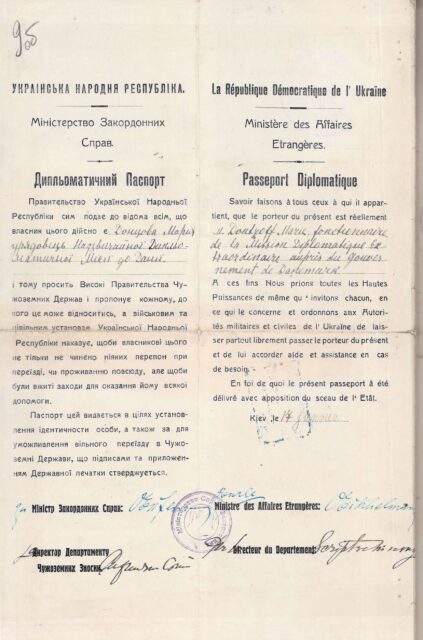
Photo: Maria Dontsova’s diplomatic passport.
Maria and Dmytro married on 27 May 1912, despite her father’s strong opposition, which she ultimately overcame after his untimely death. As the wife of a political leader, Maria supported her husband’s work while also taking an active civic role herself. She joined the women’s unit of the Ukrainian Sich Riflemen-II, organised by Olena Stepaniv.
In January 1919, Maria joined the UPR’s Extraordinary Diplomatic Mission in Denmark, led by Dmytro Levitsky. The mission travelled to Copenhagen to gain recognition for the UPR from the Danish government, spread the word of Ukraine’s resistance to Bolshevism, and assist Ukrainian refugees and prisoners of war. Maria’s expertise in information work, languages, and office administration proved crucial to the mission’s success.
At the same time, her husband, Dmytro Dontsov, was in Paris as part of the UPR-WUPR (Western Ukrainian People’s Republic) delegation attending the Peace Conference following World War I. Despite not being officially invited as representatives of a state allied with Germany, the UPR delegation aimed to secure recognition of Ukraine’s state independence or, at the very least, bring the Ukrainian issue to the attention of the conference. For this mission, having Dmytro on board was vital, as his expertise in international affairs made him a key figure in the delegation’s efforts.
The UPR envoys arrived in Copenhagen on March 2, 1919. While the Scandinavian countries did not officially recognise the UPR, the Ukrainian mission in Copenhagen was acknowledged de facto and enjoyed diplomatic privileges. With support from the Danish government, Dmytro Levytsky arranged for Ukrainian prisoners of war to be housed at exemplary farms and dairies and began laying the groundwork for trade relations. Maria Dontsova, a government official within the mission, played a key role in this work.
Meanwhile, the diplomatic missions to the USA and Great Britain were waiting for entry visas and had to remain in Copenhagen for an extended period. On May 1, 1919, a meeting was held in Copenhagen with the heads of missions from Denmark, Norway, Switzerland, England, and the USA to discuss the creation of an information bureau overseeing these countries. By March 1920, the UPR missions in Denmark, Norway, and Sweden were merged into a single Scandinavian mission led by Dmytro Levitsky.
Maria Dontsova later travelled to Switzerland, where Dmytro Dontsov was invited to head the Press Bureau of the UPR’s Extraordinary Diplomatic Mission. In Bern, Maria became involved in a women’s organisation focused on integrating Ukrainian women into international networks. Alongside the group, she attended events organised by the organisation, including the 1921 Congress of the International League of Peace and Freedom in Vienna, where Nadia Surovtsova described her as “a small, slender, blonde woman, somewhat affected.”
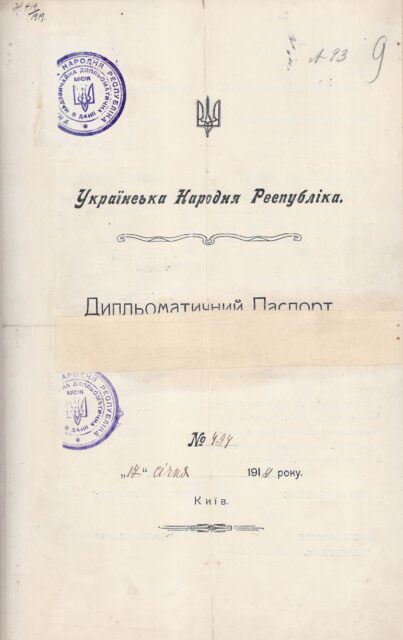
Photo: Maria Dontsova’s diplomatic passport.
In 1922, the Dontsovs returned to Lviv, where Maria supported her husband in publishing the Literary-Scientific Bulletin and began contributing her own articles. These articles mostly focused on the role of women in cultural development and appeared in Galician journals such as Zhinochyi Vistnyk (Women’s Herald) and Zhinocha Dolia (Women’s Fate). She also became actively involved in the Ukrainian Society for the Assistance of Emigrants from Great Ukraine and other initiatives.
Her commitment to the women’s movement, which she had started in Bern and Vienna, continued in Lviv. Maria joined the Board of the Union of Ukrainian Women and was chosen to represent Western Ukrainian women at the Congress of the International Women’s League of Peace and Freedom in Dresden in 1923. However, she was unable to secure permission from the Polish government to travel, as her planned speech was expected to include well-reasoned criticism of Polish policies towards Ukrainians, which she argued were designed to make life unbearable for the emerging Ukrainian intelligentsia.
Her arrival was also unwelcome because the congress was planning to admit a Polish organisation into the League. Olga Bessarab, the accountant of the Union of Ukrainian Women, worked alongside her friend Maria and had gained diplomatic experience while also engaging in underground activities. In February 1924, the Polish police arrested the young woman on charges of involvement in the activities of the underground Ukrainian Military Organisation. Shortly afterwards, after torture, they staged her suicide. Maria Dontsova was the first to inform her friends about the death of the heroine, and the Union of Ukrainian Women launched a protest, which was supported by other women’s organisations in Galicia and émigré groups.
Alongside her political work, Maria Dontsova started initiatives that today would be seen as key elements of cultural diplomacy. On June 23, 1934, during the First Women’s Congress in Stanislav, she organised a display of Ukrainian folk costumes, with help from the “Ukrainian Folk Art” cooperative and the Nova Khata (New House) publication. Maria herself showcased traditional Ukrainian attire, putting the country’s rich cultural heritage on display.
Her journey eventually took her across the ocean to the United States in 1950. There, she became an active member of the Union of Ukrainian Women of America and continued her work in the Ukrainian community abroad.
The stories of other women in Ukrainian diplomacy were similar. Most ended up in exile, where they became deeply involved in advancing the women’s movement. With determination, they fought for Ukraine’s interests on the global stage, bringing a unique, passionate, and relentless approach to their advocacy. Some even risked returning to Ukraine, now under Bolshevik rule, only to face repression and end up in Stalinist labour camps. Their lives debunk any idea that Ukrainian diplomacy didn’t have its own distinct path, showing instead how it was shaped by the bravery and resilience of women who laid the groundwork for future generations.