
The division of the Black Sea Fleet after the collapse of the USSR stands as one of the most dramatic chapters in recent history. It was about more than just ships and bases—it was the birth of a new security landscape in the post-Soviet space. From the moment Ukraine emerged as an independent state on the map of Europe, it positioned itself as a significant regional maritime power. Its coastline — stretching nearly 1,900 km from the port of Ust-Dunaisk on the western Black Sea to Mariupol on the northern Sea of Azov — marked a vast maritime frontier to defend.
For any industrialised nation, safeguarding interests at sea demands a capable navy. Ukraine naturally expected to inherit the Black Sea Fleet stationed on its territory, much like it had taken control of other military districts and formations.
On 5 April 1992, Ukraine’s first president, Leonid Kravchuk, signed a decree on “urgent measures to establish the Armed Forces of Ukraine.” Among its key points was the formation of a Ukrainian naval force: “To form the Naval Forces of Ukraine (Ukrainian Navy) based on the assets of the Black Sea Fleet stationed on the territory of Ukraine.”
But it didn’t go as planned. Moscow struck back with a decree from President Boris Yeltsin declaring the Black Sea Fleet under Russian jurisdiction, ordering the Russian flag to be raised on all its ships and vessels.
The fleet’s unresolved status took a heavy toll on morale. Officers grew frustrated, demanding clarity from politicians. Meanwhile, Admiral Igor Kasatonov, commander of the Black Sea Fleet, began cracking down on officers and warrant officers who showed sympathy towards Ukraine.
In response, the crew of the patrol ship SKR-112, led by Captain-Lieutenant Serhiy Nastenko, took matters into their own hands. On 21 July 1992, they boldly raised the Ukrainian flag and sailed unilaterally from their base in Novoozerne to Odesa, defying the fleet’s command, which had even attempted to stop them by force.
Meanwhile, the question of dividing the Black Sea Fleet remained tangled, largely because of the Kremlin’s unyielding stance. Moscow was determined not just to keep control of the fleet but also to stake a claim on Ukrainian Sevastopol. A glaring example came with the Russian State Duma’s provocative and illegal resolution of 9 July 1993, which declared Sevastopol part of Russia. Though President Yeltsin vetoed the document, its very existence laid bare the true intentions of Moscow’s leadership.
At the same time, the fleet’s command was quietly scrapping ageing ships abroad—in places like India and Turkey—turning old vessels into hard currency. To handle the financial side, a branch of the Russian bank Nevikon-Yug was opened in Sevastopol, processing all payments related to these operations.
The bitter and complex negotiations over the Black Sea Fleet dragged on until 1997. For much of that period, the fleet remained under a so-called “joint” command of the Ukrainian and Russian presidents and continued to fly the flag of the now-defunct USSR.
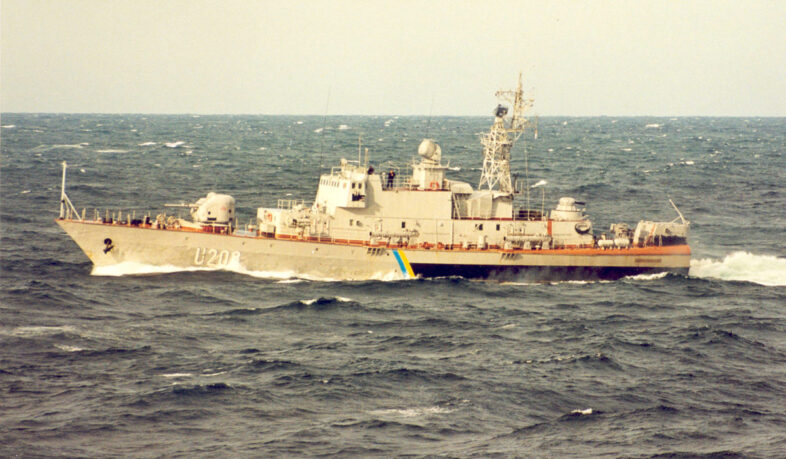
Corvette Khmelnytskyi
On 23 June 1992, in Dagomys, Ukraine and Russia signed an agreement on developing interstate relations. Both sides recognised the importance of talks to establish Ukraine’s Naval Forces and Russia’s Black Sea Fleet, based on the assets of the former Soviet fleet. From August 1992, Ukraine and Russia began formalising the division of the former Soviet Black Sea Fleet, signing the Agreement on the Principles for Forming Ukraine’s Naval Forces and Russia’s Naval Fleet. This was followed on 17 June 1993 by the Agreement on Urgent Measures for Establishing Ukraine’s Navy and Russia’s Black Sea Fleet, alongside other deals that cemented a “50/50” split of the fleet.
On 3 September 1993, talks resumed in Massandra, with Ukrainian and Russian delegations negotiating not only the fleet’s fate but also nuclear disarmament and broader interstate relations. Yet the Russian side turned the negotiations into an ultimatum: Ukraine had to immediately repay its gas debt from 1992 and early 1993, or the debt would be settled by handing over a share of the fleet.
Ukraine’s defence minister, Colonel General Kostyantyn Morozov, pushed back strongly. He insisted the Black Sea Fleet should belong entirely to Ukraine, arguing there was no justification for dividing it with Russia. He stressed that the fleet was not a commodity to be sold or a bargaining chip for settling gas debts. But his stance was sidelined—Prime Minister Leonid Kuchma dismissed it as Morozov’s personal view, not the official position of the Ukrainian delegation.
Under intense pressure from Moscow, President Leonid Kravchuk was forced to concede Ukraine’s previously agreed 50% share of the Black Sea Fleet to Russia in exchange for settling the country’s mounting gas debt. This arrangement was formalised in a protocol signed by the two presidents on 3 September 1993.
While the protocol temporarily defused tensions, it also set the stage for Ukraine’s effective loss of the fleet. The agreement sparked widespread controversy across Ukraine — among politicians, the public, and the Ukrainian Navy itself — who saw it as a betrayal of national law and interests. The Verkhovna Rada condemned the deal as unacceptable for the state.
By 15 April 1994, Ukraine and Russia signed a new agreement outlining a gradual resolution of the Black Sea Fleet dispute. Building on previous accords and the September protocol, it effectively acknowledged that Ukraine would retain only 15–20% of the fleet’s ships and vessels. On 9 June 1995, Ukraine and Russia finally agreed on the division of the former USSR’s Black Sea Fleet. The deal was signed in Sochi by Ukraine’s President Leonid Kuchma and Russian President Boris Yeltsin. As a result, Ukraine received just 18.3% of the fleet’s ships, while Russia took the lion’s share — 81.7%. In total, Ukraine ended up with 137 vessels, compared to Russia’s 388.
In reality, Ukraine ceded 32% of what was originally meant to be its better share — 117 warships and patrol boats — which Russia kept as part of the repayment for Ukraine’s $521 million debt. Alongside the ships, Ukraine received 12 aircraft, 30 naval helicopters, and around 227 coastal facilities, roughly a quarter of the shore infrastructure, plus significant weaponry, military equipment, ammunition, and other assets.
Negotiations then turned to the terms of Russia’s military presence on Ukrainian soil, covering rental fees, deployment sites, limits on personnel, armaments, fleet composition, and use of naval support facilities. These talks culminated on 28 May 1997 with the signing of the intergovernmental base agreement that set the conditions for the Black Sea Fleet’s continued presence in Ukraine.
This marked the end of the division of the former Soviet Black Sea Fleet into the Ukrainian Navy and the Russian Black Sea Fleet — a process that left many issues unresolved. Most critically, these agreements, made in defiance of Ukraine’s constitution, effectively legitimised the presence of a foreign military force on Ukrainian soil — one belonging to a country with territorial claims against Ukraine and a track record of repeatedly breaching the terms of its stay.
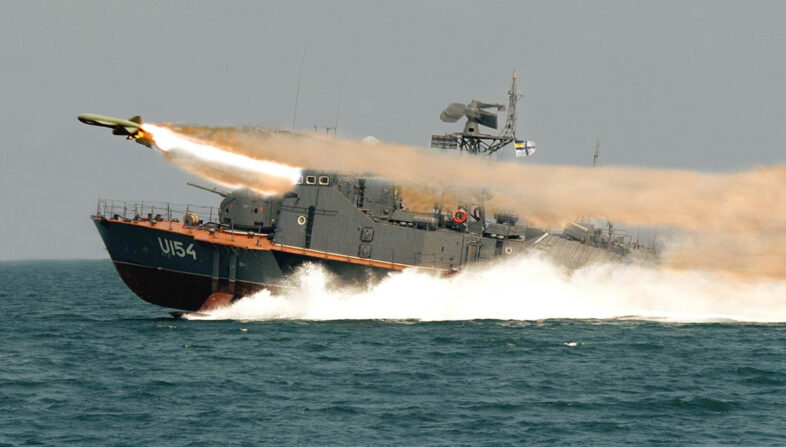
Missile boat Kakhovka
How it all began
Under the USSR, the Black Sea Fleet was far more than a regional force — it projected naval power across the Black Sea and well beyond, reaching into the Aegean and Mediterranean Seas, the Atlantic Ocean, and even the Indian Ocean. Crucially, it provided the logistical and operational backbone for the Soviet Union’s formidable permanent naval presence in the Mediterranean: the 5th Operational Squadron.
This squadron was a rotating force, made up of aircraft carriers, missile and artillery cruisers, destroyers, and submarines drawn not only from the Black Sea Fleet but from other Soviet fleets as well. Its reach was further bolstered by strategic bombers — Tu-95MS and Tu-22M3 models — launching from airfields in Crimea and near Mykolaiv, ready to carry out missile strikes on key targets.
In the event of war against the United States and NATO, this squadron was poised to launch devastating strikes against designated targets within the U.S. 6th Fleet and its Mediterranean allies. The Black Sea Fleet also had a critical role in amphibious operations, tasked with seizing control of the Turkish Straits—the Bosphorus and the Dardanelles—to secure unimpeded access to the Mediterranean, maintain a vital link with the 5th Operational Squadron, and supply it with fuel and ammunition.
Following the collapse of the USSR, Moscow’s severe economic crisis made it impossible to maintain the fleet as it once was. Yet, despite these challenges, the Kremlin was determined to prevent Ukraine from asserting naval strength, doing everything in its power to delay and obstruct the division of the Black Sea Fleet.
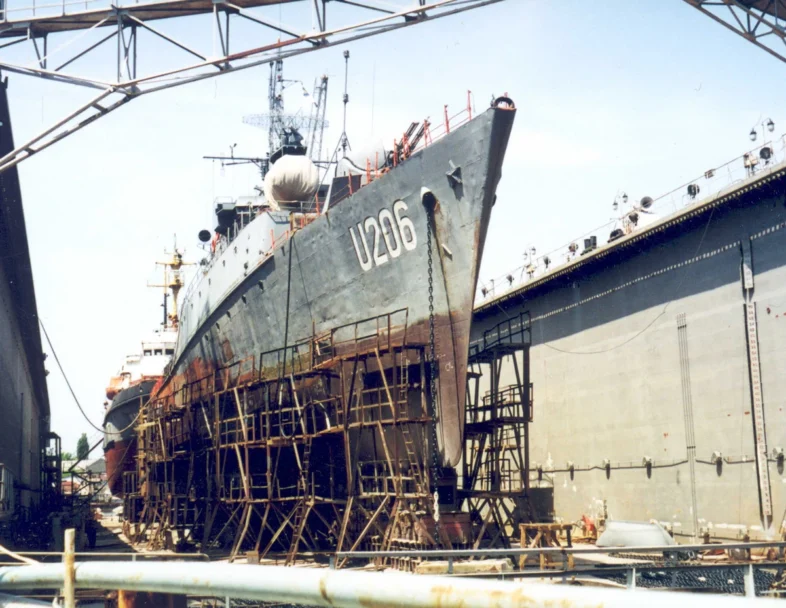
Corvette Vinnytsia
By December 1991, the Black Sea Fleet accounted for nearly 10% of the Soviet Navy’s overall strength. Its sprawling organisation included more than 1,300 formations, units, subunits, and institutions. The fleet boasted 883 vessels in total: 105 warships, 69 combat boats, 48 special-purpose ships, 191 auxiliary vessels, and 470 boats and harbour craft. Yet most were relics of the Cold War — ageing, outdated, and no longer fit for modern naval warfare.
Of the fleet, 525 ships, boats, and vessels were earmarked for division. Between August 1992 and May 1997, fleet commanders wrote off and sold 263 of these. Experts estimate that, from September 1991 to August 1992, the Russians also transferred or handed over another 95 ships and vessels—either to other fleets or to civilian agencies—further shrinking what was left.
The Black Sea Fleet’s naval aviation was a formidable force, boasting over 170 combat aircraft — including 40 Tu-22M3 missile bombers and 24 other Tu-22 variants — alongside 19 anti-submarine planes, 115 helicopters, and 35 transport aircraft.
In total, the fleet was staffed by around 70,000 personnel.
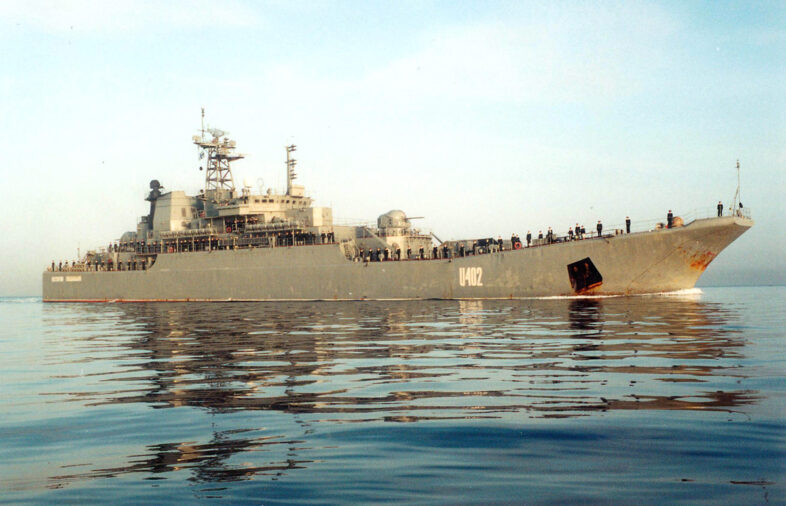
Large landing ship Kostiantyn Olshanskyi
The fleet’s presence on Ukrainian soil was extensive, spread across 24 garrisons and 572 military settlements, which included 430 residential neighbourhoods. Military units, fleet support services, and servicemen’s families occupied some 10,850 buildings. Altogether, the Black Sea Fleet held rights to around 65,000 hectares of land.
Estimates valued the fleet’s core assets at no less than $60 billion. Yet during negotiations over its division, working groups were forced to work with a sharply undervalued figure of $26.1 billion — a number imposed by the Russians.
An opportunity missed
It’s often said that Admiral Igor Kasatonov, commander of the USSR Black Sea Fleet, outright refused to submit to Kyiv. That’s partly true — but it’s not the full story, nor did it happen overnight. A lesser-known fact is that by December 1991, the Russian Ministry of Defence had already stopped funding the Black Sea Fleet (along with other units stationed on Ukrainian soil). In this context, the prospect of the fleet coming under Ukrainian control, as the country began building its own armed forces, was very much a real possibility.
Following a decree from the Presidium of Ukraine’s Verkhovna Rada on 10 October 1991, which approved the Ukrainian Military Oath and set out how it should be taken, on 3 January 1992 Admiral Kasatonov instructed Black Sea Fleet commanders to prepare their personnel to swear allegiance to the people of Ukraine in a formal ceremony planned for 20 January.
On 9 January 1992, Admiral Kasatonov personally travelled to Kyiv to take part in an All-Ukrainian meeting on military development, chaired by President Leonid Kravchuk and attended by the defence minister, commanders of military districts and armies, and senior officials of Ukraine’s armed forces.
But something unexpected happened. For reasons that remain unclear, Kasatonov was barred from attending the meeting. It’s widely believed this was due to President Kravchuk’s personal mistrust of the admiral — after all, Kasatonov had been appointed commander of the fleet by Boris Yeltsin in September 1991 without Kyiv’s approval.
The snub from Ukraine’s top military and political leadership, coupled with a joint communiqué from the Ukrainian and Russian delegations in Minsk on 11 January, which called for part of the Black Sea Fleet to be incorporated into Ukraine’s armed forces, deeply offended Kasatonov. He swiftly became a staunch opponent of Ukraine’s claims. Backed by Moscow, Kasatonov rescinded his earlier orders for the fleet to swear allegiance to Ukraine, instead insisting the personnel pledge loyalty to Russia — a move fiercely resisted by Kyiv, which only deepened the crisis. In doing so, Ukraine lost a crucial chance to bring the entire Black Sea Fleet under its control.
It’s worth recalling a historical precedent from 30 April 1918, when Moscow and Kyiv were also locked in a struggle for control of the Black Sea Fleet of the former Russian Empire. Rear Admiral Mikhail Sablin, then commander of the fleet, defied Moscow and, in agreement with representatives of the Central Rada of Ukraine, ordered the fleet to come under Ukrainian control. It raises a pointed question: perhaps some of today’s politicians would do well to study their own history a little more closely?
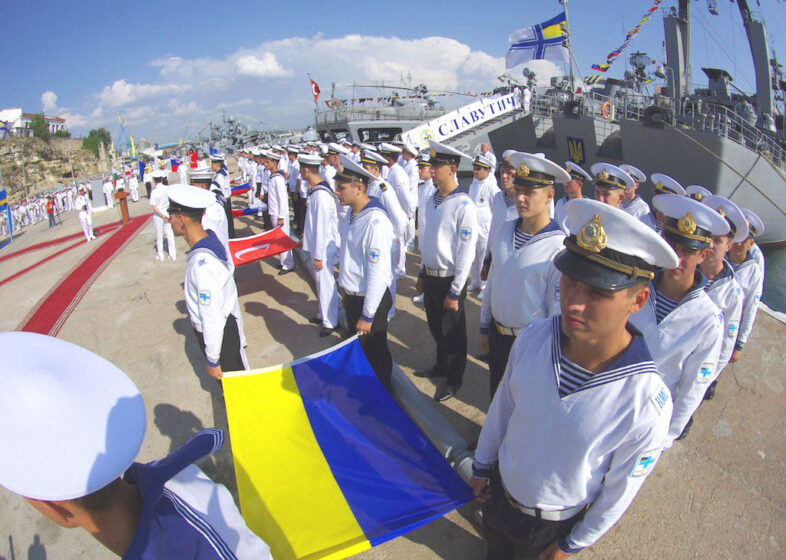
Ceremonial handover of command of the BlackSeaFor regional naval task force to the Ukrainian Navy, Sevastopol, 2013
Building Ukraine’s navy
The formation of the Ukrainian navy began even before the Black Sea Fleet was officially divided. The first ship to join Ukraine’s fledgling naval forces was the patrol vessel SKR-112. After docking in Odesa, its crew requested the ship be renamed Otaman Semen Bilyi, in honour of a celebrated Zaporizhian Cossack leader. But the initiative was shelved — the SKR was old and in poor technical condition.
Progress came soon after. On 28 July 1992, the command ship Slavutych, built at the Black Sea Shipyard in Mykolaiv, proudly raised its flag. Then, on 4 April 1993, the frigate Hetman Sahaidachny—named for Petro Sahaidachny, founder of the Zaporizhian Sich’s naval forces—was commissioned, having been built at the Kerch Zaliv shipyard.
Further additions followed: on 26 June 1993, the Feodosia shipyard More delivered the small hovercraft landing ship Donetsk to the Ukrainian navy, and by 30 December that year, Kyiv’s Lenin’s Smithy factory handed over the corvette Lutsk.
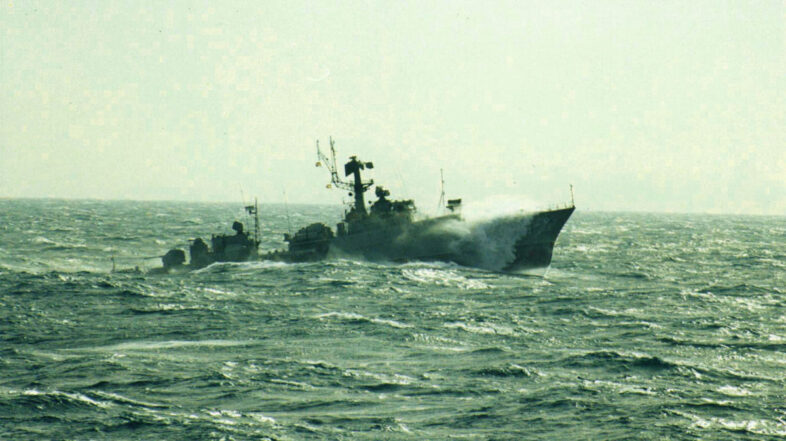
Corvette Lutsk
The division of the former Soviet Black Sea Fleet handed Ukraine 138 ships and vessels, giving a significant boost to its fledgling navy. Yet, with limited resources, only 28 of these vessels were actually repaired and made seaworthy.
By 1 August 1997, the Ukrainian Navy counted 28 named ships and vessels across various classes, each proudly sponsored by different cities and the nation as a whole. Their commanders received flags blessed at St Volodymyr’s Cathedral, and on that very day, Ukraine held its first-ever naval parade in Sevastopol — an event graced by the presence of President Leonid Kuchma.
On the other hand, this influx of ships came with a harsh price — significant Ukrainian budget funds were poured into repairing ageing, often deliberately damaged vessels handed over by the Russians, money that might have been better spent on building newer, more modern ships. Still, the Ukrainian fleet’s very existence became an undeniable fact.
The vessels inherited from the Black Sea Fleet were actively deployed, taking part in international exercises and missions. Yet, as time passed and the fleet naturally aged, the number of operational Ukrainian ships steadily declined. Meanwhile, the Russian fleet remained fully combat-ready and, in February–March 2014, played a crucial role in enabling Moscow’s occupation of the Autonomous Republic of Crimea.
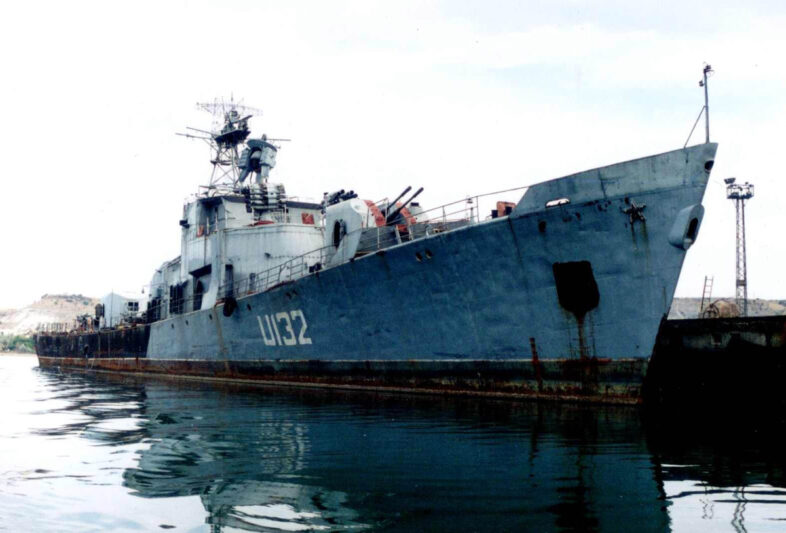
Ukrainian frigate Otaman Bilyi (СКР-112)
The events in Crimea dealt a devastating blow to the Ukrainian Navy, which lost more than 80% of its fleet along with nearly all of its coastal infrastructure. While Russia eventually returned some of the seized Ukrainian ships and support vessels, these were mostly outdated and only a handful remain in service today. The rebuilding of the Ukrainian Navy — now a crucial pillar of the country’s defence — is unfolding under the harsh realities of war and guided by new principles. But that is a story for another time.