For nearly 40 years, a wall concealed Alla Horska’s monumental mosaic in Mariupol, leaving many to assume it was gone for good. When it finally resurfaced, there was barely time to study or even admire it: in 2022, Russian shelling partially destroyed it. The mosaic’s fate — and that of its creator, Alla Horska, who was brutally killed by the KGB — mirrors the treatment Russia has long reserved for Ukrainian culture.
Horska belonged to the Sixtiers, a new wave of Ukrainian artists who pushed back against traditional Soviet conformity. She grew up in a well-connected, Russian-speaking Soviet family — her father ran several film studios — but later embraced her Ukrainian identity so fully she began keeping her diary in Ukrainian. Her talent and force of personality made her a central figure in the movement, whose work broke sharply with Socialist Realism, mixing Ukrainian folk traditions with the interrupted modernist experiments of the 1920s.
Ukraine’s Executed Renaissance and the Sixtiers were the two brightest bursts of cultural energy to break through during rare moments of eased pressure: the Ukrainisation of the 1920s and the Khrushchev “thaw” of the late 1950s and early 1960s. Together, they show just how far Ukrainian culture might have soared if not for Russia’s constant repression, censorship, and the ruthless targeting of its artists.
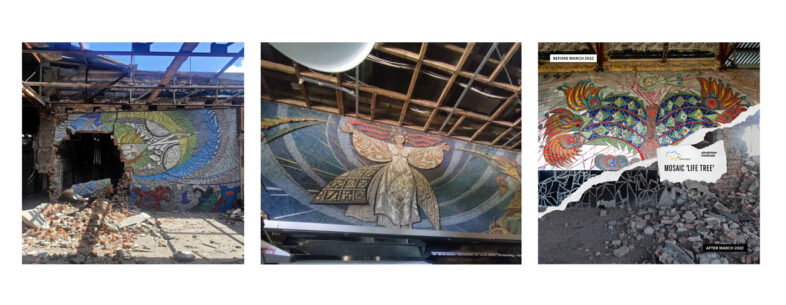
Alla Horska’s mosaics: “Boryviter,” “Ukraine Blooms,” “Tree of Life”
Across Europe and the United States, young people in the 1960s rallied around anti-authoritarian and anti-colonial causes as they pushed for universal civil rights. Ukraine saw its own version of this awakening. The Sixtiers and dissidents took up human rights activism, demanded space for cultural expression and resisted growing Russification. After Stalin’s death, the Soviet Union promised a new era of liberalisation and publicly condemned the dictator’s cult — promises that, as Ukrainians soon discovered, bore little resemblance to reality.
In 1962, Alla Horska, theatre director Les Taniuk and poet Vasyl Symonenko uncovered a mass burial site in the Bykivnia Forest near Kyiv — the resting place of thousands of Ukrainians executed by the Soviet regime. They were all in their mid-20s to early 30s, bound together by Kyiv’s Club of Creative Youth, an early spark of civil society built on volunteer energy, idealism, mutual support and solidarity. It wasn’t long before they would be swept into their own version of an Executed Renaissance.
Their only “crime” was taking the Soviet leadership at its word when it claimed to have condemned the horrors of the Great Terror in the 1930s. Not even the influence of Horska’s well-connected father could shield her. After 1962, the 32-year-old artist was barred from holding solo exhibitions or creating theatre sets. She was expelled from the Union of Artists twice — a punishment that, in the USSR, amounted to professional erasure, leaving her unable even to buy basic supplies like brushes or paint.
It took remarkable courage to stand up to a totalitarian state. Horska, working with a group of fellow artists, created the stained-glass panel Shevchenko. Her work, Mother, at Kyiv’s Taras Shevchenko University, was so raw, furious and honest that party censors, together with the university rector, smashed it to pieces as soon as they saw it.
After the Prague Spring, Soviet authorities sensed the system was wobbling and moved quickly to stamp out any hint of liberalisation.
Another act of hopeful defiance followed in 1968 when Horska and 138 other artists drafted a letter protesting the arrests of Ukrainian intellectuals and carried it to Moscow — effectively signing their own death warrant. They still believed they could reason with the state, that the line had not yet been crossed, that the authorities couldn’t possibly be waging a war against their own citizens.
The truth was far harsher. In 1970, Horska and her father-in-law were found dead, in circumstances that bore all the hallmarks of a KGB killing. Alla Horska’s funeral became a devastating moment for her entire generation. Exhibition bans, works torn down, expulsion from the Artists’ Union, and a brutal killing followed by enforced silence — all of it was inflicted on a single, gifted artist who was denied any space to express herself and, in the end, denied her life.
Today, the first retrospective of Horska’s work, Boryviter, at the Ukrainian House in Kyiv is drawing long queues. Her art — and the story behind it — resonates with new force in the midst of the full-scale war. The Sixtiers fought to preserve the fragile thread of memory connecting them to the soaring cultural achievements of the 1920s. The discovery of Bykivnia changed their worldview forever. Now, Ukrainians are looking at the Sixtiers — and their defiance of empire — with fresh eyes.