Moscow’s “victory cult” has long been at odds with the harsh reality of the many defeats its army has suffered through the centuries. On 27–28 May 2025, a quiet but telling anniversary passed: 120 years since the Battle of Tsushima, a moment that laid bare the familiar arc of Russian imperial ambition—grandiose in vision, catastrophic in execution.
It was off the coast of Tsushima Island that Japan delivered a staggering blow to the pride of the Russian navy, sinking nearly the entire fleet and sending the tsarist dream of maritime dominance to the ocean floor. The fallout was swift and symbolic: Moscow abandoned its naval aspirations and reverted to its more familiar playbook of scorched-earth retreat and land-bound belligerence.
As Ukraine continues its own resistance against Russian aggression, the lessons of Tsushima feel strikingly relevant. What does this forgotten but defining naval disaster tell us about the vulnerabilities of empires—and how might its legacy inform Ukraine’s path in the war today?
Tsushima — the significance
As Ukrainian drones take out a substantial number of Russia’s strategic bombers—effectively consigning the Kremlin’s neo-imperial ambitions to pure fantasy—many analysts have likened this Ukrainian success to the Battle of Tsushima. In terms of shattered ambitions and the loss of military hardware that will be nearly impossible to replace, the comparison feels entirely apt.
Still, Ukraine’s defeat of Russia’s naval power—and now its air fleet—has been far more humane: the targets were struck while effectively “at anchor,” on airfields rather than at sea, and without the deaths of thousands.
While the 1770 Battle of Chesma—where the Russians used fire ships in a kamikaze-style attack to destroy the Ottoman fleet—might be a closer historical parallel to the events of 1 June 2025, it’s Tsushima that truly stands out. It remains the clearest example of a David-versus-Goliath clash: a vast, cumbersome empire toppled by a smaller, more agile and technologically advanced power.
Just as the battles of Trafalgar and Jutland ended the dominance of the French and German fleets among the world’s naval powers, the Japanese defeat of Russia’s Second Pacific Squadron marked a decisive turning point for Russian militarism. After that crushing loss, Russia’s once-proud navy all but vanished from prominence during both World Wars, relegated to smaller ships and submarines.
During the Cold War, the USSR managed to assemble a so-called “fleet of vengeance” made up of nuclear-powered submarines, funded through the widespread exploitation of its people and natural resources. This fleet served to intimidate smaller nations, including Ukraine, relying on carrier-less flotillas. That was until Ukrainians, starting in 2022, began to set new, modern priorities.
Russian army: the testimonies
When historians and military experts have turned to Aleksei Novikov-Priboi’s memoirs—the “chronicler” of Russia’s greatest naval defeat—they’ve often found themselves drawn to his spirited, even heroic, mourning of lost ships, both old and new. He also detailed the ammunition mismatch—Russians relied on armour-piercing shells, while the Japanese used high-explosives that sparked devastating firestorms—the thick smoke from Russian gunpowder, poor-quality armour, the limited range of Russian guns, and, most critically, the slower speed of Russian vessels compared to their Japanese foes. Today, though, the book offers insight for very different reasons.
A textbook cause of Russia’s defeat off the Korean coast was the lack of tactical freedom given to individual ship captains. When the flagship battleship Knyaz Suvorov was damaged, its masts shattered and signalling impossible, it lost control and began drifting. The rest of the squadron blindly followed, losing all initiative in the battle. Naturally, the crews on other ships had no way of knowing that their admiral, Zinovy Rozhestvenskiy, had been wounded and was unable to command. The same paralysis affected fire control: Russian ships, led by their incapacitated flagship, tried to focus fire on a single Japanese vessel—the flagship Mikasa, from which Admiral Tōgō Heihachirō, known as the “Nelson of the East,” directed his victorious fleet. Ships too far from the Mikasa couldn’t land effective hits, wasting ammunition and precious time, while the Japanese, firing with precision and coordination, systematically destroyed the Russian fleet ship by ship.
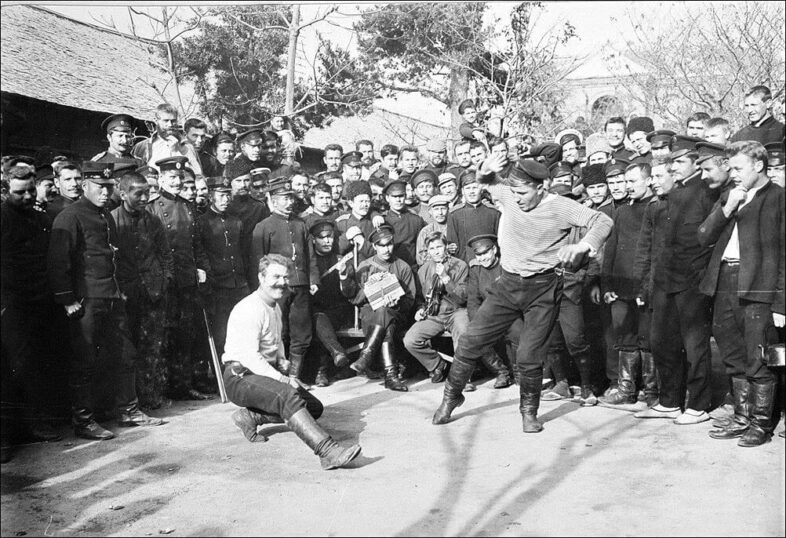
The sailors of the squadron, having made the long journey from the Baltic Sea around Europe, Africa, India and China to Japan just before the Battle of Tsushima, were far from enthusiastic about the voyage. Constant inspections and showy drills bred resentment among the crews, who referred to their ships as “floating prisons,” unsure if they were even heading into a real war. Sailors aboard the cruiser Oslyabya, which was sunk during the battle, were heard saying to one another, “Let’s just sink already—under Admiral Makarov’s flag.” Makarov had died a short time earlier defending Port Arthur.
Russians do surrender
Today, we’re no longer surprised by the absurd myths Russians spin about their supposed ferocity in battle. Throughout the 20th century, Moscow worked hard to convince both its own people and the outside world of its toughness. But a closer look at the Russo-Japanese War of 1904–1905 reveals plenty of facts that tell a very different story.
Take the famed cruiser Varyag, for example. Despite the patriotic song that still drives Russians to war with tales of false heroism, the ship was not only surrendered but handed over almost intact. It then went on to serve under a Japanese name and flag for another decade. A similar fate befell several other vessels at the Battle of Tsushima. Sometimes, the raising of the white or Japanese flag was justified—when ships were surrounded or faced imminent destruction—but there were also clear cases of misjudgement. The state-of-the-art cruiser Izumrud, for instance, was blown up on a sandbank at a moment when there was no real threat. Its commander had effectively flushed billions from the Tsar’s treasury down the drain.
The inflated “fighting spirit” of the Russians was on full display when the battleship Nikolai I was captured. The Russians themselves raised the Japanese flag, and when the enemy came aboard, one Russian lieutenant told a Japanese officer: “I’ve never been to your country. I’ve always wanted to see how you live… It’s been a lifelong dream to meet your geishas… You understand—we’ve spent eight months at sea.”
Americans had already helped Moscow concede defeat
Just three months after Russia’s crushing naval defeat at the Battle of Tsushima, the Russians found themselves at the negotiating table with their enemies. It wasn’t simply a matter of wanting to end the fighting—Japan, too, lacked the resources for a prolonged and exhausting war. The Japanese insisted that any offer of talks must come from the Russians as the defeated party, but Moscow refused to accept that role. That’s when the Americans stepped in. The United States, a staunch supporter of Japan, saw President Theodore Roosevelt take the lead in formally initiating the peace talks.
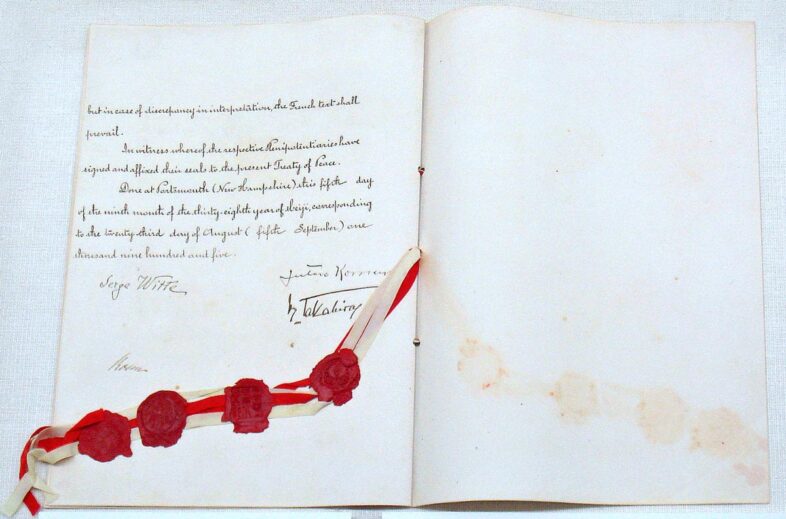
The negotiations took place on neutral ground—in Portsmouth, New Hampshire—in a strictly bilateral format. The Russians were reluctant to make any real concessions. They quickly offered reparations but flatly refused to cede Sakhalin Island. The Japanese, though weary, were prepared to continue fighting—a course Roosevelt urged them to abandon. The result was a compromise: Sakhalin was divided in two, a division that lasted until World War II, when the Soviet Union occupied the rest of the island—a status quo that remains to this day.
Despite retaining the territory, Russia never managed to reassert a meaningful presence in the Pacific. Other major powers benefited from St Petersburg’s weakening. Meanwhile, the blow to the imperial regime at home sparked a powerful revolutionary wave, forcing the Tsarist government to consider democratic reforms for the first time. In the end, military defeat has always been the sharpest antidote to Russian despotism—one for which no monarch or dictator has ever found a cure. More than a century later, that should still offer us a potent source of inspiration.