Ukrainian Christmas has always carried a political weight alongside its religious and ritual significance. It is no accident that Herod is portrayed so harshly in the Ukrainian nativity play. The triumph of light over darkness has long symbolised the hope for freedom and the breaking of political chains. Soviet authorities understood the power of the holiday and, for a time, sought to suppress it openly. Later, recognising its deeper cultural implications, they replaced it with a “Stalinist New Year.” Yet, as the old joke about Nietzsche—whom God outlived—goes, in Ukraine, Christmas outlasted the USSR. It is perhaps fittingly symbolic that the Red Empire officially dissolved on 25 December.
Christmas outlawed
After taking control of Ukraine, the Bolsheviks at first just observed Christmas celebrations—but soon set about trying to erase them entirely. The border drawn in 1921 divided Ukrainians into two parallel realities: in some areas, Christmas was still tolerated, while in others, celebrating it could bring public mockery or even jail. To stamp out mass festivities, the Soviet occupation churned out propaganda leaflets telling “godless” citizens how to behave and actively enlisted young people in their ranks. The youth threw themselves into the campaign, their appetite for progress and the usual generational tensions skillfully manipulated by the state agitators.
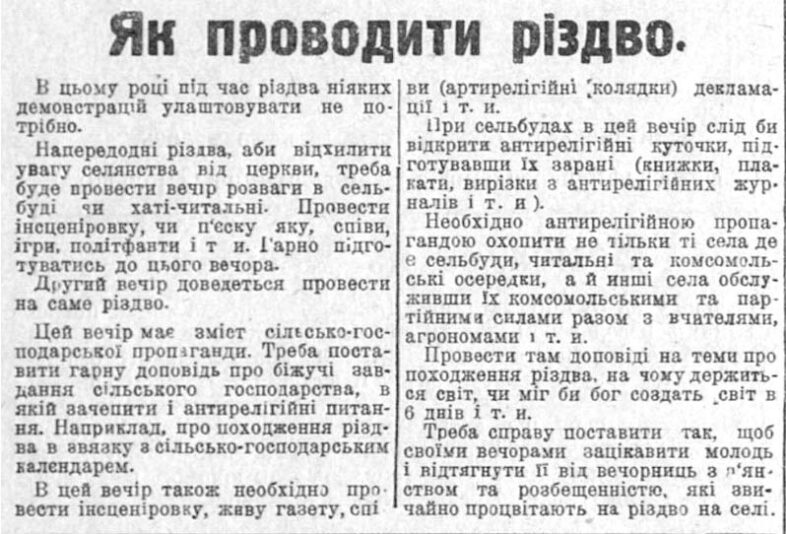
Bolshevik leaflets with instructions on how to “properly” celebrate Christmas
Ukrainians living under Polish rule and in emigration called the Soviet Union a “prison of nations”, a place where “Christmas is a forbidden holiday,” as the scholar Stepan Siropolko wrote in the Dilo magazine in 1932. He was among the first to note that the anti-religious campaign hit Ukraine especially hard, with the Russian Bolsheviks seeing Ukrainian religiosity not just as “counter-revolutionary” but also as a sign of “national chauvinism.”
In effect, Christmas became a subtle act of Ukrainian patriotic resistance. It’s no surprise, then, that the schools were repurposed as instruments of ideological control, using a supposedly “scientific” approach to anti-religious education. Primers and textbooks were filled with texts mocking faith and spiritual ideals, student “cadres of unbelievers” were organised, anti-religious songs were promoted, and any textbooks that didn’t toe the ideological line were systematically removed.
Moscow offered Ukrainian children no explanation of the social or historical meaning of traditions; instead, it imposed its own, officially sanctioned interpretation. In Ukraine, the ban on celebrating Christmas also extended to carols and shchedrivky, traditional Christmas songs, seen as “attributes” of religious holidays, despite being a rich part of Ukraine’s national folk culture.
As Kharkiv-based professor Mykola Sumtsov, also an émigré, noted, traditional Christmas songs are “imbued throughout with goodwill, respect for others, and gentle feelings,” carrying hope and spiritual uplift. It was precisely these moral and ethical values that the Bolsheviks sought to destroy, dismissing them as “bourgeois superstitions.”
By the 1930s, Stepan Siropolko was already highlighting the absurdity of Moscow’s measures. Even individual words were removed from school texts — “Lord,” “Christmas,” “Easter,” “church service” — while ordinary terms like “prayer” were deemed “bad, incorrect, unnecessary.”
The communist crackdown on Christmas reached its peak under Stalin, coinciding with the Holodomor. Ukrainian diaspora circles quoted a Swiss correspondent who visited Moscow in 1933, describing the ban: selling a Christmas tree was punishable by severe penalties, and Christmas Day itself was declared an ordinary working day.
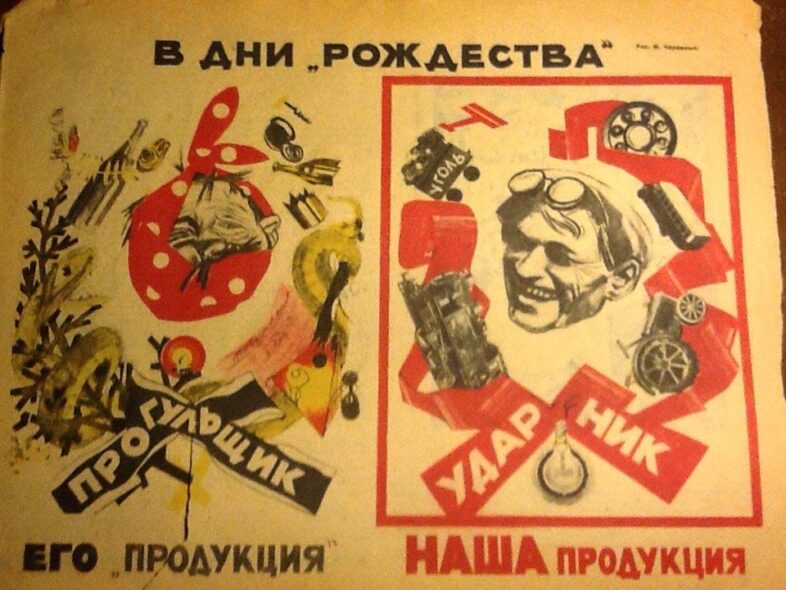
Soviet anti-Christmas campaigns leaned heavily on so-called anti-religious museums, with most former churches converted for this purpose. During the Christmas season, the League of the Godless organised mass patrols, handing out over 100,000 anti-religious leaflets. Fifty workers’ brigades were sent across various regions, including the north, to push anti-religious propaganda. Events took place in workers’ clubs, factories, schools, and childcare institutions, with special lectures and “anti-religious” games. In Moscow, street carnivals openly mocked church rituals, while theatres and cinemas staged plays and screened films that ridiculed religion.
Such practices were common across most cities and villages in Soviet-controlled areas. Even today, Ukrainian families recall stories of being harassed for keeping Christmas traditions. In some cases, family members who became part of Soviet anti-religious squads would block relatives from entering churches. For example, the author’s father was once depicted in an unflattering light on a Pioneer wall newspaper simply for taking part in carolling.
Christmas underground
Despite the bans, services still went ahead in the few churches that remained open, and believers continued to pray and celebrate according to long-standing traditions. Most Ukrainians under Soviet rule marked Christmas in secret, within the family, without Christmas trees, didukhs, or public rituals. During the brief Nazi occupation of Ukraine, Christmas once again became a legal holiday. The Ukrainian-language press, though under strict control, also raised questions about reclaiming a pre-Soviet identity. One newspaper in Kryvyi Rih wrote in 1942:
“At last, we can celebrate Christmas freely! Let us revive the old traditions! They are beautiful and show the strength of the nation. Let the grandson carry the supper to his grandfather, let the whole family gather for the Holy Supper, and let our carollers sing at the top of their voices, praising the glorified Christ and our newly reborn Ukraine.”
For fighters of the Ukrainian Insurgent Army (UPA), who carried out underground and partisan warfare, Christmas was one of the most important spiritual holidays. They celebrated it despite battles, food shortages, and the constant threat of raids. The insurgents kept traditional Christmas customs alive: the Holy Supper, communal prayers, carolling, making Christmas cards, and giving modest gifts. Celebrations took place both in villages, with the support of local communities, and in forests or hidden bunkers, where strict security measures were observed.
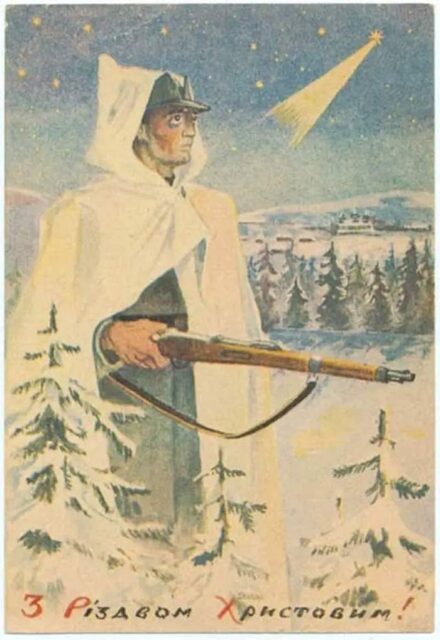
In the post-World War II era, when it seemed the Kremlin’s “Father Frost” and his “New Year” had officially eclipsed Saint Nicholas, Christmas in Ukraine remained a quiet act of resistance. The Soviet police were well aware of this, and the KGB regularly reported to higher authorities on events in Kyiv, dismissively calling them “Christmas gatherings of nationalist elements.” Students and members of the creative intelligentsia who sang carols in the streets or in private homes came under close surveillance. Celebrating Christmas meant navigating countless obstacles, but the reward—the sense of community and the light of the holiday—kept alive the hope that the “prison of nations” would not last forever.
Christmas triumphs over USSR
Although 1991 was a year of convulsions for the USSR, it was on Christmas Day, 25 December, that Mikhail Gorbachev announced his resignation as President, symbolically bringing an end to the “country of the Soviets.” This historic finale followed a chain of events, the most pivotal being the all-Ukrainian referendum on 1 December, in which the vast majority of citizens voted for independence. Just a week later, on 8 December, the leaders of Ukraine, Russia, and Belarus met in the Belovezh Forest to declare the USSR dissolved and signed an agreement establishing the Commonwealth of Independent States, later ratified by the parliaments of the founding republics. After Gorbachev formally ended the USSR, his decision was confirmed the next day by the parliament of the now-defunct communist empire.
The idea of Christmas as a triumph over Soviet communist atheism is often noted in Christian circles. It has even inspired popular accounts, like Conor O’Clery’s book, which tells a gripping, documentary-style story of “the day the Soviet Union died.” The USSR fell on Christmas—and Ukrainians regained the right to reject the Kremlin’s Father Christmas. On the same day, U.S. President George H.W. Bush announced to Americans the victory of democratic nations in the Cold War and effectively recognised Ukraine’s independence.
At Christmas, the era of the Soviet Union came to an end, and for the peoples once imprisoned under its control—particularly Ukraine—a new chapter of statehood began. For Ukrainians, the right to celebrate their own Christmas, along with other elements of national identity, continues to be something they must protect – now against Putin’s neo-Bolshevism.