From the moment Muscovy began taking shape as a tsardom and later an empire, expansion wasn’t just part of its policy—it became the organising principle of the state. Geography helped shape that trajectory, but the result was still the same: repeated waves of conquest, often followed by violence on a large scale and the absorption of conquered peoples. Where assimilation didn’t work, it was managed through changing ideological frames, from “brotherly nations” to, later on, the language of proletarian unity.
The idea of “brotherhood” with Russia also took root in Ukraine, and for some people it ran deep. But it was never stable. It shifted over time, adapted to changing political needs—and in the end, it was largely pulled apart by Russia itself.
Myth of “brotherhood” isn’t unique
Like many of the ideological tools later used by the Kremlin, the idea of “brotherly nations” wasn’t invented in Russia. It comes from a much older set of political and cultural narratives that different civilisations have used to describe relations between peoples—often mixing ideas of shared origin with clear hierarchies of power. One of the earliest and most influential versions came from the Church, which promoted the idea that all humans descend from Noah and his sons, a theme that runs through many medieval chronicles. Monarchies later picked up and adapted this “language of unity” to fit their own political needs.
Across Europe, similar “brotherhood” stories were widely used. In the Polish–Lithuanian Commonwealth at the end of the 16th and beginning of the 17th century, for example, the legend of the brothers Czech, Lech and Rus was used to argue for a shared origin among Slavic and neighbouring peoples. Powerful noble families like the Ostrogski helped reshape this idea in a Ukrainian context, with elites tracing their roots to Volodymyr the Great and even to the mythical ancestor “Rus.” This is how the idea of an “ancient Rus’ people” took shape, with its own territory and historical continuity.
Elsewhere too, the same language showed up in different forms. In Britain, “brotherhood” was used—sometimes awkwardly—to hold together the British, Scots and Irish. In 19th-century Europe, pan-German ideas leaned on a sense of shared kinship among German-speaking peoples, especially in the context of Austria’s ties with Germany and rivalry with France. In each case, the language of family and shared origin wasn’t really about equality—it was a way of organising political unity around a dominant centre.
Similar ideas exist well beyond Europe. In the Islamic world, there is the concept of the ummah—a unified community of believers. Among Turkic peoples, and in East Asian traditions, particularly in China, comparable notions also developed. In China, the idea of tianxia (“all under heaven”) placed neighbouring peoples within a framework of cultural kinship, often cast as “younger” in relation to China, which stood at the centre.
This, too, produced a sense of imagined “family,” but within a clear hierarchy, where the “elder” defines the rules and sets the order. In that sense, the language of brotherhood or shared origin has often been less about equality than about organising political relationships.
How Moscow built its own “brotherhood” myth
The Russian version of the “brotherly nations” myth didn’t emerge on its own—it was built through a deliberate reworking of academic ideas to serve political goals. In practice, that meant reshaping religious, cultural and historical narratives to fit an imperial framework.
In the 19th century, as historical linguistics and ethnology were taking shape, European scholars—including Pavel Jozef Šafárik—began classifying Slavic peoples along linguistic and geographic lines, broadly grouping them into western, southern and eastern branches. Even today, there is still debate over whether Ukrainians should be considered part of the western Slavs.
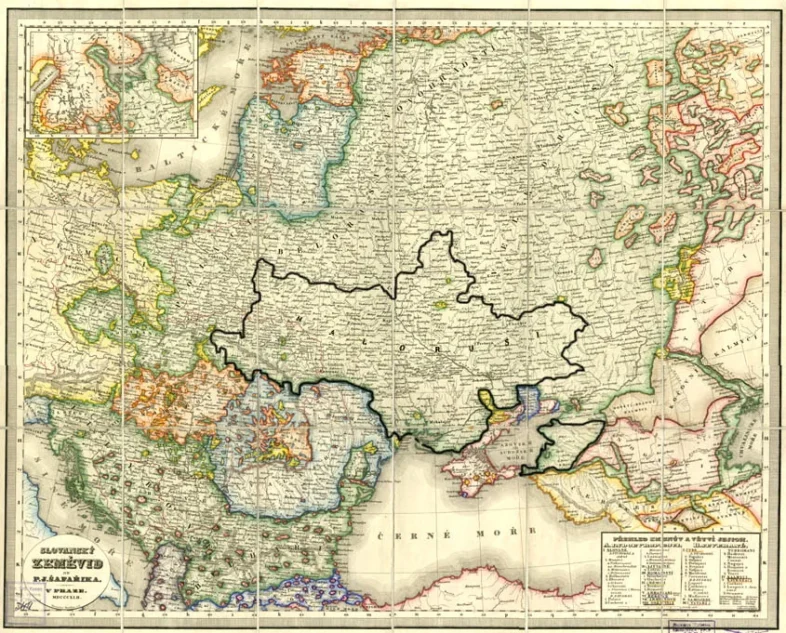
In the Russian Empire, however, this classification was taken at face value and then gradually reshaped to serve a different purpose. The grouping of Ukrainians, Belarusians and Russians under the so-called “eastern” category was reinterpreted as evidence of a shared ethnic and historical unity.
From there emerged the idea of “brotherhood” between “Great Russians, Little Russians and Belarusians”—with Muscovy’s “Great Russian”, unsurprisingly, placed at the centre. Over time, this hardened into the near-biblical notion of a “triune people,” which replaced linguistic distinctions with the claim of a single national identity and political unity. At its core, the narrative depended on downplaying—or outright denying—meaningful differences between these groups, while pushing the idea of ever-closer unity, ultimately aimed at their fusion into one nation.
A key role in entrenching this myth was played by imperial historians, most notably Nikolai Karamzin and Mikhail Pogodin, who promoted the idea of an unbroken historical line running from “Rus’” to Russia. At the same time, the notion of a “single people” was actively pushed by publicists and officials, including Mikhail Katkov, who went as far as arguing that “Ukrainians never existed and cannot exist,” describing them as a “misguided” part of a larger “Great Russian” whole.
Over time, academic ideas were absorbed into state ideology and turned into a tool for justifying imperial policy and denying Ukrainian identity. And this pseudo-scientific framework, in one form or another, has never really gone away in Russian scholarship.
Ukrainians, too, carried the myth forward
The myth of “brotherly nations” didn’t appear overnight. It was built slowly, over centuries, through a mix of historiography, theology and state ideology, with writers and political figures playing a key role. One of the earliest texts often cited is the Kyiv Synopsis (1674), usually attributed to Innocent Gizel. It traced the history of the “Rus’ people” back to biblical times and argued for the “primordial unity” of Ukrainians, Belarusians and Russians under a single ruler. In practice, it laid the groundwork for later imperial writing, where history was increasingly used to justify political subordination.
In the 18th century, this line of thinking was taken further by Feofan Prokopovych, one of the key ideologues behind Peter I’s reforms. In On the Power and Honour of the Tsar (1718), he argued that monarchical authority came from God and warned against fragmentation, stressing that the strength of the state depended on unity and centralised power. His criticism of divided principalities fed into the idea that “Little, Great and White Rus’” should ultimately be brought together under one state.
In the 19th century, the myth became more systematic and openly ideological. Court historians such as Nikolai Ustryalov, working under the patronage of Education Minister Sergey Uvarov, developed the idea of a “triune Russian nation.” Uvarov himself, in a 1833 memorandum, set out the famous doctrine of “Orthodoxy, Autocracy, Nationality,” where “nationality” was presented as the glue holding the empire together: “for the throne and the Church to remain strong, it is necessary to sustain the sense of nationality that unites them.”
It is still unclear whether Uvarov genuinely believed in this unity or was simply laying the groundwork for assimilation. Either way, the idea proved remarkably durable. It became a tool for suppressing cultural differences, which were increasingly labelled “separatism” and treated as a threat not just to the autocracy, but to the empire itself.
Myth at peak: 300 years of Pereiaslav Agreement
In the Soviet period, the imperial-era concept was repackaged into the official myth of “brotherly nations,” now reinforced by a clear hierarchy with Russians cast as the “elder brother.” At the same time, communist ideology added a new layer of propaganda: with religion pushed aside, unity was recast through proletarian internationalism—a form of class-based brotherhood. Ideas like the “friendship of peoples,” the “Soviet people,” and “Soviet patriotism” became central.
The language of propaganda blended political slogans with family imagery almost effortlessly: the “Soviet Union as a family of brotherly nations,” the “native Communist Party,” “brotherly peoples,” and even “Father Stalin.”
Behind the rhetoric, however, the reality was unchanged. Despite being formally divided into republics, the system continued to promote assimilation and the dominance of Russian culture, now under the updated language of “brotherhood.”
The idea of the brotherhood of the three East Slavic peoples became a cornerstone of Soviet academia. Joseph Stalin played a key role in cementing it, with the notion of the “elder Russian brother” elevated to state policy, particularly after the Second World War. It was after his death—but based on plans developed during his rule—that the most масштаб celebration of the so-called “reunification” of Ukraine and Russia took place.
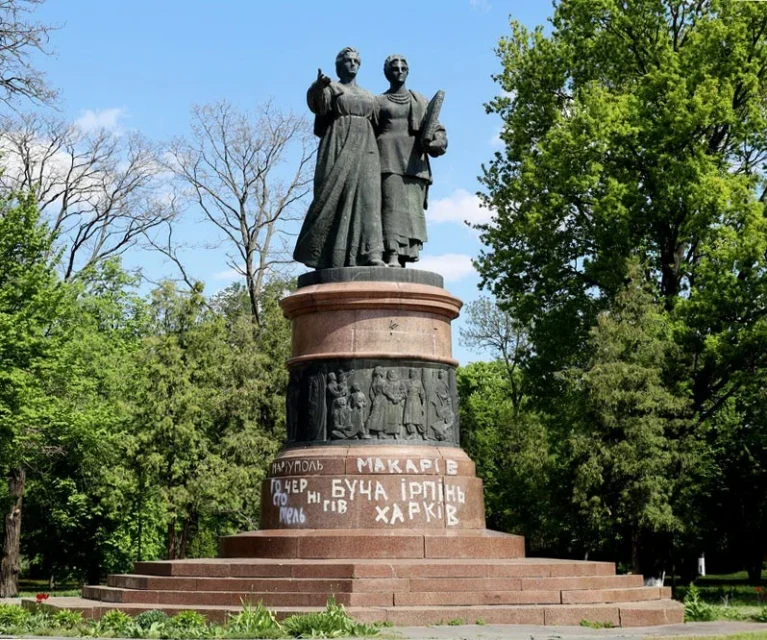
The large-scale campaign marking the 300th anniversary of the Pereiaslav Rada in 1954 marked the real peak of the “triune people” myth. In the official Theses on the 300th Anniversary of the Reunification of Ukraine with Russia, approved by the Central Committee of the Communist Party, Bohdan Khmelnytsky’s 1654 agreement with Muscovy was presented as a “natural” and “centuries-old” aspiration of the Ukrainian people to unite with the Russian people.
In doing so, the historical complexity and political context of the alliance were flattened into a simple narrative: from a “shared origin,” to an inevitable “reunification,” and finally to the creation of the USSR as the “highest form of brotherhood.” Notably, Soviet scholarship—so often proud of its dialectical method—built this argument on a fundamental logical contradiction, which was nevertheless repeated uncritically across all official channels.
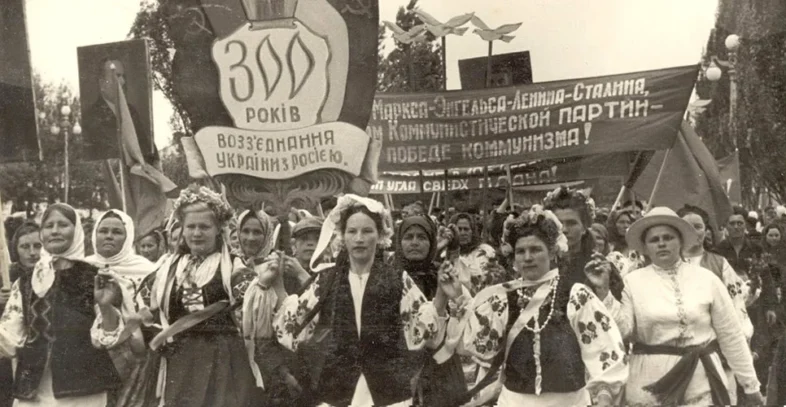
At the same time, the interpretation rested on a clear hierarchy. Russians were cast as the “elder brother,” supposedly bearing a leading historical mission, while Ukrainians were assigned the role of the younger, grateful partner. Through mass propaganda, literature and academic writing—from Pavlo Tychyna’s essays to Mykola Bazhan’s speeches—the idea was steadily fixed in place as an emotionally charged “family” metaphor.
In practice, though, it served a distinctly colonial function: justifying Ukraine’s subordination, blurring its distinctiveness and reinforcing the idea that such dependence was historically “inevitable.” For many Ukrainians, belief in this pseudo-familial “brotherhood” with Russia persisted well into independence.
Russian film Brother — myth cancelling itself?
The worldview many Russians hold today still echoes the language of the so-called “Russian world” (russkiy mir in Russian), popularised by Russia’s cult film Brother 2. Yet, when it comes to the idea of brotherhood with Ukrainians, the film feels less like an affirmation than a break with it. Ukrainians are cast as outsiders—even as enemies—kept firmly apart from the Russian hero character. Lines like “you’re no brother of mine,” along with talk of Ukrainians having to “answer for Sevastopol,” carry more resentment and a sense of revenge than anything resembling “reunification.”
The fact that this made it into mainstream culture says a lot. Even then, after the Cold War, the idea of “brotherhood” was already starting to wear thin in the public imagination. Looking back from 2014, and especially after the full-scale invasion of 2022, Brother 2 reads almost like an early signal of where things were heading. The language of brotherhood gives way to rivalry; unity turns into conflict; a shared past becomes something to fight over.
After the collapse of the USSR, the idea of a “greater Russia” held together in part by the hope of reunification—if not within the old Soviet borders, then at least in the form of a union between the so-called three “brotherly” Slavic nations.
Ukraine’s Orange Revolution in 2004, and then the Euromaidan in 2013–2014, hit at the core of Russia’s self-image. The idea of Ukraine moving decisively towards the West simply didn’t fit with the revival of Moscow-centred imperial thinking that had been taking shape since the early 2000s. And this isn’t just about politics or preference—it goes much deeper than that. For Russia, Ukraine is central to its whole historical narrative. Without control over Kyiv, that story starts to fall apart, forcing a rethink of Russia’s place in the world. And that’s something today’s Moscow has struggled to do.
Putin’s Russia: genocidal face no longer needs “brotherhood” mask
Ukrainian academic Serhii Yefremov once wrote that Soviet punitive systems had already marked a decline from those of the Russian Empire. What we’re seeing today feels like a further step in that direction. The current Kremlin leader—whose thinking is often seen as far less sophisticated than that of earlier figures like Lenin—hasn’t tried to refine the old narrative so much as drop it altogether, stripping away any remaining mask of “brotherhood.”
Putin’s rhetoric hardly needs unpacking. At its core, the message is simple: Ukraine is not meant to exist as anything separate, not even within a loose federal arrangement that earlier Russian leaders might have tolerated. This is no longer about uneasy coexistence between “brothers,” but about one side absorbing the other—a kind of political cannibalism.
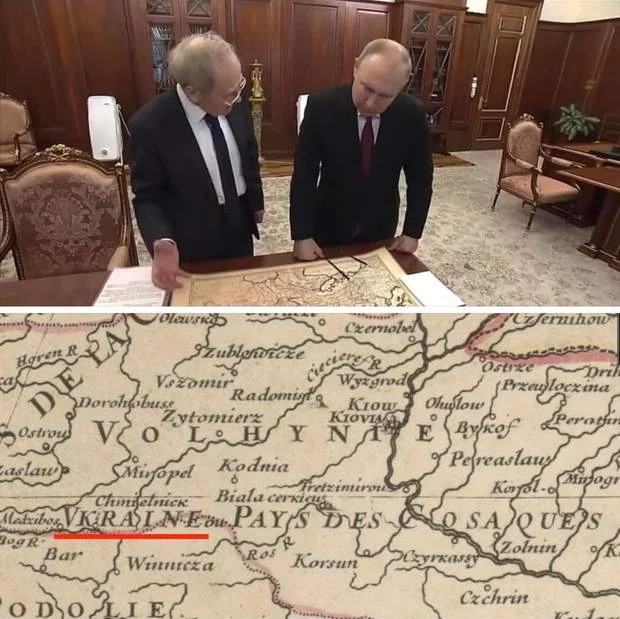
Putin’s 2021 article, On the Historical Unity of Russians and Ukrainians, reads like a distillation of the “brotherly nations” myth after centuries of evolution. In it, he pushes the claim that Ukraine’s “true sovereignty” is only possible in partnership with Russia, before arriving at the blunt conclusion: “We are one people.”
What sits behind that argument is a clear attempt to deny Ukrainians any real agency—to erase their subjectivity altogether, by whatever means are required. Had such a vision ever been realised, it’s not hard to imagine the language of “brotherhood” being revived once again.
But Russia’s full-scale invasion after 2022 made something else clear: the rhetoric of “brotherhood” is no longer even necessary. The violence, the массові crimes against civilians, the attempts to erase Ukrainian identity—all of it stripped the idea down to what it always was: not a value, but a tool.
In that sense, the myth has run its course. It no longer conceals an imperial project—it exposes it, showing how historical narratives can harden into something openly aggressive.