Mykola Lysenko is often called the father of Ukrainian classical music, but this title doesn’t fully capture the extent of his impact on Ukraine’s history. His name is intertwined with an entire era of cultural development—not just in music but also in theatre, arts education, and the socio-political landscape. This was a time when Ukrainian culture faced constant scrutiny and repression under the tsarist regime. Lysenko was also one of the first to consider the European future of Ukrainian culture. But let’s explore this story in more detail.
***
A descendant of aristocratic heritage
Mykola Lysenko was born on March 22, 1842, in the village of Hrynky, Kremenchuk County, in the Poltava region. His father, Vitaliy Romanovych, was a military officer, following a long family tradition that had been passed down through five generations. According to family lore, the founder of the Lysenko lineage was a descendant of Lysenko-Vovhura, an associate of Bohdan Khmelnytsky. Later, the Lysenko family settled in the Chernihiv region, with the composer’s direct ancestors tracing back to Colonel Ivan of Chernihiv and Pereyaslav.
Mykola’s mother, Olha Yeremiyivna, came from the noble Lutskyi family. She had an excellent education, having studied at an institute for noble young women, and was a great admirer of European culture, especially its music. It was she who first recognized her son’s artistic talent and began teaching him to play the piano at the age of five. The young boy showed exceptional ability, impressing everyone with his extraordinary musical memory and the ease with which he learned new melodies. At just nine years old, he composed his first piece of music, a Polka, which his father published as a birthday gift for him.
Lysenko’s national identity
Mykola’s parents made sure he received not only a solid education but also the opportunity to nurture his natural talents. He attended the Geduen and Weil boarding schools in Kyiv before moving on to the Second Gymnasium in Kharkiv, where he also received formal musical training. Lysenko stood out academically, consistently ranking among the top students and earning honours as he progressed to higher grades.
In Kharkiv, he gave his first public performances at chamber gatherings. Mykola’s closest friend and cousin, the playwright Mykhailo Starytsky, noted in his memoirs that Lysenko’s worldview developed with an aristocratic flair, shaped by his education at classical boarding schools and the aristocratic values instilled by his family’s traditions.
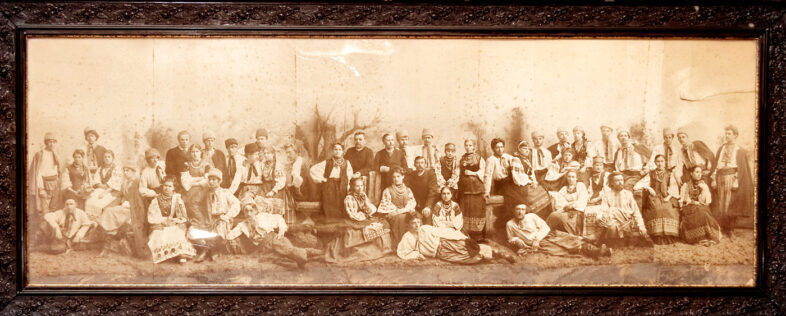
Photo: Mykola Lysenko with his choir
During the holidays, the young man immersed himself in the world of folk songs, games, rituals, and legends—cultures that captivated him completely. As a teenager, he was deeply moved by the poetry of a Ukrainian poet and artist, Taras Shevchenko, which he and Mykhailo Starytsky discovered while visiting relatives. They spent an entire night reading, marvelling at the poetry’s form, language, and bold themes. Mykola was particularly struck by the musicality of Shevchenko’s language.
Even then, folk motifs began to influence his artistic vision. He transcribed melodies from folk songs and composed accompaniments for them. A pivotal moment in his development came during his studies at Kyiv University, where he became actively involved in civic life and later emerged as one of the leaders of the Kyiv Ukrainian community.
Studies in Leipzig
In the latter half of the 19th century, when Ukrainian lands were divided between two empires, culture became a powerful tool for awakening national consciousness and uniting the people. Ukrainian language, literature, theatre, and music took centre stage. For Mykola Lysenko, music was not just a passion; he understood its crucial role in shaping society.
In 1865, Lysenko successfully defended a dissertation in natural sciences at Kyiv University. Two years later, he travelled to Leipzig to study at the conservatory, determined to master his craft. This decision was supported by his friends in the Hromada, who believed refining his skills was essential.
At the conservatory, Lysenko perfected his piano technique under Professor Carl Reinecke, who, after hearing him play during the entrance exam, praised his “genuine talent.” He also received piano instruction from virtuoso Ignaz Moscheles, pianist and teacher Ernst Wenzel, and Gewandhaus concertmaster Professor Ferdinand David. In addition, Lysenko studied conducting with Carl Reinecke and music theory and composition with leading German professors Ernst Richter and Benjamin Papperitz. The faculty admired his dedication and exceptional progress.
In his first academic year, Lysenko was invited to Prague for a music festival, which featured the inaugural joint concert of Slavic folk songs. The program included Serbian, Bulgarian, and Czech folk songs, while the Russian choir, conducted by someone using the pseudonym Slavyansky for the occasion, performed a selection of Bulgarian, Russian, Belarusian, and Ukrainian pieces. However, the Ukrainian songs were the choir’s weakest performance, and Lysenko was asked to take over their rendition.
In Prague, Lysenko faced the challenge of preparing a high-quality performance on a tight schedule. To showcase the uniqueness of Ukrainian music, he included his own piano arrangements of Ukrainian folk songs in the program. When “Hey, Don’t Be Surprised, Good People, at What’s Happened in Ukraine” was performed, the renowned Czech musician Reiner exclaimed, “That is the spirit of the steppe!”
Olena Pchilka, a Ukrainian writer and civic activist, reflected on Lysenko, saying, “Only those who had the privilege of hearing him perform personally can truly imagine the impact that song had during that solemn festival!”
During his second academic year, Lysenko was preparing for his final exam, during which he performed the first movement of Beethoven’s Piano Concerto No. 4 in G major. His performance impressed the Leipziger Tageblatt, which published an article in April 1869, praising his remarkable skill and noting that the brilliant cadenza was entirely his own creation.
Following this success, Lysenko had the chance to stay in Europe and pursue a distinguished career as a pianist. However, he made the conscious decision to return home, where important work awaited him.
It was during his time in Leipzig that Lysenko’s first published works emerged — including the Suite on Themes of Folk Songs in the Form of Ancient Dances for piano and collections of Ukrainian folk song arrangements for voice and piano. In total, Lysenko published seven such collections, each containing 40 songs, along with 12 Choral Decades (arrangements for choirs of various sizes), ritual collections (including Kolomiyky, Carols, Shchedrivky, Spring Songs, Weddings, and Kupala Celebration), and two collections for children and youth (Youthful Songs and Collection of Ukrainian Folk Songs). Together, these works included more than 500 arrangements.
Additionally, after his successful performance in Prague, Lysenko was invited to compose music for Taras Shevchenko’s Kobzar, marking the start of his Shevchenkiana — a collection of nearly 100 works inspired by the poet’s legacy.
Studying in Germany had a profound impact on the development of Mykola Lysenko’s musical style. However, during the Soviet era, when Ukraine’s most notable figures were either silenced or reframed within a Soviet narrative, this influence was downplayed. Instead, a narrative emerged suggesting that Russian culture had a significant impact on Lysenko’s work. This idea was not only reflected in numerous publications but also prominently featured in a 1981 exhibition in Kyiv. While the exhibition included a few references to Lysenko’s studies in Leipzig, it emphasized the “powerful” influence of Russian composers at key points. Yet, historical records reveal that Lysenko dedicated much of his life to resisting Russian influence, striving to showcase the European potential of Ukrainian culture.
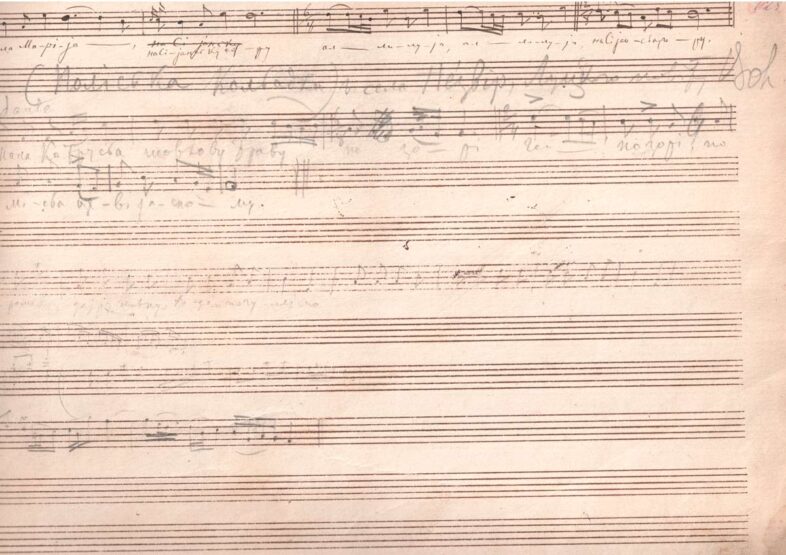
Until December 10, 2024, visitors to the Museum of Prominent Figures of Ukrainian Culture can explore the Mykola Lysenko in Leipzig exhibition. Here, they can view unique handwritten scores and photographs and even listen to works composed during his time in Germany. The exhibition was made possible with the support of the Goethe-Institut Ukraine and in partnership with the Ivan Franko International Foundation.
Maestro’s contribution
Upon returning to Kyiv, Mykola Lysenko fully immersed himself in both public and artistic life. He became an active member of the Kyiv community, composed new music, and began his concert career. At his solo performances, Lysenko showcased his skills as both a pianist and a choir conductor, presenting notable European works as well as his own compositions. Audiences were captivated by his virtuosic performances.
His niece, writer and public figure Lyudmila Starytska-Chernyakhivska, captured the essence of his artistry, describing it as follows: “No one else’s playing could be compared to his… When he performed his own and other Ukrainian works, he infused them with something extraordinary, like a touch of yevshan-herb [thyme – ed.]… In his playing, millennia came to life… You could hear the deep, ancient Slavic past. And there, behind the piano, he was the Prophet Boyan. Inspired, passionate, with the power of a lion’s paw strike and a proud gaze, he transformed completely.”
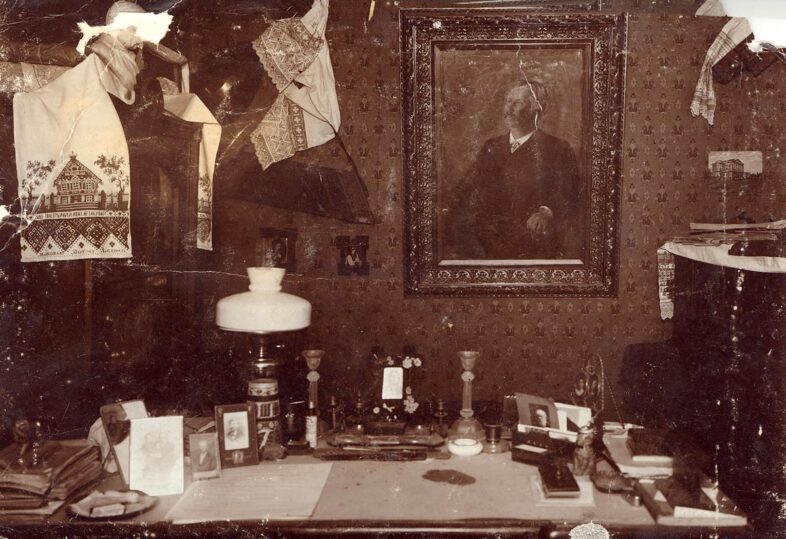
Photo: Mykola Lysenko’s writing desk at his residence on Mariinsko-Blahovishchenska Street, 95 (now Saksahanskoho Street), 1912.
One of Mykola Lysenko’s most significant contributions to Ukrainian culture was his work in composing Ukrainian operas. His first attempt was the heroic opera Harkusha, which Lysenko began in 1863 with librettist Mykhailo Starytsky. However, they were never able to finish it. After returning from Leipzig, Lysenko and Starytsky resumed their collaboration, and in 1872, they created the musical comedy Chornomortsi, which was later reworked into an opera. Two years later, they teamed up again to create Christmas Night, with Starytsky writing the libretto based on Gogol’s work and Lysenko composing the music. The piece was performed at the Kyiv City Theatre with the help of an amateur theatrical group, including the authors themselves. The production was a great success, and many scholars consider it the birth of Ukrainian opera theatre. Lysenko went on to compose a total of ten operas, including Christmas Night, The Drowned Woman, Taras Bulba, and Aeneas, as well as several children’s works such as Pan Kotskyi, The Goat and the Wolf, and Winter and Spring.
Mykola Lysenko made a crucial contribution to the development of Ukrainian culture and the awakening of national consciousness through his choral work as both a composer and conductor. His efforts to build and direct choirs, including organizing four major choral tours, were not only about creating unique artistic performances but also about uniting people, especially the youth. Lysenko’s primary goal was to raise choral music to European standards, and in doing so, he influenced future generations of choral conductors and composers, such as Kyrylo Stetsenko and Oleksandr Koshyts. From 1919 to 1922, the Ukrainian Republican Chapel, which carried forward his legacy, captivated audiences not only in Europe but also in North and South America.
In a natural extension of his artistic and public work, Lysenko founded the Music and Drama School in 1904. The school featured departments for music, Ukrainian and Russian drama, and even a bandura class. By 1918, it was elevated to the status of a Music and Drama Institute, laying the foundation for higher artistic education in Ukraine—a crucial step for cultural development. Today, the National Music Academy of Ukraine, named after Pyotr Tchaikovsky, and the Kyiv National University of Theatre, Cinema and Television, named after Ivan Karpenko-Kary, are direct successors of this institution.