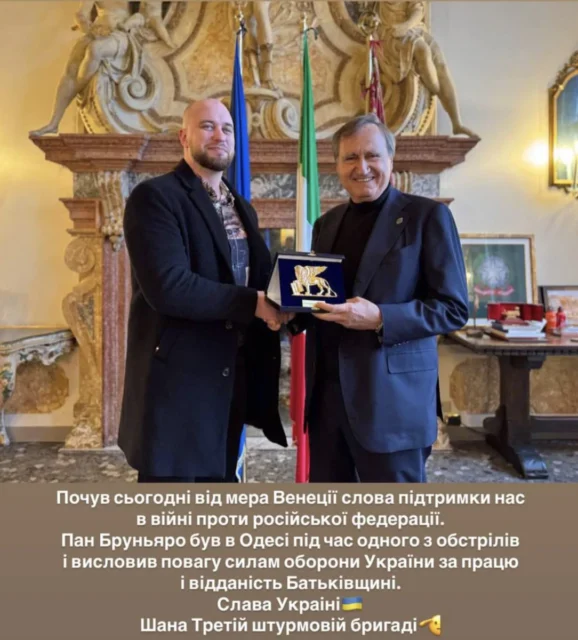
Being in the right place at the right time certainly rings true for Yanis Tereshchenko, an intelligence officer with the 3rd Separate Assault Brigade. His springtime encounter in Italy quickly made him a name across Europe. On 10 March 2025, in Venice, Yanis saved a passerby’s life by applying a tourniquet to stop heavy bleeding from a knife wound. The story of this Ukrainian soldier was picked up by nearly every European news outlet. Venice’s mayor, Luigi Brugnaro, personally presented Yanis with the prestigious “Lion’s Commendation.” You’ve probably caught wind of it too, at least in passing, as Ukrainian media widely celebrated the remarkable event.
In our conversation with Yanis, Venice came up—though from a rather unexpected angle. Naturally, we also delved into weightier, more urgent matters: how much longer Ukraine can hold back the tide; why Russia is a giant with feet of clay; whether this war was ever avoidable; why Europe depends on Ukraine; and what needs to be done to strengthen the Defence Forces. The interview was long but packed with insight and genuinely eye-opening. It’s well worth a read, especially if you’re feeling weary of the war or running low on hope.
— Your Venetian adventure made you quite famous, but did you actually get to enjoy Venice? After all, you were there on holiday, weren’t you?
— It definitely shook things up and put a dent in the usual holiday vibe. I spent a lot of time on calls and interviews. Not many from Ukraine, but plenty from across Europe. The first calls could start as early as 8 a.m. Ukrainian time and the last ones wouldn’t end until around 9:30 p.m. local time. But it wouldn’t be true to say I didn’t enjoy the break. Actually, I had a better rest than usual. That incident became a kind of anchor, keeping me in a work mindset the whole time. I came back feeling like I’d unwound somewhat, but I never really switched off.
— What impressed you most about Venice?
— Venice is a remarkable city. Though some times of year aren’t the best to visit. The hot summers, the carnival, and the crush of tourists can be overwhelming. It’s a tiny place, full of narrow streets and tightly packed buildings—houses stacked practically on top of each other. Every half-metre matters.
We were lucky to be there in early March, just after the carnival and before the tourist crowds arrived. I generally love Venice. The churches, cathedrals, basilicas, and piazzas all inspire a real sense of history, culture and beauty.
Then there’s the city’s unique setup—everything’s on water. In the morning, you step out onto a bridge with your coffee and watch goods being delivered by boat to markets and shops. Taxis, police, ambulances—they’re all boats and gondolas. I’m not sure I’d want to live there permanently, but as a visitor, it’s one of the most fascinating places I’ve been.
— Do you get to travel often?
— I wish I could say every six months, but honestly, no. Sometimes it’s nine months straight without a break.
— That must be tough, being away from your loved ones for so long?
— It really is. In nearly four years, we’ve seen each other for less than 60 days in total. It’s hard, especially on relationships. The hardest part is knowing my child learned to speak without me, started kindergarten without me, and will go to school without me. The moments a father should be there, my son’s experiencing without me. But he’s lucky to have his mother, my wife. I really can’t complain.
— Many people leave Ukraine, saying they don’t want their children to grow up amid war. What makes you stay? Why don’t you leave, even though you could?
— Leave and never come back? No, I can’t do that. There are things that matter too much to me. Sacrificing my own interests, my family relationships, to fight for my country? Yes. If I could pay the price for everyone on my own, I would. But there are thousands, tens of thousands, maybe even hundreds of thousands of us.
This isn’t just about us trying to sort out our own problems. This is about the world order. Ukraine is where the fate of the entire world is being decided — Europe’s financial and physical security is on the line. Because Russia threatens all of Europe, not just us. Because the United States is pressuring Europe, and physically defending Europe is a core part of NATO and America’s involvement in it. NATO was built to counter Russia. And all of this is being decided here, in Ukraine.
Even if we put aside security and military concerns and look purely at everyday life, Ukraine is shaping the future of medicine and telecommunications. Right now, amid war and relentless shelling, Ukraine is building telecommunications infrastructure because maintaining high-quality communication is essential — not just between military units, but also with civilians. I’ve been just a kilometre from the enemy, living deep in a forest strip, sheltering underground in a dugout — yet I can still play Minecraft with my son, who lives in Belgium. This is our reality.
Technology, drones, robotic systems — all are in active use. It’s long been known that many inventions were born from wartime necessity: ballpoint pens, microwave ovens, drones. When this war ends, drones won’t vanish. Instead, they’ll remain central to photography, aerial surveys, industrial reconnaissance, and even delivery services. This is the future being forged right now, in Ukraine.
— Do Europeans really understand what’s at stake?
— Yes, but “Europeans” is a broad term, and there are nuances depending on who you talk to. In my conversations with European journalists, I haven’t met anyone who didn’t grasp what’s happening here. Of course, it varies by outlet—regional versus global—and, naturally, there’s a range of perspectives. But I’ve never encountered anyone speaking from a pro-Russian standpoint. Quite the opposite, in fact. There’s a strong pro-Ukrainian sentiment, a kind of European optimism grounded in support for Ukraine. People express solidarity, sympathy, pride in our fight. They help wherever they can, wish us victory, condemn Russia, its government, its policies—and say clearly that Russia must be defeated.
These sentiments aren’t just from journalists—they come from ordinary people too. When I’m in tourist areas, strangers often ask where I’m from. The moment I say “Ukraine,” I’ve never been met with indifference or hostility. No one has ever said, “Russia will defeat you.” Instead, the response is always one of support and sympathy.
When I visit my son’s school and talk to his teachers, those encounters are warm and full of genuine kindness. But even here in Ukraine, not everyone feels fully connected to the war — some see it as something distant, “happening somewhere else,” or simply don’t engage. We can’t force people to fight, either here or across Europe. But to say Europe is indifferent? Absolutely not.
— Would European countries cope if they found themselves in a similar situation?
— European militaries are reasonably well-prepared for conflicts among themselves, in my view. That’s based on their army sizes, combat readiness, defence industries, and equipment. But if we’re talking about a full-scale land war in Europe against Russia—without Ukraine in the picture—Europe simply couldn’t stand up to Russia on its own. They’d need America’s support. And while the US is largely capable of taking on Russia, that hinges on a political decision that, crucially, hasn’t yet been made.
Europe won’t fight Russia without Ukraine, because it doesn’t have the means, capacity, or political will. That’s why Russia’s drive to destroy and absorb Ukraine is so critical for them.
Ukraine isn’t just a country; it’s a mobilisation resource—a raw materials and industrial base. Russia wants to seize it to fuel a future war with Europe. Belarus is part of this equation too, acting as another frontline. It’s about dividing the continent into pro-Russian and post-Russian zones. Poland is part of this frontline as well. This stretch between the seas—between Russia and Europe—is what we’re holding, because we have the means to do so. And historically, we’ve been holding it for many years.
You could list three or four dozen wars of varying scale against Russia—and we emerged victorious in more than twenty of them. Europe, however, has never fought like that. Sure, there have been local battles and clashes with significant consequences, but for us, every single day counts in the unfolding conflict. Every hundred metres matters.
At the NATO level, Europe fully recognises that Ukraine is its shield. And it’s not just an abstract understanding—it’s shaping their actions.
Right now, NATO is in the midst of a major rearmament effort. They recently updated their doctrine, setting goals through to 2030. Why? It’s clearly not about cosmetic changes. Essentially, they’re preparing to be ready for a possible war with Russia no earlier than 2030. Until then, they need to rebuild their arsenals, recruit troops, and strengthen their capabilities. You can’t just build factories to produce ammunition overnight—there are raw materials to secure, legal frameworks to establish and logistics to organise. It’s a complex, long-term process.
— So, all this time, we just have to keep holding Russia back?
— Exactly. Until 2030, something has to be done to contain Russia. And what’s the answer? We have to keep fighting. The Russians know this perfectly well too. They have no intention of striking a deal or calling a halt to the war.
Talk of “let’s give up Luhansk and Donetsk, recognise Crimea as Russian, and end the war” — it’s simply fantasy.
— What about the idea that Russia will eventually run out of steam? That by the end of 2025, they’ll be in serious trouble?
— That’s possible. They could face major problems. But so could we. There are countless factors beyond anyone’s control. Predicting the future is a thankless task. It’s far better to replace guesswork with solid planning.
But planning means understanding the reality, having the data as well as grasping the many complexities — in short, having the competence to do it. You can’t plan blindly. Plans need to be precise: clear dates, numbers and measurable benchmarks. And above all, you need administrative resources to make that happen.
Is there no resource in Ukraine to organise this? There is. Is there no material base? That exists too. Maybe the problem is a lack of people? We have plenty — the largest army in Europe, in fact. So, can we use these resources to keep fighting until 2030, or even beyond, drawing on support from international partners — their weapons, technology, and logistics — to defeat Russia on our own terms? Yes, absolutely.
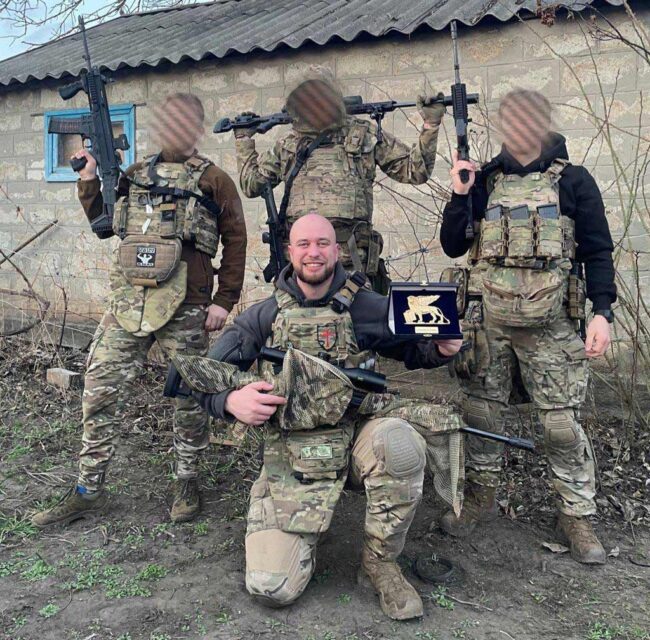
What do we need to make this happen? We must be properly prepared, use our forces and resources effectively, and respond swiftly to the realities on the front line. In other words, we need to modernise—ourselves and our army.
We’re now transitioning to the Corps system. Take us, the 3rd Assault Brigade: we began as a Territorial Defence battalion, evolved into a Special Operations Forces regiment, then an Armed Forces brigade, growing into the largest brigade in Ukraine’s military. Now, we’ve become the Third Army Corps. Our command structure remains unchanged, and the people are the same—we don’t recruit from thin air; these fighters have been developed within the brigade. Our commander is Andriy Yevhenovych Biletsky, the man who led the defence of Bakhmut in 2023. Back then, we were up against one of the best-equipped units—the Prigozhin-led Wagner group. Wagner was ground down and destroyed, but we kept fighting.
We carried out a tough operation in Avdiivka — challenging in every way: the planning, the resources, and especially the geography. The entire area was under enemy control. In fact, it would have been easier to avoid Avdiivka altogether than to try and take it. Yet here we are, speaking now with hard-earned experience behind us. Yes, it came at a heavy cost. Did we lose our combat capability? No, we didn’t. After withdrawing, we kept fighting — the war didn’t stop.
— Can the experience of the 3rd Assault Brigade be scaled across the entire military?
— Absolutely. That’s exactly the point. But it’s no longer just a question of military tactics. This is political — it’s about strategy, leadership, personnel, and more.
We’re lucky to have Andriy Biletsky. He’s invaluable. But the country can’t be carried on one man’s shoulders. We need more units, built and trained the same way. We have the experience to do that.
So, in my view, this war will last until 2030 — that’s certain. Russia isn’t going to back down or negotiate. In 2022, Russia demanded we withdraw from Luhansk, Donetsk, Zaporizhzhia, and Kherson regions. Yet, that same year, it pulled back from Chernihiv, Kyiv, Sumy, Kharkiv, and parts of Kherson — even losing full control of Kherson, which it had seized in the first wave of the invasion. Russia still can’t fully capture Luhansk. It’s willing to sacrifice tens of thousands of lives just to hold on to one village — a tiny place with two intersecting streets and ten houses.
Alright — if we don’t have enough troops, we’ll fight with drones. Can we put that experience to use? Absolutely. Can we effectively command those forces? Yes, we can. But that takes political will. It means modernising the army and actually doing something with it. You can’t just hand someone a rifle and say, “Go fight.” Those days are over.
What we need is a system. Support for every soldier who goes to the frontline. While they’re there, they need reliable communication, cover, fire support, evacuation teams ready for emergencies, and reinforcements if they’re overwhelmed. Cooperation between units — that’s where the focus must be.
It’s 2025 now. Despite Russia’s terrible losses and the territory we’ve reclaimed, they’re not saying, “Let’s find a way to settle this.” Instead, they’re saying, “You don’t want to negotiate? Fine, we’ll attack Sumy and Kharkiv.” Russia is going all in, still pretending it can do anything. But it can’t. Everything it was capable of, it’s already tried. What we’re seeing now are desperate, last-ditch attempts.
And we have to match that effort—to stop Russia’s advance, to squeeze it as hard as possible. Diplomatically, on the battlefield, by targeting its fuel and energy infrastructure—wrecking oil refineries and processing plants. Simply put, we have to keep fighting. But to do that, we need an effective system. We must draw clear lessons, make decisions based on them, and put those decisions into action in the military. Modernisation is essential.
— Do you worry that such a prolonged war could have irreversible consequences for Ukraine?
— Those consequences are already here. What could be more irreversible? Could Russia push as far as the Khmelnytskyi region? Maybe, in theory—someday. But I just can’t see it. Look at how far they’ve come in two years, since the end of 2023. They took Avdiivka—a city that once held 40,000 people. That’s hardly a major gain: just one per cent of our territory in two years. So sure, maybe they’ll keep fighting for another 200 years. But do they have the resources for that? No, they don’t.