Vladimir Putin’s recent high-level meetings with foreign leaders have increasingly brought in representatives from Asia, particularly Southeast Asia. Moscow continues to draw on the legacy of the Soviet Union, among other tools, to sustain and expand its influence in the region. At the same time, the war in the Middle East and disruptions around the Strait of Hormuz are opening up new opportunities for the Kremlin to strengthen its position there.
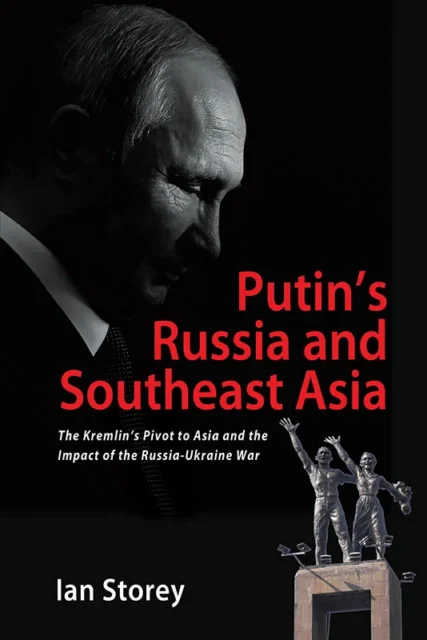
Yet Russia can hardly be described as a major player in Southeast Asia, especially in economic terms, says Ian Storey, Senior Fellow at Singapore’s ISEAS–Yusof Ishak Institute, in an interview with The Ukrainian Week. Storey is the author of Putin’s Russia and Southeast Asia: The Kremlin’s Pivot to Asia and the Impact of the Russia–Ukraine War, published last year.
The Ukrainian Week spoke with Ian Storey about the narratives Russia uses in its engagement with countries in the region, how Moscow pursues its “nuclear diplomacy”, and how the European Union and the United Kingdom have managed to maintain a relatively positive image in Southeast Asia.
— Russia is, economically speaking, a relatively minor player in Southeast Asia, and you make that point very clearly in your book. At the same time, it remains a significant actor in the region. In your introduction, you set out four reasons for this. My impression, however, is that many of them are still deeply rooted in the Soviet legacy. How do you see this factor?
— First of all, as far as I know, my book is the only single-authored English-language study of Russia and Southeast Asia, which is quite remarkable given that Russia is a player in the region. Earlier works tended to focus on the Soviet Union and Southeast Asia. The most recent of those came out in 1992, when the Russian Federation had existed for barely a year.
Russia is not a major power in Southeast Asia, certainly not in economic terms, and economics is really the key factor here — including trade, investment, and overseas development assistance. But Russia remains a player, and it does have certain strengths. One of those is the legacy of the Soviet Union, which remains very strong. That should not surprise us, as the legacies of empires tend to be long-lasting.
Take my own country, the UK, for example: the legacies of the British Empire are vast across the world, including in Southeast Asia. Russia, of course, was never a colonial power in Southeast Asia, but it built important relationships with regional states during the Cold War — particularly Vietnam and Laos. Those remain Russia’s two closest partners in the region.
Both countries continue to feel a strong sense of gratitude for the support the Soviet Union provided during the Cold War — military assistance that helped them defeat France and the United States, as well as economic support at times when they faced sanctions from much of the world. This gratitude is genuine; it is not merely symbolic or rhetorical.
China, for example, also provided significant assistance to Vietnam during the Vietnam Wars, yet Vietnamese narratives tend to place far greater emphasis on Soviet support. Indonesia is another important case. In the 1950s and 1960s, shortly after independence, the Soviet Union was a close friend and ally of Sukarno’s administration. That was almost seventy years ago, yet people in Indonesia still remember the support the Soviet Union provided.
One of the themes of my book is what we call “memory diplomacy” and the way Russia has quite adeptly leveraged it to its advantage — reminding countries of the support it provided and of its role in backing anti-colonial movements during the Cold War.
What’s interesting is that accusations framing Russia as a neo-colonial or neo-imperialist power because of its war against Ukraine don’t really resonate in Southeast Asia. People there don’t tend to see Russia as a colonial power. When they think in those terms, it’s Britain, France, the Netherlands, or the United States that come to mind — but not Russia, even though, of course, Russia itself was a colonial power in Central Asia, Eastern Europe, and elsewhere.
— We can also see Russia’s memory diplomacy and wider information strategy at work in South Asia, especially India. Russia puts considerable effort into shaping narratives there. RT, for instance, is active in India and works with well-known public figures and broadcasters. Compared with Southeast Asia, does Russia have a similar informational presence there?
— That’s a good question. I touch on it briefly in the book, though in retrospect I think I could have gone into more depth. RT and Sputnik aren’t particularly well-known media outlets in Southeast Asia. One key reason is that they don’t broadcast in local languages. They mainly operate in English, which makes a big difference. You might find RT in hotels, but who is actually watching it? I’m genuinely curious, because I suspect very few people are. People in this part of the world also have plenty of alternative media choices. RT does have an office in Vietnam, which I believe is its only one in the region.
Russia has also signed media cooperation agreements with countries such as Vietnam and the Philippines, which essentially help facilitate the dissemination of Russian narratives — including those about the war and other issues. However, Russian media influence is not particularly widespread.
A much larger concern in this part of the world is Chinese propaganda rather than Russian propaganda. At the same time, the two are connected, because many Russian narratives about the war — for example, claims that the West provoked Russia into attacking Ukraine by offering it NATO membership, or that it uses Ukraine as a proxy and President Zelensky as a puppet — are amplified through Chinese-language media in the region. This is particularly visible in Singapore, which has a majority ethnic Chinese population. Many people there get their news from mainland Chinese media, but also from sources in Taiwan, Hong Kong, and elsewhere.
— In your book, you also discuss what you call Russia’s “nuclear diplomacy” in the region. How successful has it been? And compared with the early years of Putin’s presidency, how much has Russia’s approach changed?
— In some ways, Russia has been quite successful in its nuclear diplomacy in Southeast Asia, as two countries have signed agreements with Russia to provide nuclear power plants: Myanmar and Vietnam.
The Vietnamese project has had a somewhat complicated history: it was initiated, then suspended, and has now been revived. The Vietnamese Prime Minister was recently in Moscow, where an agreement was signed for Russia to build a nuclear power station with two reactors in southeastern Vietnam [Khánh Hòa province – ed.]. The project in Myanmar is expected to involve a small modular reactor, probably of the same kind Russia is currently building in Uzbekistan.
The current energy crisis triggered by the war in the Persian Gulf will likely encourage Southeast Asian countries to accelerate their transition towards alternative energy sources, including nuclear energy. At the same time, they have plenty of options — they are not tied to any single partner. They can turn to China, Russia, France, or the United States. All of these countries are competing to sell their nuclear technologies in the region.
So far, Russia is ahead of its competitors. Two countries have already signed agreements with Moscow, while no other supplier has yet secured similar deals in the region. Those recent agreements with Vietnam, and earlier with Myanmar, therefore act as a kind of advertisement for Russia. Other countries — Indonesia, for example — may start to take the Russian option more seriously. But again, they have alternatives, and I expect China to become increasingly aggressive in promoting its nuclear technology in the region.
— If I may compare Southeast Asia once again with South Asia, particularly India: in India, France is actively competing with Russia in nuclear diplomacy. What about Southeast Asia? Are countries there also looking towards cooperation with Europe, or have they tried to shift away from working with Russia in the nuclear sector?
— I’m not entirely sure how active France is specifically, though I wouldn’t be surprised if it is quite active, given that France is an important player in Southeast Asia in arms sales and a number of other areas. The countries I hear mentioned most often are Canada, South Korea, Japan, Russia, China, the United States, and possibly the UK as well. All of them are actively promoting their expertise and technologies.
What Southeast Asian countries seem to be most interested in, however, are small modular reactors (SMRs). At the moment, China and Russia are essentially the only countries that have developed SMR technology, so they are somewhat ahead of the curve here.
The interest in SMRs is largely because they are presented as cheaper and safer. They are more flexible, can potentially be integrated more easily into existing power grids, and come with a range of other practical advantages. The project in Vietnam, however, will not involve an SMR. It will be a conventional nuclear power plant and would therefore, I would expect, be quite expensive.
— At the beginning of our conversation, you mentioned that your book is the first, and in fact the only, English-language book on this topic. Why do you think that is? Is it simply that scholars are not that interested in Russia’s role in Southeast Asia?
— I sometimes joke that Russia isn’t an important country in the region, and yet it still took me 526 pages to explain why. Russia may not be a major player, but there are still plenty of stories to tell — from arms sales and its relationship with ASEAN, to a large part of the book focused on how countries in the region responded to Russia’s invasion of Ukraine.
I actually started writing the book before Ukraine was attacked. Once the invasion began, the project became more difficult, but also much more timely. I look at how each of the eleven countries in the region responded. And what you see is a full spectrum of reactions: at one end, Myanmar, which openly endorsed Russia’s actions; at the other, Singapore, which condemned Russia and imposed sanctions. Most of the other countries sit somewhere in between. What I was trying to understand is why these responses vary so much, and what shapes them. History and relationships inherited from the Soviet period are certainly part of that picture.
Essentially, most countries adopted a neutral position. They do not want to become involved in what they see as a dispute between major powers — a distant war in which they believe they have no direct stake, even though in reality it does affect them.
Singapore was the main exception. It described Russia’s invasion of Ukraine as an existential issue because Singapore is a small state surrounded by larger neighbours. Since gaining independence in 1965, Singapore has generally opposed the use of force by larger states against smaller ones, for fairly obvious reasons.
— I noticed the sections in your book on countries’ positions on Russia’s war against Ukraine. It raised a debate we often have in Ukraine: how should Ukraine communicate with these countries, and what arguments might work? Ukraine was also part of the Soviet Union, but many in the region don’t necessarily remember that. Could that historical angle resonate there?
— You raise a very important point, because I’ve discussed exactly this issue with Ukrainian diplomats in the region. I suggested to them that Ukraine’s Soviet past could potentially be used in conversations with countries such as Vietnam. For example, people in Vietnam told me that many Soviet military advisers were in fact Ukrainians. I also spoke with a retired Vietnamese ambassador to China who told me he had learned to drive tanks in Kharkiv in 1972.
Of course, it’s complicated, because this was also a difficult period in Ukraine’s own history. Last month, I spoke at your Diplomatic Academy and suggested that Ukraine could perhaps turn this historical complexity to its advantage — reminding countries that Ukraine, as part of the Soviet Union, also contributed to support for anti-colonial movements and similar initiatives.
But you are right: Russia has one major advantage in this region — everyone knows Russia, while comparatively few people know Ukraine. When Ukraine became independent in 1991, it established diplomatic relations with nearly all countries in the region, but many embassies were opened only later. As a result, Ukraine did not promote itself in the region from the very beginning. It is catching up now, of course.
I’ve heard, for example, that in Indonesia the Russian ambassador can call a government minister and secure a meeting almost immediately. A Ukrainian ambassador simply does not have the same level of access or decades of accumulated influence. Building those relationships naturally takes time.
Another issue I mention in the book — although it is rather unfortunate — concerns Muslim-majority countries in Southeast Asia, particularly Indonesia and Malaysia, where President Zelensky’s Jewish heritage can sometimes become a factor.
— At the same time, Ukraine also has the Crimean Tatars, who are Muslim. However, I’m not sure how much people in the region actually know about the Crimean Tatars.
— I do not think many people in Southeast Asia know much about that. But you raise an important point regarding Islam. In Southeast Asia — particularly in Malaysia and Indonesia — Russia is often perceived as a country that is relatively friendly towards Islam, largely because of its long-standing support for Palestine.
But if I mention Chechnya, most people do not know what it is. Nor do many remember the Soviet invasion of Afghanistan in 1979. So, there is a tendency to focus on certain aspects while overlooking others — or simply not knowing about them. Knowledge of Russia’s historical relationship with the Muslim world is often selective and not always internally consistent.
— One thing that struck me while reading your book, especially the survey data, is how prominent the European Union is in how it’s perceived across the region. In those polls, the EU comes across as a trusted actor and, in some ways, a potential leader. How did it build such a strong position in Southeast Asia?
— I think you’re referring to our annual survey.
— Yes, the annual survey conducted by your institute [The State of Southeast Asia: Annual Survey Report — the latest edition — Ed.].
— We actually released the latest edition just a few weeks ago. The EU consistently scores very highly, as does Japan, particularly when it comes to being seen as a reliable actor. Even though the EU is not a single unified actor in the way a nation-state is, people generally have positive perceptions of it. One of the EU’s advantages in the region is that it does not really offend anyone.
People often have strong opinions about China or the United States. They do not tend to have equally strong feelings about the EU — except that they generally see it in a positive light. I think regional elites certainly understand how economically important the EU is in terms of trade and investment. At the same time, they also recognise that the EU is not really a strategic player in the region.
We used to include Russia in our survey questions, but Russia consistently scored so poorly that we eventually removed it and replaced it with the UK, which I always found somewhat surprising.
The country that consistently commands the highest level of respect is Japan. Japan is a major economic actor in the region and also possesses considerable soft power. People love Japanese food and enjoy travelling to Japan. In diplomacy, Japan tends to work quietly behind the scenes to achieve its goals, unlike China and the United States, which often pursue their objectives much more visibly.
— How did the UK perform in the results?
— The UK actually scores surprisingly highly on several indicators, and I still do not entirely understand why. But I think it takes us back to what we discussed earlier: the legacy of empire.
The UK has enormous soft power in the region — football, education, the English language, music, and media — and people generally have positive perceptions of all of these things. If you look at the UK purely from an economic perspective, however, it is certainly not a major player in Southeast Asia.
— Could South Korea and Japan, as influential players in Asia, act as a bridge for Ukraine to strengthen its ties with Southeast Asian countries, especially given Ukraine’s closer relations with both?
— I do not think Ukraine could really use its relationships with South Korea or Japan as a pathway to improving relations with Southeast Asia. I think it would be more effective to engage directly with each country.
As I describe in the book, Russia has seriously damaged its relations with both South Korea and Japan because of the invasion. Both countries condemned Russia and imposed sanctions. North Korea’s deployment of troops to Kursk further heightened tensions with South Korea.
But Northeast Asia and Southeast Asia are fundamentally different regions. If I were Ukraine, I would focus on building relationships with Southeast Asian countries individually rather than approaching them as a bloc.
— How do you see relations between Russia and Southeast Asian countries developing in the future, especially if instability in the Persian Gulf continues and the war in Ukraine remains unresolved?
— If you read the conclusion of the book, it is not especially optimistic about Russia’s future overall. As you probably know, Russia faces serious demographic challenges. Its economy also remains heavily dependent on fossil fuels, even as countries are increasingly expected to phase them out over the coming decades.
Russia simply does not have very much to offer Southeast Asia. People in the region do not drive Russian cars or use Russian consumer products. Russia is, however, an important supplier of commodities such as fertilisers, sunflower oil, and wheat.
The crisis in the Persian Gulf has created opportunities for Russia to present itself as a reliable partner when it comes to food and energy security. Several countries are currently discussing energy deals with Russia. The Philippines has already purchased 700,000 barrels of oil and reportedly signed a larger agreement for around 2.4 million barrels. Thailand, Malaysia, and Indonesia are also considering oil purchases.
There are also ongoing discussions about fertiliser exports. Indonesian President Prabowo Subianto visited Moscow recently, where talks focused on food and energy security rather than defence cooperation. Interestingly, his defence minister was in Washington on the very same day discussing security matters there.
These developments could give Russia what I would call a short-term “sugar rush”. Russia may temporarily increase exports of oil, gas, fertilisers, and wheat, while perhaps also benefiting from opportunities in nuclear energy.
There is also the Russia-ASEAN commemorative summit in June to mark thirty years of dialogue partnership. That will provide Russia with another opportunity to present itself as a reliable partner for countries in the Global South. Every time Southeast Asian leaders meet with Putin, it allows Russia to send a message to Western countries: “Look, your attempts to isolate us internationally have failed. We have plenty of friends around the world. We are meeting with the 11 ASEAN countries in June.”
The interesting question will be which leaders actually attend at the highest level. I suspect countries such as Singapore and the Philippines may send lower-ranking representatives, perhaps deputy prime ministers or foreign ministers, but many others will likely attend. President Prabowo, for example, has visited Russia several times over the past few years. Malaysian Prime Minister Anwar has also travelled there repeatedly. Myanmar, meanwhile, has become one of Russia’s newest partners in Southeast Asia, largely because it is seeking diplomatic legitimacy, energy assistance, and military supplies to support its ongoing civil war against anti-government forces. Russia will undoubtedly use events such as the Russia-ASEAN commemorative summit to reinforce its image as a global power.
One of my arguments in the book, however, is that Russia is not actually a great power in Southeast Asia. It is more accurately a regional power presenting itself as a global one. And it often does so quite effectively — through memory diplomacy, arms sales, nuclear cooperation, and similar instruments. In that sense, Russia is able to present itself as far more important in Southeast Asia than it really is.