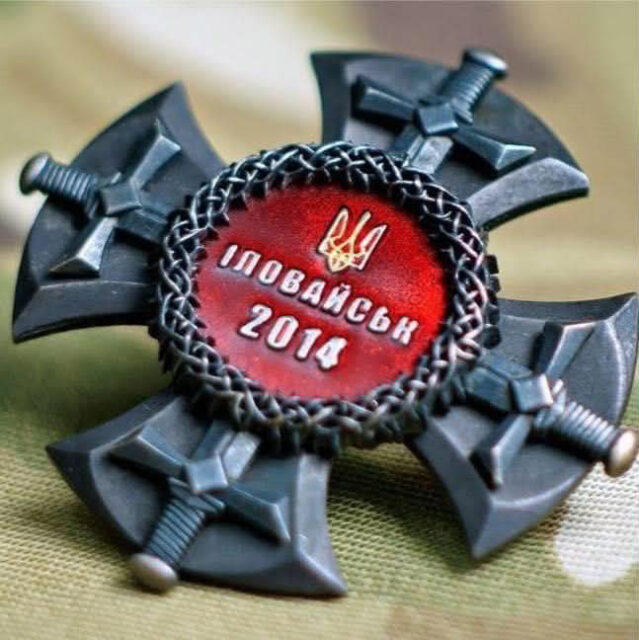
Andriy Dobrovolskyi, known by the callsign “Kum” [‘godfather’ in Ukrainian – ed.], has been fighting in Russia’s war against Ukraine since 2014. He served with the Dnipro-1 battalion and suffered his first spinal injury during the withdrawal from Ilovaisk, leaving him temporarily unable to walk. After years of treatment in Ukraine and Lithuania, along with numerous surgeries, he got back on his feet and returned to service, joining the personnel support unit of his home battalion.
Today, despite living with a disability, limited mobility in his right leg and constant, severe spinal pain, Andriy drives, embraces life with remarkable determination and holds on to one dream: to see the aggressor state reduced to ashes.
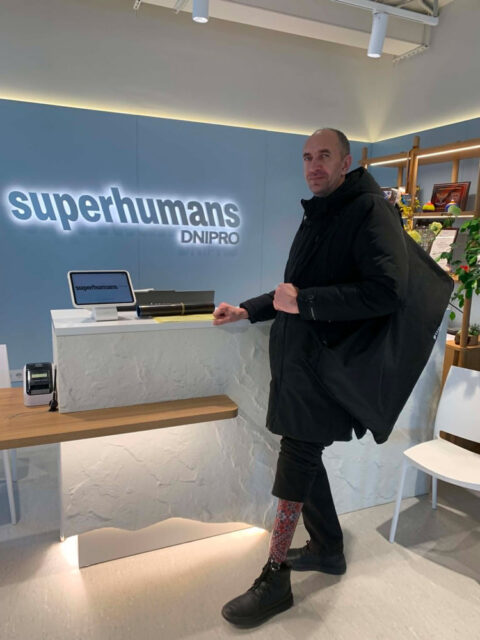
When Russia launched its full-scale invasion in February 2022, he was given another chance to return to combat. But in an instant, everything changed. Andriy stepped on a tripwire mine, losing his left foot. Soon afterwards, he was fitted with a prosthetic leg.
We spent two hours talking about his time on the frontline, what he went through in combat, how his injuries changed his life, what keeps him moving forward, his plans for the future and how veterans should be treated. We could have continued talking for much longer, but the constant pain in Andriy’s back eventually forced us to stop — he cannot sit still for extended periods.
— Take us back to 2014. How did your combat journey begin as a volunteer, and at what point did you realise there was no going back to your former civilian life?
— It all began on June 13, 2014. A month earlier, on May 12, while I was still serving as a police officer, I was assigned to the Dnipro-1 battalion. We went through a short training period, then were deployed to provide security during Ukraine’s special presidential election. After that came Mariupol Airport, where we prepared to clear out the separatists and their strongholds. That was the first time I came under real gunfire and heard an NSV machine gun firing around Hretska Street. That’s how my combat career began.
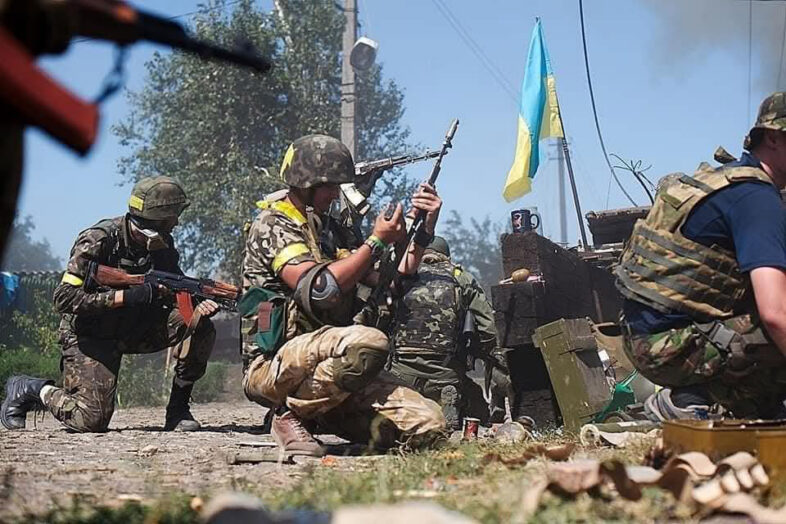
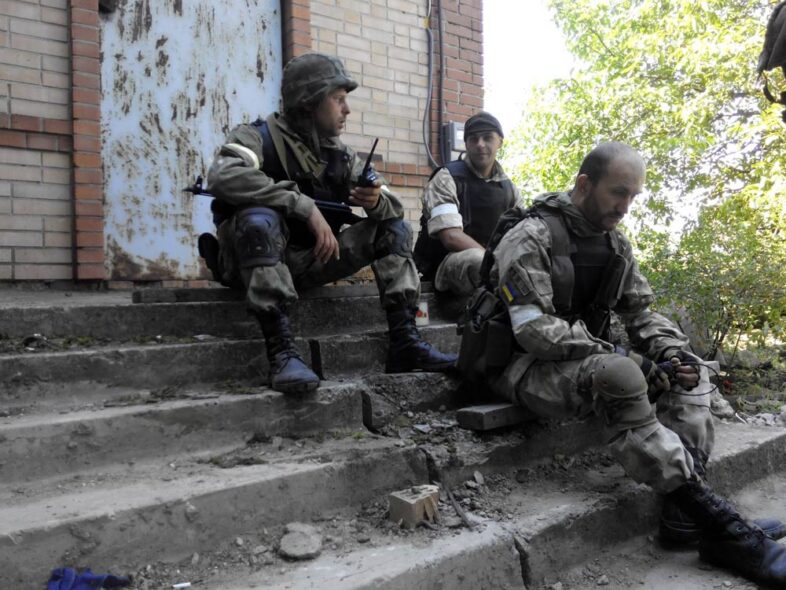
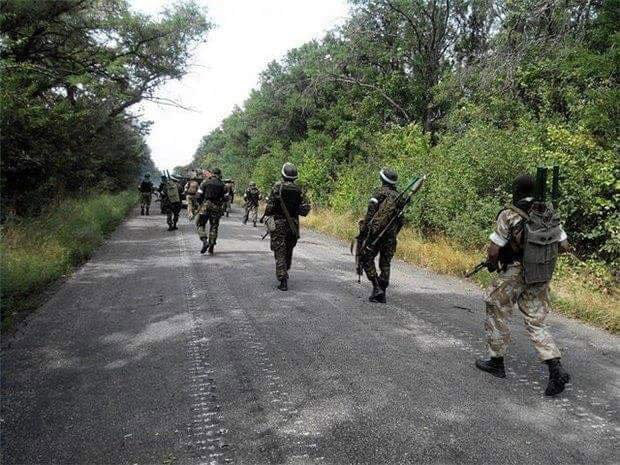
But my first real experience of combat came in Ilovaisk, where we were deployed in August 2014. The first point of no return was August 18, when we lost our brothers-in-arms. It was terrifying. At the time, we had no idea it was only the beginning. Some of us had already seen combat in Sector M, but nothing could have prepared us for the hell we encountered in Ilovaisk.
By August 24, 2014, we realised the Russians had dug trenches all around us, cutting off both the approaches to the city and the routes out. That was when we began to suspect we had entered Ilovaisk far too quickly and far too easily. We were also told that Russian forces had crossed into Ukrainian territory.
By then, everyone was utterly exhausted. We’d run out of food and water, and reality itself seemed distorted. We didn’t know where we would spend the night or where our next meal would come from. There was no point staying in the city any longer. Either we got out, or we were all going to die.
— How did you make it out of Ilovaisk, and what happened to you during the withdrawal through the “safe” evacuation corridor promised by the Russians?
— On the evening of August 28, our commanders made the decision to pull out, after the Russians promised us a ‘safe’ and ‘unimpeded’ withdrawal. By then, we had almost nothing left: no equipment, no combat vehicles, and all the buses had been destroyed. We kept searching for water in wells.
We drew up our routes and later learned about the agreements and arrangements made for the evacuation corridors. It seemed like things might become a little easier. We found an abandoned kiosk with mineral water and lemonade, finally managed to get something to drink, and then set off across the fields. But it wasn’t long before the shelling began.
Our vehicle was in the middle of the convoy. Reports of casualties started coming over the radio. When bullets began hitting our minibus, it became clear that we had to fight back with whatever we had: a few rounds of ammunition, several VOGs, six shots from a rocket launcher. We were being hit by artillery, mortars and machine-gun fire.
The van already had flat tyres and was moving on bare rims through fields of sunflowers and corn. We abandoned it, taking only the most valuable things with us. We moved forward along the edge of the field, spotted two MT-LBs and jumped inside. I was sitting with my back facing the direction of travel. At some point, I heard the sound of the armour being struck. And then the lights went out – I lost consciousness. It happened at around 9:30 in the morning, and I only came round at 1:00 p.m.
I was lying in the middle of a field, and when my vision finally cleared, I started looking around in every direction. I saw a young man. He was 21. We talked for a long time. I was lying there, and he was lying there too. The difference was that I was wounded — I could feel it was somewhere near my spine, and I noticed a small amount of blood — while he had simply ended up in the field, probably after falling out of a vehicle.
He told me, “I’ve been lying here for three hours already… I need to do something, because my whole body is starting to go numb.” He stayed there because the Russians were firing at us from the trenches from time to time.
He kept asking me what he should do: try to escape, stay put, or surrender. Those were completely normal questions in that situation. I advised him to wait until it got dark, so he would be less visible. But he didn’t listen. He stood up and walked towards the trenches with his hands raised.
A Russian tank drove up about 500 metres away from him and fired once. When I looked back at the place where I had last seen him, there was nothing left but a cloud of dust… Those bastards [Russian armed forces – ed.] have never had any moral principles.
After gathering what little strength I had left, I decided to crawl across the field. I pulled myself forward with my hands because I still couldn’t feel my legs. I reached a residential area and began making my way through the gardens behind the houses. The shock started to wear off, and the pain began spreading through my body. I started screaming from the pain and eventually lost consciousness. But at night, our guys, who were hiding in the houses nearby, would come out to check on me. From time to time, they would ask how I was holding up. They told me to stay strong and promised they would get me out.
I waited until morning, then crawled out onto the road and started screaming — probably from a mixture of despair and pain. An elderly man came out, dragged me back inside, covered me with boxes and said, “Your commander is driving past here. Wait, they’ll pick you up soon.”
It was Vsevolod’s unit from the Red Cross group with the markings on their vehicles. They took me away and brought me to the place where the wounded were being held. They covered us with a tarp to protect us from the heat. The only medic there had nothing left in his first-aid kit except for a bottle of cognac. He would soak a piece of cotton in it and moisten our lips. We would suck on it, and somehow it seemed to make things a little easier.
This Vsevolod from the “Red Cross” unit gathered and evacuated a total of 87 wounded soldiers.
— In those unbearable circumstances, what helped you hold on? What thoughts kept you going?
— I felt anger and an overwhelming desire for revenge. I wanted to survive and finally see Russia burn.
— How did your treatment and recovery begin after your first injury, and what were the biggest challenges you faced along the way?
— At the time, everything felt like a blur. I remember the helicopters and the moment when, after we landed in Dnipro, I finally felt a sense of relief. During the evacuation, our helicopter had to land three times because of the risk of enemy fire. It was freezing cold, and someone kept me warm by holding me close with their own body.
When I saw the airport through the window, I realised that the worst was behind me. I sent messages to my mother and wife to tell them I was alive and had been taken to Mechnikov Hospital. Until then, they had spent days not knowing whether I was alive or what had happened to me.
Then the surgeries began — the first, then the second. We were incredibly fortunate that Lithuania agreed to take in wounded Ukrainian soldiers for treatment. It was a deeply moving and powerful act of support. We were transported by ambulance and then flown on a military aircraft, where we were placed in special suspension hammocks for the journey. I travelled with hope and faith that a miracle would happen and that I would walk again.
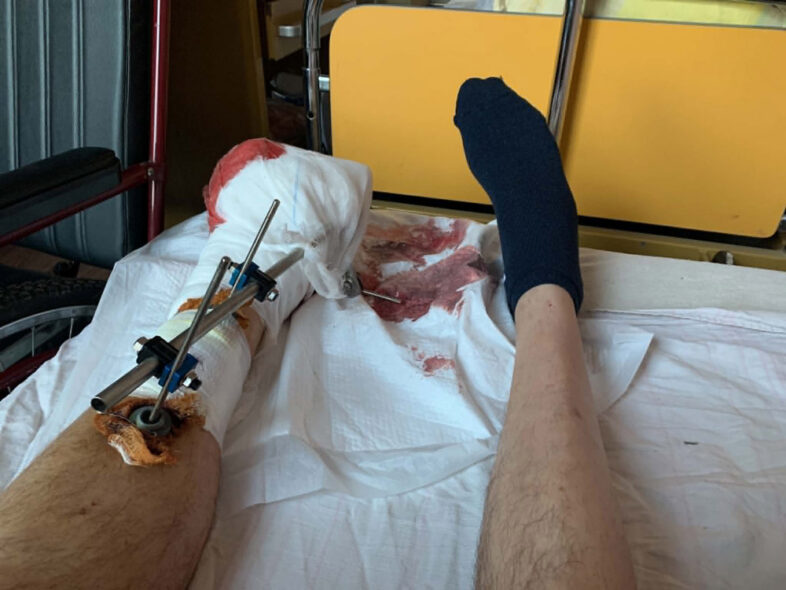
During the first surgery, doctors removed a fragment from my spinal canal. During the second, they removed damaged tissue. Three more operations followed in Lithuania. The fourth surgery, performed by surgeon and professor Vladislav Keda, proved to be the turning point: that was when they discovered the necrosis. The doctors told me that even without plates, if I maintained moderate but regular physical activity, I could recover and eventually learn to walk again.
Later, back in Ukraine, I had a microstimulator implanted. Doctors believed that the stimulation could help restore the neural connections. Until then, my left foot had been completely unresponsive. When I walked, I had to swing it forward by inertia and let it hit the ground, because the muscles below my knee were barely working.
I felt a sense of freedom for the first time when I was returning to Dnipro. I was already able to move around on my own with crutches. But then another fear appeared — stairs. I was afraid I would fall. Later, I started noticing the ramps around Ukraine, too. I would look at them and think: how is a person with a disability supposed to use this? They are simply too steep.
— What was it like returning to everyday life in Dnipro? How did people treat you?
— After I returned, I spent some time undergoing rehabilitation at the Solonyi Lyman sanatorium. But they did not really know how to work with injuries like mine. They often wouldn’t even let me go to my treatments on my own because they were afraid my condition might get worse. I didn’t agree with that approach.
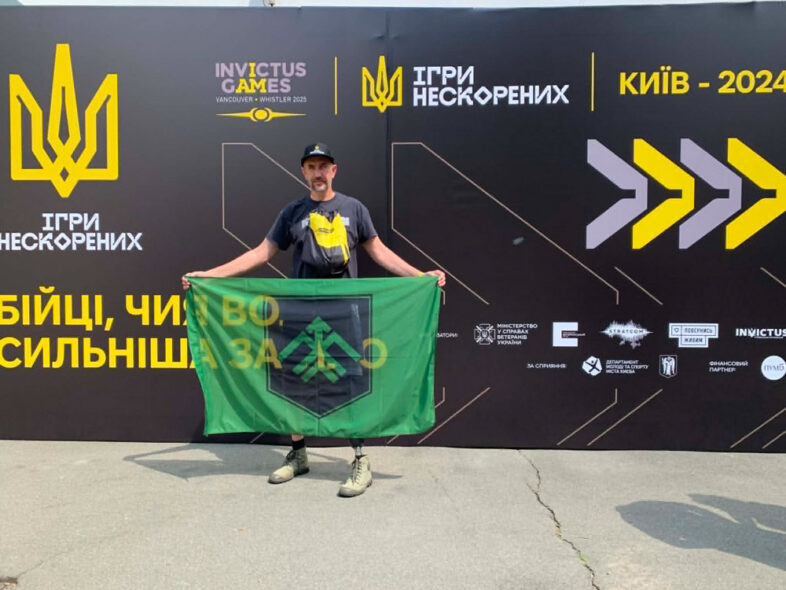
At the same time, I understood that while Ukrainian society was learning how to adapt to us, my main goal was to recover as much of my physical ability as possible. Because all of us — whatever names people give us, whether it’s “bunnies,” “kittens,” or anything else — want to remain independent, capable people after the war. Together with another veteran, I started taking part in sports competitions for veterans. I competed in the ATO League and later in the Invictus Games. That became another important part of my return to normal life.
There have been some upsetting moments, too. Once, I was walking home when a group of drunk men started mocking the way I walked. But to tell you the truth, it didn’t really affect me.
Even now, the hardest thing for me is getting around on my own. When my car breaks down, I have to either walk uphill or wait for a minibus. For someone with a serious injury, using public transport can be a real ordeal.
Eventually, I returned to my military unit. Some of the people there had also been through Ilovaisk, and their attitude towards me was incredibly humane: there was no excessive pity or sympathy, just respect and understanding. At first, I continued working in my field; later, I transferred to the administrative office. Of course, I wanted to do more, but the most important thing was something else — being close to my brothers-in-arms rather than simply staying at home and recovering.
— What do you remember about February 24, 2022? What was the mood in your unit, and what were your expectations as the full-scale invasion began?
— We were prepared because the command had warned us about a possible invasion. We were told to collect our uniforms and equipment from storage. It was obvious: 150,000 Russian troops were not just gathering near our borders for no reason. We even joked that we would have to buy up all the gear from shops like “Militarist.”
I wanted to go to the front line, but they wouldn’t let me. There were more than 100 veterans from the old guard in the unit. Later, the regiment was transferred from the police to the National Guard of Ukraine. In total, they brought together more than 700 people. I handled paperwork, worked as a driver, kept records of combat operations and transported sappers. Once, by chance, I came across a Russian cache containing rocket launchers and ammunition. I loaded everything up and brought it back to the base.
— What happened when you were injured for the second time?
— We needed to clear a route to one of the villages near Sloviansk so we could recover a tank and an MT-LB. We arrived at the location, dropped off the sappers, and continued along a road that had already been checked and cleared of mines.
Suddenly, some locals stopped us. They were visibly agitated and said our [Ukrainian soldiers – ed.] soldiers were lying in the fields and needed to be retrieved. I got out of the vehicle and walked over. I stepped over a fallen tree, and at that exact moment felt a powerful hit to my leg — as if someone had struck me with a sledgehammer. I fell straight onto my back.
I started calling out to my comrade, who had stayed by the vehicle on the other side of the landing zone. He heard the explosion but didn’t immediately understand what had happened. When he crawled over to me, he saw the reality: my left foot was almost completely gone.
He dragged me back to the car. Then another problem came up — he didn’t know how to drive. So I got behind the wheel myself, while he gave me water and lit my cigarettes.
What made it even more frustrating was that I had only just learned how to operate an anti-tank guided missile. The guys from the 15th Brigade had trained us. None of our guys wanted to take it on, but I stepped up — and I learned how to do it. I even started thinking about joining a fire support company because I wanted to do something more useful than just driving around with the sappers.
Then I was taken to Dnipro. I still had part of my heel left, but the head of the trauma department gave me a choice: either we spend six months trying to save the foot, or we amputate and prepare for life with a prosthesis. I thought about a comrade who still gets around by hopping on his heel, and I agreed to the reamputation.
After that, the prosthetics and rehabilitation process began quickly.
— How did the people around you react after you were injured for the second time? Who helped you get through that period?
— After two years of the full-scale invasion, doctors had already become used to treating the wounded. There were fewer unnecessary emotions; everything was handled calmly, professionally and almost automatically. With such a huge number of wounded coming in, it is much harder for doctors to give each person the same level of attention and care they were able to provide in 2014.
The greatest support I felt came from volunteers. There are far more of them now, and they genuinely look after the wounded. I remember one time, when I was in the hospital’s mental health ward, volunteers unexpectedly brought us varenyky as a small gesture of support.
When it comes to social support, there are still many issues that need to be addressed. The biggest challenge, in my opinion, is the lack of specialists who can help veterans navigate the system — people who can support wounded soldiers with paperwork and help them deal with the bureaucratic hurdles they encounter.
— When you talk about inclusivity in Ukrainian society today, what does it mean to you? Is it only about accessible spaces, or is it also about how we treat people with military experience? What should the government be doing to better support veterans?
— I see inclusivity as a long-term, collective effort to help veterans adapt to civilian life. It requires the involvement of everyone: the government, local communities, businesses, non-governmental organisations and society as a whole. Each of them has an equally important role to play.
For me personally, it is important to feel that I am still needed. Right now, I am exploring opportunities with non-profit organisations, foundations and businesses where I could use my experience to support military personnel. I have been sending out my CV, have already had several interviews, and hope to start a new job soon. The Superhumans Center is helping me with this process.
Veterans will feel like full and valued participants in public life when respect for the military and remembrance of those who have fallen become a natural part of how children are raised. This is what healthy patriotism means: knowing our history, understanding the key moments in our struggle for independence, and recognising that we must defend our land, our country and our values. Speaking your native language is the right thing to do. After all, this war is not being fought for power or for politicians — it is being fought for the right to live.
When we talk about government support, it should be about much more than one-off payments, pensions or ceremonial events. The state needs to create real opportunities for veterans to develop, grow and fulfil their potential.
For instance, if Dnipro has a University of the Third Age, why couldn’t we create something like an Institute of Veterans of Ukraine — a place where veterans could learn, develop new skills, share their experience and get involved in civic life? I would be happy to be part of such an initiative. We also need to take another look at the laws that help veterans find jobs and start their own businesses, especially when it comes to tax incentives, and make sure they actually work.
When we talk about building an inclusive society, it’s not just about ramps or accessible restrooms. It’s about understanding that veterans are people with their own experience, knowledge and potential — people who have a lot to offer and who should have every opportunity to contribute.
— After everything you’ve been through — two serious injuries and all the challenges that followed — what helped you keep going?
– My life motto is fairly simple: try not to dwell on negative thoughts. Humour helps me a lot with that. I also love spending time in my garden — being close to nature, getting some fresh air, and simply taking a moment to look at the trees and the sky.
I try to stay as active as I can, too. I make sure I do my stretches every day. I’m hoping to take up rowing soon and I’ve already arranged my first lessons. Any kind of physical activity really helps with my back recovery.
But I think the most important thing is to keep moving forward, whatever challenges life brings. There’s a quote from Carl Jung that has always stayed with me: “I am not what has happened to me, I am what I choose to become.” And that’s something I try to live by — the past can’t be changed, but I can choose how I move forward.