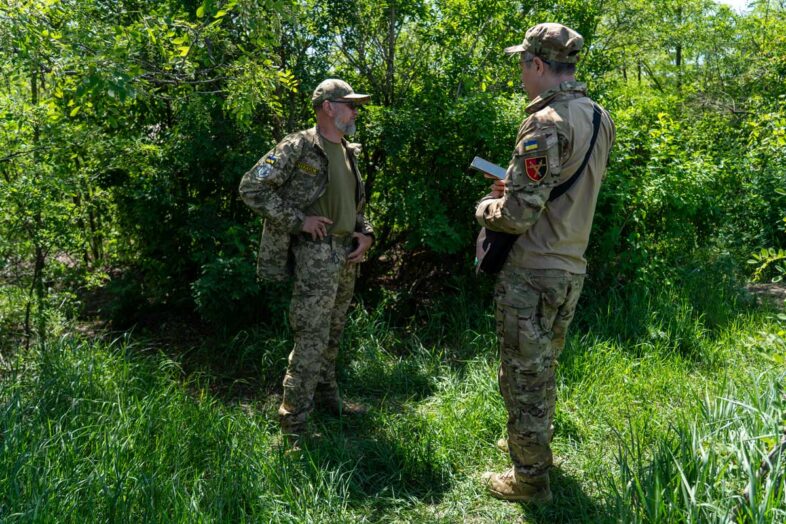
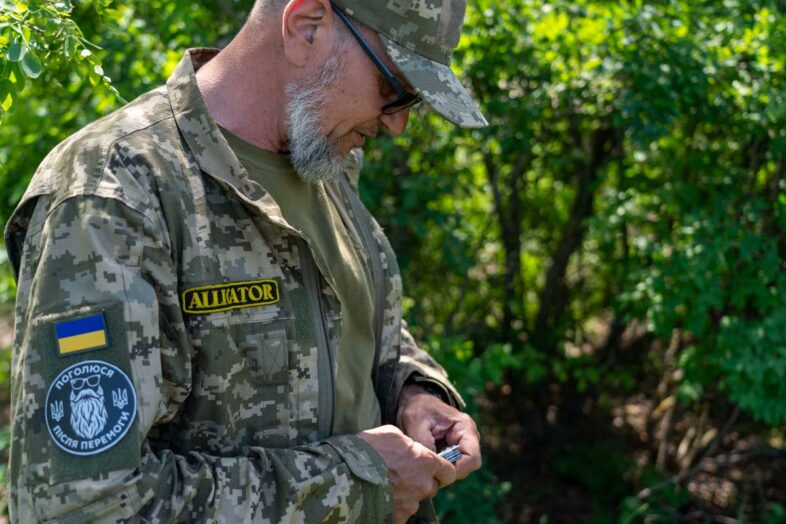
He steps out of a fog-drenched grove near Pokrovsk, a beard now grown out like Saint Nicholas and a calm that would make Buddhist monks seem unsettled by comparison. Junior sergeant Oleh of Ukraine’s 32nd Steel Brigade, call sign “Alligator”, has just returned from a mission deep inside what soldiers describe as the very “throat” of the enemy advance. For more than five months, he and his partner remained hidden in plain sight — unseen, yet persistently lethal.
“The nickname ‘Alligator’ has been with me since childhood,” says the 55-year-old. “That’s what they called me back then, and it just stuck.” The name followed him well beyond childhood. “When my son was born, my colleagues brought a big plush crocodile and said: ‘You’re Alligator Senior, and this is for Alligator Junior.’”
Oleh left his occupied hometown in 2015, eventually settling in Kryvyi Rih, where he worked as a steelworker at ArcelorMittal.
We meet with him at the brigade’s training ground, where he is now passing on what he learned to new recruits. He speaks evenly, without urgency, in the steady cadence of someone used to keeping control under pressure. Only occasionally does something flicker in his eyes — a brief spark of the man who has outmanoeuvred death in places where it seemed to have the upper hand.
“I was mobilised a little over a year ago,” he continues in the same measured tone. “I’m a junior sergeant now — but the rank actually goes back to my conscript service in Soviet times. I served in the Pacific Fleet, on Sakhalin Island.”
By Oleh’s own account, he was on course to make first-class petty officer, with three chevrons on his sleeve. That changed after what he describes as an especially audacious unauthorised absence. “I lost my ‘second class’ over that,” he says with a faint smile. “Back then, the security officers told our command: he deserves a medal for ingenuity, and you deserve a tribunal. I managed to outsmart all the officers.”
That same instinct — what he calls the ability to “break the system” — has, he suggests, proved useful once again near Pokrovsk.
— What was your mission out there?
— Our task was to be the “ears and eyes”, 360-degree observation. Together with my partner, I moved into a narrow “corridor” of land, an area already marked red on Deep State maps. When we checked in over the radio — “Are we the first ones?” — the answer came back: “Yes, you are the first.”
By the second day, it became clear the forest was not empty. Russian tracks cut through it in several directions — one straight through their position, others to the right and left. We had four relatively quiet days to dig in. What we built was a makeshift dugout, covered only with branches cut using a multitool, plastic sheeting and piled earth. There was no opportunity to move elsewhere or reinforce it properly.
So, we improvised. The position was disguised to look like nothing at all — just another patch of forest that would be passed over without a second glance. Branches were scattered to mimic natural fall, the logic simple: if it looked ordinary, it would most certainly be ignored.
Most of the time, it worked. Russian troops would bypass their position, adjusting routes without noticing anything out of place. Some, however, pushed straight through the thicket and came face to face with us at close range. It didn’t go well for them. They’re still decomposing there now.
Yet, most simply walked past. Coordinates were relayed, and Ukrainian drone units took care of the rest from the air.
— How did you manage to stay undetected so close to Russian movement routes?
— We broke their logic. Normally, Russians look in dense bushes or deep holes. So we did the opposite — we set up on a small patch of ground, almost an open clearing. The thinking was straightforward: no one would look there, because it makes no sense. And it worked.
The entrance to our position was technically visible but so carefully camouflaged that it blended into the landscape. They would come through, see it, and report over the radio: it’s an abandoned burrow, no one’s there. And they’d just move on.
What passed us was a steady stream of Russian troops moving through the corridor of fighting. There were their “camels”, as we call them — soldiers hauling heavy duffel bags — and assault groups in body armour pushing hard towards Pokrovsk without food or water. At times, they would even scavenge discarded bottles just to drink whatever was left inside.
We watched them come and go, rarely engaging — everything had to remain invisible. Only when contact became unavoidable did we act.
The discipline was absolute: no unnecessary movement, no exposure, no trace left behind. Even waste had to be buried and covered with leaves so that nothing betrayed their presence — not a footprint, not a scrap of disturbed ground. You never knew who might pass by. And there were no people there, really — only enemies.
— When did the Russians realise there was someone operating in that sector?
— We got there in August. By around October, Russians started to piece it together — that their people were disappearing in that corner of the forest. At one point, there was even talk that it might be a roaming sabotage and reconnaissance group.
Soon after, the Russians began sending in bait teams. They would literally sit down for a smoke break right next to us, about ten metres away. We didn’t breathe. We just listened to them talk — about how they’d enter Pokrovsk, what they’d loot, which cars they’d buy and how they’d pay off their mortgages.
We would wait them out, then pass coordinates and let Ukrainian drones finish the job. We just directed the ‘birds’ at them.
But one morning, the pattern changed. A new group moved in — and with it, an operator with clear experience, methodically firing into every bush, every hole, every body along the way. I told my partner: “This time they came for us.” Russians quickly figured out our hideout. As soon as the drone operator picked up our concealed entrance, the strike followed.
— Was that your first serious assault? How did you act in that battle?
– We took one [Russian – ed.] down immediately. We had a pile of captured ammunition, two clean AKs and an RPK. The first minutes set the tone for everything that followed. I was hit almost straight away. I was wearing gloves; I looked down — my fingers were just hanging. I told my partner: “I’m a 300.” No panic. I just kept working — loading magazines with my left hand, blood dripping. It wasn’t critical. I held my sector and kept passing him ammunition.
My partner then seriously wounded one of the Russians. That guy was gurgling, choking… it went on like that for about forty minutes. It broke their morale completely. Their drone — their “bird” — then came in and dropped explosives on the position. Then the Russians pulled back. Another was later taken out with a single shot on the road.
They were shouting at us: ‘Khokhols [Russian ethnic slur for Ukrainians – ed.], surrender!’ And Sashko shouted back: ‘F*** you, guys, let’s have a fight!’
You know, Sashko is from the Kharkiv region and normally speaks Ukrainian, but in that moment switched into what sounded like a Volhynian accent. And then he gave them a burst from the machine gun.
After that, the shelling intensified. Mortars came in from three directions. One round landed about a metre away and buried them in soil. It knocked us hard, but we dug ourselves out.
I even managed to recover most of his gear afterwards. Everything was in place — I was lucky how it had been positioned. The only thing I couldn’t find were my knee pads and elbow pads. That’s a shame – very useful things when you’re crawling around.
— How did you withdraw from the destroyed position?
— In the dark. The moon gave just enough light. Mortars were still firing, but we understood the basic rule: movement was safer than staying still. A moving target is harder to hit.
We moved at a normal walking pace, shoulders loose, trying not to attract attention. Then we spotted a reconnaissance drone — a Mavic. We immediately went under a fallen tree, curled up like snails under thermal cloaks.
That’s when the FPV drone came in, running on a fibre-optic line. The blast went off less than a metre and a half from our heads. It was a heavy shock. Shrapnel flew everywhere, but somehow none of it hit us. A piece of ammunition landed right next to me, still hot and sparking. I just flicked it away with my hand.
Then came another wave — a bomber drone dropping munitions directly onto the tree above us. One landed about a metre from my partner’s feet and failed to detonate. Our guardian angel was definitely working overtime that day.
We didn’t move for three and a half hours. Everything felt numb. You’d be afraid to breathe. The Mavic circled overhead, just five metres above, scanning for movement. It has never found us. When the drone finally left, we got up and moved on to another position — a solid dugout further back.
— Did you stay there for more than two weeks?
– Twenty-four days, to be precise. The dugout held firm — built from heavy logs, it was strong enough to withstand mortar fire. Russian assault groups came again and again; at times they even threw grenades into the entrance. But inside, the position had been built like a maze. All we really got was a bit of smoke.
The mission itself never changed: we had to observe. Russians kept passing through the area — some across open ground, others alarmingly close.
Getting out was the hardest part. On the final day, my partner was shot in the leg. Sashko, a medic himself, knew exactly what to take and when. The pain was intense, but he kept moving. To make our withdrawal possible, we stripped him of everything that wasn’t essential. Even the ballistic plates were removed from his body armour, leaving only the carrier vest — just enough to slow shrapnel if needed. He hobbled on, leaning on his rifle.
We withdrew without drone support, relying only on radio communications. Command knew I had a good sense of direction, so they simply passed on coordinates and landmarks, telling me where to go and when to turn.
Sashko was hanging on by sheer determination — crawling, rolling, or sliding depending on the terrain. I gave him all the painkillers we had taken from enemy medical kits, keeping just one for myself.
I carried everything — body armour, five magazines, a backpack, a stack of power banks. Sashko kept telling me to drop it: “It’s heavy.” I told him: “No, we don’t know what kind of situation we’ll end up in tomorrow.”
It was late November, and the cold was biting. While we were still holding the position, supplies trickled in: first thermal underwear, then winter gear, followed by blankets, sleeping bags, and hand and foot warmers.
We slept in shifts. Whoever was off watch would crawl into a sleeping bag, with a blanket on top. The second blanket had straps — it could be thrown on like a cloak, and we would take turns on watch like that.
Our route back ran along what soldiers call the “road of death” — a stretch littered with destroyed vehicles, abandoned positions, and enemy FPV drones fitted with explosives, the so-called “watchers” left hovering until something moves.
Most had long since run out of battery. Still, we avoided each one as if it were live. Shell craters filled with rainwater punctuated the road. At times, we dropped straight into the mud and drank from them.
Sashko laughed: “What tasty water — the best on the coast.” It had a faint greasy taste, but in that moment it felt like the most precious thing in the world.
When we could no longer walk, Ukrainian soldiers met us with a “tachanka” — a large improvised handcart. Sashko was loaded onto it, while I kept moving alongside. Over the next two nights, we covered roughly ten kilometres through the fog.
Then came the evacuation.
We were given hot food and tea, and three hours in a bed. We shared a single mattress, curled up tightly together. I’ve never slept so deeply in my life.
— What kept your spirits up during those 150 days?
— Humour saved us. I’d brew coffee, and Sashko would taste it, saying: “This is the best coffee on the coast.” Every morning we played the same game. He’d ask: “So, Alligator, are we having dinner today?” I’d answer: “Of course we are.” He’d smile: “Well, I trust you. I don’t trust the bastards.” The next morning it would be me asking.
When people ask me now whether I was scared, I say honestly: the first 15 minutes. After that, it becomes something else. Just work — dirty, hard, deadly dangerous work — but work that has to be done. We did it.
— You are now training recruits. What is your main advice to those going “to zero” for the first time?
– I tell them: don’t panic. If the enemy is looking in your direction, it doesn’t mean he sees you — he’s just scanning. The main thing is to stay in control.
I wasn’t born for war. I’m a steelworker, a railway worker, a driver. I never thought I’d be the one to shoot first. But that’s what it’s come to. I am a warrior now, and I shoot without hesitation. If someone asks me, “Did you shoot people?”, I answer: “No, I shot the enemy.” He took my home and my family, so he has to be shot. And I’ll do it until victory.