Ukrainian emigration to China and Japan after the defeat of the Ukrainian People’s Republic remains one of the least studied chapters of Ukrainian history. In an interview with The Ukrainian Week, historian and scholar Olha Khomenko, a PhD researcher at the Oxford School of Global and Area Studies, talked about the Ukrainian diaspora in Manchuria and Japan, the work of Ivan Svit, the development of Ukrainian life in Harbin, and the links between Ukrainian émigré centres in Asia, Europe and North America.
– Olha, how did you first get into researching Ukrainian emigration to China and Japan after the fall of the Ukrainian People’s Republic?
—I graduated from the Faculty of Philology at Taras Shevchenko National University of Kyiv, where I studied both Ukrainian and Japanese. After graduating, I worked as a diplomat in the cultural section of Ukraine’s embassy in Japan. But I was always drawn to academic research. After receiving a scholarship from Japan’s Ministry of Education, I went on to study at the University of Tokyo, where I completed both my master’s and PhD in Japanese. I stayed on afterwards to work, and in total I spent around 14 years living in Japan.
At the time, very few people in Japan knew much about Ukraine. Most understood that Ukraine had once been part of the Soviet Union, but many still referred to us as Russians or simply as “Soviet people”. Most knowledge about Ukraine still came through the Russian language and Russian studies. Even in the 2000s, people increasingly recognised Ukrainians and Russians as distinct, but there was still very little real understanding of Ukraine’s own history or culture
That’s when I came up with the idea of introducing Ukraine to Japanese readers through literature—letting them discover it for themselves. In 2005, together with my colleague, Japanese translator Fujii Etsuko, I put together an anthology of contemporary Ukrainian literature in Japanese and published it in Tokyo.
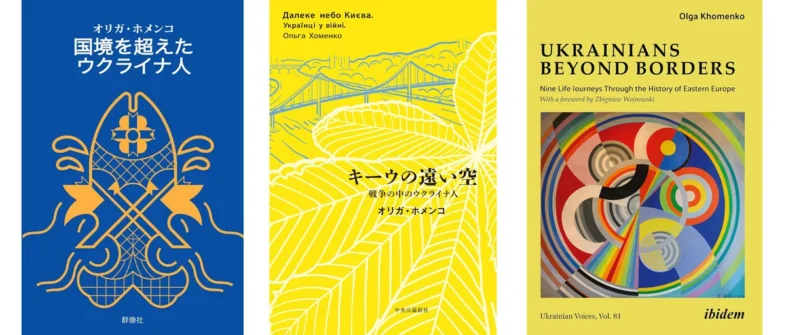
Olha Khomenko’s books on Ukraine and Japan
I also worked on television programmes about Ukraine for Japanese audiences and wrote a lot about the country. In 2014, and again in early 2022, just before the full-scale invasion, my books From Ukraine with Love and Ukrainians Who Overcame Borders came out in Japan. Through stories of both well-known and lesser-known Ukrainians, I wanted Japanese readers to get a sense of our history and experience.
I spent years promoting Ukraine in Japan, but over time I started to ask a different question: what came before us? Was there already a Ukrainian presence in East Asia long before our generation?
The turning point came when my first PhD supervisor at the University of Tokyo, Professor Kazuo Nakai, gave me a photocopy of Ivan Svit’s The History of Ukrainian-Japanese Relations, which had been published in the United States in 1972. I still remember thinking, “My God, what is this? I’ve never heard of any of it. There was a Ukrainian diaspora in Asia?” That was the moment I began collecting material and gradually immersed myself in the subject.
Unfortunately, very little is still known about the Ukrainian diaspora in Asia, even within Ukrainian studies. For decades, China and Japan were largely overlooked by scholars of the diaspora, although researchers like Andrii Popok and Viacheslav Chornomaz have been working to change that for more than twenty years. The Japanese scholar Yoshihiko Okabe has also made an important contribution. Since joining the University of Oxford, I’ve tried to write and speak about this history more often and bring it to a wider audience.
– How large was Ukrainian emigration to China and Japan in the 1920s–1930s—and was it mainly political refugees?
– In Japan itself, the Ukrainian community was relatively small. But in Northeast Asia—especially in Manchuria and the Russian Far East—there were sizeable Ukrainian populations. On the eve of the revolutionary period, estimates suggest that somewhere between 800,000 and a million people from Ukrainian lands were living there.
The roots of this go back to the second half of the nineteenth century. After the abolition of serfdom, many Ukrainian peasants were disappointed with the small plots of land they received. At the same time, the Russian Empire was expanding east and looking to populate its new Far Eastern territories. Ukrainians from the southern provinces were encouraged to move, with the promise of much larger land allocations than they could get at home. The catch was that they had to move as entire families.
From the 1870s right up to the 1917 revolution, this led to the formation of large Ukrainian settlements across the Far East. Japanese sources from the time also note a significant Ukrainian presence in the region. These communities were often economically successful, setting up farms, forming their own choirs and theatre groups, and gradually—living alongside Russians, Buryats, Koreans, Chinese and others—beginning to see themselves as a distinct national community in their own right.
After the proclamation of the Ukrainian People’s Republic, the whole thing took on a much more political edge. Between 1917 and 1918, four Ukrainian Far Eastern Congresses were held, where delegates even discussed whether they could align themselves with the Ukrainian state project. By the end of it, they had drafted a proposed constitution for Ukrainians in the Far East and issued a declaration to the world’s peoples. So this wasn’t just cultural activity—it was a serious attempt to think through a political future.
That changed quite dramatically once Soviet power was established in the region. By the time the Red Army arrived in October 1922, many Ukrainian public and political figures had already been forced out. A large number of them moved to Harbin, around 500 kilometres away. Harbin already had a sizeable Ukrainian community, and a Ukrainian club had been active there since 1906. From that point on, the city quickly emerged as one of the main centres of Ukrainian life in the region.
Harbin was a remarkable city. It was built around the Chinese Eastern Railway, and Ukrainians were really involved in it — building it, working on it, running parts of it. One of the main figures there was General Dmytro Horvat, a Ukrainian from the Poltava region, who ended up heading the railway administration. And quite early on, Ukrainian clubs, organisations and cultural life were already emerging in the city. Later on, that becomes more organised — the Ukrainian Manchurian District Council, and even a consulate of the Ukrainian People’s Republic.
When Japan took control of Manchuria in 1932, the Ukrainian community came under new pressure. Without a state of their own and often lacking proper documentation, Ukrainians had to find ways to hold on to their cultural and national identity in increasingly difficult circumstances.
That being said, it would be wrong to treat Ukrainian emigration in Manchuria in the interwar years as just a story of political refugees. The community had deeper roots, going back to economic migrants who arrived in the late nineteenth century. After the defeat of the Ukrainian People’s Republic, they were joined by a much more politically charged wave of émigrés and former soldiers, and community life shifted — becoming far more openly national in outlook, and explicitly tied to ideas of statehood.
– Were the political émigrés in Harbin organised in any formal way?
— Yes, the Ukrainian political émigré community in Harbin was fairly well organised—though far from unified. You had people from across the spectrum of the Ukrainian movement living side by side: supporters of the Ukrainian People’s Republic, Hetmanite circles, OUN members, and activists from other currents.
Among the more prominent figures was Professor Viktor Kuliabko-Koretskyi, a former Minister of Posts and Telegraphs in Hetman Pavlo Skoropadskyi’s government. On the Ukrainian People’s Republic side, there was Ivan Svit—a native of Kupiansk who studied at Kharkiv University. After moving to Vladivostok, he became directly involved in the Ukrainian national movement in the Far East and later emerged as one of its key chroniclers.
Ivan Svit really sits at the heart of this whole story. He wasn’t just a participant in events on the ground—he also left behind one of the most detailed records we have of Ukrainian life in the region. I ended up writing a whole book about him, The Far Eastern Odyssey of Ivan Svit, published in December 2021. It traces his journey from Ukraine to China, and then on to the United States. There’s also a section where I reconstruct the names and fates of the people around him—the core of that community. And one thing that really stands out is that most of them didn’t come from Galicia, as is more typical in Ukrainian diasporas in places like the US or Canada, but from central Ukraine.
– What did Ivan Svit’s “dream Ukraine” look like—and did he still hope for the restoration of Ukrainian statehood?
– Absolutely. Ivan Svit belonged to a generation shaped by the Ukrainian Revolution of 1917–1921, for whom the defeat of the Ukrainian People’s Republic was never the end of the story.
For him, Ukraine was never an ethnographic curiosity or a matter of cultural autonomy inside someone else’s state. It was a country, a state, in its own right. He was convinced the Ukrainian question would return to the international stage sooner or later, and so he set about preserving the political memory of the liberation struggle and keeping a sense of national consciousness alive in exile.
One of his key tools was the newspaper Manchurian Vistnyk, which he published in Harbin between 1932 and 1937. It came out in Ukrainian and Russian, had a Japanese title, and sometimes included articles in English. In a way, it was aimed at a very mixed readership—communities across the region that had lost, or never had, statehood after the collapse of the Russian Empire. Within that, the Ukrainian story in the Far East was framed as part of a wider struggle for national self-determination.
Svit is a really interesting figure in his own right. He was born in Kupiansk in Ukraine’s Kharkiv region, the son of an Orthodox priest, and he lost his father quite young. He later studied at Kharkiv University, which at the time was one of the main intellectual centres in Ukraine and very much part of the emergence of modern Ukrainian political thinking. That’s where a whole generation came through—people who would later play a real role in the national movement.
He never actually graduated from university because of the First World War and the [Russian] revolution. In March 1918, he set off for the Far East, originally hoping to make his way to the United States eventually. But things didn’t go to plan. He ended up in Vladivostok just as the Ukrainian movement there was gathering pace—between the second and third Ukrainian Far Eastern Congresses—and was drawn into public life, drifting almost naturally into journalism. Later on, he became one of the key figures documenting and writing the history of the Ukrainian presence in the Far East.
– Had Ivan Svit already fully formed his Ukrainian identity by that stage?
– I would even say that Svit didn’t “become” Ukrainian in exile — he arrived in the Far East already fully formed as a Ukrainian. Today, you often hear claims that places like Kupiansk or Kharkiv were always under strong Russian influence, but if you look at the historical sources, the picture is much more complicated. Imperial census data, for example, shows that in Kupiansk most people actually spoke Ukrainian. The Kharkiv region was the heart of Ukraine’s historic Slobozhanshchyna region—one of the core areas of historical Cossack Ukraine.
The environment he grew up and studied in really matters here, too. Kharkiv University was one of the key centres where modern Ukrainian national thought was taking shape, bringing together people who were right at the origins of the Ukrainian political movement, including members of the Tarasivtsi Brotherhood. So Svit was formed in a setting where Ukrainian culture and the national idea were very much alive, not something abstract or marginal. And when he got to the Far East, that sense of identity only deepened. He arrived in Vladivostok right in the middle of the Ukrainian Revolution and a real wave of national awakening among Ukrainians there, and quickly got involved in public life, fully committing himself to the ideas of the Ukrainian People’s Republic. It’s quite telling that around that time he even shortened his surname from Svitlanov to Svit. On the surface it looks like a small, formal change—but in reality it was a clear act of self-identification and a way of marking distance from the Russian imperial background.
After moving to Harbin in 1922, Svit continued working as a journalist. He collaborated with the Russian-language newspaper Gunbao, where he edited a “Ukrainian Life” page on the activities of the Ukrainian community in Manchuria. But his real goal was always to launch a proper Ukrainian newspaper.
Paradoxically, that only became possible once Japan established control over Manchuria. The Japanese authorities promoted the idea of “coexistence” among the region’s peoples—though in practice this mainly meant Japanese, Chinese, Manchus, Koreans and Mongols. Ukrainians weren’t even officially on the list. But Harbin was so multiethnic and unusual that Svit managed to argue there was a need for a Ukrainian press. It really was a city where all kinds of communities lived side by side—national, political and religious. Ukrainian, Georgian, Tatar and Polish organisations, former soldiers of the Czech Legion, Russian émigré groups and many others all operated there.
And it was precisely this kind of environment that allowed Ukrainians to sustain their cultural and civic life – and gave Svit room to push forward with his journalistic and public work.
For him, the Ukrainian cause was never just about folk culture. He was always thinking in terms of statehood. And he was convinced that even in exile, Ukrainians had to keep the memory of their own state alive and be ready for the moment when the question of Ukrainian independence would come back onto the international agenda.
– You’ve previously spoken about the global nature of Ukrainian émigré networks in the 1920s–1930s, particularly the links between Harbin and Paris.
– I’m working on this topic at the moment, and what keeps surprising me is just how global Ukrainian networks already were in the interwar period. Today, we tend to think of globalisation through the lens of the internet and instant communication, but Ukrainians were plugged into global information flows long before anything digital existed.
Of course, there was no internet, no social media. It all worked through letters — vast amounts of correspondence. What stands out is just how connected these communities were. Ukrainians in Harbin were in regular contact with émigré centres in Paris, London, Prague and Warsaw, as well as across North America, particularly New York.
They shared newspapers, books, ideas and news, almost in real time by the standards of the day. So people in Asia were never really cut off from the wider Ukrainian world.
Take Ivan Svit’s Manchurian Vistnyk, launched in 1932 at one of the darkest moments in Ukraine’s history. Even from thousands of kilometres away, Svit worked hard to stay informed about events in Soviet Ukraine. He relied on Japanese, German and other foreign sources, followed the international press, and monitored radio broadcasts to piece together what was happening. As a result, Ukrainians in Manchuria were often remarkably well informed—sometimes on a par with Ukrainians elsewhere. They also, crucially, knew about the Holodomor.
After the Second World War, when Svit moved to the United States, he helped introduce the Ukrainian community there to the experience of Ukrainians in China and Manchuria. In many ways, his work is what moved the history of the Far Eastern emigration beyond a purely local story.
– Looking back at those early global Ukrainian networks we’ve mentioned earlier, was their strength largely driven by a desire not to be absorbed into the larger societies and states Ukrainians lived in?
– I’d say the key feature here wasn’t so much a kind of defence against assimilation, but rather a very strong, almost stubborn determination to stay Ukrainian in any circumstances. People adapted to changing political realities, but they didn’t let go of their identity.
If you look at Manchuria in the first half of the 20th century, it’s a place where regimes and borders were constantly shifting. Ukrainians arrived there with Russian imperial passports, or later on papers from the Ukrainian People’s Republic, which eventually stopped being valid. After that, they lived on Chinese documents, and later on Japanese permits—always temporary, always something that had to be renewed. And at the same time, Harbin was this very multilingual, very crowded imperial city. There was a large Russian émigré community, Russian schools, churches, newspapers – even a Soviet consulate. So on the face of it, you might expect Ukrainians to simply dissolve into that Russian environment. But that’s not what happened.
One of the main ways they held on to their identity was through print culture. Ukrainians published newspapers, books, reference materials—basically creating their own information space. A really striking example is the “Green Ukraine” map, produced in 1937 by a group of activists led by Ivan Svit. It didn’t just record Ukrainian presence in the Far East—it also placed it, symbolically, within a much wider Ukrainian historical and geographical narrative.
I managed to track down this document in American archives and later included it in my monograph on Ivan Svit. What’s interesting is that the map doesn’t only show Ukrainians—it also includes other peoples and regional communities, like Koreans, Buryats, and even Transbaikal Cossacks treated as a distinct ethno-cultural group. Its very publication clearly irritated the Soviet consulate, which tried to block it. In the end, it only went ahead after a long process of negotiation with the Japanese authorities.
Another striking example is a Ukrainian–Japanese dictionary published in 1944. Its very existence points to a community that was still large and active enough at the time to produce something like that.
At the same time, it would be wrong to romanticise the relationship between the Ukrainian community and the Japanese authorities. Like any imperial power in the region, the Japanese administration clearly tried to use different émigré groups for its own purposes. A 1936 Japanese report, for instance, divides Ukrainians in Manchuria into socio-economic categories: former railway workers and property owners, wage labourers, and what it calls the “unfortunate intelligentsia”. This last group were mainly political émigrés who arrived after the defeat of the Ukrainian liberation movement and often lived in very harsh conditions.
It was precisely this group that the Japanese treated with particular caution. Yet even today, at conferences, you still hear simplified claims—often from Western scholars, and quite often German ones—that Ukrainian figures in Manchuria were collaborators.
Yet, I believe that flattens out a much more complicated reality. These were stateless people who found themselves caught between several empires, trying above all to preserve their community and maintain some sense of political agency. And that’s why these stories really require careful, balanced work rather than quick moral judgements.
– What became of the descendants of Ukrainian émigrés in Manchuria? Did many stay in China, or leave after the Second World War—some with Ivan Svit’s help to Latin America?
– This is where you really see what makes this diaspora different. Unlike Ukrainian communities in Canada, the United States, or Brazil, the Far Eastern Ukrainian diaspora has more or less disappeared as a local community. Today, there are virtually no direct descendants left in China.
After the end of the Japanese occupation in 1945 and the arrival of Soviet troops, the situation for Ukrainians changed dramatically. At the same time, China was sliding into open conflict between the Kuomintang and the Communists, which eventually ended with the Communist victory. For most Ukrainian émigrés, it became clear there was simply no future for them in China. Some had already left Harbin earlier. Ivan Svit, for example, moved to Shanghai in 1941, which at that point was still outside Japanese control. After the war, it was there that he ended up playing a crucial role in the fate of hundreds of Ukrainian refugees.
The issue was that, to emigrate, people had to officially prove their ethnic origin. Many didn’t want to go back to the Soviet Union, but to avoid that, they first had to prove they weren’t Russian. In response, Svit revived the Ukrainian National Committee in Shanghai and began issuing certificates confirming membership in the Ukrainian community.
What’s interesting is that the first of these documents actually came in the form of small booklets with the trident on the cover—they look surprisingly close to modern Ukrainian passports. The Soviet embassy reacted immediately, protesting that the committee was issuing papers in the name of a state that didn’t exist. After that, the Ukrainian organisation was re-registered as a cultural society, and the certificates were simplified. But the main point had already been achieved: people now had documents that helped them secure so-called Nansen passports and leave China.
The emigration process itself was anything but straightforward. People had to raise money for travel, get the right permits, and find countries willing to take them in. The Ukrainian community in Argentina played a particularly important role here, agreeing to receive a large group from China. Others made their way to the United States, Canada, Australia, or European countries where they already had family.
Ivan Svit himself eventually moved to the United States, where his wife’s relatives lived. And there, he took on a different kind of mission: preserving the memory of Ukrainians in Asia. Even after Manchurian Vistnyk was shut down in 1937, he kept collecting documents, memoirs and biographical notes about people involved in the Ukrainian movement in the Far East. That work eventually became a manuscript, A Brief History of the Ukrainian Movement in Asia, written in Harbin in 1937 but never published during his lifetime.
I later found this manuscript in the archives and was able to publish parts of it in my monograph. It’s an incredibly valuable source, not least because Svit wasn’t just writing history from a distance—he was directly involved in the events himself.
Svit had no children of his own. Yet, he lived a long life that stretched across much of the turbulent twentieth century—born in 1897, he died in 1989. His wife, Maria, a Ukrainian theatre actress who had been taken to the Far East as a child, stayed by his side through revolutions, emigration, war, the loss of their homeland, and constant moves between countries and continents. He spent his final years in the United States and died in Seattle. There is something striking in that—someone who spent so much of his life preserving the memory of Ukrainians in the Far East ending up on the far side of the Pacific.
– Do you see any continuity between Ukrainian communities abroad after the fall of the Ukrainian People’s Republic and those we see today?
– Even with all the differences between the two periods, I still see the same patterns repeating. Ukrainian society has long had a strong horizontal structure—you can trace it back to the Cossack era, and it’s still visible today.
In the 1920s and 1930s, Ukrainians were scattered across the world—from Paris and Prague to Harbin, Shanghai and New York. There were no emails, no social media, no instant communication, and yet people stayed in touch. Much of this wasn’t driven by institutions or states, but by people organising themselves. That’s essentially how the Ukrainian global network functioned at the time.
And in a way, we’re seeing something very similar today. After 2014, and especially after 2022, Ukrainians around the world began organising again in a very spontaneous, grassroots way. Volunteer groups, fundraising drives, cultural projects, advocacy efforts in support of Ukraine—they tend to emerge from the ground up, without central coordination. People find each other, connect, and take responsibility.
We saw it during the Revolution of Dignity, and we’re seeing it again in the war today. Ukrainians abroad aren’t just helping the country—they often end up acting as informal ambassadors, whether they set out to or not.
No doubt, there’s an important difference between these two periods. In the interwar years, Ukrainians were a stateless people, trying to hold on to their identity and political memory in exile, without any state of their own behind them. Today, there is an independent Ukraine — a real centre of gravity for Ukrainians around the world.
And maybe this is one of the most consistent features of Ukrainian society over the past century. We call it resilience now, but I see it more as something shaped over time—the ability to organise quickly, support each other, and keep a sense of agency and voice, even in the hardest circumstances.