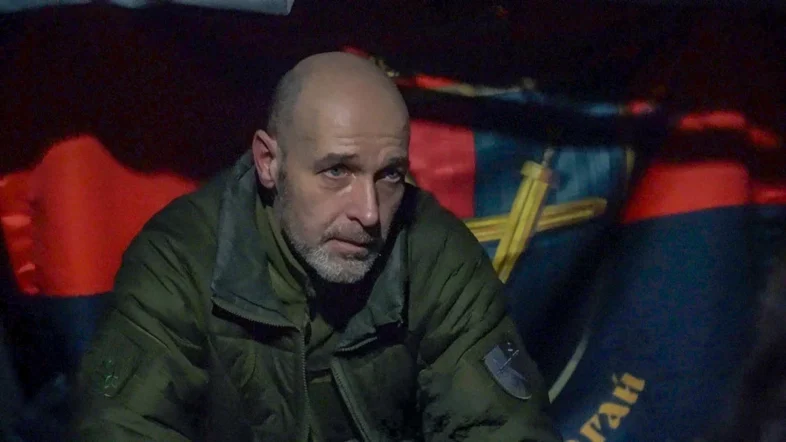
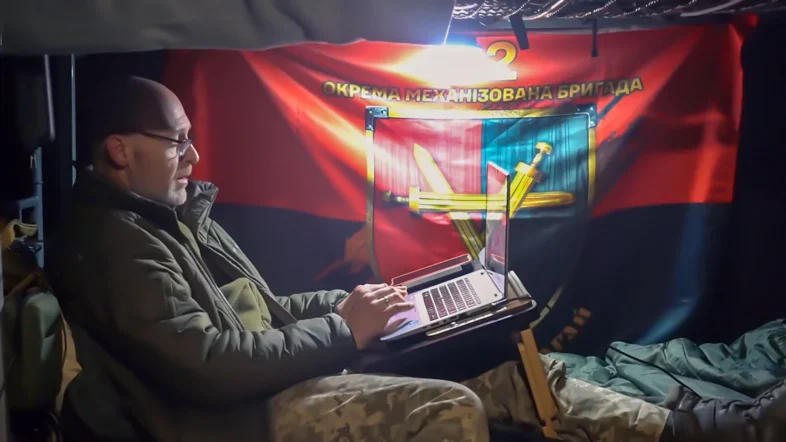
Inside the tent, space is tight — rows of bunk beds, the lingering smell of a potbelly stove, barely a trace of privacy. This is both the office and the sleeping quarters of Major Denys Lozynskyi, the deputy battalion commander for personnel psychological support. His 32nd Steel Brigade has been holding the line in the Pokrovsk sector for over a year. Nearby, at a training ground camp, new recruits of the 32nd Separate Mechanised Brigade go through their Basic General Military Training (BGMT), living in neighbouring tents under the same stripped-down conditions as their officers.
At 55, Denys is—in civilian life—a businessman, the owner of a telecommunications company in Kyiv. But there’s nothing of the desk officer about him. He is here, in the field, shoulder to shoulder with his men. Our conversation ranges from how civilians are turned into soldiers, to a captured Russian who learned nothing from his first time at war, and to why, in his view, this war is set to drag on.
— Denys, you had a successful business, a comfortable life. How did you end up here in this tent?
— After what happened near Kyiv in 2022, I couldn’t see myself as just a piece of meat — something you push around, force to its knees, and shoot in the back of the head. I’m a human being. I have dignity, and I have my country. I wasn’t going to let anyone tell me how to live or run my life. So I chose to resist. To fight.
On the very first day of the full-scale invasion, I went to the Territorial Recruitment Centre. I already had an officer’s rank and combat experience, so they put me in as deputy commander of a security company attached to the enlistment office. In that unit, there’s only one deputy position — for personnel psychological support. That’s where I ended up.
Now I’m in a combat brigade, but in the same role. Four years in — you can imagine the experience — and I know everything I need to know to do this job.
My job is all about the people. I look after everyone who comes into the battalion, including the newly mobilised recruits in our unit within the 32nd Brigade. Our goal is to get them ready. They go through what’s called Basic General Military Training (BGMT) here, and my role is to get them in the right mindset, keep them motivated, and support them along the way.
That’s the core of it. On top of that, I handle all the day-to-day and bureaucratic stuff — paperwork, pay, leave — for both the guys already serving and those still in training. Everyone comes to me. It’s a 24/7 job. There’s no clocking off. Sure, I might leave camp to take documents to headquarters, so I’m not always around. But my deputies are always on hand, and a lot of issues get handled by sergeants and unit commanders as well.
— Your job is all about people. How does a civilian, ripped from his home yesterday, become part of the military machine?
— In civilian life, you mostly work by motivating people — inspiring them. Here, you also have to be tough.
The window to get someone mentally ready for war is tiny. He’s still a civilian, hasn’t smelled gunpowder, has no combat experience. Just yesterday, he was at home, warm and safe: hot shower, his mother’s cooking, his wife nearby. Now he shows up here and, first and foremost, has to take responsibility for himself. If he’s not used to self-discipline — leaving a sock here, a boot there — when it comes time to get ready for training, it all falls apart. He doesn’t get ready in time, and he lets everyone down.
Then there’s the mindset — why we’re here, what our purpose is. Some people aren’t motivated; they don’t want to be here. Honestly, none of us really do, but we have to be. Some find the strength to push through, to stay and serve. Others just shut down. They sit there and say, “I shouldn’t be in the army.” For them, it feels like some cruel twist of fate. You have to work with people like that — show them why they ended up here, why this is their path, and find a way to reach each one individually.
Some of them are picked up off the street while trying to dodge service. They arrive with nothing — not even a toothbrush. You have to provide the basics: a towel, some personal items. Someone smokes but has no cigarettes — you make sure they get some.
Reveille is at 6 a.m., then a full day on the training ground, nonstop physical exertion. It’s a shock. My job is to help these yesterday’s civilians get into the rhythm. About 30% of them — even those who were, as they say, “rounded up” — clear that hurdle fast. They fall into line and serve just fine.
The setup here makes it clear this isn’t a prison. There are normal people around, a bathhouse to wash up and proper meals to eat. Once they see that, they start to relax and feel part of the group. The toughest stretch is always at the start — the first three, five, ten days.
The second group is made up of soldiers returning from combat. Sometimes they come back, as we say, completely “burnt out.” They’ve spent long stretches on the front line and need rest, proper food, and human contact. Sometimes they need specialist help. We have psychologists on hand, and if I see someone dealing with serious combat stress that I can’t manage through normal methods, I send them to the Combat Stress Control Group (CSCG). They take the soldier in, and the specialists work with him directly.
— And what if someone flat-out refuses? “I won’t do it, I don’t want to, I wasn’t made for war”?
— We tell them: you’re already in the army, you’re already here — there’s no turning back. We have to defend our homeland. It’s a tough conversation, because it usually turns into a debate about fairness: “Why me? Why isn’t Vasya [someone random – ed.] serving — he’s hiding — and I got caught, so I have to fight for him?”
We try to put it in perspective: “Life isn’t always fair. This is the hand you’ve been dealt. But a year from now, when you go on leave, you’ll be able to look people in the eye. You will have done your duty.” For many, that flips a switch inside.
If someone digs in their heels, though, the talk gets harder. There are legal tools: recording the refusal on video, internal investigations, the State Bureau of Investigation, even prison. It’s a criminal offence. But thankfully, cases like that are rare.
— You mentioned motivation. What’s driving the men who are joining the army today?
— It’s different for everyone. Guys from occupied territories are a whole other category. They’re furious — their motivation is to take back their homes. Sometimes you even have to hold them back so they don’t charge into an attack too early.
Then there are those who’ve lost family. Their pain turns into pure rage.
But most of the time… motivation grows here, in the brotherhood. When you realise you can’t let down the man sleeping in the bunk next to you, that’s when it clicks.
— Are there enough resources for psychological support?
— There’s never enough. People are the hardest thing to deal with. You can fix a vehicle — find the money, get a mechanic. People? They break in ways you can’t predict. A guy serves, everything seems fine — and then something clicks in his head, and he’s no longer himself. Figuring out why and helping him through it can be incredibly hard.
Add in the conditions we’re in: combat, losses. Brothers-in-arms dying. You have to figure out how to live with that. You were talking to a man yesterday, a day or two passes — and then you hear he’s “200” [military slang for ‘dead’ – ed.]. That hits hard.
— Has anything changed since the full-scale invasion began? Are soldiers dealing with different challenges now?
— There are fewer motivated guys these days. For me, as a psychological support officer, that means more work.
— What was your combat experience before 2022?
— Back in 2015–2016, I volunteered for the ATO. I served as a communications specialist near Chasiv Yar. The war then was different — calmer in some ways — but we were still fighting, still under shelling. What does a communications specialist do? You set up a field communications hub, head out to the front line to the guys, and you program radios. That was the work. Of course, moving around like that, you get caught up in all sorts of situations. Plenty of things happened — some you never forget.
— There’s a lot of talk about a ceasefire, about negotiations. What do the soldiers think?
— That really depends on the individual, but the general mood is clear — almost no one believes in it. We face the enemy face-to-face. Let me put it bluntly: there’s no trust in those people.
They’ll sign anything, and then they’ll be back. We have a story in our brigade that says it all. We captured a Russian soldier. He was exchanged. And some time later… we captured him again. We asked, “How is that possible? You swore you wouldn’t pick up a weapon again.” And he says, “Where else was I supposed to go? I’ve got no money. I signed a contract, and I came back to kill you again.” How do you negotiate with people like that?
— So when will the war end?
— I believe in only one thing: as long as Russia exists as the empire it is today, we’ll be at war. This isn’t a new fight — this war has been going on for 300 years. Russians built their history by stealing ours. They call themselves Rus’. And if an independent Ukraine exists, with its own real history, the Russian Empire loses its meaning. That’s why they’ll keep fighting us until they crumble into the Moscow, Ural, and Buryat republics.
Could that happen in five years? Twenty? A hundred? Maybe. But as long as they remain an empire, they won’t leave us alone. And we’ll keep fighting so we’re not erased.
— Every day you hear hundreds of problems, the pain and fears of others. How do you handle it yourself?
— Coffee, cigarettes. In the evenings, TV series — just to switch my brain off. Otherwise, you could go crazy. And, of course, talking to the people I love, those waiting for me at home. That’s my anchor. I’m here for them. So they can live in their own country, not someone else’s colony.