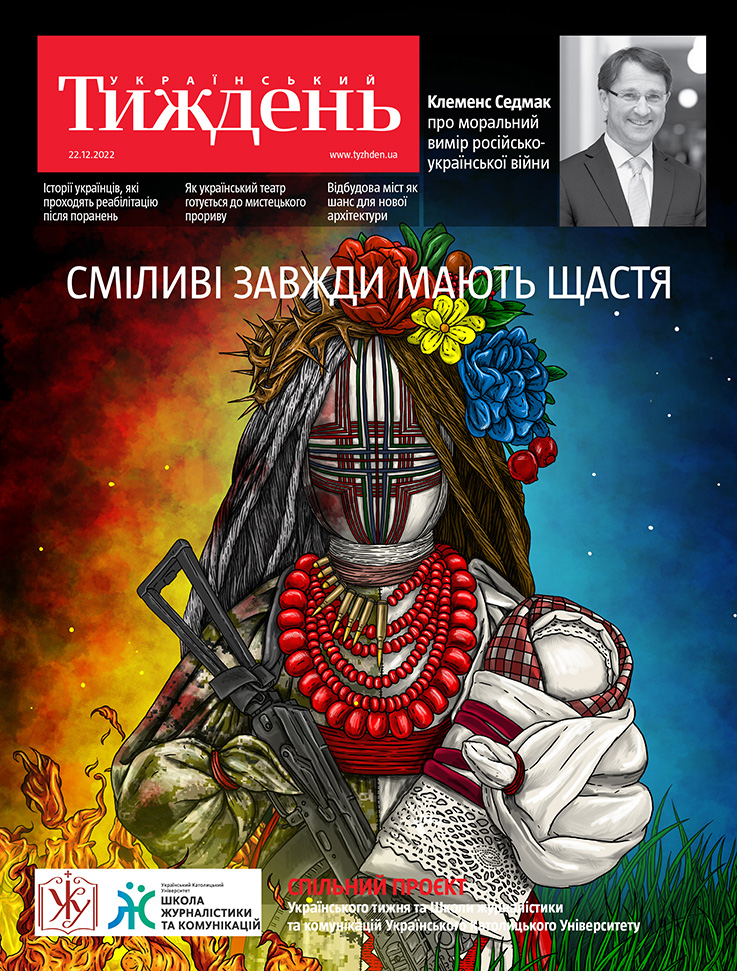
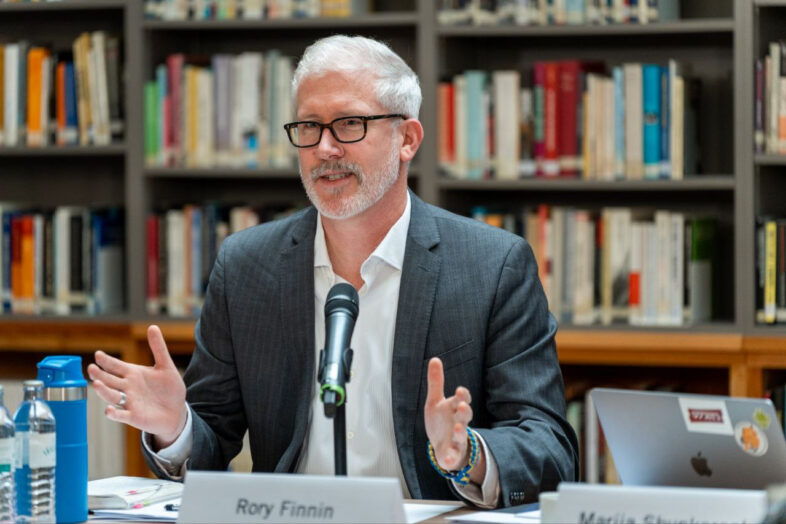
Rory Finnin, founder and Professor of Ukrainian Studies at the University of Cambridge, is one of the few foreign scholars who has mastered not only Ukrainian but also Crimean Tatar. For his debut book, Blood of Others: Stalin’s Crimean Atrocity and the Poetics of Solidarity (2022), he worked with sources in Ukrainian, Russian, Turkish, and Crimean Tatar. His interest in Crimea is no accident. “If you’re studying Ukraine, you have to recognise the unique historical significance of Crimea,” he tells The Ukrainian Week. We also spoke with him about the decolonisation of Russian studies abroad, why Crimea remains so poorly understood, and how culture shapes the future.
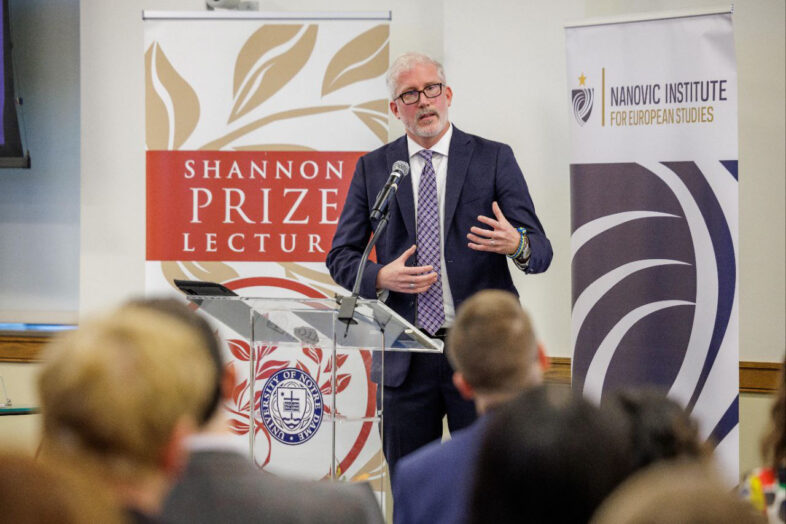
— I would like to start with a reference to your discussion with archbishop Borys Gudziak that took place at the University of Notre Dame (USA) at the beginning of March 2025. You were discussing many topics —hope among them — as well as the decolonization of Russian studies in the universities around the world. The University of Notre Dame recently decided to rename its Department of German and Russian Languages and Literatures as the the Department of German, Slavic and Eurasian Studies. How has the decolonization of Russian studies been progressing over the years?
— It has been progressing, but slowly. I think the advent of the full-scale invasion forced people to see the slow violence that has been penetrating Ukrainian life and particularly Western scholarship about Ukraine and Russia for a long time.
I find the concept of slow violence, a term coined by the scholar Rob Nixon, very helpful here. And if you apply the concept of slow violence to Western academic work, particularly with reference to the region often called ‘Eastern Europe’, you see that it has meant an epistemic suffocation of voices that are not Russian in this field. It has involved an intellectual laziness that has encouraged students to work and study in Russian, but not in Ukrainian, Belarusian, or Crimean Tatar.
With the full-scale Russian invasion of Ukraine, there was suddenly a mass confrontation with this slow violence. People had to face it — though slow violence is typically hard to perceive. There was a moment of clarity. Genuine efforts to amend for mistakes and to try something new were launched in universities around the world. While I do not want to disparage these efforts, they are still insufficient. We need to do so much more. We have to press for an engaged effort from different disciplines, university administrators, philosophers, politicians.
This effort cannot be limited to people who study Ukraine or Russia. It has to be global, which means that it requires strategy and a lot of time. The conference at the University of Notre Dame was very exciting because I could see there a very coherent and very strategic approach to this problem. Not only did they rename what had been the Department of German and Russian Languages and Literatures as the Department of German, Slavic and Eurasian Studies, but also they launched a Ukrainian Studies Hub. And they are very serious about it. They have deep connections with the Ukrainian Catholic University, which gives them a special understanding of Ukrainian academic life and the inspirations that are driving it. But beyond places like Notre Dame, I see insufficient progress. Sometimes I feel as though we’re settling back into old bad habits.
An unspoken problem is often financial. Many professors of Russian literature or history might agree with ‘decolonizing the field’, but they may not fully understand what that entails. There is a lack of consensus around the concept. If it means replacing posts in Russian history and literature with others, not simply increasing capacity in the teaching of the Ukrainian language, history, and culture, then such changes may seem a threat to them on a very basic institutional level. The issue is no longer intellectual; it is personal. This means we need to have difficult discussions. And we need to have them openly.
— Academia is generally slow to change. But the process we are talking about has been progressing for some years already. Has it been going quicker or still slowly?
— It is progressing at different rhythms. As I mentioned, it changed radically very quickly at the start of the full-scale war. But sometimes I have a sense of déjà vu. In 2014, I remembered a similar spike in attention, and then I witnessed a retraction of attention years afterwards. Everyone is pulled in different directions, but sustained progress requires constant focus.
— There are many discussions about Crimea in the context of potential peace negotiations. Military generals have emphasized why Crimea is important for peace in Ukraine and the broader region. As a scholar, could you elaborate on Crimea’s historical importance to the region and its connection to Ukraine?
— If I take a step back and think about this question, I think about how important Ukraine is generally. Ukraine is the most important space on the globe geopolitically. Everything hinges on its fate: legal order, sovereignty, human morality. And at the epicentre of all this is Crimea—a place that is deeply misunderstood.
The eye of the storm is typically marked by silence or stillness. Crimea is the eye of the storm in this sense. It is the ground zero, the linchpin of so much of this Russian aggression, and yet in the West you only rarely hear politicians and journalists speaking about it. This has been a longstanding problem in Ukraine too. Serhiy Plokhy and I were just speaking about this issue very recently for panel discussion at Harvard. Prof. Plokhy made this terrific point, that Crimean Tatars for Ukrainians are probably the least known of the neighbours or the others of Ukrainian history. Ukrainians tend to know more about Russians, Poles, Jews, but less so about the Crimean Tatars.
This knowledge gap is another consequence of slow violence, and it has affected Ukrainians over decades. Russian historiography and disinformation invited Ukrainians not only to see Crimean Tatars as an antagonist, but also to see Crimea as somehow ‘outside’ Ukraine. But when you examine documents about the 1954 transfer of Crimea from Soviet Russia to Soviet Ukraine, you see even the Politburo highlighting the fact that Crimea is a ‘natural extension of Ukraine’s southern steppe’, which is their precise wording. Centuries of history make clear that Ukraine is bound up with Crimea, and Crimea with Ukraine. It is a relationship of interconnection and symbiosis. Russia does not have that same kind of symbiotic relationship with Crimea. It has a relationship, obviously, by way of conquest.
— Your book Blood of Others: Stalin’s Crimean Atrocity and the Poetics of Solidarity is devoted to Crimea. Why did you decide to focus on Crimea in your book?
— My journey with the book was very personal. When I lived in Ukraine in the 1990s and visited Crimea for the first time, it was at the peak of the local separatist movement and pro-Russian mobilization, which later retreated after the establishment of Ukraine’s Constitution in 1996. Around this time I started reading poems in Ukrainian about the Crimean Tatars. When I went to Crimea, I naturally recalled these poems, met Crimean Tatars, and then discovered how much I did not know about their history and culture. I also realized that my friends back in the village in central Ukraine where I lived and taught were also ignorant about them. And if they did know anything, they tended to have stereotypes or very generalized ideas. They certainly knew little about the displacement of the Crimean Tatars over centuries, about Stalin’s brutal deportation in 1944. This blank spot bothered me. Later, when I embarked on a closer study of Ukraine, I encountered this blank spot across various fields of knowledge.
It is a troubling absence. For a scholar of Ukraine, you have to recognize Crimea’s unique historical importance. One could argue, for instance, that we would not have seen the rise of the Cossack Hetmanate without the alliance with the Crimean Tatars in the seventeenth century. My book tries to address this problem.
— In the Ukrainian Shelf podcast, where you appeared alongside journalist and researcher Elmaz Asan, Elmaz mentioned how, when she tried to ask people in Cambridge about their knowledge of Crimea, most responses focused on the Crimean War or Russian literature—such as Sevastopol Stories by Leo Tolstoy. Only one mentioned the Crimean Tatars. So, this imperial construction of Crimea as part of Russia is still very much present in the West. Also, when we talk about settler colonialism in relation to Crimea, I have only come across the term in your book and the work of Ukrainian researcher Martin-Oleksandr Kyslyi. How possible is it to decolonize knowledge about Crimea in the West? Besides your book and Kyslyi’s work, have there been other efforts to do so?
— There are more and more every day. Despite the horrors of the war, there is an exciting intellectual movement underway. Martin-Oleksandr Kyslyi is an outstanding historian and part of a larger group of scholars involved with a new organization called Ruta. They are trying to look at many issues of society, culture, politics outside of the Russian frame, through underrepresented voices and from fresh perspectives, using Ukraine as intellectual inspiration.
So much intellectual momentum is on their side. I feel that the traditional, conventional ways this region has been studied are increasingly being seen as useless. When I was writing my book Blood of Others, I was shocked by how infrequently the term settler colonialism was applied in our scholarship — even though the Kremlin’s actions in Crimea over centuries have been a clear, classic case of it. So what got in the way of our clarity and understanding? The answer has to do with Russian soft power and the way it revolves around different kinds of cultural and intellectual spectacle. The West has been distracted and seduced by this spectacle of Russian power. This is a human epistemological problem. I think we are finally addressing it and moving in a new direction.
In fact, I find it shocking how the very term settler colonialism – the practice of effacing, erasing, and replacing native populations – tends to be uncommon in our accounts of Ukraine’s history. There is a tragic refrain of Ukrainians and Ukraine’s indigenous peoples being displaced and dispossessed, but we rarely called these events by their name. And that meant that we failed to connect them to other cases of settler colonialism around the globe and then to make inroads into explaining, for instance, Ukraine’s connections with peoples of the so-called Global South, who tend not to see Russia as a brutal colonizing power. And I think that is where we are facing one of the most important intellectual challenges.
— In your opinion, how is Crimea important for boosting Ukraine’s relations with the so-called Global South countries?
— I think it is massively important. Crimea offers so many opportunities to present Ukraine differently to new communities in Africa and across Asia. The historical experience of the Sunni Muslim Crimean Tatars, for one, offers us a bridge to other faiths and cultures. It speaks to Crimea’s complexity, which in turn speaks to the complexity of Ukraine. I do not mean to instrumentalize Crimea, to use it as some sort of tool, but I think its deeper integration into our study helps us explain Ukraine to the world in new, more vivid ways. This is something that Omeliyan Pritsak, Ahatanhel Krymskyi, and so many others have said to us for a very long time. We just need to be open to their message. It can help us fight back against this slow violence of epistemic and academic suffocation.
— The legacy of both Omeliyan Pritsak and Ahatanhel Krymskyi is still somewhat of a blank spot, even for many Ukrainians. Do you think we, as Ukrainians, also need to invest more in studying and understanding it?
— I think such a blank spot is just another example of Russian soft power expanding influence, using concepts of sameness and difference as weapons. Catherine II, for instance, would declare peoples beyond imperial reach as “fraternal” or even “same”, then invade them — and then accuse those who fought back to be traitors to a motherland that they had never sought to join. This kind of conquest has intellectual costs over centuries, which shape perceptions of self and other, ally and enemy.
Now we should not romanticize the historical relationship between Crimean Tatars and Ukrainians. There have been a lot of mutual cases of violence and antagonism, whether it is Crimean Tatars raiding the Ukrainian lands for slaves in the 16th, 17th centuries or even Ukrainians participating in the dispossession and deportation of the Crimean Tatars, seizing their own property as well.
But there is also a deep narrative of solidarity and connection that we need to appreciate today. We see it in the sources. I remember, for instance, reading Krymskyi’s lyrical poetry for the first time. I recall being intrigued by his name. Then I read his epistolary correspondence with Lesya Ukrainka. At one point, he calls Lesya “a person of principle,” which is such a powerful way of describing what makes Lesya Ukrainka such a remarkable human being. One connection leads to another. In Lesya’s letters, you see her identify with Crimean Tatar culture and spar with her uncle Mykhailo Drahomanov about Crimea and the Crimean Tatars. Fate brings Mykhailo Kotsiubynsky to Crimea [Mykhailo Kotsiubynskyi worked in a Phylloxera Commission in Crimea, which was created by that time government to combat aphid insect that was destroying vineyards and while being there got inspired by the culture of Crimea Tatars — Ed], and Crimean Tatar culture and society help take his prose to new heights. So there is so much about the rise of modern Ukrainian culture that has roots and connections with Crimean Tatar culture. We need only open our eyes to it.
The moment we start to explore those connections, we begin to see truly compelling narratives — not only of anti-colonial resistance, but of solidarity across faiths, languages, and identities. We begin to see Ukraine clearly as a space of belonging that defies expectations. Whether you are ethnically Crimean Tatar, as Krymskyi thought, or ethnically Polish or Jewish, you can be Ukrainian. This civic conception of national identity helps drive contemporary Ukrainian society. And it is something the West has largely failed to understand for too long. The fact that so many Western politicians still refer to ethnicity or language as defining categories shows that we have a lot of work to do. They fail to see Ukraine as a political idea which is not necessarily based on language, ethnicity, or faith. Studying Crimean Tatar culture and history within the larger field of Ukrainian Studies offers such an important corrective.
— Transferring the concept of the “poetics of solidarity” from your book to today’s situation — Russia’s war against Ukraine, do you see that kind of solidarity emerging with Ukraine now?
— The book explores moments in which writers spread and distributed texts to readers in order to inspire them to stand up for certain ideas and principles. I was very privileged to speak at length with Mustafa Dzhemilev several times about how he would receive a poem by Borys Chichibabin and then circulate it widely, or how he would correspond with Vyacheslav Chornovil about a poem by Ivan Sokulskyi from what was then Dnipropetrovsk. These texts travelled around the world, moved readers, and created real impact. We do not see quite the same dynamic across borders today.
We could talk for a long time about Russian poets and their perspective about this war. They may oppose it, but do they acknowledge the deep-rooted history of chauvinism, imperial control, and conquest? I’m not sure. But the thing I do see is how culture keeps leading the way. I am always amazed when I go to Book Arsenal, for instance, when I witness how the cultural life of Ukraine, the curiosity, the sense of intellectual opportunity are so apparent there.
That is really what I wanted to focus on in the book — how culture actually shapes our future. We tend to concentrate on statecraft, on politicians, and on the latest headlines. But under the surface, deep in the cultural realm, there are texts, songs and paintings that are constantly moving the emotions of people. We may not always appreciate it, but the work of culture goes on. I believe that it will triumph.