There’s little left to say about 2000 Metres to Andriivka that hasn’t already been said: Mstyslav Chernov’s second Oscar nomination, the film ranking third on Letterboxd in September 2025, and praised by the Financial Times as “a film not to be missed.”
In Ukraine, more than ten thousand people have already seen the work of Ukrainian filmmakers Mstyslav Chernov and Alex Babenko, making it the country’s highest-grossing film of the year.
The Ukrainian Week spoke with Babenko about his journey in documentary filmmaking, how he first met Chernov, and the real people whose stories lie at the heart of 2000 Metres to Andriivka.
— How did you get into journalism?
— It all started during the Revolution of Dignity in Kharkiv. I saw journalists out in the field and felt an instant connection — it just clicked. Sofiia Bobok, who now photographs for Reuters and whose parents ran journalism courses for school students in Kharkiv, advised me to start with a strong foundation in the humanities before moving on to a master’s in journalism.
Back then, I had two main options: the Ukrainian Catholic University (UCU) or Mohylianka. UCU offered only a handful of programmes — no more than eight. In the humanities, it was basically history, sociology, or social pedagogy. I chose history, spent four years studying it, and then decided to continue at UCU, this time focusing on journalism.
— Did you want to be a war reporter from the start?
— No, never. And honestly, I still don’t. Back in 2013, when I was fifteen, I wasn’t conscious enough to even think about being involved in a real war. But in 2022, that changed. By then, I had graduated in journalism a year earlier, and since it’s the only field where I really have skills, I decided I could be useful by telling as many people as possible about Russian war crimes.
I speak good English, so I immediately started working with international media. But I still don’t think of myself as a war reporter — I’m a documentarian covering the war. I seriously doubt I’ll cover other wars once this one ends – if it even ends.
— So, when did you first start filming?
— In my fifth year at university, almost right after enrolling. I got my first job as a journalist at Brutal Football, writing and photographing match reports. That’s where I shot my first footage, though I mostly worked with video. My first real video project was for Radio Free Europe/Radio Liberty — we went to Henichesk during my fifth year, and that’s where I made my first video story, which later aired on Crimea.Realities.
— So, does 2000 Metres to Andriivka count as your first serious documentary project?
— I’d done some work on other documentaries, but only as a guest cameraman shooting a few scenes here and there. If we’re talking about a full, end-to-end project, then yes — this was my first proper experience.
— Watching the film, I kept wondering — you couldn’t have known what the soldiers’ body cameras would capture. How did you work with that footage?
— It wasn’t so much a decision to work with it as a decision to use it. Almost all the GoPro footage, apart from mine and Mstyslav’s 360-degree camera, was shot by soldiers from the 3rd Assault Brigade on their own. These were just their personal recordings, which we already knew about because they’d been posting similar videos on the brigade’s YouTube channel for years.
Mstyslav saw how valuable this material could be, and we managed to get the brigade’s permission to use it. They handed the files over, but as a cameraman, I wasn’t involved in editing. My role was to coordinate with the brigade and collect the footage. The decisions about what ended up in the final cut were made by Mstyslav and the film’s editor, Michelle Mizner.
— By the way, how did you start working with Mstyslav?
— It goes back to 3 March 2023, the last time I went to Bakhmut. That day, during an artillery strike, I lost my car. I was working with my French colleague, Samuel Gratacap, and our vehicle got stuck in the mud — right at the entrance to Bakhmut — just as Russian artillery began targeting the area.
The soldiers of the 93rd Brigade saved our lives, theirs included. Initially, they were trying to repair a crossing so they could continue their mission, but a Russian drone spotted us, and the artillery started firing directly at our position. There was another vehicle with us — an L200 pickup — and I think there were nine or eleven people packed into the back. Together with the soldiers, we managed to get out of danger and were driven to Chasiv Yar, where we ended up without transport. We were just walking down a street when we bumped into Yevhen Maloletka, Vasylisa Stepanenko, and Mstyslav. That’s how I met him for the first time.
After that, we didn’t see each other for a while. We crossed paths again on 1 June 2023 in Kyiv, on International Children’s Day, when the city was shelled by Russia. That day, the security guard didn’t manage to open the shelter in time — three people were killed, including a nine-year-old child, and sixteen others were injured. By then, I had already started publishing with the Associated Press as a stringer — a freelance journalist. I was mostly doing photography at the time, and I told Mstyslav that day that I’d be very keen to learn from him and work together if the chance came up.
A few months later, he suggested a joint trip. By that point, I had already spent two months covering the 3rd Assault Brigade, working directly with the 2nd Mechanised Battalion — the soldiers who would later become the protagonists of the film. I decided to share their story with Mstyslav, introducing him to Herych, one of the soldiers who had helped us with logistics. From there, we essentially started working on the material together.
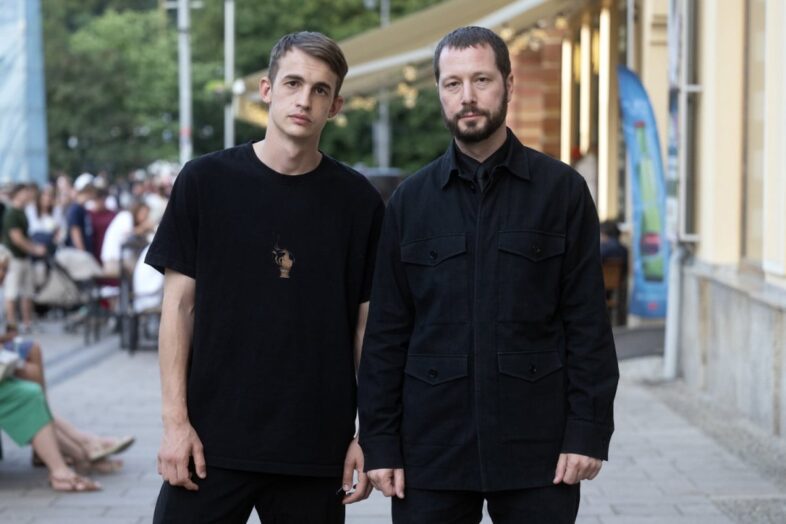
Photo: Film Servis Festival Karlovy Vary
— Mstyslav once said he wanted viewers to leave the cinema not in tears, but angry at what the Russians have done. What reaction would you hope for?
— Honestly, I wouldn’t give a different answer. For me, what matters is that people understand — that they see this film as a way to get as close as possible to the experience of Ukrainian soldiers. What we show in the film is the war as it was two years ago. Today, it’s even more dangerous. I’d really like people not to retreat into grief or sadness, not to try to shield themselves from what they’ve seen, but to be ready to engage with this reality.
— When you spend so much time at the front, how do you switch off or find balance when you return to civilian life?
— That’s a tough question, and honestly, I’m still figuring it out. Taking breaks is crucial — the longer you stay in a combat zone, the more your sense of danger blurs. Mentally, it’s challenging. For me, it’s actually easier to be at the front, where the world and people’s motivations make more sense to me than back in the rear. And a lot of soldiers feel the same way.
It feels like many people are living their own lives now, and the sense of unity we had in 2022 isn’t the same. There’s a distance between what’s happening at the front and how life goes on behind the lines. I really want to help bridge that gap through art and journalism.
— Let’s talk about the film. In one of his interviews, Mstyslav mentioned the importance of dramaturgy in shaping a documentary that really sticks with the viewer. How did you approach structuring it?
— In documentary filmmaking, the process usually comes in stages: you shoot first, then write the script, and only after that do you move into editing. Once the material is collected, the director, screenwriter, and editor work together to shape it into a narrative that engages the audience.
In my role behind the camera, we didn’t interfere with that process at all. The most we did was talk with the soldiers. And if there’s an opportunity to build a narrative from what we’ve filmed, I think it’s worth doing — but that only happens after shooting is done. Documentaries generally draw fewer viewers than feature films, which is why I believe every documentary should be treated with a strong sense of dramaturgy from the start.
— How did you plan your filming so you wouldn’t get in the soldiers’ way or put anyone at extra risk? Did you have a kind of on-site “choreography”?
— At that time, the counteroffensive was in full swing, and the 3rd Assault Brigade had already liberated large stretches of territory before Mstyslav and I began working. I’d been observing their operations all summer, so it was really more about access and the trust they placed in you, letting you do your job.
It was improtant not to get in the soldiers’ way. Even before reaching Andriivka, we filmed medics on duty and in command posts. The risk was lower there, but the soldiers were fully focused on keeping their teams safe under constant drone surveillance. Our job was to capture as much as we could without getting in the way or interfering.
Things moved fast, and we tried simply to capture as much as we could. After the death of “Gagarin,” we went to his funeral on 14 September, and by the 16th, we were already in Andriivka.
Later, when Mstyslav was working on the editing, more concrete and focused ideas began to take shape, but there was never a predefined plan for exactly what we needed to capture. We simply followed the heroes as events unfolded and time allowed. For example, I visited Fedia and his unit many times, filming them during their day-to-day activities. Some of that footage made it into the final cut of the film, while other scenes didn’t.
So I can’t really say it was about choreographing movements or planning every shot. It was much more about staying in constant contact with the soldiers, being there for the moments that mattered, and making sure we didn’t miss anything important.
— You mentioned “Gagarin’s” death. When you lose someone you’ve worked closely with, how do you find the strength to keep filming? Can you even separate the professional from the personal in war?
— When someone dies, they’re gone. And if you’re attached to them, if you care about them, of course, you feel that loss. It doesn’t matter whether you met them in life or only knew them through filming. Human relationships stay human, no matter whether there’s a camera between you.
Five or six months after Gagarin’s death, “Freak” went missing, and “Sheva” and “Kobzar” were killed. It was brutal — learning week after week that someone I knew, someone I had filmed, someone I had shared foxholes with, was gone. In those moments, sitting together in a trench, you’re constantly thinking about each other.
I need to know, for instance, where Mstyslav keeps his tourniquet so I can help right away if he’s hurt. You’re always tuned in to the people around you, learning to build trust fast so that, when it really matters, you can react and communicate without hesitation.
Working on 2000 Metres to Andriivka was a completely different experience. I stayed in long-term contact with the people I was filming, meeting them repeatedly and visiting them when they were back in the rear.
I filmed an interview with a soldier with the call sign “Kobzar” just a week or two before he was killed, and we were still messaging only days before his death — I’d been sending him video. Losing people like that is devastating, and for me it doesn’t matter whether they’re a character in the film or someone I knew personally — the loss hits just as hard.
— Some films resonate more with domestic or international audiences, but 2000 Metres to Andriivka seems to work on both. Do you agree?
— For many viewers abroad, seeing the war presented this way is completely new. Ukrainian audiences are more or less familiar with GoPro footage — from the 3rd Assault Brigade’s YouTube channel, other brigades, or just clips circulating on social media. But for Western viewers, it’s often the first time they see a war captured like this.
I’ve noticed that for Ukrainian audiences, the soldiers’ experience we show feels immediate and relatable. In the West, that connection isn’t there — it’s not their country, not their war, even if they can empathise. And not everyone outside Ukraine realises that most Ukrainian soldiers are volunteers. In the film, everyone except “Sheva” is under 25. These are people who went to war entirely by choice. At the international premieres I attended, I saw audiences visibly shocked and coming away with a deeper understanding of what the Russian-Ukrainian war really is.
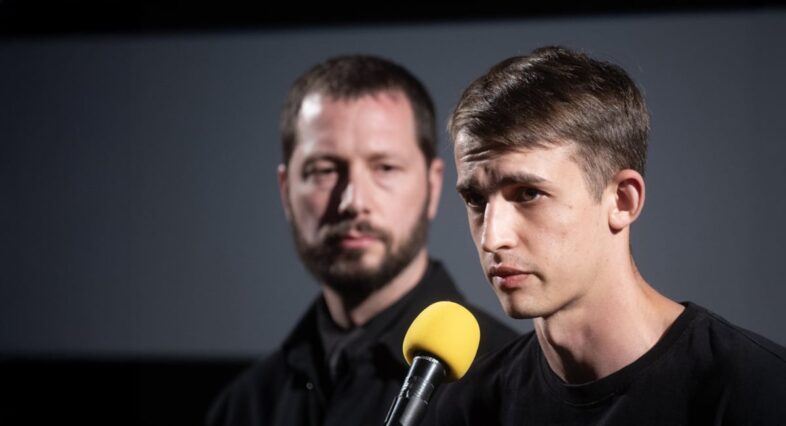
Photo: Film Servis Festival Karlovy Vary
— By the way, which international premiere made the biggest impression on you?
— Probably Sundance. It was incredible to see a film we’d poured so much work into on the big screen.
I remember a comment from a speaker during one of the panel discussions. Speaking with Mstyslav, she said, “Before, I couldn’t comprehend that war is really like this.” I heard similar thoughts many times afterwards, expressed in different ways.
On one hand, it was invaluable that the film could bring the soldiers’ experience closer to the audience. Even people who had been following the Russian-Ukrainian war gained a new understanding of its complexity, seeing it through the eyes of the Ukrainian infantry.
On the other hand, the war of 2023 is very different from the war of 2025. Our challenge now is to show it as it is today. I can hardly imagine anyone getting as close to Russian forces as we did back then — we managed it because there weren’t nearly as many drones at the time. Now, that would be virtually impossible. But our mission remains the same. When I first started this work, I thought it was crucial to show the war as close-up as possible. In Kramatorsk, just 16 km from the front line, businesses are open, public transport runs, and people live, more or less, normal lives. But only 5–10 km further, everything changes completely.
For me, filming the war up close is about showing what life is really like for the people most affected. And now that’s become a huge challenge — drones, drones, drones. The grey zone is expanding. We’re constantly looking for ways to capture it, to document the reality as fully as we can.
— From time to time, I hear people say it’s too soon to make a feature film about the Russian-Ukrainian war while it’s still happening. What do you think?
— I think it really depends on whether the filmmaker feels they have something to say. Personally, I don’t — at least, not yet. I don’t want to spend my time on feature films while a full-scale war is ongoing.
Right now, the priority is documenting and gathering stories. The time for artistic interpretation will come after the war. But if someone spots a story and has the drive to tell it now, that’s completely valid.
— I don’t like asking this, but I have to: how do we get the truth about the war out there while Russia is being welcomed back at film festivals?
— Russian propaganda has been carefully and successfully built over decades. It started in the Soviet Union and has continued actively since 2014. There are even studies on Russian interference in elections in places like Moldova, with clear evidence. Dealing with that is complicated, and it’s not my job to dwell on it.
My job is to make my projects as strong and truthful as possible, to stick to journalistic standards, and to reach as many viewers as I can. That’s all we can do. I think time will put everything in perspective. 2000 Metres to Andriivka is still finding its way, but from what I’ve seen, it’s getting noticed in a way Russian war films rarely are — take 20 Days in Mariupol, for example, which really connected with international audiences. This year alone, Ukraine has released over 15 documentaries, with premieres in Karlovy Vary and Copenhagen. I wouldn’t say our documentary scene is booming, but it’s growing, and that matters. All we can do is keep telling these stories, building Ukrainian culture, and showing it to the world however we can.
Russian propaganda is a much bigger, tougher problem. My focus is on doing our work as well as possible, rather than worrying about what obstacles Russia might put in our way.