Ukrainian-Polish relations have never been straightforward, not least because of the two countries’ competing historical narratives. But in the first year of Russia’s full-scale invasion, as Poles opened their homes to Ukrainians fleeing the war and the two countries’ leaders spoke of one another as close allies, it briefly seemed those old disputes had been pushed aside. History no longer appeared to stand in the way of a close partnership.
That optimism has since faded. The tensions that have surfaced in recent months suggest that even a shared sense of existential threat is not enough to keep old disputes from returning. This time, however, the fallout has spread well beyond politics. It has seeped into everyday life, shaping relations between Poles and the more than one million Ukrainians now living in Poland.
Is this the deepest crisis in Ukrainian-Polish relations in years? How have four years of living side by side reshaped the way Poles and Ukrainians see each other? And why do Ukrainians in Poland remain, in many ways, an “invisible minority”?
The Ukrainian Week spoke with Piotr Pogorzelski, deputy director of Polish Radio for Foreign Audiences and host of the podcast Po prostu Wschód (“Simply East”), about the state of Polish-Ukrainian relations, the narratives driving public opinion on both sides of the border, and why everyday contact has done less to bridge the divide than many had hoped.
— You’ve been covering Ukraine for years, and this is far from the first downturn in Polish-Ukrainian relations. Is this the most serious one you’ve seen? Or does it partly reflect the times we live in — with social media, Russian disinformation and political polarisation amplifying the sense of confrontation?
—I can’t remember relations between Poland and Ukraine ever being this tense. We’ve had crises before, but they mostly played out at the political level. This time, the tensions have spilled into everyday life.
More than one million Ukrainians now live in Poland, so this is no longer just about what politicians say. Whether in a small town or a big city, almost every Pole now comes across Ukrainians in everyday life — at work, in shops, in cafés and restaurants.
— One might have expected those personal contacts to soften attitudes, at least to some extent. If the tensions have shifted from politics into society at large, does that mean even direct personal relationships no longer make much difference?
— I think the polling speaks for itself: attitudes towards Ukrainians are getting worse. So, unfortunately, all those everyday interactions don’t seem to be changing people’s minds as much as we might expect.
I do have one theory, though. I can’t prove it, and I don’t know whether anyone has actually studied this, but it seems to me that many Poles make a distinction between the Ukrainian they know and Ukrainians as a group. They might genuinely like Sasha from work, get on well with their Ukrainian neighbour or chat with the woman at the local shop, but that doesn’t necessarily change the broader image they have of Ukrainians. It’s almost as if those are two separate categories in people’s minds.
Because if people’s day-to-day experiences really matched what the polls are telling us — earlier this year, only 28 percent of respondents said they viewed Ukrainians positively, while 43 percent said they viewed them negatively — then everyday life would be far more tense than it actually is.
There’s another thing I’ve been wondering about. It may even be that, if those Ukrainians weren’t here at all, attitudes would be worse still. But that’s just my intuition. I haven’t seen any research that really looks at that question.
One study I found particularly interesting was conducted by the Mieroszewski Centre. It used the Bogardus social distance scale to measure how Poles feel about Ukrainians, asking respondents whether they would object to having a Ukrainian as a neighbour, a colleague or even a member of their family. The results suggested a surprisingly low level of social distance. In other words, a significant number of Poles said they would have no problem with, say, a Ukrainian marrying into their family.
But I think those answers reflect how people feel about the Ukrainians they know personally, rather than about the more abstract, stereotypical image of ‘Ukrainians’ as a group. Of course, it’s also important to remember that this research was conducted before the sharp deterioration in attitudes we’ve seen over the past year.
— The Mieroszewski Centre’s 2025 survey also points to an interesting discrepancy. Nineteen percent of Poles said they had no personal contact with Ukrainians, yet only 10 percent said they were unsure how they felt about them. That would seem to leave around 9 percent whose views are shaped not by direct experience, but by the media, political rhetoric or social media.
— Yes, that fits with what I’m saying. There seems to be this abstract image of “Ukrainians” that some people view negatively, while at the same time they genuinely like the Ukrainian they work with every day. Those two things can exist side by side. Of course, there are also people who simply have no personal contact with Ukrainians at all. I should add, though, that I’m looking at this from the perspective of Warsaw. In a small town, the picture may well be different.
There’s another interesting point, too. Ukrainians are now living everywhere in Poland, but that doesn’t necessarily mean Poles and Ukrainians have meaningful relationships. Even when they interact, those contacts are often quite superficial. A recent qualitative study by Krytyka Polityczna, We Are Not at Home Here, based on interviews with 25 Ukrainians living in Poland, found exactly that. Even people who have lived in Poland for years often said they had very few close relationships with Poles and had never really formed lasting friendships.
So, in a way, Ukrainians in Poland have become an invisible minority. You hear Ukrainian on the bus, in cafés or restaurants — they’re clearly part of everyday life. But that doesn’t necessarily translate into closer relationships. Poles and Ukrainians often live alongside each other rather than with each other.
That’s the paradox. Earlier studies showed that Poles generally want foreigners living in the country to work, obey the law, pay taxes and have legal status. And, by and large, Ukrainians tick all of those boxes. So I don’t think that’s where the problem lies. In my view, it’s the political and historical narratives that shape perceptions. Mistakes have been made on both sides — yours and ours — and they have had the biggest impact on how Ukrainians are viewed.
What’s striking is that Ukrainians in Poland have never carried the kind of negative stereotype that Poles once faced in countries like the United Kingdom.
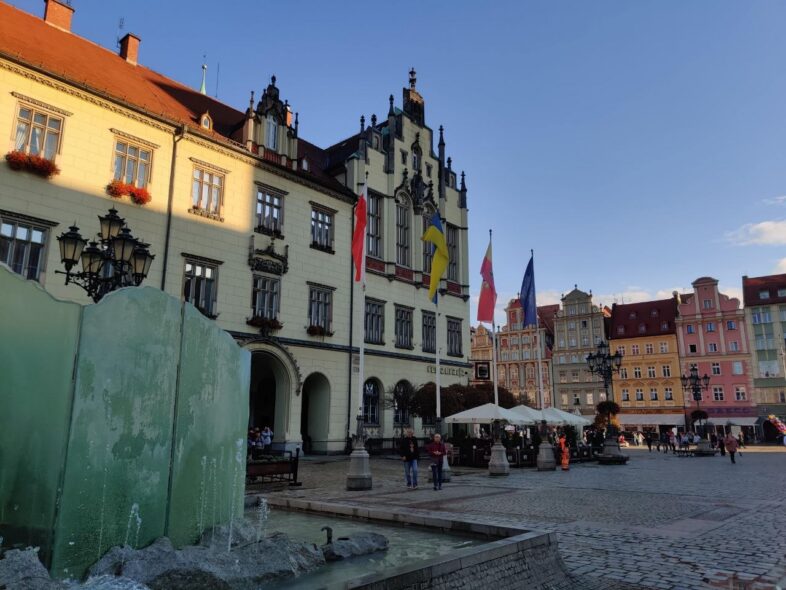
Wrocław, June 2022. Photo: Olha Vorozhbyt
For example, we don’t have Ukrainian jokes in Poland in the way that there are Polish jokes in the United States or the United Kingdom. Nor do we have derogatory expressions like Polnische Wirtschaft in Germany. That phrase goes back many years, and attitudes have changed since then, but it was once used to mock the supposedly poor quality of Polish work. The same goes for jokes like: “Go on holiday to Poland — your car is already there,” implying that Poles stole cars. Or another one: “A Pole is driving a car. Who’s behind the wheel? A German police officer.”
There is no equivalent of that when it comes to Ukrainians in Poland. The negative attitudes we see today are rooted much more in history and politics than in cultural stereotypes or everyday prejudice.
I’d add one more factor, although I haven’t seen it reflected in any research — it’s simply something I’ve noticed. Ukrainians working in Poland, for example, in Polish households, sometimes end up reinforcing the image of Ukraine as a poor and deeply corrupt country. I understand why they do it. In a way, it’s a way of justifying their decision to move to Poland. But I don’t think people always realise how much that can shape the way Poles see Ukraine as a whole.
— Are there any communities in Poland where attitudes towards Ukrainians are more positive than in others?
— In theory, people always say attitudes are better in bigger cities because people there are more used to living alongside foreigners. But I can’t point to any particular place where that’s clearly the case.
I was discussing this recently with researcher Olena Babakova on my podcast, Po prostu Wschód (“Simply East”). She made a point that really stuck with me. In 2022, many Poles suddenly encountered a very different image of Ukrainians. They weren’t just people coming to Poland for low-paid work. Many had good jobs, belonged to Ukraine’s middle class and, in some cases, earned as much as — or even more than — the Poles around them. In a way, it shattered a long-held stereotype.
I’m not sure everyone has come to terms with that. For years, many Poles saw Ukrainians as a kind of “younger brother” — someone Poland should guide, advise and help on the path to the EU and NATO. Then, all of a sudden, someone turns up in a Mercedes, earns as much as you do — or more — and lives much the same lifestyle. I don’t know whether everyone in Poland has accepted that. For some people, I suspect, it has become a source of frustration.
Another thing that I think matters is just how visible Ukrainians have become in Poland. The way they spend their free time — going for walks, having picnics, sitting in cafés and restaurants — is sometimes a little different from how many Poles do it. And, of course, if you’re speaking a different language, people notice you.
A friend of mine once said that, without young Ukrainians, Warsaw would feel like a dead city. Walk along the Vistula Boulevards or through the city centre — Nowy Świat or Krakowskie Przedmieście — and much of the energy comes from young people from Ukraine and Belarus, many of whom speak Russian. That makes this community even more visible.
And these aren’t people who simply need help. They’re working, earning money and spending it. In doing so, they challenge the traditional idea of what a minority is supposed to be: quietly working in the background, perhaps studying at university, but otherwise staying largely out of sight. Instead, they’re out in the city, living their lives much like everyone else.
It’s also worth remembering that, for decades, Poland was a largely mono-ethnic country. The minorities that did exist — whether Belarusian or Ukrainian — were generally well integrated and didn’t strongly emphasise identities distinct from the Polish mainstream. Then, almost overnight, more than a million Ukrainians arrived. For many Poles, that was a genuine shock. A country that had been overwhelmingly Polish-speaking suddenly became multilingual.
— It seems to me that, in Ukraine, we do not fully appreciate how deeply the issue of Volhynia is felt as a trauma by many Poles. At the same time, despite our geographical proximity, many Poles do not fully understand Ukraine either — from the realities of everyday life during the war to the country’s history, or why many Ukrainians today look to the UPA as a source of inspiration and resilience in their current struggle. For many Ukrainians, the UPA is first and foremost associated with resistance against the Soviet Union and a totalitarian regime. Would you agree?
— Whenever the UPA is mentioned in Poland — on television, in newspapers or online — the story is almost always told the same way. People hear that the UPA was responsible for the killing of 100,000 Poles in Volhynia and Eastern Galicia. Sometimes, right at the end, there’s a single sentence noting that Ukrainians also remember the UPA as a force that fought against the Soviet Union.
To me, that’s the heart of the problem. Poland and Ukraine are talking about the same organisation, but through completely different historical lenses. In Ukraine, the focus is on the fight against the Soviet Union, while Volhynia is often missing from the conversation. In Poland, it’s the opposite. The conversation begins and ends with Volhynia, while the Soviet context is largely absent.
I’ve even thought that, if Volodymyr Zelenskyy wanted to ease some of the controversy surrounding the UPA Heroes Special Operations Forces Centre, he could simply add the words “who fought against the Soviet Union”. I think something as simple as that could help move the conversation forward — at least from the Polish perspective.
So yes, there is a certain asymmetry. But it’s not just about the different ways the UPA is remembered. History simply plays a much bigger role in Polish public life than it does in Ukraine. It always has. Historical issues regularly find their way into political debates. For years, the Law and Justice party (PiS), for example, tried to mobilise anti-German sentiment. I don’t think it was particularly effective, but it clearly resonated with part of the electorate. Today, we’re seeing something similar with anti-Ukrainian sentiment.
I think much of that, again, is rooted in history. At the same time, neither side is particularly sensitive to the other’s historical memory.
Our politicians often use history as a political tool. But history itself has genuinely mattered to Poles for decades. Volhynia, for example, was a taboo subject throughout the communist era. During the Polish People’s Republic, it simply wasn’t something people were allowed to talk about. In much the same way, the UPA was also a taboo subject in Soviet Ukraine.
At the same time, I think Zelenskyy and those around him also approach history in a largely instrumental way. It’s not really part of his family’s story. I don’t think you could say that the memory of the UPA was something cultivated in the Zelenskyy family.
— What about coverage of the war itself and what everyday life is really like for Ukrainians?
— When it comes to reporting on Russian strikes against Kyiv and other Ukrainian cities, algorithms obviously play a role, especially if someone gets most of their news from social media. But if you’re talking about television news, the war is still covered every day.
Although the way it’s presented can sometimes be quite revealing. A few days ago, I was watching the evening news. The first story was about the Polish-Ukrainian crisis. Then came a domestic Polish story. Only after that did they move on to Russian strikes on Ukrainian cities.
So the two topics were very deliberately kept apart. But the war is still a constant presence in Polish news. It’s not as if people have forgotten about it. Of course, it no longer leads the television or radio bulletins, but the truth is it hasn’t been the top story for several years now.
— Do you remember whether the Volhynia tragedy was ever discussed at school when you were a student?
— I honestly don’t remember whether it was mentioned at school. But when I was growing up in the 1980s, Volhynia was a taboo subject. People talked about it, if at all, only privately — around the kitchen table, among family or close friends.
At the same time, during the communist period, there were plenty of books and popular films about the fight against the so-called Ukrainian gangs in the Bieszczady Mountains (a mountainous region on the border between Poland, Slovakia and Ukraine — ed.). Historian Grzegorz Motyka writes about this in a recent conversation with journalist and historian Andrzej Brzeziecki in their new book, Games of Memory: On Historical Policy, Poland, Ukraine and Russia.
Their argument is that this narrative, in a way, filled the gap left by the silence around Volhynia. While Volhynia itself remained off limits, there was no shortage of stories about fighting “Ukrainian gangs” in the Bieszczady region.
That narrative also served another purpose. It helped justify Operation Vistula and fit neatly into the broader idea of Polish-Soviet friendship, since the Soviet Union also portrayed itself as fighting “UPA gangs” in the Carpathians.
— In a recent interview with Onet.pl, Paweł Kowal, chair of the Polish parliament’s Foreign Affairs Committee, quoted the UN secretary-general as saying that history is the hardest issue for close nations to deal with, while the future is the easiest. Yet Polish politicians continue to say that “Ukraine with Bandera will not enter the EU”, suggesting that the past is being used to block the future. Or is it more complicated than that?
— It depends on what you mean by “the future.” If you’re looking at it through the eyes of Polish politicians, the future ends sometime next autumn, when parliamentary elections are due. That’s the horizon they’re working towards.
I’m starting to wonder whether anyone in Polish politics still thinks in terms of bigger ideas — the kind of vision Jerzy Giedroyc championed (a prominent Polish publicist and one of the architects of Polish-Ukrainian reconciliation, who advocated a strategic partnership between Poland and independent Ukraine, Belarus and Lithuania — ed.). Or whether anyone is thinking beyond the next election at all.
Sometimes I even wonder whether they’re thinking in economic terms anymore. Because so much of the hostility towards Ukraine today seems to be driven by one thing: winning votes.
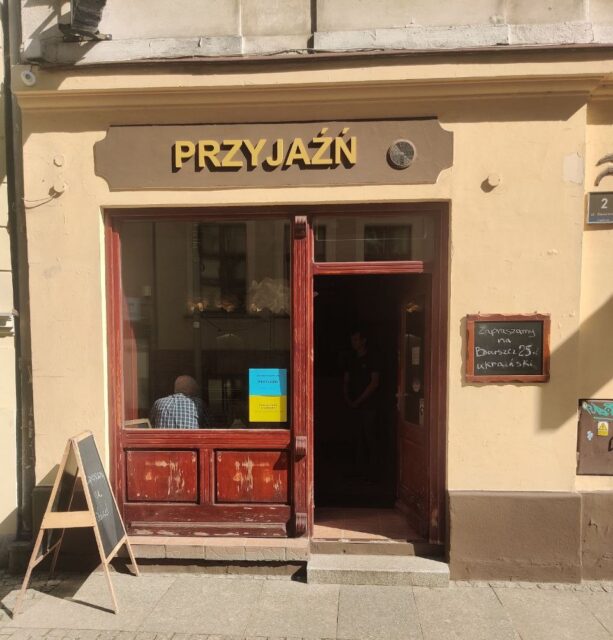
Poznań, June 2022. Photo: Olha Vorozhbyt
To be fair, though, it’s worth pointing out that when Przemysław Czarnek — Law and Justice’s candidate for prime minister if the party wins next year’s election — called for military aid to Ukraine to be suspended over historical issues, the backlash came not only from his opponents but from within his own party. Even Jarosław Kaczyński, the party’s leader (Ed.), distanced himself from the remarks, because they echoed Kremlin narratives. And, despite everything, the overwhelming majority of Poland’s political class remains firmly anti-Russian.
Business sees things very differently. For companies — especially those that see investment opportunities in Ukraine and across the European Union — closer cooperation simply makes sense. But politicians, in my view, are thinking almost exclusively about elections.
At the same time, I don’t quite know what to make of Ukrainska Pravda’s recent reporting about Zaluzhnyi and Zelenskyy, and the suggestion that the authorities in Kyiv are considering elections this autumn rather than next year. It makes me wonder whether Zelenskyy, too, feels he can’t afford to take a step back in relations with Poland because it would make him look weak.
The Ukrainian issue has become a political tool for Poland’s right. But it’s not only the right. Last year, Rafał Trzaskowski (the mayor of Warsaw and then a presidential candidate — Ed.) also tried to appeal to anti-Ukrainian sentiment. For example, he argued that Ukrainians should no longer receive the “800+” child benefit. In the end, though, it made no difference. Right-wing voters don’t trust him anyway. Whatever he does, they’ll always see him as an outsider.
And then you have all these populist gestures. Take the case of the Ukrainian man who was deported after catching a catfish in a lake in Warsaw. Just a few weeks later, there was a very similar incident involving a drunk Polish man fishing in a lake at a historic site in Dresden. He was fined, but nobody talked about deportation. In any case, that would have been meaningless — he could simply have crossed back into Germany, since there is effectively no border between the two countries.
Or take the Ukrainian blogger who drove his car to Morskie Oko, the mountain lake in the Tatra National Park. He was banned from entering Poland for five years. Yet an Australian tourist who committed a very similar offence received only a three-month driving ban in Poland.
To me, it looks as though Poland’s government is trying to outbid the right on populism. We don’t seem to have politicians who stick consistently to their principles in the way, for example, Romania’s President Nicușor Dan does. Here, it often feels as though the political direction changes with whichever way the wind is blowing.
To sum it up, the Polish Sejm declared 2026 the Year of Jerzy Giedroyc and Juliusz Mieroszewski. Both believed that an independent Ukraine, Belarus and Lithuania were in Poland’s strategic interest, and that Poland should support those countries once they gained their independence. And yet, ironically, it feels as though we may end up using this very year to bury that legacy. Because I simply don’t see many politicians in Poland today who are thinking in terms of bigger ideas.
— Does Giedroyc’s legacy still matter in Poland today?
— Well, no, first of all, we should avoid broad generalisations like “all Poles”, “Poland”, “all Ukrainians” or “Ukraine”. There isn’t a single Polish view on this. Different political camps see it differently.
That said, I do think the populist approach I mentioned earlier has become dominant across much of Poland’s political establishment. The argument now is that there’s no longer any reason to keep supporting Ukraine, Belarus or Lithuania — that Poland should simply look after its own interests, full stop. With anti-Ukrainian sentiment running high, some politicians no longer see much political value in backing Ukraine — whether through public support or by advocating for its accession to the European Union.
But there is still another camp. Many intellectuals continue to argue that this support remains essential. The real question is how much influence they still have over those in power.
A good example is a recent article by Zbigniew Parafianowicz in Wirtualna Polska. His argument is that Ukraine is now an independent state, Ukrainians have consolidated their statehood, and that, in a sense, Giedroyc’s doctrine has already accomplished its mission. That, he says, was its original purpose.
But I think that’s the wrong conclusion. Ukraine still needs support. And sweeping arguments that there’s no point supporting the country because the authorities are unwilling to tackle corruption overlook a large part of Ukrainian society that wants something very different — a country that looks more like the West than Russia.
Those aspirations are worth supporting, regardless. That’s why I think it’s far too early to write off Giedroyc’s doctrine.
— As of November 2026, more than 280,000 Ukrainian schoolchildren and university students were studying in Poland. Could they become a bridge between the two countries in the future? Or do reports of bullying in Polish schools — particularly involving Ukrainian children — make that unlikely?
— For example, I haven’t seen anything like that at my daughter’s school. They recently had a big school celebration where Ukrainian children sang a song in Ukrainian. It all felt completely natural, and I haven’t heard of any bullying there. But that doesn’t mean it isn’t happening elsewhere. Of course it is.
And it’s not just schools. There was recently a case in Bielsko-Biała where Ukrainian girls were harassed (referring to an incident involving Ukrainian teenagers on public transport in Bielsko-Biała that received widespread attention — Ed.). Children who experience things like that will remember them. If they return to Ukraine one day after being treated badly in Poland, those experiences will stay with them into adulthood. But the opposite is true as well. If they were treated with kindness, they’ll remember that too.
Age matters as well. Think about teenagers between 14 and 18. Those are formative years — when people build close friendships, fall in love for the first time and form memories that stay with them for life. That’s why I think Poland has every reason to make sure Ukrainian children and teenagers feel welcome here, especially because they’re growing up studying history from Polish textbooks — in other words, through the Polish perspective on history.
I’m not saying that this perspective is propaganda — Poland is not Russia, after all. But it is still the Polish interpretation of history. So, from Warsaw’s point of view, someone who graduates from a Polish school could be an asset. They might later work in institutions that bring our countries together, or perhaps build a multicultural family. That, in itself, would be a positive outcome.
The question, though, is how many of these children actually want to return to Ukraine — and how many ultimately will. I sometimes speak to Ukrainians living in Poland who don’t speak perfect Polish but still want to stay because, as they tell me, their children have already settled here. They have friends, they go to school here, and they want to study at Polish universities.
So this may ultimately become a bigger challenge for Ukraine, because some of these children could, in a way, become a lost generation for their country. From Warsaw’s perspective, however, this is precisely the group that could play a positive role in relations between our two countries.
— You live in Poland, but your work keeps you closely engaged with both Poland and Ukraine. Looking at the public debate in both countries, what do you think is missing? What kinds of stories could help Poles and Ukrainians better understand one another?
— I think Ukrainian pop culture is still far too absent from Poland — and the same is true of Polish pop culture in Ukraine.
I like it when Ukrainians appear naturally in our media. Take those street interviews on Polish television. If you’re filming in Warsaw, you’re almost guaranteed to stop someone from Ukraine. And Polish broadcasters don’t edit those people out. They let them speak. I think that’s important because it sends a very simple message: these people live here too, and their views are part of the public conversation.
I’d like to see much more of that. I’d also like to see more Ukrainian television and streaming content available in Poland, and more Polish content available in Ukraine. Even something as simple as Netflix shows the gap. The catalogue in Poland is different from the one in Ukraine, so I can’t watch many Ukrainian films while living here. There are some exceptions. Last year, Antarctica, the documentary by the Ukrainian traveller Anton Ptushkin, was released in Polish cinemas and actually attracted a decent audience — not just Ukrainians.
The same goes for music. It would be great to hear more Ukrainian artists on Polish radio, and more Polish music in Ukraine.
I remember that after the full-scale invasion began, Polish radio stations started playing some Ukrainian music. But, naturally, it was mostly Okean Elzy, along with I Am a Soldier by 5’nizza. I still have no idea why that particular song became so popular in Poland, but somehow people rediscovered it at the time.
What’s interesting is that the Ukrainian song that’s probably had the longest staying power in Poland is Seksualna by VovaZiLvova and Mirami. I notice it all the time. I’ll pop into the little shop in my neighbourhood, the assistant will have VOX FM or Radio ESKA playing, and there it is again.
I also think it would be worth creating something like the Franco-German television channel ARTE. What makes ARTE so interesting is that it doesn’t just focus on bilateral relations. It looks at everyday issues through the eyes of both countries. There might be a programme about waste collection or mental health, for example, showing how the same issue is approached in both Germany and France.
Something similar could be created for Poland and Ukraine, with stories filmed on both sides of the border. The problem is that Poles have very little sense of what everyday life in Ukraine actually looks like. We simply don’t know each other well enough.
I also think — although, again, this is just my personal observation — that some Ukrainians living in Poland inadvertently reinforce a negative image of Ukraine. These are often people who arrived before 2022, and I suspect that, in a way, they’re trying to justify their decision to leave. They’re often the ones telling the Polish families they work for all sorts of incredible stories about Ukraine, and those stories inevitably shape how Poland sees the country.