In Ukraine, a wide range of veteran-related projects has emerged, from grants supporting veteran-owned businesses to a broad network of psychological support and rehabilitation initiatives. At the same time, the Ukrainian soldier has become a familiar figure in films and books, and is often consulted on screenplays and literary works. Together, these cultural trends shape how Ukrainian veterans are seen — perceptions that are often more symbolic than realistic, even when grounded in real testimony, a pattern that is particularly noticeable in film and theatre.
Over the past two to three years, Ukrainian theatre has increasingly involved veterans of the Russian war against Ukraine. Where once their stories were mainly used as material, people with real military experience are now appearing on stage themselves. In 2024, for example, Wild Theatre and Ukrainian director and screenwriter Natalka Vorozhbyt, together with the support organisation Veteran Hub, created a documentary performance about the experiences of the partners of Ukrainian soldiers and veterans. Although the project focused less on veterans themselves and more on those waiting for them at home, it was still, inevitably, a story about war and returning from it.
There is also a cultural and educational initiative called the “Theatre of Veterans”, which brings together veterans of Ukraine’s war with Russia. The project was launched in 2024 with the involvement of the Theatre of Playwrights and the media group TRO Media. Its aims are broad: it is designed as a rehabilitation tool for people who have experienced traumatic events, injuries, concussions or limb loss; it gives veterans the chance to learn professional theatre writing and bring their ideas to the stage; it supports the creation of strong, competitive artistic work, including plays, scripts and short stories; it is intended to have a therapeutic effect; and it provides psychological support from experienced specialists.
Put simply, the aim is not only to give veterans a chance to express themselves creatively as writers and performers, but also to help them adjust to civilian life. It is a form of art therapy that reaches a wider audience while also carrying a broader mission, described on the project’s social media page as follows: “The world must see Ukraine’s struggle through the eyes of its defenders.” The project is coordinated by well-known actor and director Akhtem Seitablaiev. The Theatre of Veterans currently has three productions in its repertoire: Eneida, Military Mum and Lemons.
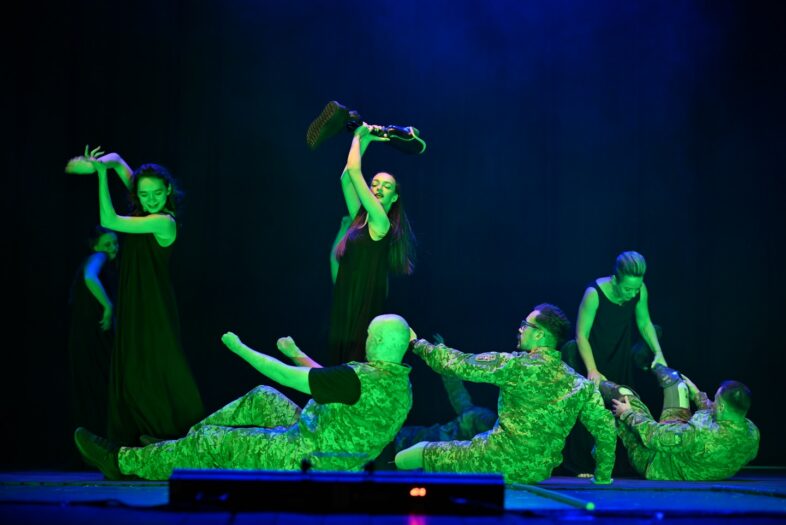
Of course, this is far from the only theatre work in Ukraine involving veterans of the Russian war against Ukraine. Writing for Zaxid.net, Natalka Horishna highlights several other examples. At the Maria Zankovetska Theatre, Alina Sarnatska’s play Balance turns the audience into listeners wearing headphones, through which they hear the voice of servicewoman Olena Apchel. Then, there is the production Lviv 3000 written by veteran Andrii Hryhoriev during his rehabilitation at the Unbroken centre. Another play, One on One, is based on the real story of veteran Mykhailo Fatieiev and follows a man returning from the front. Meanwhile, the Vydyvo Theatre in Stryi reworks classical plays, giving them an autobiographical layer. In April 2026, the Theatre of the Unbroken — part of the “Therapy Through Art” initiative within the Unbroken ecosystem — staged the tragicomedy Lift Director in Lviv, based on real stories of veterans undergoing rehabilitation at the Unbroken centre.
The cast in these productions is made up mainly of veterans of the Russian war against Ukraine, which gives the performances a real sense of authenticity, even within the limits of theatre. The Ukrainian Week also interviewed Oleksa Kravchuk, a demobilised veteran with combat experience who now runs the Lviv Municipal Theatre “And People. And Puppets”. Veterans are now showing up in theatre in all sorts of roles. At the same time, some audiences can be quite harsh or critical about veterans’ performances on stage. But these projects aren’t just about theatre in the usual sense, especially since most of the participants don’t have formal training. They sit somewhere between art, lived experience and psychology, which means they can’t really be judged by standard artistic criteria alone.
A separate question is how Ukrainian veterans are portrayed in cinema, where genre conventions are stricter, and screenplays are often written by civilians. More than two dozen feature films on the subject have already been made, while documentaries are now too numerous to count easily. Yet documentaries do not really construct an artistic image of soldiers; more often, they present a stylised fragment of military or near-military reality. That is why, in the context of this article, feature films matter more, as they offer a more symbolic portrait of today’s veterans.
The Ukrainian Week previously wrote about Maksym Nakonechnyi’s war drama Butterfly Vision, which follows aerial reconnaissance officer Lilia Vasylenko as she returns from captivity, where she was raped while pregnant. The film shows a woman who, for a range of reasons, struggles to find her place in civilian life and ultimately returns to military service.
“This is a story about trauma and post-traumatic stress disorder, which is extremely difficult to overcome in any adequate way. And the heroine’s way out does not seem like the best one, because the war will end sooner or later, and there is no certainty that Lilia will then be able to build a life in peacetime. But that comes later. For now, the butterfly is flying — and so is the heroine, driven by a sense of mission, calling and purpose. In that sense, it is also another story about trying to drown out trauma and problems through work, forgetting that eventually the butterfly will land and be forced to painfully confront non-military reality, like Lilia, whose veteran’s ID is refused by a minibus driver who does not want to let her ride for free.”
In 2024–2025, a wave of films about the Russian war against Ukraine came out, many of them focused on how hard it is for veterans to adjust to civilian life. One example is Daddy’s Lullaby, directed by Lesia Diak, a drama about a veteran named Serhii trying to rebuild his relationship with his wife and their three sons, while the trauma of war keeps getting in the way of how he sees the world.
Another recent standout is Killhouse, which follows a rescue mission by Ukrainian servicemen attempting to evacuate an injured married couple from occupied territory. A defining feature of Liubomyr Levytskyi’s tactical action thriller is the involvement of real servicemen and veterans from Ukraine’s Defence Forces in its production, including members of the 3rd Assault Brigade, the Security Service of Ukraine’s Alpha Group, military intelligence, and the wider military community. More than 80% of the cast are active or former military personnel.
In May, the psychological drama Tired, directed by Yurii Dunai, was also released. The film follows veterans Liuba (Valeriia Khodos) and Andrii (Dmytro Sova) as they try to cope with the traumas of war while finding support in each other. But indifference from those around them, along with their own fears, becomes a serious test for their relationship. Here too, servicemen and veterans were involved in the production, working both behind the camera and on screen.
This is, of course, far from a complete list of such films. But even these examples point to a broader trend: war films in Ukraine are increasingly being made with the direct involvement of people who have real military experience. As a result, they tend to feel more authentic and help shape a more grounded image of veterans on screen.
Art is, of course, a distorted mirror. But in the case of the Russian war against Ukraine — where there is already a vast amount of real footage from the front — the role of theatre and film is beginning to shift. It is not so much that the line between documentary filmmaking and soldiers’ own recordings is blurring, but rather that art is increasingly becoming a form of art therapy, involving not only veterans’ experiences but veterans themselves as consultants and performers.