In his essay The Language of War (2024), Ukrainian writer Oleksandr Mykhed captures the first year of Russia’s full-scale invasion, tracing the wartime state of mind of Ukrainians as they are thrust into what he calls an “unwanted” experience of war. He documents not only the emotional toll, but also the stark facts of destruction and loss.
“While I am writing this, they have just bombed a children’s hospital. They demolished 1,500 houses, 202 schools, 34 hospitals; 85 children died.”
Elsewhere, he lists the numbers with almost unbearable precision: “Russia fired 84 missiles. 43 were shot down by Ukrainian air defence. Russia launched 24 kamikaze drones. 13 were intercepted. Russia destroyed about 30 critical infrastructure facilities, 35 private houses, four high-rise buildings and one school. […] As a result of Russian missile attacks across the country, 19 people died and 108 were injured.”
The book reads like a running ledger of devastation — an unrelenting record of lives cut short and cities scarred. That accumulation of figures becomes something more than statistics: a tightly coiled spring of grief, pain and anger, building toward a scream that will one day echo across Ukraine’s landscape on the day of victory.
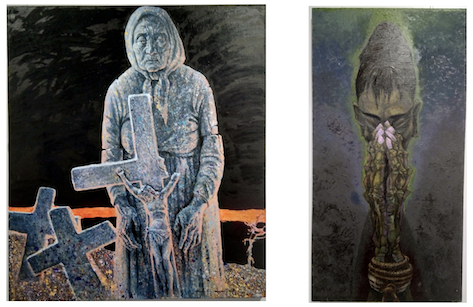
Kata Rudakova, The fate of a woman, 2022, Kyïv; Kostyantyn Tereshchenko, Behind the garages, 2022, Kherson, Tranas Photos: N. Kramar
“We don’t know when this war will end. However, I know what I will do on the day of our victory. I will go out on a wide road running between the fields. High skies. An amazing landscape before me. Another week or two will pass, and the season will change, hiding the scars of war. My body will be shaking. The cold wind will be hitting my face. Somewhere inside my chest growing and howling will begin, and then grow into a scream. The inner spring, which has remained compressed all this time, will be released. I don’t know how long it will last. A moment, dozens of minutes. I don’t know how long I will be screaming for all the fallen, tortured, killed, kidnapped, damaged, raped, maimed, wrecked, missing, unburied. I will be screaming from pain. I will be screaming to the point of pain.”
For now, though, what remains is the almost superhuman effort of those still alive, working “until full exhaustion” to bring Ukraine’s victory closer. Oleksandr Mykhed sees his own role in that struggle as documenting the war — “to ensure that what we’ve been through, our rage, and the horrors that modern Ukraine is experiencing, becomes a collective memory”.
The Language of War traces how he comes to terms with his craft in this new reality. At first, writing feels useless against the backdrop of invasion. Gradually, however, it re-emerges as something “akin to breathing”: a means of personal survival — “Literature does not save anyone, except me,” he says — and, perhaps even more importantly, a tool in the pursuit of criminal justice.
“[These days art has a daily purpose—that of a chronicler. To ruthlessly record every criminal step, every act of the Russian occupiers. The reality of non-fiction, a documentary in which there can be neither editing nor even colour adjustment. Because this is evidence for the tribunals. Because these are chunks of reality that are crying out. We must survive in order to testify and not let Russia’s crimes be forgotten. The more of us they kill, the more of us will bear witness to their evil.”
Book and its titles
The Language of War is a blend of forms — “a mixture of genres, with diary entries, news reports and chapter-length interviews,” as Luke Harding of The Guardian observes. Oleksandr Mykhed intertwines his own writing with the voices of friends and family, alongside fragments chronicling war crimes committed by the Russian military. Some of these records were compiled by the lawyer Roxolyana Gera, a friend of the author.
The Ukrainian title of the book, A Call Sign for Job, combines a biblical reference with a military one. The Old Testament figure of Job points to the Ukrainian people, who continue to endure inhumane suffering and relentless losses inflicted by the aggressor while holding on to faith. The military term “call sign”, meanwhile, captures the new wartime reality — one marked by “shifted values and feelings” and by a new language forged to reflect it. “The language of war is direct, like an order that cannot have a double interpretation and needs no clarification. We speak more clearly, more simply, in chopped phrases, saving each other’s time and saturating conversation with information. With no tears. With no rhetorical questions.”
This new language is stripped down and unsentimental. It is thick with military slang — 4.5.0 meaning “all is well”, plus + standing for “roger that” — and it revives vocabulary from the Second World War: purge, filtration, Gauleiters. It is also saturated with the blunt arithmetic of war. Names, addresses and phone numbers are written on the backs of small children in case they are lost — or killed.
On the Ukrainian side, Mykhed describes a “language of exact definitions and conscious responsibility for every word spoken”. On the Russian side, he sees a total inversion of meaning: “liberated territories” used to describe ruined cities and towns; “Special Military Operation” standing in for war; “denazification” meaning the killing of people for being Ukrainian; “victims of the regime” and “forced migrants” referring to those who left Russia after the invasion began.
Yet the Ukrainian title of the book also hints that faith alone — even faith as steadfast as Job’s — may not be enough. Mykhed returns to the Old Testament more than once. In liberated Borodianka, near Kyiv, he writes about a damaged statue of Archangel Michael that many Ukrainians read as a sign: “the cross fell out of the hands of the Archangel Michael, but the sword remained”. And in the closing pages, he is explicit about the tone he seeks: “The stories I need now are simple. They should have rage, love for the homeland, revenge, and life according to the laws of the Old Testament. This is how I tried to write The Language of War.” What does “life according to the laws of the Old Testament” mean? The necessity of legal and just punishment for evildoers? The right to self-defence? To rage and hatred?
“My hatred flows from the small things to the big ones,” Mykhed says. “Every fibre is filled with it. Hatred towards the smallest particle of Russian collective consciousness and to their greatest symbols […] And should I consider this deep hatred as a new experience? How should I manage this anger? Or should I?”
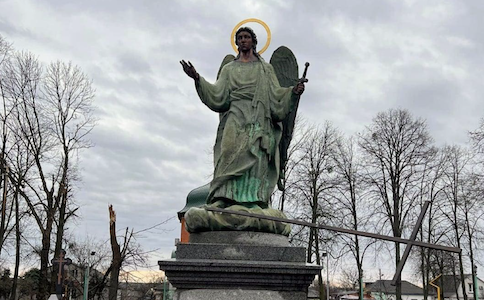
Damaged statue of Archangel Michael in Borodianka near Kyiv, its cross toppled but sword still standing (photo: vechirniiy.kyiv.ua)
Many faces of hatred
The philosopher Günter Anders describes hatred as a primary, instinctive form of negation, often accompanied by a dark anticipation of destroying the other, which affirms one’s own existence. He also distinguishes two types, depending on whether it arises naturally or is artificially induced.
“Natural” hatred appears in the act of fighting: “I fight somebody, hence I start hating him. L’appétit vient en mangeant, la haine vient en luttant,” Anders writes — appetite comes with eating, hatred comes with fighting. “I hate him, therefore, I fight with more brutality. Both hatred and fight intensify each other.”
Seen this way, Mykhed’s — and Ukrainians’ — hatred of Russians emerges as a natural response to the aggressor: “a war criminal,” “a cannibal, a terrorist and a rapist.” Do you remember the (naïve) poster slogan on the Maidan: “We love Russians, but despise Putin”?
In “artificial” hatred, Anders explains, people “receive it free of charge at home, just like water, gas, and TV. They consume the hatred delivered to them and throw themselves, full of hatred, into the struggles of the moment.” Those in power, he adds, deliberately cultivate this hatred so soldiers can kill with fervor and devotion. They do not hate the enemy because of anything the enemy has done; they hate without knowing who they hate, why they hate them, or even why they are fighting — though they believe they know.
Looking at Russia today, it’s clear that the state’s manufactured hatred—poured through TV screens and propaganda—has poisoned ordinary Russians, turning them into a “wild horde” for which “no experience of studying the banality of evil can prepare.” As Anders warns, “No matter how pessimistic you are, Russia will do something worse.”
In the conversations between Russian soldiers in Ukraine and their families in Russia, captured in the documentary Intercepted (2024), those speaking are full of spite toward banderovtsy and amerikosy — slurs for Ukrainians and Americans. Yet as their talks unfold, it becomes clear that these ordinary Russians know nothing about the Ukrainians — an imagined enemy they hate so fiercely — who surprise them in every aspect of their life, so different from their own.
But there is a third scenario, also mentioned by Mykhed. After one of Kyiv’s shellings, he writes: “It turns out that the Russians struck with two bombers from Astrakhan. I turn on Google Maps to see where this Astrakhan is and how far it is. It is 1,558 kilometres from here to the centre of this city on the Caspian Sea. Their hatred crosses this distance in minutes.” Let us examine this case closer, following Mykhed’s reflection.
“I think about the little Russian man who seemingly cannot decide on anything. But he can still aim missiles at civilian facilities with his well-groomed little hands, with the dried blood of Ukrainians under the nails,” Mykhed writes. He continues: “The Bellingcat investigation lets you take a closer look at the quiet, invisible murderers, the cogs in the banality of evil, those who seemingly do not exist, as it’s ‘Putin’s war’.”
A thirty-year-old Matvey Lyubavin is one of those “cogs.” On Instagram, he posts about fashion shows he organises; on Twitter, he reviews new movies, like any ordinary young man. He also supports Navalny — while at the same time working at the Main Computation Centre of the General Staff of the Armed Forces of Russia, launching “missiles so surgically precise they hit exclusively civilian facilities” and killing Ukrainians in their sleep, remotely and dispassionately. “What does shelling even matter? It’s just a job. Routine. Everyday life.”
This, Mykhed notes, is akin to the “killing without hate” of the American pilots who bombed Hiroshima — interviewed by Anders — who admitted they did not really hate the Japanese people while on “mission.” “The idea that it is better to hate without killing than to kill without hatred did not occur to them,” the philosopher berates.
There is one more, paradigmatic, example of “virtuous” killing without hatred: Adolf Eichmann. The American writer Mary McCarthy paints this portrait of the SS officer in charge of the trains to Auschwitz:
“One could not find a better example of a mass murderer, who was at the same time an irreproachable pater familias (Chaplin’s Monsieur Verdoux), than ineffable Eichmann. One of his lawyers said that he resembled a postman — somebody you meet every day operating his regular tours, and whom you rarely notice. He was naturally on good terms with Jews; it was part of his job. […] The fact that Eichmann was excessively delicate, that he could not bear seeing the blood, that he was even an idealist, allowed him to take a distance from reality […], which facilitated his administrative task. Eichmann seems to have been of cordial nature, not a block of ice, and this was helpful in his duty to dissipate all suspicions, of Jews and of the foreigners whom he was in contact with, to keep them at a distance from reality as well.”
On “moral imagination”
What is wrong, then, with Eichmann’s or Lyubavin’s “distance from reality”?
Anders can help us understand. In his book We Sons of Eichmann (1964), an open letter addressed to Eichmann’s son Klaus, he reflects on the moral failure of the German people during World War II. Committing millions of industrial-scale crimes under the Nazi regime, Anders argues, was made possible because of an imbalance: humans have a virtually limitless capacity for technical fabrication, but a limited ability to imagine what their actions actually do to others — to picture the monstrous consequences of their deeds and, as a result, to truly empathise with the victims.
In other words, it is dehumanisation through technology and the loss of “moral imagination” that create a world where ethics are sidelined by technical capability. Fadabini sums it up: “The moral implications of this gap are clear: out of sight (blindness) and out of mind (apathy) makes action, any action, fall into the grey area beyond good and evil, making its perpetuation possible.” For Anders, Eichmann is closer to us than we would like to admit. We are all “sons of Eichmann” as long as we accept living in a world — the “Eichmannworld” — where it is possible to kill at a distance, dispassionately, and without remorse.
This is a serious diagnosis, one that could help explain the world’s, from the Ukrainian perspective, insufficient empathy towards Russia’s war of annihilation in Ukraine. This lack of empathy shows up in everyday life — Russian culture still surrounds us as if nothing happened: musicians, films, or Russian narratives in Hollywood movies. Appeals like Mykhed’s, calling for Russia to be silenced as long as it continues destroying Ukraine and killing its people, often don’t feel strong enough to counter the widespread pretense that Russian culture isn’t being used as a propaganda tool to minimise and whitewash its war crimes. How do we foster the “moral imagination” and empathy for the victims that can revive our ability to act for good or evil? In other words, what can awaken a slumbering conscience?
Ukrainian “tissue of life”
For Anders, the answer lies in art. Not as decoration or distraction, but as a kind of training — something like watching an ancient Greek tragedy — that widens our horizons and sharpens our sense of right and wrong. A recent example is Jonathan Glazer’s 2023 film The Zone of Interest, which sets the chilling calm of the Auschwitz commandant’s family life against a quiet act of courage: a Polish teenage girl who sneaks out at night to leave apples for prisoners along the paths and trenches leading to the camp. The horror lies not only in the violence, but in the eerie normality surrounding it.
Much of Ukraine’s cultural response to Russia’s war works in a similar way. Films, novels, poems, songs and paintings focus not only on destruction, but on what the Ukrainian writer Sofia Andrukhovych calls “micro-experiences” — the small, easily overlooked details people tend to brush aside. The café where you used to meet friends. The local market. The playground your child loved. Things that might seem minor at first glance, yet together form “the fabric of life itself.”
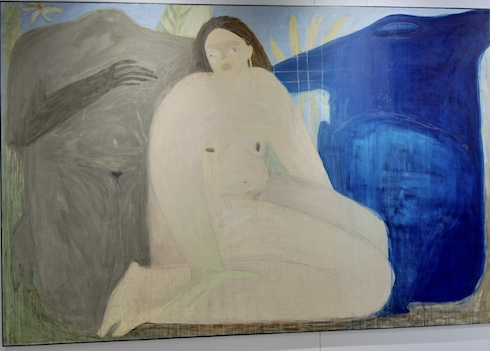
Anastasia Vlasenko, Memory, 2022. Photo N. Kramar
The Language of War belongs to this body of work. It offers a vivid account of the (extra)ordinary texture of wartime life in Ukraine — a life lived in constant proximity to death, with no room to postpone living. No tolerance for the job you hate. No energy for unhappy relationships. Only time, as one of Mykhed’s correspondents puts it, to “live — truly live — our lives.”
The emotional arc swings wildly: from despair to acceptance to a hard-won strength. Fear, over time, curdles into indifference — edged with anger, a thirst for revenge, and the blunt instinct to survive. Rage and hatred are “converted” into donations to the Ukrainian army. And alongside all this, a new wartime sensibility takes shape — an acute attention to details that once seemed trivial, paired with a sudden, almost boundless tenderness.
Mykhed captures this shift in a scene from the area around Hostomel airport after deoccupation. The landscape is scarred, but life — stubbornly — pushes through:
“A tattered zinc box for 1,080 5.45 calibre cartridges is lying on the ground. A little further on there are boxes with the labels of Russian special forces. Near several entrances, the owners are rummaging in the ruins, looking for things, raking the rubble. Someone had thrown away a torn bag of potatoes earlier. It is sprouting frantically. Bowls with water and food for cats are placed everywhere. Someone has to take care of them.”
Or take the wake for Mykhed’s friend, Viktor Onysko — less a funeral than a defiant celebration. It felt like a small but stubborn victory of life over death, as if these everyday fragments — music, jokes, shared memories — were themselves pushing back against Russia’s senseless assault on “ordinary everyday life in its immediate truth and humble beauty,” as the philosopher Anatoliy Akhutin has written.
“And in the evening, we had a party. Loudspeakers played your favourite tracks. Walls were hung with your beautifully composed quotes and funny screenshots from your chats with friends. At the bar, they were serving ‘Moron’ cocktails (there was also an option ‘Moron with lemon’ for connoisseurs). […] Your photos and videos were projected onto the wall behind the DJs. In most of the videos you were playing with Zakha and other kids. The whole evening was a ritual of farewells, when death got a dance-off, and pain poured out through sweat, tears and laughter. […] It was a master class in the hatred of death. It was a master class in love for life.”
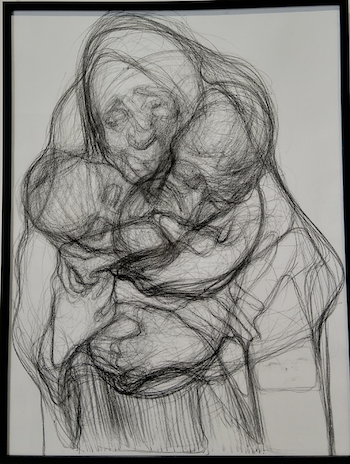
Iryna Vorona (Baltaziuk), Together, 2023. Photo: N. Kramar.