War disrupts more than the physical world — it reshapes the way we think. Questions about protecting oneself while promoting Ukrainian culture are becoming increasingly urgent: in choosing repertoire, attending conferences, or shaping educational programmes. On the battlefield, choices are immediate matters of life and death. In the cultural sphere, there appears to be space to reflect, weigh options, and set ethical limits. But is there really?
The debate came to the fore when Lviv conductor Oksana Lyniv decided to stage Pyotr Tchaikovsky’s Russian opera Eugene Onegin, drawing strong public reaction. It raised key questions: how should Ukrainian artists handle Russian repertoire when contracts and foreign audiences expect it? And what should Ukrainian cultural diplomacy look like after years of Russian cultural dominance?
These issues demand more than public opinion. They require insight from professionals who navigate these challenges daily and understand the practical and ethical stakes.
Russian presence, Ukrainian absence?
It’s hard to find a corner of the world without Russians, and it’s especially noticeable on the stages of international cultural events. For Ukrainians, that reality keeps raising the same difficult question: what does it mean to share space with Russian artists — at festivals, in conservatories, or within major cultural institutions? The emotional pushback is understandable. But how should it shape professional decisions? When does it make sense to refuse to participate, and when is it worth staying in the room, even if the room is shared?
The controversy around the Lviv National Opera made that tension painfully clear. The theatre cancelled a performance by Ukrainian singer Valeriia Pluzhnikova because of her earlier appearance in a Milan production alongside Russian performers as a student. The backlash was immediate, much of it aimed at the theatre’s communication. Beyond the PR missteps, however, the episode exposed a deeper question: should the presence of Russians automatically exclude Ukrainians?
Cultural manager Oksana Hizhovska puts it bluntly: Ukrainians need to be in the rooms where cultural decisions are made. International festivals, biennales, touring productions — these aren’t just showcases, they’re platforms. If you’re there, you have a microphone. If you’re not, someone else fills the space.
And in today’s climate, stepping back means risking invisibility. If Russians are on the programme too, she argues, that only raises the stakes. Ukraine’s position has to be stated clearly and publicly — in interviews, in statements, even in the artistic choices themselves.
Pianist Violina Petrychenko sees it much the same way. Ukrainian musicians, she says, shouldn’t opt out of international projects simply because Russians are involved. The key is how you show up. Participation isn’t the problem — losing your sense of who you are would be. At the same time, she’s realistic: Ukrainians can’t expect European institutions to enforce a blanket boycott. Democracies don’t work that way, and those calls aren’t Kyiv’s to make. What Ukrainians can control is their own line in the sand — including a firm refusal to promote Russian culture, which has become inseparable from a state waging war against Ukraine. The bottom line, Petrychenko argues, is visibility — and representing the country with clarity and self-respect.
Pianist and cultural diplomat Marta Kuziy argues that clarity is everything. From the outset of Russia’s full-scale invasion, she took a hard line, refusing to appear at events that included Russian participants and ruling out Russian repertoire altogether. But her position has evolved. Today, she says, blanket refusals don’t always serve Ukraine’s interests — sometimes being present matters more. She points to this year’s International Fryderyk Chopin Piano Competition in Warsaw. Russian contestants were allowed to compete under a neutral flag. Ukrainians, however, were nowhere to be seen. For Kuziy, that absence is troubling. Is it a lack of interest? A lack of support? Whatever the reason, she argues, Ukraine cannot afford to be missing from a stage that visible — especially when cultural presence translates into political weight.
Taras Filenko pushes the argument further. Ukrainians, he says, should show up precisely where Russian influence runs deepest. He recalls being invited, in the second year of the full-scale war, to perform at the Museum of Russian Art in Minneapolis — an institution that had publicly backed Ukraine since the invasion began. Even so, he hesitated. In the end, he decided that while defence helps you hold your ground, going on the offensive is riskier — but it also opens up the possibility of shifting the narrative.
Filenko performed an all-Ukrainian programme and was struck by the audience’s reaction. Most were Americans, but a few Russians were in the hall — and openly supportive of Ukraine. For him, that audience mattered. “Their voice carries more weight at home than ours ever could,” he says. “If they stand up for Ukraine, they do it where I can’t.”
He believes it’s essential to go exactly where Ukrainians are absent — into spaces dominated by Russian influence. His work aims to raise awareness in places where the Russian cultural narrative still holds sway, including across the Global South.
For the experts, there’s no question: Ukrainian visibility on the international stage is crucial, even in the trickiest or most uncertain situations.
Contract versus conscience
“Getting an invitation from this orchestra is incredibly prestigious — not just for a Ukrainian conductor, but for any conductor… Of course, if I say ‘no,’ I probably won’t get a second chance,” Oksana Lyniv said in an interview, explaining her decision to stage Tchaikovsky’s Eugene Onegin at the Saxon State Opera.
Performing Russian works is often written into an artist’s contract. But can a contract outweigh a moral choice? And can the decisions of conductors, soloists, and orchestra members really be measured by the same standard? Most of the experts The Ukrainian Week spoke with began their answers the same way: “It’s a very difficult question.” And indeed, much depends on personal principles and the specific circumstances.
Oksana Hizhkovska sees a sharp line between professional duty and conscience as clear: it’s crossed the moment a compromise starts to feel like a personal betrayal. She says that if an artist can’t say no, they still have the right to explain their stance — publicly or within their ensemble. Staying silent, she warns, only plays into the normalization of the aggressor; speaking out turns art into a form of resistance.
For soloists and conductors, the line is much clearer, says Violina Petrychenko. If you’re invited as a recognised artist, you have the right to make your position known and to refuse to perform Russian music on ethical grounds. This isn’t about confrontation — it’s about maintaining dignity. The line is crossed when professional duty becomes symbolic support for the aggressor’s culture. Performing Russian repertoire today is a gesture that carries weight, and every Ukrainian abroad has the right to say no.
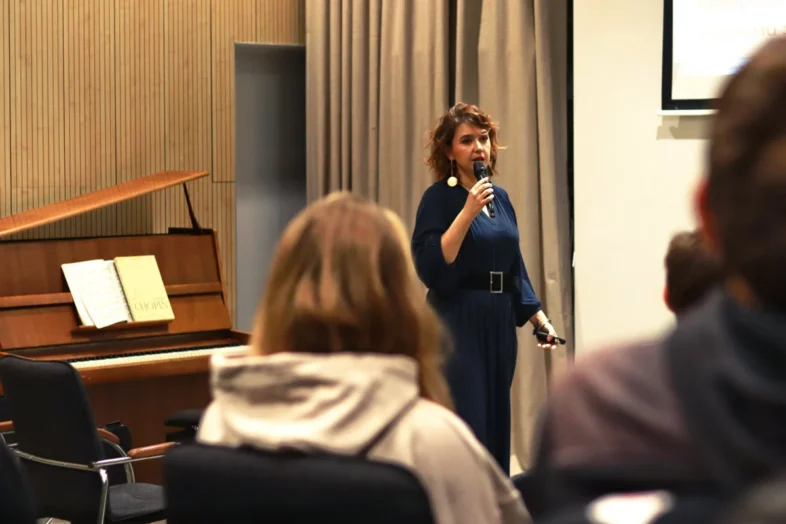
Marta Kuziy giving a lecture at the Ukrainian Catholic University
In this case, Marta Kuziy advocates for actively seeking ways to expand the presence of Ukrainian music in international repertoires. She sees the role of Ukrainian musicians in global institutions as steadily filling programmes with Ukrainian works and advancing their cultural agenda.
For that reason, Kuziy doesn’t share Oksana Lyniv’s view that it’s impossible to operate without Russian repertoire. She points to conductor Nataliia Ponomarchuk as an example of a more effective approach: Ponomarchuk presented a work by Borys Liatoshynsky in collaboration with the BBC Symphony Orchestra. That success, Kuziy notes, came from careful negotiation and persistent effort to ensure Ukrainian music gets heard wherever possible. She argues it’s crucial to look beyond the immediate moment — to think long-term, act strategically, and not simply “cut everything off” today.
Taras Filenko takes an even harder line. He not only refuses to perform Russian music but actively pushes back against its dominance in concert programmes. After going through the Pittsburgh Symphony Orchestra’s season, he found that 28% of the works were Russian — and he fired off a letter asking, “How many Ukrainian pieces have you performed over the past two years of full-scale war?” When he learned that Russian pianist Denis Matsuev was scheduled to perform, Filenko sent a letter warning that if the concert went ahead, he would take steps to disrupt it. The outcome: Matsuev’s appearance was cancelled.
Filenko acknowledges that orchestral musicians with no say in programme choices have limited leverage. Still, he argues, even small gestures — like wearing a Ukrainian flag pin or ribbon on a tailcoat — count as taking a stand. Nevertheless, executives, he says, have an even greater responsibility: they must ask themselves why Russian repertoire is still being performed at all.
Ukrainian cultural diplomacy: where do we begin
However intense the debates around the “Russian question” may be, the real issue is something else: how Ukraine puts its own culture on the world stage. Ukrainian artists abroad often face a lack of clear guidance — when, where, and how to represent their country, what support is available, and which actions will actually bolster Ukraine’s reputation. This raises a bigger question: what should Ukrainian cultural diplomacy look like in practice, and how should it be built?
For Oksana Hizhovska, effective cultural diplomacy starts with a long-term strategy — one that supports artists, produces content, and shapes narratives that can compete on a global scale. It needs to be systematic, built with institutional resilience and a clear strategic vision. Ukraine must maintain a consistent presence at major international cultural events, not just show up sporadically, using cultural institutes, scholarships, residencies, and translation programmes to make its mark.
Hizhkovska also points to a rising global appetite for decolonial narratives — and she says Ukraine fits squarely within that conversation. The key, she argues, is a clear decolonial lens: acknowledging repression, appropriation, and cultural distortion, while also presenting an alternative and putting Ukrainian artists back on the global stage. For her, Ukraine needs to reclaim its rightful place in European and world cultural history — a spot long distorted or claimed by Russia.
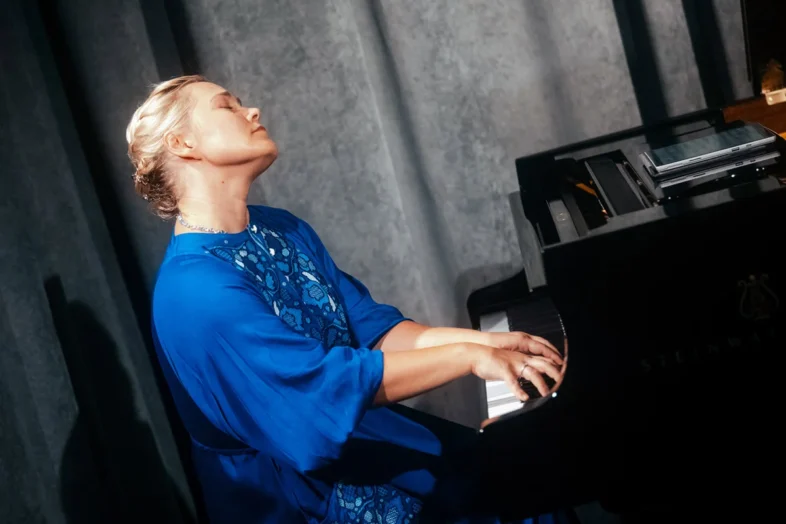
Violina Petrychenko
Pianist Violina Petrychenko emphasizes the need for state-backed programmes to support Ukrainian festivals, touring projects, and other cultural initiatives. Her own experience shows the gap: the “Sounds of Ukraine” festival she founded relies heavily on German partners and private donors. Many artists are forced to chase grants abroad, turning to foreign foundations because Ukraine still lacks effective support mechanisms. For Petrychenko, it’s just as important that the world hears the Ukrainian voice not only through the prism of war, but also through the beauty, depth, and humanity of its culture.
Marta Kuziy draws a distinction between two forms of cultural diplomacy: governmental and civic. The governmental side includes the Ministry of Foreign Affairs and its affiliated Ukrainian Institute, which follows a strategy built on European principles. This makes its work relatively predictable and publicly documented.
Civic cultural diplomacy, by contrast, is what every Ukrainian abroad does — artists included. They represent Ukraine through day-to-day interactions, shaping the country’s reputation one personal connection at a time. While the Ukrainian Institute provides guidelines and recommendations, these often don’t reach practitioners, hampered by limited access, gaps in communication, or a lack of clear information. As a result, many musicians aren’t sure exactly how they can advance Ukraine’s message or contribute to the broader cultural agenda the country aims to promote.
Marta Kuziy argues that Ukrainian artists abroad should be at the centre of cultural diplomacy. They’re the ones who see how things work on the ground. The challenge, she says, is combining a clear national agenda with a practical understanding of the local cultural landscape.
Ukraine must assert itself, and that requires a long-term strategy supporting specific priorities. In music, for example, this year’s focus has been the anniversary of Borys Liatoshynsky. That has meant backing performances of his works, including the opera The Golden Ring, taking them abroad, publishing and recording his compositions, and promoting existing interpretations. Only by steadily building and expanding Ukrainian content can the country strengthen its visibility on the global cultural stage.
Taras Filenko shares the call for state support but goes further, offering new reference points for performers based on his own experience. He believes that artists travelling abroad should move beyond the instinct to showcase themselves first. Instead, they should step back and put the informational message front and centre. That means programming more works by Ukrainian composers. Audiences come not only to show support — though that matters — but also to hear something new. Ukrainian musical culture, he notes, remains largely unknown to the world.
Filenko designs his programmes to be half music, half storytelling, using slides to share insights about culture and history. He stresses the importance of speaking directly to the audience from the stage and mastering foreign languages — especially English — so artists can answer questions and engage after the performance, which he sees as just as crucial as the music itself. He also prioritises working with university students, not just established concert halls. “Don’t pray where others have already prayed,” he says, summing up his approach in a single line.
“If we want to present Ukraine effectively abroad, we need to understand its history and culture, share our own experiences, and connect them to the audience’s context,” Filenko explains. He recalls spending months studying a rhapsody by Indonesian composer Ananda Sukarlan, based on folk themes, so he could perform it alongside Mykola Lysenko’s rhapsody on Ukrainian motifs. The comparison highlights that the musical quality is equal — and helps audiences see that Lysenko was a pioneer in weaving folk elements into the rhapsody genre.
All of this, Filenko stresses, requires deep knowledge and active engagement. For him, every performance should carry both an educational and a political dimension.