Today in Ukraine, winter fortune-telling are mostly associated with St Catherine’s Day (24 November) and St Andrew’s Day (30 November). But the festive season from Christmas to Epiphany is just as rich in traditional fortune-telling. It’s a time when everyday objects take on a magical life, and household animals become enchanted helpers — all in the hope of glimpsing a future full of surprises.
Boots flying through the air are a familiar sight during Malanka, the traditional Ukrainian New Year celebration. On New Year’s Eve, girls would try to predict their future husbands by tossing their footwear over an obstacle — a house, a gate, a well, or sometimes even their own heads — and watching which way the toe pointed. That direction supposedly hinted at where matchmakers were waiting. The exact technique varied from region to region. In the Lokhvytsia area, for instance, the ethnographer Oleksa Ripetskyi recorded a local tip: a boot thrown by hand wouldn’t work — it had to be flung straight off the foot. The boys, meanwhile, weren’t just watching. Their part of the ritual was a playful theft: they’d sneakily grab the boot, leaving the girl hopping barefoot in the snow. The stolen shoe would later be returned for a symbolic ransom — a kiss or a drink would do.
Stepan Myshanych, a folklorist, preserved a New Year memory from Yevdokiia Dmytrivna Cherevychna (born 1915), a resident of the village of Nyzhni Rivni in the Chutiv district of Poltava region, that captures this playful tradition perfectly. “Come on, let’s go — let’s throw boots over the house! See where the toe points — that’s where she’ll marry. So we throw the boots, and the boys overhear us — and nick them. And then what? There’s snow everywhere. We’re pleading: where do we go, how do we get home? One girl who lives nearby runs off, finds another shoe or wraps a scarf round her foot just to make it back, because the snow’s freezing.
Meanwhile, the boys grab a boot — one, two, maybe three — and sneak off without a word. The next day they turn up: ‘Right, girls, recognise whose boots these are? Set out some wine and we’ll give them back.’ So what do we do? We start pinching wine from our parents, quietly, so father won’t find out — otherwise we’d get a hiding! One girl steals a bit, another does the same, as much as they demand. A litre, a litre and a half. We hand it over to the boys. That’s how it was, back then, on New Year’s.”
Ukrainian folklorist Fedir Kolomyichenko, who studied fortune-telling traditions in the Chernihiv region, notes an unexpected twist: in some areas, young men could join in the boot-throwing too. The ritual was simple but symbolic — a piece of bread went into the right boot, a lump of stove clay, or pechyna, into the left. Standing with their backs to the gate, they would blindly pick a boot and toss it over their shoulder. If the boot with bread landed in the street, it promised a prosperous married life; if it was the one with clay, the couple could expect a tougher road ahead.
A similar practice existed in the Kharkiv region, but here it was used to predict the harvest. According to the researcher Petro Ivanov, the head of the household would hide a piece of bread in one boot and a lump of charcoal in the other, then ask a child to pick one. The boot with bread promised a generous yield, while the one with charcoal warned of a lean year.
To make their predictions more accurate, people often took special foods with them — the season’s first pancake, a small loaf of palianytsia (a traditional Ukrainian bread), or a handful of kutia, the ceremonial grain dish served with raisins, poppy seeds and honey. Windows of other households were seen as symbolic portals to another world, so anything overheard from them was believed sure to come true. But in some places, the magic of the winter holidays was so potent that all it took was stepping over one’s own doorstep.
In the village of Kliushnykivka in the Poltava region, for example, girls at midnight would scoop kutia into a spoon and circle the house three times, then pause and listen: the direction of a dog’s bark would indicate where marriage awaited. Hearing the clink of glass was a bad omen, warning of a husband who would be a drunkard. Even worse was the sound of an axe striking — a sign of sudden death.
Among the Lemkos, divination came with its own incantation. After the Holy Supper, girls would run outside, call out, and look around: “Hop, hop! Where is my lad?” And in the Bardejov district of Slovakia’s Prešov region, young women would approach a willow tree to comb their hair, shout a divinatory formula, and listen to the echo: “Huk, pig, where I’ll be the lady of the house; where the voice answers — from above or below — that’s where she’ll be married,” writes researcher Yosyp Varkhol.
Festive animal oracles
In traditional Ukrainian courtship rituals, animals often played a starring role. Take dogs, for instance. On St. Andrew’s Day, they were treated to special balabushky to see whether a girl would marry that year. Later, if fortune smiled, those same yard dogs would be the first to sense the arrival of matchmakers, bursting into barking to warn the bride-to-be and her parents.
Fortune-telling with little loaves sometimes shifted closer to the winter solstice. In Transcarpathia, for example, girls baked special bobalyky, each one named after a potential suitor. Then they would invite a cat or dog into the room and watch carefully which loaf it grabbed — that, they believed, would reveal the name of the girl’s future husband.
In the Lemko region, folklorist Mykola Mushynka recorded an unusual form of fortune-telling involving a pig. After the Holy Supper, a girl would knock on the pigsty door and ask, “Rokhnu, rokhnu, will I be married this year?” A grunt from the pig meant yes; silence meant no.
By contrast, Ahatanhel Krymskyi — a Ukrainian linguist and folklorist — notes that in the national poet Shevchenko’s homeland, the Zvenyhorodka area, roosters could serve as unexpected fortune-tellers. On Malanka, the bird would be brought into the house and presented with three possible treats: millet, water, and clay. “Fate, fate, crested one! Tell me what awaits me this year?” the girl would ask, her eyes never leaving the rooster. If it drank the water, the fortune-teller was destined to marry a drunkard; if it pecked at the millet, a good, capable householder awaited; and if it went for the clay, she would remain longer in her parents’ home.
By the mid-twentieth century, this kind of fortune-telling was still practised in the Donetsk region, with particular attention paid to the bird’s thirst. Women from the Bakhmut area — Hanna Krasnianska (born in 1926) and Nadiia Lahoda (born in 1930) — remember it like this: “They’d bring the rooster into the house and set it in front of a mirror. If it drank the water, they said the husband would be a drunkard.”
If it didn’t, people assumed the husband would be a capable householder, and that harmony would follow in marriage. Seeing a sheep on Christmas was also taken as a particularly good omen. In the Kupiansk district, people paid close attention to the first animal they met after stepping outside the gate that day: a sheep promised a calm, prosperous life, while a dog signalled hardship.
Tetiana Parkhomenko, who studies seasonal customs in Ukraine’s Rivne region, points out that even sheep and rams weren’t read the same way. In the village of Ostrivsk, in the Zarichne district, a girl would head to the cowshed on New Year’s Eve and grope around in the dark for an animal. If she grabbed a sheep, she would stay unmarried; if it was a ram, marriage awaited her.
Reading omens at the festive table
Gathered around generously set tables on 24 and 31 December, families tried to guess whether the coming year would be just as plentiful. On Christmas Eve, they’d look out the window and count the stars: a sky full of them promised a good harvest come summer and autumn. The same hope was read in kutia that rose high in the pot — a sign that next year’s haystacks would stand just as tall.
New Year’s was also a time for meteorological fortune-telling and forecasts for the year ahead. The ethnologist Oleksandr Kurochkin writes about these customs in his essay Holidays and Rites of the Calendar Cycle: “Numerous New Year omens and forms of fortune-telling were in circulation. In the Poltava region, for example, people would watch the clouds on New Year’s night: if they moved from the south, it was believed that spring crops would thrive; if from the north, winter crops would do best. That same night, they also tried to predict which grains would yield the most. Bundles of wheat, rye, barley, oats, and other grains were left outdoors, and it was thought that whichever crop the frost touched would be the most abundant.”
In the Rivne region, housewives would take the kutia straight from the oven, cover it with oak leaves, and then read the amount of condensed steam to predict whether the summer would be rainy. Further east, in the Slobozhanshchyna region, women aimed for even greater precision, trying to forecast rainfall for each specific month. They would peel twelve onions, salt each one, and place them in a warm oven. By morning, the onions whose salt crystals were the dampest were said to mark the months with the heaviest rain.
Another widespread ritual involved spoons. After the evening meal, the bowl of kutia was left on the table, and each family member placed their spoon inside, weighed down with a piece of bread. If one of the spoons fell overnight, it was taken as a dark sign — the person it belonged to was thought unlikely to see out the year.
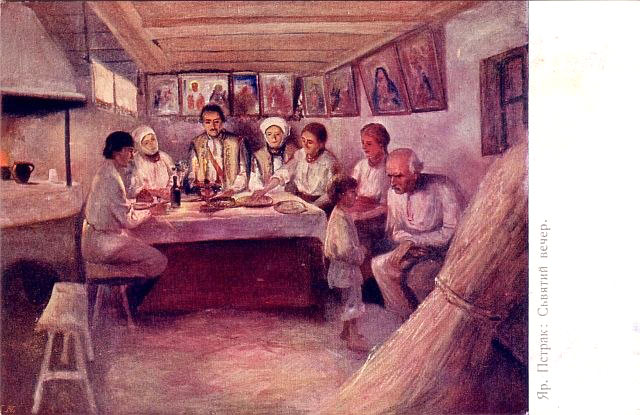
Yaroslav Pstrak, “Holy Evening”
Visions of what’s to come
According to tradition, a dream on the eve of a major holiday could reveal the future. Girls, going to bed, would call on their future husbands to appear in their dreams. To help summon him, they might place a comb under their pillow, hoping he would come to brush their hair, or eat an oversalted balabushka at night, so he would offer them a drink in the dream.
Sometimes, entirely unexpected objects appeared on the bed. In the village of Zhurba in the Ovruch region, for example, girls would fall asleep with a boot — under this condition, they were said to be able to see their future husband during the night, according to folklorist Tetiana Pominchuk.
Fortune-telling using water, or hydromancy, was also common. These rituals took place at Christmas and New Year, as well as on Epiphany, when water was believed to be especially potent. A prophetic dream could be invoked by setting up a “well” or a “little bridge” of water. Maria Ivanivna Rudyka, born in 1922 in the Kramatorsk region, remembers: “Before Epiphany, they’d do all sorts of fortune-telling. They’d make a little well out of matches, put a tiny plate in it, pour some water, and whoever came to water the horses there — that would be the bridegroom. And it worked. It really did. You’d dream that such-and-such a person came — and then he’d come to propose. That’s how it was. Truly, it was true.”
The secrets of the “little bridge” fortune-telling were described by researchers Viacheslav Kushnir and Nataliya Petrova, who studied traditional wedding rituals in the Odesa region. On the night before St Basil’s Day, in northern Odesa, it was common to pour water into a bowl and balance objects like twigs across the rim to imitate a bridge. The water “bridge” would then be tucked under the girl’s bed without her knowing. In the morning, the family would ask about her dream: if a young man had carried her across the bridge in the dream, he was her destined husband.
In other regions, the ritual didn’t need to be secret — the girl could set up the bridge herself. Sometimes the construction was simple, sometimes more elaborate. In the village of Svarytsevychi, in the Rivne region, a comb was placed on a cup of water; in Vashkivtsi, in the Chernivtsi region, a cherry twig was added to the comb.
Reading the future in fence posts
To get a glimpse of their future husband, girls would head out on New Year’s Eve and count the posts in a fence. In the dark, they’d count out twelve — or “three times nine” — and mark the chosen one with a ribbon. Come morning, they would examine it closely, reading the post as a stand-in for the man they were meant to marry. The signs varied by region. In the Lokhvytsia area, for instance, an old, knotted post pointed to a poor, likely older husband, while a smooth, straight one promised a young and well-off suitor.
In other parts of Ukraine, like the Izium area, a smooth post was actually undesirable — a planed post meant poverty, while one with bark foretold wealth. Some forms of fortune-telling were quicker and didn’t require waiting until morning. Girls would count the fence posts, reciting in turn: “Widower — fine man, widower — fine man,” and whoever came up at the end… well, the last post was supposed to reveal the status of the potential groom.
Another playful version had them embracing as many fence slats as their arms could reach: an even number meant the girl would be paired soon, while an odd number signified that it wasn’t yet time for marriage.
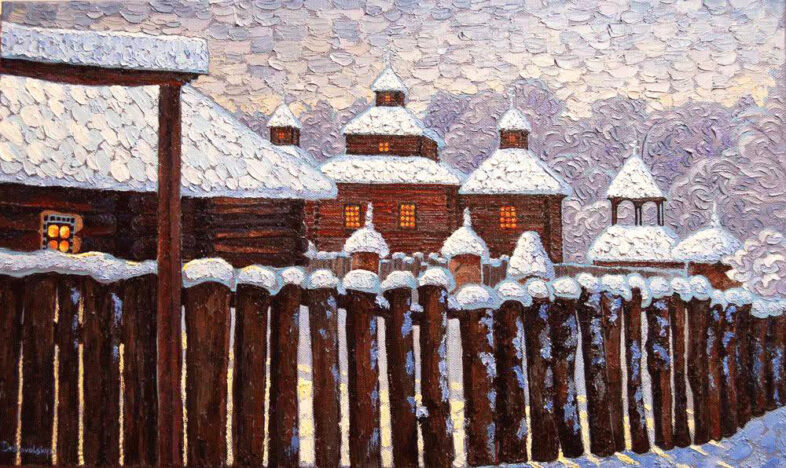
Dmytro Dobrovolskyi, “Koliada”
Candles, mirrors, magic
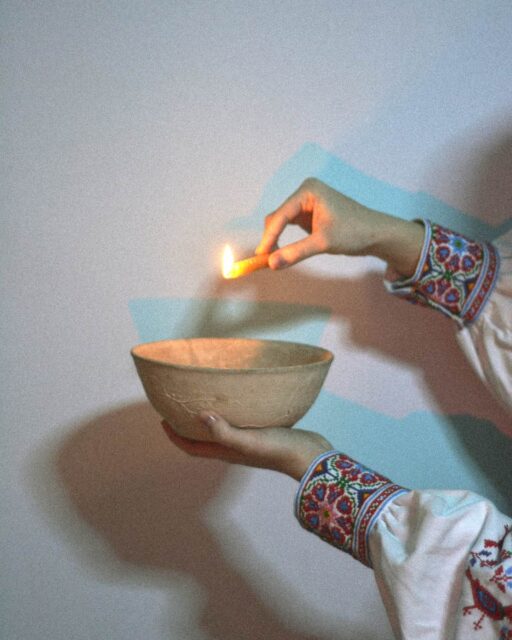
While lighting their homes with candles, young people often used the flickering flames to predict the future — a type of fortune-telling known all across Ukraine. Girls would melt wax in an iron spoon and pour it into cold water, where it would instantly harden. The shapes formed by the wax were then “read” to reveal a glimpse of their fate. Sometimes an extra step was added: holding the wax up to a light and interpreting the shadow it cast on the wall. It was like a little festive shadow theatre.
Hanna Arkhipivna Yalovenko, from the Bilhorod region, recalled a version using the shadow of burning paper: “They burned paper. At twelve o’clock at night, we’d take a pan, turn it upside down, put the paper on it, burn it, and watch the shadow. My sister saw horses harnessed to a cart, and they went off. That year, she got married in another village, and they arrived on horseback. I was still little then — mine just burned up, curled, and stayed right there.”
People also paid close attention to the smoke rising from a blown-out candle. After the Holy Supper, family members would stay at the table, snuff out the flame, and watch where the smoke drifted. If it headed toward the door or the cemetery, it was taken as a sign that someone in the house might die. In those moments, the oldest grandparents would sigh deeply, feeling the omen personally. The household’s good mood was only preserved if the smoke rose straight up or toward the icons — a sign that everyone would live to see the next Christmas.
Fire was also used for divining matters of love. Petro Shekeryk-Donikiv, a researcher of Ukraine’s Hutsul culture, wrote that on St Basil’s Day, Hutsul women would take two small bundles of flax — one for themselves, one for their beloved — and set them alight with a taper. If the two flames met, it meant the couple was destined to be together; if they drifted apart, no romance was in store.
But the most intriguing — and also the most mysterious — part of the ritual began when candles were placed on either side of a mirror. Folk belief held that at midnight, a girl could catch a glimpse of her future husband… or, more ominously, an evil spirit. The latter, of course, was highly unwelcome. To keep it from leaping out of the mirror into the room, the mirror had to be quickly overturned or covered with a cloth. Still, even these precautions didn’t always protect against misfortune.
A respondent from the village of Slovechko in the Zhytomyr region recalled a chilling story: her friend, while trying this fortune-telling, saw a coffin reflected in the mirror — and soon after, she passed away. “My friend was telling fortunes, and she saw a coffin — she died quickly afterwards,” she claimed. Some modern researchers suggest that the particular danger of “mirror” fortune-telling might explain why they appear far less often than other rituals in 19th-century ethnographic records.
Weaving winter wreaths
In the Carpathians and the surrounding foothills, festive magic often took the form of wreath-making. Girls would weave wreaths from straw, placing the Christmas bread, the karachun, on top, and then — eyes shut — toss them onto a fruit tree. If the wreath caught on the first try, it was said that the girl would soon try on a wedding crown of her own.
“Prepare the sleigh in summer, the cart in winter,” goes a Ukrainian proverb — and cautious Lemko girls would certainly have agreed. According to folklorist Mykhailo Shmaida, to tell fortunes at Christmas, they would gather periwinkle in the autumn. Taking it to church, they plucked the leaves one by one, wishing that the overseers would follow them.
In the Rakhiv region, on the eve of St Basil’s Day, Hutsul girls had a slightly different ritual: they broke young willow or plum branches, wove them into wreaths, and at midnight tossed them into a bucket of well water. Tradition held that whichever wreath sank meant the girl would marry; whichever floated meant she would remain unmarried.
Today, these playful traditions offer a charming alternative to crafting decorative Christmas wreaths from fir, cones, and berries. Fortune-telling has shifted from predicting fate to simply providing a fun, festive way to spend time — and in this case, the joy is far more important than the outcome.