Exactly 290 years ago, a Polish noblewoman named Marcjanna took her seat before a painter as he began work on her portrait. The occasion was most likely a milestone in her family’s fortunes: the appointment of her husband, Mikołaj Jan Podoski, as voivode of Płock in the Polish–Lithuanian Commonwealth. Today, Płock is a city in central Poland on the banks of the Vistula.
The artist portrayed the 53-year-old Marcjanna frontally, her head slightly inclined towards her right shoulder. Her dark hair, already streaked with grey, is gathered into an elegant high coiffure, fastened with a costly ornament. Beneath the bust-length image, the painter added an oval inscription spelling out her new status: “Marcjanna z Rokitnickich, hrabina Podoska, woiewodzina Płocka, roku 1736.”
In the portrait, Marcjanna appears calm and self-assured. She had grown older in a loving marriage and took pride in her sons. One of them, Józef Antoni Podoski, would go on to hold high office as grand master of the kitchens of Lithuania, serve as the Commonwealth’s envoy to the Ottoman Empire, and later, like his father, become voivode of Płock.
Marcjanna died the year after the portrait was completed. The painting, however, went on its own long journey. Decades later, it surfaced in Kyiv, eventually entering the collections of Saint Sophia Cathedral — a place the noblewoman herself never saw in her lifetime.
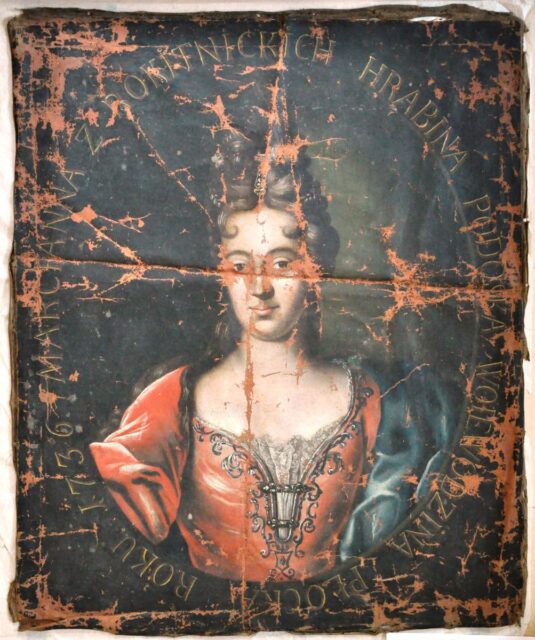
Portrait of Marcjanna Podoska, 1736. Oil on canvas. Collections of the National Sanctuary Saint Sophia of Kyiv
Museum staff at Saint Sophia of Kyiv first encountered Marcjanna’s portrait in 1949, while unpacking crates of artworks and artefacts “returned” to Kyiv by Soviet forces from Germany after the upheaval of the Second World War. One of them, labelled U–70 in the museum’s intake records, contained more than 60 items: photographs from the 1928 restoration of Saint Sophia Cathedral’s frescoes, icons, lithographs of the Golden Gate, and drawings of Ukrainian sacred architecture and art. Such materials are familiar today to curators at the National Sanctuary “Saint Sophia of Kyiv.”
The surprise came when staff pulled out a canvas folded crosswise and carefully unrolled it. It was Marcjanna’s portrait. Even now, the impression is immediate: the painting seems to have arrived in Kyiv by accident. Before the war, it was most likely part of an unidentified European museum collection.
Yet, the question remains—which one?
When the portrait entered the St Sophia Museum’s collection in 1949, it was registered under a different name — as the “Portrait of Countess Potocka” (Inv. No. KN 35). The author of this piece later had the chance to compile a standard museum catalogue entry for the work, still listed under that title, from the holdings of the National Sanctuary “Saint Sophia of Kyiv.”
Cataloguing requires careful verification of attribution, and in this case, the inscription on the canvas left little room for doubt about Marcjanna’s identity or the outlines of her life. What remains unclear, however, is where the painting came from before it reached Kyiv. The museum collection it once belonged to has yet to be identified.
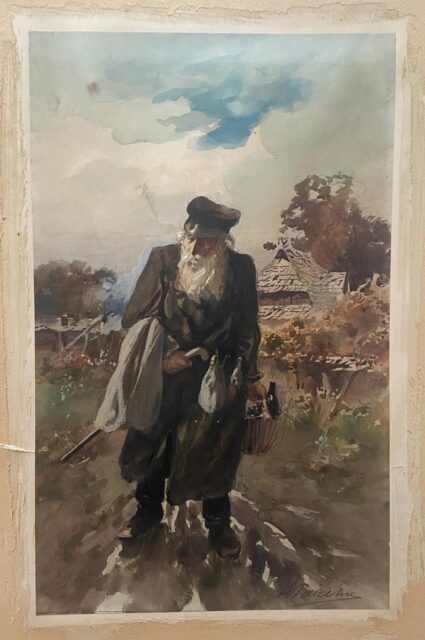
Old Jewish Man. Gouache on cardboard and paper. Collections of the National Sanctuary Saint Sophia of Kyiv
Marcjanna’s portrait wasn’t the only surprise in crate No. 70. That same year, 1949, the St. Sophia Museum also received a fascinating drawing. It depicts a full-length figure of an elderly Jewish man, his long grey beard framing a face under a low cap, walking along a hazy dirt road. He holds a cane with a metal handle in one hand and a basket with food and a glass bottle in the other, while small grey pouches — maybe wallets — hang from his belt.
In the lower right corner is the artist’s signature. In 1949, museum staff read it as “M. Rusecki.” Under that attribution — “M. Rusecki (?). Old Jewish Man” (Inv. No. KN-35) — the gouache on cardboard has remained in the collection of the National Sanctuary “Saint Sophia of Kyiv” ever since.
Whether the signature was read right at the time remains unclear. There is good reason to doubt it. What is certain, however, is that an artist named Rusecki did exist — in fact, more than one.
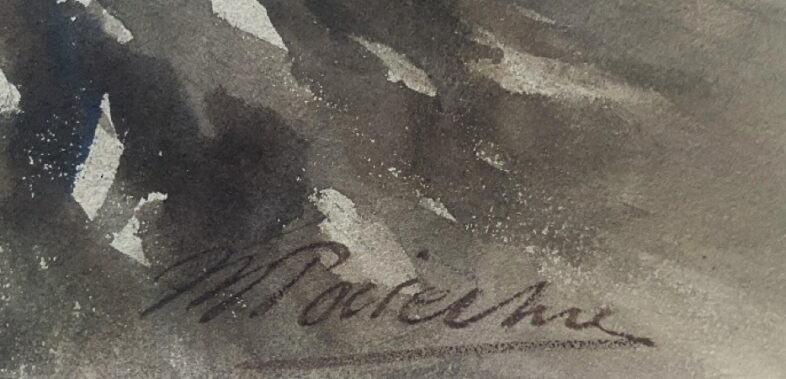
Signature on the drawing “Old Jewish Man”
The trail leads west again — to Poland and Lithuania. In Lithuania, the most venerated Christian image is Our Lady of the Gate of Dawn, honoured by both Catholics and Orthodox believers. Painted in the 16th–17th centuries, this iconic image has stood above Vilnius’s city gates for centuries, seen as a spiritual protector of the city.
The Gate of Dawn icon, along with the Black Madonna of Częstochowa — Poland’s most important miraculous image — appears at the very opening of Adam Mickiewicz’s landmark poem Pan Tadeusz:
“O most holy Virgin, who shines at the Gate of Dawn
And guards our Nowogródek, and above us
In Częstochowa pours out heavenly light! …”
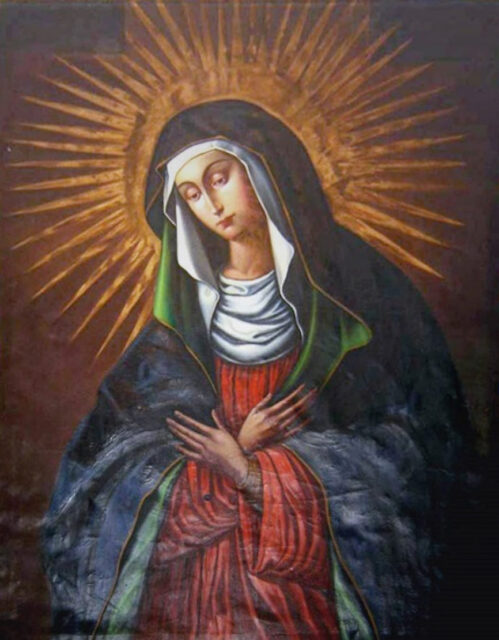
Our Lady of the Gate of Dawn, Vilnius, Lithuania
Believe it or not, the famous Our Lady of the Gate of Dawn was once lightly restored by an artist named Rusiecki. The Polish painter Kanut Rusiecki (1801–1860), who lived and worked in Lithuania, was asked in the mid-19th century to touch up the icon. But it’s unlikely he would have signed it as “M. Rusiecki.”
The signature is more likely his son’s — Bolesław-Michał Rusiecki, who also became a painter. Born in Rome, he learned his craft there before continuing his studies at the St. Petersburg Academy of Arts. In 1853, he earned the title of academician for his allegorical painting The Confluence of the Vilia and Neman Rivers.
Even after studying abroad, Bolesław-Michał spent most of his life in Wilno (today’s Vilnius), under the watchful presence of the Gate of Dawn icon. He was eventually buried there at the Bernardine Cemetery, alongside his wife.
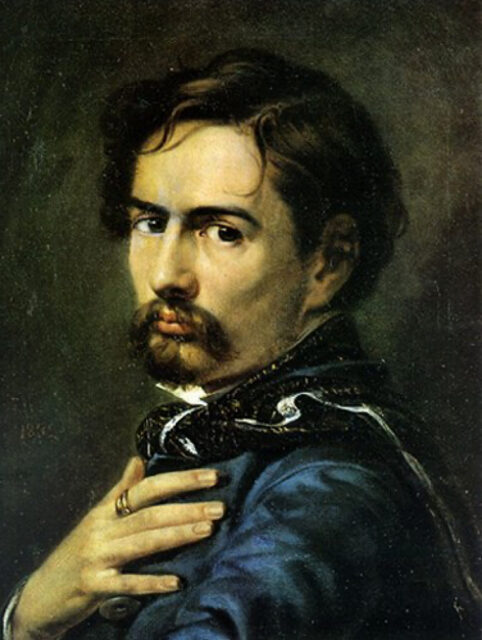
Self-portrait by Bolesław-Michał Rusiecki, 1852. Oil on canvas. Lithuanian National Museum of Art
The portrait of Marcjanna Podóska and the drawing Old Jewish Man stand out from the usual Sofia Kyivska collection — but they have another thing in common. On the back of each piece are old inventory numbers: “No. 3239” on the drawing and “No. 3385/A” on the portrait. It looks like they once belonged to the same, now-unknown museum collection, probably from before World War II. And once again, the trail points west — most likely to Poland or Lithuania.
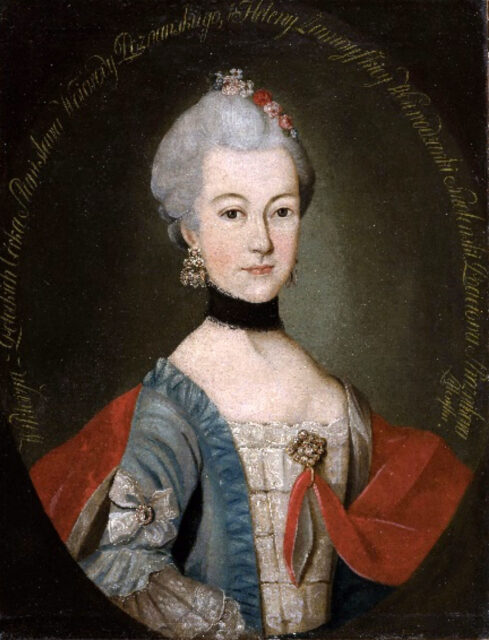
Wiktoria Potocka, portrait by Franciszek Pawlikowicz, late 1760s. Oil on canvas. Lviv National Art Gallery, Inv. No. Zh-4530
Who knows if Marcjanna Podóska will ever return home. Somewhere out there, her husband may have been waiting for her — literally — for almost 300 years. The portrait was painted in 1736, the same year Mikołaj Jan Podóski became voivode of Płock, and the inscription makes the message clear: she was now the “voivodina of Płock.”
There is a reason to believe that Marcjanna’s likeness was once part of a paired portrait set of the Podóski couple. A close parallel can be found in the 1760s portrait of Wiktoria Potocka by Franciszek Pawlikowicz, still on view at the Lviv National Art Gallery. The format is strikingly similar: the same oval composition, the same emphatic titulature. Wiktoria’s portrait is known to have been painted as a companion piece to that of her husband, Ludwik Potocki, a Lithuanian castellan, now held by the National Museum in Wrocław.
Chances are the portraits of Marcjanna Podóska and her husband were commissioned in 1736 to mark the family’s rise in status. They were probably made for the Podóski estate in the village of Rusinowo — now part of Rypin County in Poland’s Kuyavian-Pomeranian region — where Marcjanna spent most of her life.
Whether Marcjanna will ever be reunited with Mikołaj Jan, and whether his portrait still exists, remains an open question. If it does, finding it would feel only fitting.
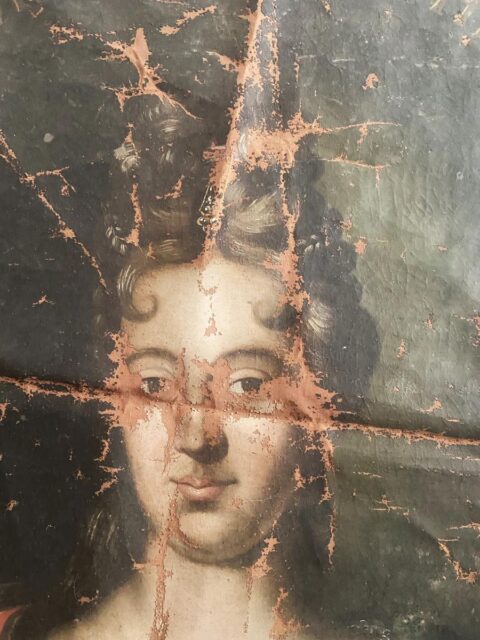
Detail of the portrait of Marcjanna Podolska