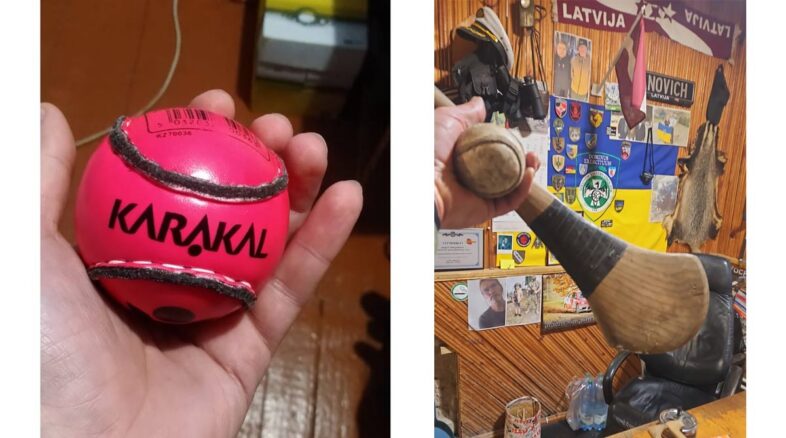
At the headquarters of the 32nd Steel Brigade, a fellow officer picks up a sliotar — the ball used in Ireland’s national sport of hurling — from the table and asks, surprised: “Oh, you play?” I’ve long collected sporting artefacts from different cultures, but this time the ball led to an unexpected encounter. The officer, originally from the Vinnytsia region, put me in touch with Latvian Andis Priednieks, who has lived there for more than 15 years.
A former racing driver and champion in rally and autocross, Andis first came to Ukraine to launch a business making hurling sticks. It didn’t work out as planned, undone by a familiar mix of bureaucracy and war. But he stayed. After the start of the full-scale invasion, he turned his yard in the Vinnytsia region into a full-fledged repair hub for vehicles used by the Armed Forces of Ukraine. We had a brief phone conversation during a short break between his trips to the front line and Latvia.
– Andis, in a way, it was Ireland and its national sport of hurling that brought you to Ukraine all those years ago?
— A colleague once told me about hurling — the fastest game on grass, with a history going back to the 1200s. The sticks used in the game, called hurleys, are traditionally made from the root part of ash trees. At the time, Ireland was going through a construction boom. The European Union was pouring money into the country, and huge areas of forest were cut down for new motorways. Suddenly, they realised they were running out of wood for their national sport: nearly half a million hurleys are broken there every year.
While they were planting new trees, a window opened up in the market. I sent two Latvian guys to Ireland to learn the craft. But ash trees in Latvia grow for more than 100 years, the climate is colder, and the wood is different. Specialists told me there was a country with perfect conditions and plenty of the right kind of ash — Ukraine.
— And you decided to set up production here, in the Vinnytsia region?
— In 2005, I came here with my eldest son and saw that the ash trees were genuinely excellent. At first, I tried working through Ukrainian forestry enterprises in four different regions. I wanted to show them how to prepare the wood properly — you have to cut the stump higher than usual and then dig out the root system. But it didn’t really work out: it’s a very delicate process and needs strict control. I ended up losing a lot of time and money.
So, in 2009, I moved here myself and settled in the Tulchyn district. We struck a deal with the local forestry enterprise — we would train them and work together. Things were going quite well. In Ireland, there are more than 200 master craftsmen, and each county has its own style of hurley, so we worked directly with them, using their templates. In total, we produced over 20,000 hurleys and around 50,000 wooden blanks, which were shipped all across Ireland. Our sticks even ended up being used in Dublin’s main 80,000-seat stadium.
Then Yanukovych [Ukraine’s former president, ousted by popular protests in 2013 – ed.] came to power, and problems with customs began. After the Maidan, the local forestry director started putting obstacles in our way. Then came the pandemic, the war… and production had to be put on hold.
— The full-scale Russian invasion changed your priorities. Instead of making hurleys, you’re now supplying vehicles to the front line. How did you move from that into volunteering?
— When the Russians launched their full-scale war in 2022, I gave my jeep to a lieutenant I knew from our town. His unit was operating behind enemy lines, carrying out difficult missions. Unfortunately, he was killed.
That’s when I decided I had to bring more vehicles from Latvia for his unit. I brought one, then another. I’ve spent my whole life in motorsport — as a mechanic and rally driver — so I understand very well what kind of strain vehicles take at the front. So I started welding frames and reinforcing suspensions.
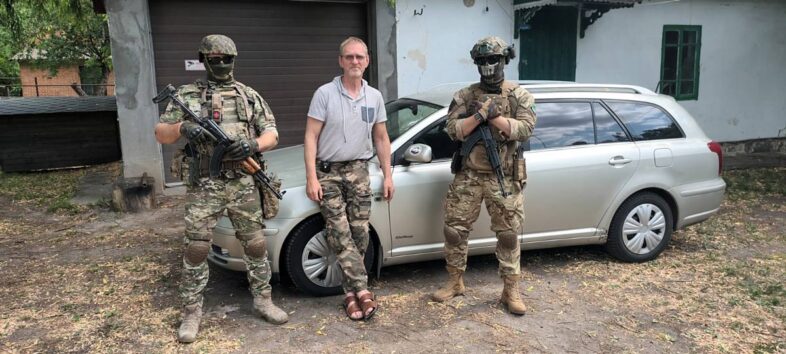
The guys saw the quality of my work and the calls started coming: “Andis, make us another one!” Word spread quickly. Since then, I’ve repaired and sent around 300 vehicles to the front. Just yesterday, I came back from Pavlohrad — dropped one vehicle off there and brought another back for repairs on a tow truck.
Now I have my own workshop here in the village of Mayaky. A businessman from Kyiv even donated the tyre-fitting equipment.
These days, I drive to Latvia every two weeks. I buy vehicles there, bring them back, repair them, get them into top condition and send them to the frontline. It’s hard work. I’m 64 years old. But when I see how much harder things are for the guys on the front line, I feel I simply don’t have the right to stop.
— You buy vehicles in Latvia and drive them here yourself, a distance of about 1,500 kilometres. Who helps you with all this?
— When professional motorsport became too expensive, I moved into mechanics. Today, I’m immensely proud of my student, who went on to become Latvia’s autocross champion. He recently donated his reliable Hyundai Terracan to the Armed Forces of Ukraine. That jeep used to race in brutal winter sprints on Latvia’s snow-covered tracks, but now it has a very different — and far more important — role. Today, that former racing vehicle is serving on the Zaporizhzhia front, pulling Ukrainians out from under shelling and saving lives.
Helping the Armed Forces of Ukraine has become a major collective effort among my Latvian friends. In Latvia, the movement was started by Reinis Pozņaks, head of the NGO Agendum. He came to Ukraine in the first days of the war, saw everything with his own eyes, and put his own life at risk. Since then, Latvians have sent thousands of vehicles to Ukraine.
I also have strong support here in Ukraine from MP Larysa Bilozir and the MHP-Hromadi foundation. They help secure funding. For example, they might allocate 120,000 hryvnias, and I head to Latvia, find the best vehicle I can for that money, bring it back, repair it in my workshop, and hand it over to the military.
Why do we Latvians do this? Because we know exactly what the “Russian world” means. When they came for us in 1940, they set our country back by 50 years. There’s hardly a family in Latvia that doesn’t have someone who was pulled out of their home and sent to Siberia.
We understand this all too well. Tiny Latvia is now putting a third of its military budget into Ukraine. And there’s a real, almost emotional sense of gratitude to the Ukrainian people for standing firm and holding the line against Russia’s invasion.
More than 30 years ago, Dzhokhar Dudayev [first president of Chechen Republic of Ichekria assasinated by the Russians in 1996 – ed.] said Russia was a country that had lost its spirituality and its humanity. The Caucasus, he warned, would not be enough for its imperial appetite — it would come for Crimea, and then for all of Ukraine. But it is here, in this fierce struggle, that it will finally break its teeth.
I’ve lived in Ukraine for 15 years now. My wife and my family are here. When the full-scale war began, many people left. But I realised I no longer have any other country but Ukraine. This is my home, and I will do everything I can to help it win for as long as I have the strength.