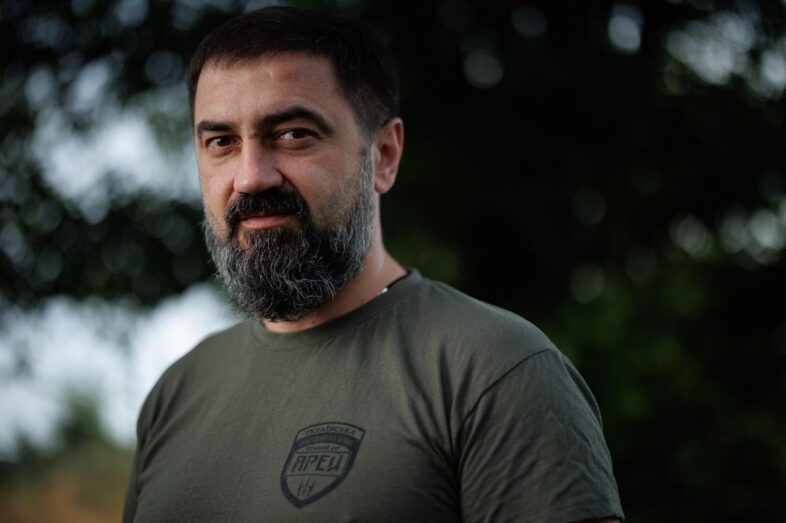
At 27, Kryvyi Rih native Serhiy Zherebylo was already leading a unit at the Inhulets Mining and Processing Plant. He later worked in the company’s management, served on the executive committee of the Inhulets district, and eventually became the district head. When Russia launched its full-scale war, he left his civilian post to join the Defensce Forces. In the Armed Forces, he rose from soldier to deputy commander of the Arey separate assault battalion in 2022. On January 1, 2026, when Arey was reorganised into a regiment, he became the regiment’s deputy commander.
“In 2022, people were confused, some were scared and ran,” Zherebylo told The Ukrainian Week. “I realised there was nowhere to run — we had to act, and the first step was gathering people. With the guys from Inhulets, we headed to the Kherson region. At first, we were like free fighters, doing our own thing. Then the 60th and 17th brigades moved onto the right bank of the Inhulets River. They asked who we were. We said we were the ‘Kherson direction’ group. And who’s in charge? That’s how I got the call sign ‘Kherson.’”
— At the start of the full-scale invasion, you helped evacuate many people from occupied areas. How did that operation unfold?
— We weren’t regular soldiers yet, though some of the guys from my Inhulets neighbourhood had experience from the ATO. But when the Armed Forces started pushing back the Russians and liberating the first settlements, like Krasnivka and Pryhiria, and the land was still burning, people needed help. Back then, we were basically acting like partisans, doing whatever we could. With support from the mining and processing plants and Kryvyi Rih’s city leadership, we brought in equipment, dug trenches, and built fortifications.
Many people were under occupation in Arkhanhelske and Velyka Oleksandrivka. In March, it was still cold — alternating between sleet and frost. Those who could flee crossed the river, and we helped evacuate them with local farmers. Later, someone asked me if I knew how many people we had moved. Over 1,500! It was daily work. Many were sick, and we helped them across the river, hiding them under tarps in a tractor trailer, moving as if we were doing farm work. Then we settled them in Kryvyi Rih. We also handled evacuating the deceased.
— Back then, Ukrainians managed to halt Russians right on the outskirts of Kryvyi Rih.
— There were many civilian excavator operators — from the water utility, the mining and processing plants, the heating network, and private companies. They were digging caponiers and trenches while our tanks waited about a kilometre behind them. One man would operate the excavator, another would listen for incoming shells. If something came in, the only option was to jump straight from the machine into the crater. The enemy burned two of our tractors, but everyone survived. These were real men.
We were also tasked with restoring a communications hub at a grain silo in Bila Krynytsia, under the cover of the National Guard. It was our first combat mission — a tough one, but someone had to do it. By then, I was a sergeant commanding an engineering and sapper platoon. This was April–May 2022. We already knew “Makedonets” — Oleksandr Hryshchuk, the commander of the Arey regiment. His group was near Bilousove, while we were a bit further away, near Velyka Oleksandrivka. Snipers were already targeting us. We chased Russian sabotage groups, and they chased us. It was a completely different kind of war from what we see today. There was no stable front line yet, far fewer drones, and in many places you could still move around on foot…
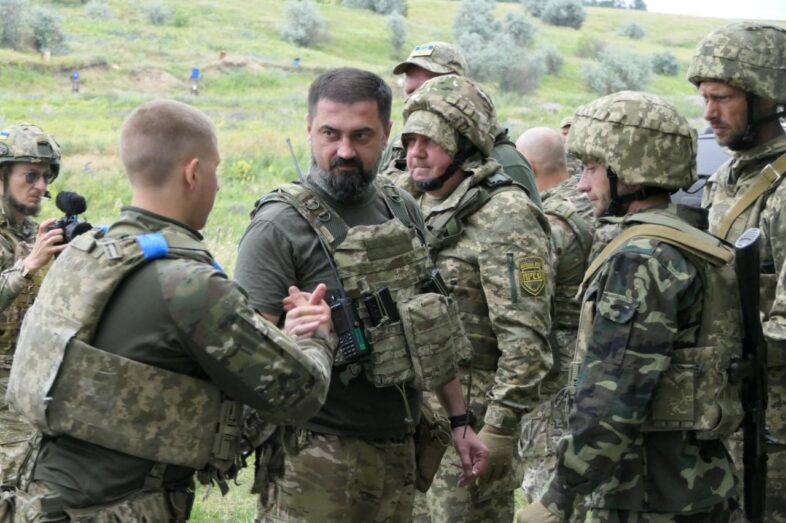
— What was it like going from the district office straight to the front lines?
— Kryvyi Rih stretches for 126 kilometres. Its southern part is the Inhulets neighbourhood, home to about 40,000 people. Nearby is the mining and processing plant, with large water reserves, bomb shelters, and tunnels.
The Russians had a plan to seize Inhulets and cut it off from the rest of the city. If, God forbid, they had managed to hold the plant, their artillery could have reached the centre of Kryvyi Rih. It could have turned into a second Bucha — especially since Buryat troops were advancing at the time.
We did everything we could to stop that. People came out into the streets, built checkpoints, and made Molotov cocktails in their garages. We held the enemy at the approaches to Inhulets. They tried three times: first sabotage groups attacked from the left flank — we pushed them back. Then they came from the right. The weather also helped us. The asphalt roads were mined, and the fields were muddy up to our necks. Inhulets held.
That was when I had to turn the page on my old life. Start from scratch — from soldier to platoon commander — and bring people together. You can give everything you have if you believe in what you’re doing. And even more when you trust your people, and they trust you. That’s when you get results.
— How did the Arey battalion get started, and how did it grow into the regiment it is today?
— Makedonets tactical group was called “Arey.” They were volunteers who had already carried out combat missions. My platoon handled more specialised work. We met in the Kherson region and from the first day became practically brothers. Later, we had to move from being what we called “free Cossacks” to becoming an official unit. My guys and I held a general assembly. I joined the first battalion of the 129th Territorial Defence Brigade and explained to everyone that this war wouldn’t be over in a day — we needed proper support and social guarantees, in case, God forbid, something happened to anyone. Oleksandr gathered the group and proposed that we join the Territorial Defence Brigade. We were offered the chance to form our own rifle company.
That was May 2022 — the beginning of Arey as an official unit. Soon after, a directive came to create the 7th battalion within the brigade. Our company had already proven itself, so the decision was made to build the battalion around our unit.
It felt a bit like the old Cossack tradition — we gathered together and chose our commander and deputy by a vote. That’s how, in August 2022, we became a rifle battalion. We began recruiting — mostly volunteers from Kryvyi Rih, Zaporizhzhia, and Mykolaiv.
The battalion was being formed while at the same time carrying out missions in the Kherson region. It played a direct role in the liberation of Kherson, and by the end of 2022 its fighters had freed a number of settlements, pushing Russian forces back to the Dnipro River. For two months, they held positions on the riverbank opposite Enerhodar. On December 31, they received orders to redeploy to the Zaporizhzhia front, covering the Varvarivka and Huliaipole areas. They completed the mission without losses, and on March 7 were tasked with moving to the Donbas, to Novosilka.
After a long period of preparation, they first carried out defensive operations before going on the offensive on June 8. Their sector included Velyka Novosilka and Neskuchne. There, they achieved significant gains, pushing the enemy almost to Staromlynivka in the Volnovakha district — first alongside the 108th Territorial Defence Brigade, and later with the 35th Marine Brigade.
In 2023, however, they ran into far tougher resistance. Up to that point, when Ukrainian forces pressed, the Russians would usually fall back. Neskuchne had already been stormed several times — two brigades had tried and failed to take it. This time the approach was different, and it worked. There were losses, but they were minimal. The defenders were Wagner fighters and they fought hard. Still, the unit managed to break through Surovikin’s notorious line and inflict heavy losses on Russian forces.
Later on, we were redeployed to the right flank near Staromaiorsk, where heavy fighting raged in the groves. Following a month of recovery, we were tasked with special operations by the Main Intelligence Directorate, starting in Russia’s Belgorod region. We captured the village of Kozynka, marking our first parachute insertion. The operation impressed the intelligence service — we proved we could get the job done. Then, like a firefighting crew, we held Russians back and patched gaps in the Zaporizhzhia defences. Next came another special operation with the Main Intelligence Directorate in the Kharkiv direction. By that time, we were already a separate assault battalion — an independent unit.
During the Kursk operation, we were once again attached to the 129th Brigade and went on the offensive. It was intense fighting, a complex operation, but we held our ground and completed the mission. In spring 2025, after a brief recovery, we returned to the Kharkiv region for more special operations. By August, we were back in Donbas, tasked with cutting off Russian salients during a breakthrough that had advanced nearly 20 kilometers.
— What do you remember most from your time in Donbas?
— From October 8 to 10, we pushed back the biggest attack near Volodymyrivka. Arey stormed and cleared two settlements. The Russians regrouped and launched a major counterattack — first with two groups on motorcycles carrying soldiers, then with 21 armoured vehicles. It was a fierce fight, but we held our ground and destroyed all their equipment and troops.
By that time, we were already part of the main assault forces. That’s how we grew into a regiment. Today, Arey has seven battalions.
— How did things change once Arey became a regiment?
— A regiment operates on a different level. It requires a different kind of planning — not just tactical tasks, but strategic-tactical ones. Right now, we have three company-tactical groups on the front, stretching from Sumy to Zaporizhzhia. At the same time, we’re building up the strength needed to carry out operations as a full regiment.
The greatest value of our regiment is that we’ve stayed together. One for all, ever since 2022. No one here is chasing a military career — people came for different reasons. The volunteer spirit that defined the battalion has carried over into the regiment, and the personal bonds are still there, without the usual army formalities.
I’m not sure there are many units that have remained together with the same commanders since the start of the full-scale war. The fight goes on, and there’s still a lot of work ahead.