Heroic defence and halting the enemy. Assaults and counteroffensives. The Kursk operation… Over four years of full-scale war, “Arei” has grown from a group of 30 volunteers into a regiment. On the anniversary of the start of the great war, its commander, Oleksandr Hryshchuk, reflects on the unit’s combat path.
A group of 30 volunteers joined the Defence Forces and blocked the enemy’s advance through southern Ukraine near Voznesensk.
“We started pushing them back and reached Snihurivka,” Hryshchuk recalls. “That’s where trench warfare really set in. From there, we moved into the Kherson region, and that’s when ‘Arei’ began to take a more structured shape. More brothers-in-arms kept joining, and before long, we were around a hundred strong. We joined the sixth battalion of the 129th Territorial Defence Brigade as a company. Reinforcements kept coming, and we continued to grow. Eventually, we decided to form a second battalion within the 129th — that’s how the ‘Arei’ Battalion was born.
Before that, our company had been pushing back Russian forces near Oleksandrivka and Arkhanhelske. Once we became a full battalion, we held the line near Velyka Oleksandrivka in the Kherson region — the point from which the counteroffensive really began.”
For the regiment’s commander, 2022 is also defined by the successful defence of Bilousove in Kherson, a position few were willing to hold, as well as the assaults on Velyka Oleksandrivka and Arkhanhelske, and the attacks through the tree lines, where, tragically, losses were unavoidable.
“We reached Sahaidachne — it used to be called Maksym Gorky,” the commander recalls. “That’s when they told us: stop, time to regroup. In Nikopol, we were assigned to guard the river line to stop any landing operations.
We didn’t stay there more than a month before being sent toward Mariupol, where we recaptured two company strongholds. From there, we moved a short distance to support another Territorial Defence brigade. Later, we got orders to replace Azov in Velyka Novosilka in Donetsk. We took up defensive positions there, arriving on March 8, 2023.
At the end of the summer, we were ordered to assault Neskuchne. We stormed Neskuchne and pushed on to Makarivka and Storozheve. After that, together with the 35th Marine Brigade, we launched an assault on Staromaiorske. Once we retook four more tree lines, we were pulled back to recover.”
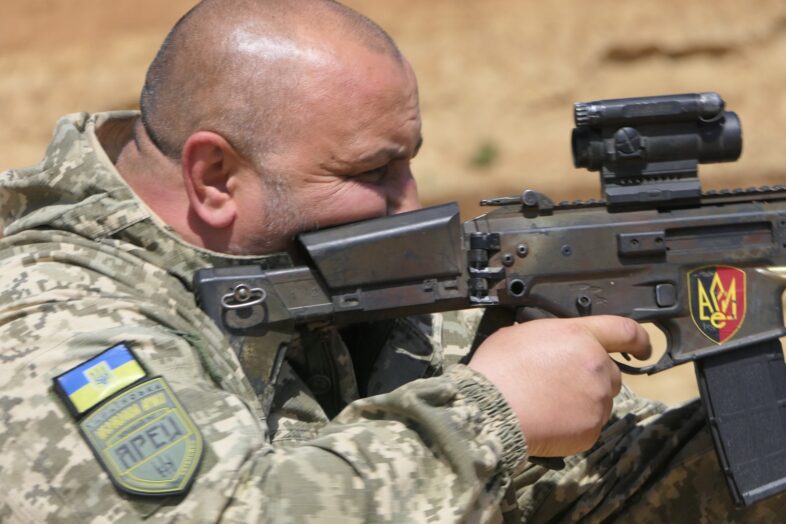
A month of rest — and then back into the fight, this time shoulder to shoulder with units from Ukraine’s Main Intelligence Directorate. By early 2024, the fighters of “Arei” were already crossing into Russian territory, assaulting Kozinka in the Belgorod region. They also fought near Vovchansk, where intercepted intelligence showed that Russian forces had begun to openly fear “Arei.”
“Why were we chosen for HUR [Ukraine’s military intelligence service – ed.] operations? Because we’re just as crazy as they are. They’d heard we complete our missions one hundred percent,” Oleksandr Hryshchuk says.
Next came battles to retake positions in the Zaporizhzhia region, and from there — a new chapter: the Kursk operation. “Arei” fought in the Kursk region for nine months. “For our guys, it doesn’t matter where they’re sent, as long as they’re fighting. We captured a lot of prisoners there. But the Kursk operation was tough — new terrain we had to adapt to. We’re used to fighting in the steppe, but there it was forests. We needed a different tactic…”
The fight for Ukraine in 2025 did not pause, despite negotiations and diplomatic meetings. “Arei,” of course, did not stand aside. And on January 1 this year, the battalion officially became a regiment. “It means a broader front of attack, more work, and more responsibility,” the commander says.
Oleksandr Hryshchuk was a reserve officer before the war, so when Russian aggression began in 2014, he joined the ranks of the Armed Forces of Ukraine. He fought in Shyrokyne and Marianka.
“The Russians were never my brothers — I know our history well… So I went into this war against them without hesitation. It should have started even earlier. This war should have been waged by our parents back in 1996, when our nuclear weapons were taken from us. They stayed silent — and the result is that we are fighting now.
Back in 2014, though, we were many years younger, so it wasn’t easy. There are memories from those times, but I see them as training, close to real combat. Without those years on the Donbas front, 2022 would have been much harder. Many guys learned to fight back then and already knew what to do. A lot of those who were with me in 2014 are now in ‘Arei’ as well.
When the full-scale war started, the first thing we did was hit enemy depots. The first battle of the big war? A tank showed up and started firing at us — everyone ran, we stayed. I’ve been used to that since 2014. In this war, we hit them [Russians – ed.] so hard that I think, once we win, they won’t be coming back for a long time. Everything will be Ukraine — that’s my motto.”