At the training ground of the 32nd Separate Mechanised Steel Brigade, basic combined-arms training (BCAT) is in full swing. Recruits, divided into three groups, move cautiously through a strip of forest. Today’s focus: radio communication during tactical movement.
“I might disappoint someone, but I don’t have a soldier with the callsign ‘Ya.’ I don’t understand who’s reporting to me,” a hoarse, stern voice crackles over the radio. The speaker is an instructor with the callsign “Pukh.” Sitting in a dugout beside a radio station, he monitors every step the recruits take. His job is to teach yesterday’s civilians not just to press the button, but to transmit vital information clearly, concisely, and without panic.
“Pukh, Pukh. Leshy calling. I see a trench at one o’clock,” the radio hisses uncertainly.
“Leshy, copy. Check carefully and move on. Did you copy?” the instructor responds instantly.
“Akula, I hear you and copy. What do you need?”
“I see a tangle at ten…”
“Akula, copy. Move carefully — there could be tripwires.”
Unpleasant surprises are part of the training. During an engineering exercise, another group of recruits had deliberately left tripwires rigged with training PIRO-5M grenades. Every few seconds, the radio springs to life. At first, the messages are jumbled, words get lost, and signals overlap. Pukh lets out a sigh.
“I’m teaching them to report at every step so they’re not afraid of the radio. In real combat, of course, they won’t describe every branch. But right now, we need to break that fear of the handset. Especially those fresh from training—they’re scared to speak because back there someone yells at them. I don’t yell; I teach. But time is short, and it’s precious. I advise them to run through in their head first what they’re going to say: press the button, wait for the sound, then give the report.”
The recruits make their way back to the start of the route. “I’m in position, movement complete,” they call out from the bushes.
“Minus, Yuvelir, minus!” the instructor snaps. “You didn’t reach the strong point, you didn’t take up a defensive position. That’s your biggest mistake. You haven’t even arrived, and you’re already reporting you’re there. The commander thinks you’re in cover. What if the enemy already holds the position? Fire opens, you yell ‘Contact!’ The commander sends FPV drones. Who do they hit? The one storming the strong point—that’s you. Reporting ‘in position’ only counts once you’ve entered, checked, and secured the building. Only then.”
All the groups return to the dugout, soaked and focused. The debrief begins. “Any questions? Honestly, I should get a medal today—I didn’t swear once during the whole exercise!” The men laugh, the tension easing. “Alright, go grab lunch. After that, you’ve got a tough afternoon. The instructors will put you on the range. My job’s the easiest—I just talk to you,” Pukh jokes.
Sergeant Ihor Korotkevych, known as “Pukh,” is 49. Before the full-scale war, he ran a farm in the Chernihiv region. Then the Russians arrived. After surviving the occupation, he volunteered for the army. He fought near Kupiansk and Toretsk, partially losing his health, but stayed in service to pass on his experience.
“I just scolded a guy for having his radio too loud, and then I remembered how once that saved a life,” Pukh smiles. “We had a commander who went the opposite way—he’d say, ‘Turn the radio up full blast!’ And then yell over the air: ‘Hit them with thermobarics, burn them all out!’ The bastards heard it and… just walked right out to surrender. But that’s the exception. Most of the time, the sound should be kept to a minimum.”
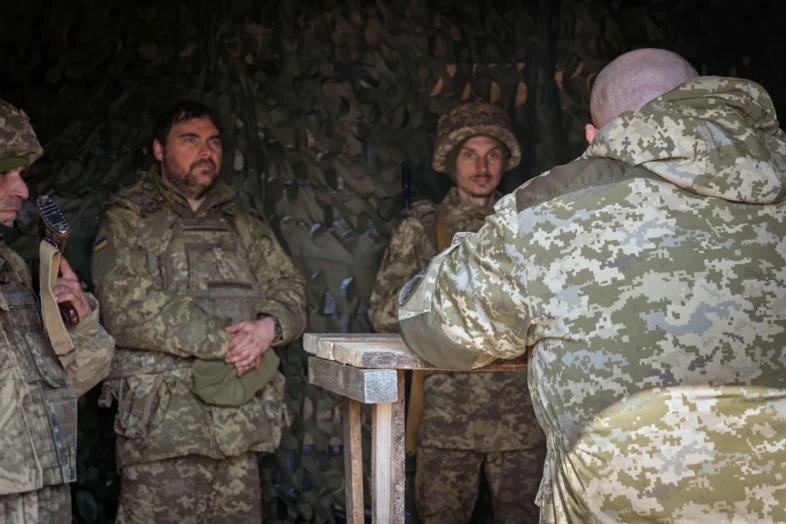
“We’re not here reading them some old notes from who knows when. Every one of us has combat experience, and we teach what we’ve lived through ourselves, along with what we hear from unit commanders. War moves—it doesn’t stand still. Take our 1st mechanised battalion: they were the first in the brigade to start charging radios from FPV drone batteries. They got adapters, and I’m already showing recruits how to do it. When you’re stuck in a dugout for weeks without a generator, but need constant communication, this can save your life.
We’re constantly talking to guys coming in from scratch, and we immediately fold all this fresh experience into training. We teach properly because every one of us has comrades on the front lines. You know you’re preparing reinforcements for them. I’d be frustrated if they sent some untrained rookie who we’d have to fight alongside—and train under fire.
Sometimes, a sergeant has to go beyond combat lessons and tell newcomers what motivated him to volunteer in the first place.”
“Before the full-scale invasion, I lived in the Chernihiv region, in Novhorod-Siverskyi district,” Pukh continues. “I kept cows—sold milk, butter, cheese. In the first days of the war, we were under occupation. The Russians didn’t enter our village because it was off the main road, but across the district, they were brutal. We were completely cut off, without any supplies.
My youngest daughter was six. She came up to me and said, ‘Daddy, I want some sugar.’ A child doesn’t understand war. She was used to getting what she asked from her dad—though I never spoiled her. And here I am, a grown man, head of the household, unable to get two measly kilos of sugar for two weeks. That feeling of helplessness in your own home—I’ll never forget it.
As soon as the occupiers were driven out, I went to the military commissariat myself. No one handed me a summons.”
“I’d done my conscript service back in 1993–1995, in a construction battalion. I’d never trained as a radio operator or had any connection to the military before. Once in combat, they handed me a radio—and off I went.
At first, I joined the 405th Rifle Battalion. I went through basic training in Starychi and was then sent to Kupiansk. I was assigned to an anti-tank platoon, but mostly we were used as infantry.
After leaving the positions, my back locked up badly. I’d had problems before, and the body armour didn’t help. I was hospitalised in Sumy and told not to lift more than seven kilos. They planned to move me to the reserve company since my duties were limited. But the unit needed an experienced radio operator at the command post, so they put me there and said, ‘We’ll pull you out in two weeks.’ This was in Toretsk. Serious fighting began. My medical certificate had expired… and I ended up staying in the unit. I got the radios in order. There was heavy artillery fire back then. I went for rehab, ended up in a psychiatric ward, and from there returned here, to the instructors’ group.”
“There’s no point in trying to make me an infantryman anymore: my back is shot, my legs give out, I can barely hear out of my right ear, and I don’t even try to aim with my left eye—I can’t line up the front and rear sights. It’s all from concussions, though none of it is officially recorded, because when you’re concussed, you often don’t leave the position for a week. And the scar on my cheek? That’s from before the war—a leftover from the ’90s.
But as an instructor, I can still be useful. Many of the guys come straight from the front and say ‘thank you.’ I feel like I’m helping them, even if only a little.
I don’t always share my experience of being under occupation with newcomers—only when they start showing off.
Sometimes they whine: ‘Why me? Everyone should stick to what they do best. I’m not cut out for this war.’ I tell them, ‘And what am I, a professional soldier? No, I joined the army back in 2022.’ They ask, ‘You came yourself? V0luntarily?’ I answer, ‘Imagine that. And people like me are running out.’
“These ‘why me?’ complaints frustrate me. I ask them, ‘What about the ones who’ve already fallen? Or those left wounded?’”
“We have instructors here who aren’t even thirty. Young guys who signed contracts from day one and went in as stormtroopers. Now they’re shot up, deaf, crippled. Look at ‘Picasso’—tall, strong, handsome, and he’s lost an eye and an ear. Or ‘The Frenchman’—a sergeant, a good young guy, 26, but his leg is a major issue.
And you hid from the war for four years. Sat at home, ate, drank, slept soundly. And now, brought here, you suddenly think you’re sick?”
Since December 2024, the 32nd Separate Mechanised Steel Brigade has held firm on the Pokrovsk front.