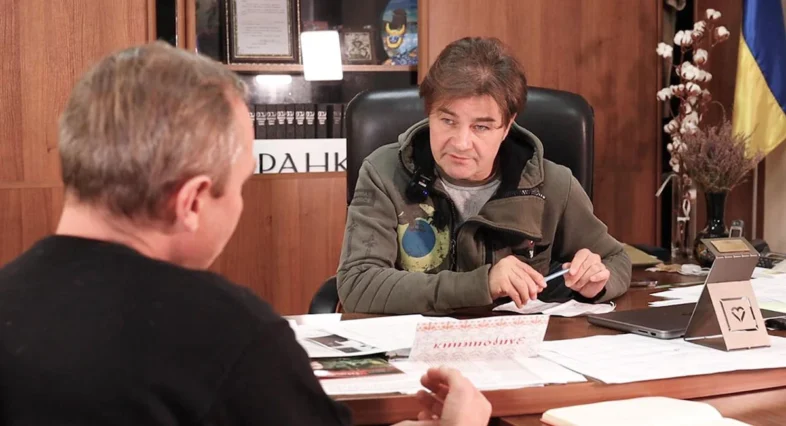
In this exclusive interview with The Ukrainian Week, Yevhen Nyshchuk, twice the Voice of Maidan, twice Minister of Culture, and now the General Director and Artistic Director of the Ivan Franko National Academic Drama Theatre, reflects on a range of pressing topics: the defence of Kyiv and the liberation of Kherson, the theatre boom during the war, and the reasons behind people’s fears of mobilisation. He also discusses how artists are helping to bring victory closer and shares what impressed world leaders like Scholz, Macron, and Trudeau about The Konotop Witch.
***
— How did the war start for you?
— For me, Russia’s full-scale invasion of Ukraine felt inevitable. I remember my father warning me about it back when I was in school. He always said that one day, Russia’s true face would be revealed to the world. This was our eternal enemy, the same force that sought to crush the [Ukraine’s] Cossack state, to destroy our quest for freedom during the era of the Ukrainian People’s Republic. It was the power that tormented us with famine, wiped out our Shot Renaissance, and decimated our intellectuals, scientists, and cultural leaders. And, of course, after the Maidans, it had already begun. The so-called Anti-Terrorist Operation (ATO) marked the start of this war.
Psychologically, I was prepared, and many others were too—not just me. But for the majority of Ukrainians, it was a shock. How could this happen? Rockets striking cities across Ukraine, hitting every corner, regardless of religion or language.
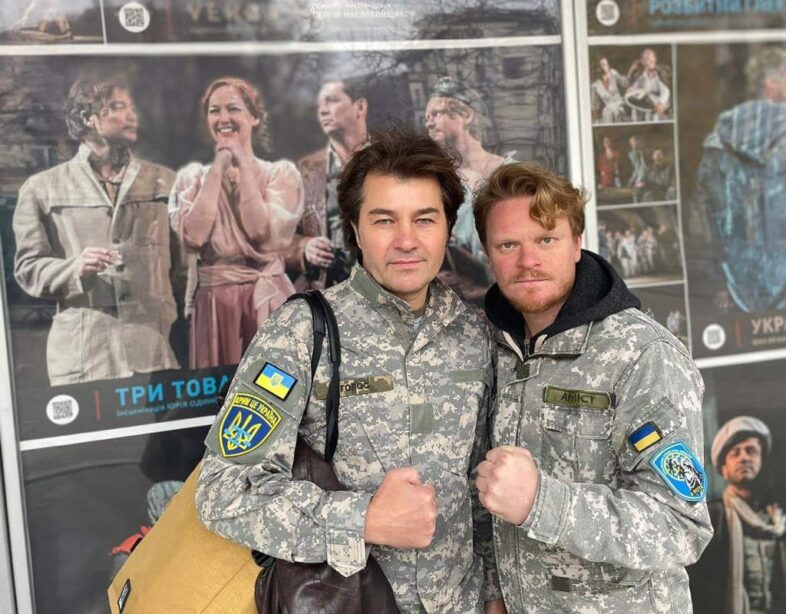
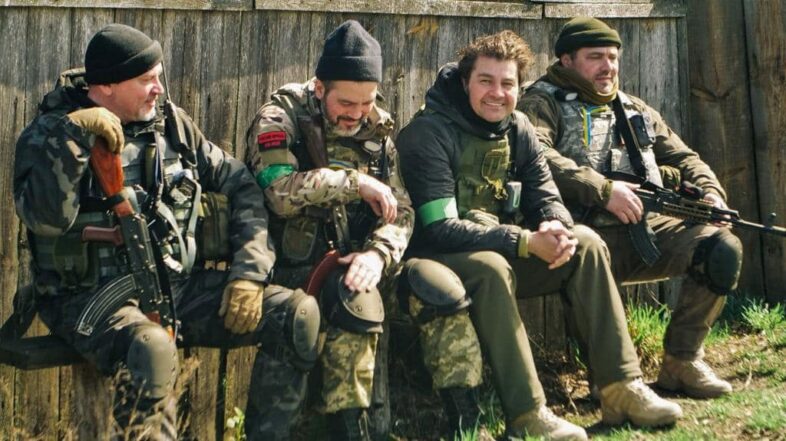
The first instinct was clear: join the Defence Forces. I immediately rushed to enlist in the Territorial Defence. At that point, though, there was an overwhelming number of volunteers. I signed up and was told to wait. But I couldn’t wait for long, and there was no telling how long it would take. A volunteer battalion was formed in my area, and it started operating in the Kyiv region. We formed an aerial reconnaissance team and headed to the outskirts of Bucha, Stoianka, and Hostomel, working alongside military brigades.
After the Kyiv campaign, we continued tracking down Russians who had ‘lost their way’ in the Chernihiv region. Then, we were offered a chance to head south. By that point, I had already formed strong bonds with my comrades—people from all walks of life, some with combat experience. They all agreed to go, and I said I was in too. They hesitated and told me, “Zhenia, think about it, maybe you shouldn’t.” But I didn’t see why not.
So, we went. I officially enlisted in the Mykolaiv region, in Voznesensk, where I was assigned. As volunteers, we became soldiers of the Armed Forces of Ukraine.
— By that point, the Russian advance had been stopped, the front had stabilised, and preparations were already underway to drive the enemy out of the Kherson region?
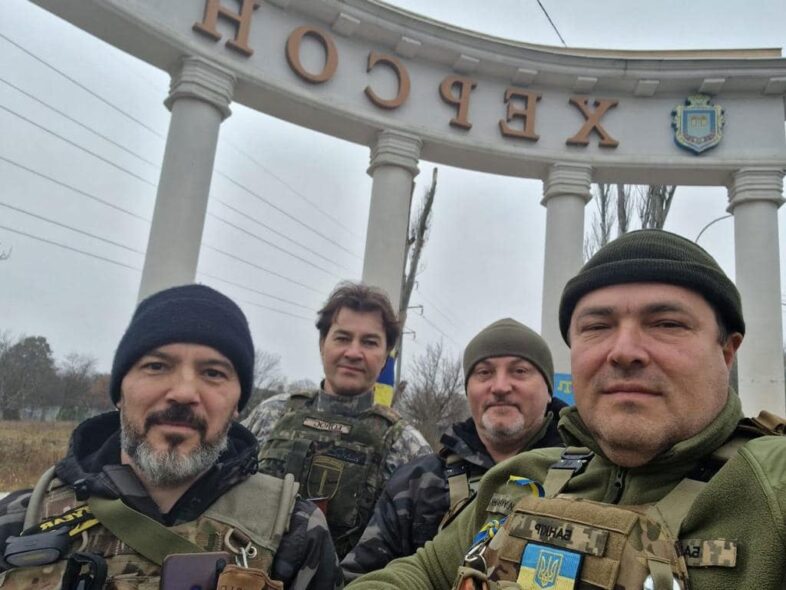
— Exactly, the Kherson campaign, as we called it. Pravdyne, Shevchenkove, Stanislav, and many other villages where we scouted the areas we would eventually liberate. And, of course, Kherson itself.
— What was it like when you entered the liberated towns and villages? How did the people welcome you?
– The Kyiv campaign was shorter, but I clearly remember the moment on March 29th when everything suddenly went quiet. At first, we didn’t understand what was happening; then, we were told the enemy was retreating. It was an incredible feeling. I remember how we made our way to the Romanivskyi Bridge, which had been blown up, crossed under it, grabbed a car abandoned by some taxi drivers, and raced at full speed. From there, we worked at various locations, eventually reaching Bucha. And that moment, when you could finally look around and see… unfortunately, what we saw were the brutal Russian atrocities.
It was the same in Kherson. On the third day, when I entered the city with the guys, the emotions of the people who had endured nearly eight months of brutal occupation were overwhelming. When the children ran up to us, they didn’t ask for anything. We had brought supplies, but they didn’t care about that — they were just so happy to finally be able to come outside. It was an indescribable feeling.
I went to the theatre because I’d heard that some corrupt officials had started collaborating with the Russian occupation authorities. I thought I’d check it out and see if I could catch anyone in the act. But when I got there, I discovered they’d all hidden away, and everything was locked up. I didn’t want to break anything, so I just recorded a video. I sent a message to my colleague, theatre director Oleksandr Knyha, saying, “That’s it, we’re taking back our theatre.”
Unfortunately, due to constant shelling, the theatre can’t operate fully right now. It’s running partially in Mykolaiv and occasionally comes to me at the Franko Theatre, where we provide a stage. But entering Ukrainian Kherson — that was truly one of the greatest feelings of pride, joy, and happiness I’ve ever experienced.
— I know you continued working in the theatre while fighting…
– I didn’t go back to work as usual. I was allowed to leave now and then, maybe once or twice a month, to perform. But it wasn’t immediate — it took about six months before the theatre could fully reopen at its own venue. In the meantime, we started performing at the Lesia Ukrainka Theatre in June. One play, Three Comrades by Remarque, really stood out. It hit home with the emotions soldiers are feeling right now. It lifted spirits and felt especially meaningful. So, I’d sometimes take a leave, get permission for a short break, and then return. There wasn’t much work at the time anyway.
— How does it feel to move between the front lines and the civilian world, where some people seem disconnected from the reality of the war?
– This war is different. The nature of it means you can go on specific missions and then return, but of course, some soldiers spend long stretches of time, day and night, in the trenches — it’s different for everyone. At times, the discomfort was overwhelming, to say the least. There was even a sense of inner outrage. You arrive in one part of the country where life seems to go on as if nothing is happening, and then you head back to the front, where everything is exploding — where blasts tear apart cows and animals, and you witness it all. It’s incredibly difficult, psychologically.
The toughest moments often come during rotations or while waiting for redeployment. Active engagement keeps you focused. Yes, it’s risky, but you know exactly what you’re doing every second.
— What about fear? A lot of people are terrified of joining the military. Some are willing to pay huge sums to avoid it, even risking their lives to escape mobilisation…
– I joined the military without a second thought. But later, when personal family matters led to my transfer to the reserves in April 2023, I realised just how difficult it is to demobilise. Right now, for many, the biggest fear is the uncertainty of when they’ll be able to leave. No one knows how long the war will last. For many people, it’s psychologically crucial to understand: am I signing up for one year or two? If I survive, if I have the strength and health, I can continue, but at least knowing there’s an endpoint — say, two years down the line — brings a sense of clarity and relief.
That uncertainty, the fear of not knowing anything, is truly terrifying. Many people I’ve spoken to feel this way. Back then, we didn’t think about it; we just went. Now, people think: I’m joining, but how do I get out? That’s why a law specifying a defined term of service is so necessary. People are losing their professions, their jobs, and may never be able to return to their previous careers. Every profession has its unique aspects. Three years is a long time, and on top of that, there’s psychological fatigue. I’m not even talking about the physical toll. Physical exhaustion can be managed — you sleep it off, and that’s it.
— How did you reintegrate?
— I was experiencing a genuine case of what’s commonly referred to as PTSD. In January 2023, when I returned from the frontlines during a rotation period and was preparing to transition into the reserves, the condition became unbearable. I didn’t know what to do because I couldn’t function fully in civilian life, yet I was no longer capable of carrying out the role I had performed on the frontlines for two years.
— What do you think can help in moments like that?
– Having specific work to focus on is crucial. We’re even starting to engage with the veteran community here at the Franko Theatre. For those returning after severe injuries, having a job and something meaningful to dedicate themselves to is incredibly important. The uncertainty of not knowing where to go — whether at the front or in civilian life — can lead to serious consequences.
— How did you transition back to the theatre in this new role?
– In truth, my appointment as the head of the legendary Franko Theatre wasn’t entirely unexpected, given my experience from two terms as Minister of Culture. First and foremost, it met all the criteria for leading a national institution. Being a People’s Artist or a well-known actor on its own isn’t enough to become a director. The role requires over three years of leadership experience, both administrative and artistic, and it turned out I was one of the few in the theatre who met this requirement. The collective wasn’t keen on someone from outside or from a different theatre. I’ve been working as an actor for over a decade.
The previous director, a highly respected figure, was in his seventies and had completed his mission as his term came to an end. So, the transition was somewhat expected and unfolded in a fairly balanced way.
For me, though, it was still an emotional and multifaceted experience. This is, after all, a legendary ensemble. It’s a huge responsibility – overseeing an enterprise of around six hundred people. It’s not just about performances; it’s about ensuring this vast creative organism continues to function smoothly.
— How did the theatre welcome you as its director?
– I can’t speak for everyone or get into their minds, but the overall atmosphere and the feelings I’ve experienced have driven me—and continue to motivate me—to do great work. Above all, the pressure of not letting anyone down is something that weighs heavily on me. It’s something I care deeply about. I’ve had many discussions with colleagues about areas that need different approaches or shifts, and of course, I’m focused on implementing those changes. Plus, I have a strategy and a programme that I share with the team, and naturally, I need to keep pushing that forward.
— Now that you’re seeing the theatre from the director’s perspective, how have your expectations and plans changed?
– Honestly, I owe a lot to everyone, especially to the team, because this is a collective effort. In a very short time, we’ve made significant strides—not only in rebranding the theatre but also in solidifying its role in society. What happens on stage can take many forms, but what matters most is how the theatre presents itself in this challenging time. We’ve expanded beyond just performances.
Within our walls, we’ve launched social programs like “Voice of the Theatre.” Our venue is now a home for theatres that have lost their own spaces—places like Kherson, Sumy, Luhansk, Mariupol, and Kharkiv. This is about helping friends in difficult times. We also collaborate with the veterans’ movement and focus on renovation and inclusive programs because accessibility is more important than ever.
I’m not one to focus only on repairs, though. It’s crucial to have compelling arguments when approaching businesses and financial institutions to invest in the theatre during such a challenging period. I’m incredibly grateful to the partners who stepped forward—first and foremost, Sense Bank and Visa. These are socially responsible companies, alongside the state sector, which truly understands the importance of art and theatre, including the Franko Theatre, both within Ukraine and internationally.
We’re breaking myths as we go. The theatre was once seen as something static, only reaching certain layers of the Ukrainian diaspora. But now, we’re on a major tour of leading cities in Europe, bringing productions like The Witch of Konotop (a satirical novel by Ukrainian writer Hryhorii Kvitka-Osnovianenko, written in 1833 – ed.) and Caligula to new audiences. And what’s even more exciting is that non-Ukrainians are buying 85% of the tickets. This is significant. It shows that people want to see us, our Ukrainian culture, and understand what we stand for. This is cultural diplomacy in action—using culture as a form of soft power.
We’re also opening up our space for exhibitions. We regularly host presentations from various partners and creative groups. One of the most notable events was an exhibition by one of Ukraine’s most prominent contemporary artists, Ivan Marchuk, held at the Franko Theatre. Initially, people questioned why we’d host an exhibition—aren’t there enough galleries? But we felt that, in the context of theatre, it made perfect sense to showcase Marchuk’s works on Taras Shevchenko. These pieces, preserved by the Shevchenko National Reserve, are rarely displayed, and it felt fitting to share them with our audience. Now, with nine hundred people attending performances every day, they also have the chance to engage with these important works. We’re telling the story of our history, our present, and the pain our society is enduring during the war.
In just six months, we’ve raised and transferred over six million UAH (approximately 162,000 USD – ed.) to support the Ukrainian Armed Forces through the Povernys Zhyvym Foundation. We don’t just provide tickets; we also donate entire boxes—my own director’s box included—for raffles to help fund the purchase of essential items for our defenders. In total, we’ve raised around 10 million UAH. Having returned from the front myself, I understand that we’re working in two ways: those who are on the front lines and those who support them. We’re the ones working for the front.
There are nineteen of us still on the front line—there were twenty-one, but Alexander Pecheritsa and I are now in the reserves. Sadly, two of our colleagues have gone missing, but we remain hopeful. We’re deeply involved in all the processes that are shaping Ukraine right now.
We’re constantly travelling with theatrical brigades to military units and rehabilitation centres. I personally accompany my colleagues on these trips, visiting frontline cities in small groups with concert programs, excerpts from performances, and simply offering words of support. It’s something that’s truly needed.
— Is there a demand for such things?
— Right now, we’re experiencing an incredible boom, and it’s truly amazing. And not just at the Franko Theatre. People are craving live energy. Cinema has always been, is, and will continue to be wonderful and necessary. But in the end, you watch the screen and evaluate the film. In theatre, though, you feel the energy in the moment. It’s a remarkable exchange. At the end of a performance, there’s almost a shift in the applause. Initially, the audience is applauding the actors, grateful for their work and the performance. But then, it feels like they’re applauding themselves—because they see each other.
Even after the Shahed drones attack and rockets rage through the night, we still come to the theatre. We show up and send a message to the enemy: we are here, we keep fighting, creating, and loving. And that means we will surely win.
The performances vary—there are comedies, and we don’t cancel them because soldiers and internally displaced persons (IDPs) attend. They want to absorb that energy of life. Even when we address difficult subjects, the performances remain life-affirming. People want to see hope, and we provide it. And that, above all, is what matters.
— I’ve noticed that many people are turning to The Witch of Konotop these days, including you. Why do you think it’s resonating so much right now? Is there something about it that feels particularly relevant?
— It’s a unique blend, reimagining Ukrainian classics in a modern way while subtly preserving authentic motifs. This performance, like others we work on, avoids the feel of Soviet folklorism. Instead, it integrates melodies and solo chants that Susanna Karpenko, our choirmaster and composer, discovered and recreated while working with the Bozhychi ensemble. These are traditional motifs from Slobozhanshchyna, gathered from those who carried the tradition. At the same time, there’s a contemporary beat, mixing modern Ukrainian and global music. These stunning blends, on one hand, reflect our historical continuity, while on the other, they show we are very much in tune with the present.
The costumes are extraordinary and truly fashionable, and the makeup is striking. Yet they are deeply rooted in Ukrainian tradition. The wall, the window, the mud house, and the threshold from which everything begins—they are all simple, because simplicity is often the heart of genius. The artist, Tatiana Ovsiichuk, drew inspiration from old family photos—images of her grandmothers and great-grandparents. She says she saw this wall in those photos and almost recreated it for this performance. Our decorators continue to refine it before each show; it’s almost like a ritual, something magical.
In the performance, no one directly talks about the women who confronted the Russian tanks, saying, “Why have you come here? You don’t know about the Konotop witches. You know all of you will die here.” Director Ivan Uryvskyi didn’t change anything, but he brought Kvitka-Osnovianenko’s words to life. These incredible Ukrainian women are strong beyond measure, and when they set their minds to something, they make it happen. And that magic unfolds right before your eyes. Yes, through theatrical techniques, but still, it captivates and astonishes. When we showcased a scene from this performance in Switzerland, figures like Scholz, Macron, Trudeau, and over a hundred other world leaders were filming it with their phones. It truly struck them. And it was about Ukrainian women—their power, their energy.
– How does art help us in our fight? What can artists do aside from supporting soldiers?
– Many artists set aside their instruments from the very first days and went straight to the front lines. Sadly, many of them have already given their lives, just like journalists. There’s no official designation when it comes to defending your country, and I have deep respect for their courage.
Then there’s the long-term impact of the war and the undeniable power of artists across various fields. When Russia swept through the Kyiv region, they didn’t just invade—they also targeted cultural institutions, burned libraries, and destroyed the Prymachenko Museum. In Ivankiv, they didn’t need anything else; their sole purpose was to burn that museum. It’s what they fear most: those symbols of our identity that they’ve always tried to erase. But we continue to preserve and rebuild them.
To answer the question—every artist who pours their energy into their craft carries immortality with them. Because every act of art is about permanence, about identity, about our history and our lives. It’s the only way. The films created by our filmmakers still resonate deeply with us. And that’s a powerful source of inspiration. From the very first days, Mykhailo Illienko began reaching out to me: “When can I bring films to the soldiers? Where can I go?” I’d ask the commanders, and they’d respond, “What films? There’s danger here – who will take responsibility for that?” But no matter the risk, he still went, bringing old films and new ones to share with them.
Take Andriy Rizol’s project, for example—he created a powerful, impromptu initiative to capture the thoughts of artists who found themselves on the front lines or are connected to it. The emotions that come through in this work are extraordinary. And then there’s Taras Kompanychhenko, a Shevchenko Prize laureate. Nothing would be the same without him. He finds the music, the song, the ballad that gives meaning to sacrifice and heroism. He’ll say just a few words, and from the pain of loss, it transforms into a powerful tribute to each hero who dies for our country. He’s there every day, at farewells, in hospitals, and at military medical centers. Because he offers strength, provides catharsis, and instills the belief that these sacrifices will lead us to the victory we so deeply desire.
The war may have been inevitable, but in many ways, we weren’t ready for it. What do we need to rethink about ourselves now? What are we missing that could help us grow stronger and avoid repeating our past mistakes?
I’ve had a unique experience—I’ve been a participant and the voice of both Maidans, and I’ve served as Minister of Culture twice. It feels like being in two completely different worlds. The Maidans were about protesting the system, while as a minister, I focused on dismantling parts of that system. I introduced a new cultural grant system, created the Ukrainian Cultural Fund and the Ukrainian Book Institute, rebranded the State Cinema Agency, and secured the first-ever state investment in Ukrainian cinema—principally excluding Russian productions and actors. I, in a way, “cancelled” them.
Yet, the remnants of the Soviet system still persist. Many who once hid in its shadows continue to strive for a comeback. It was like this after the Revolution on Granite, after the Orange Revolution, and after the Revolution of Dignity. Then came the war, and now—this full-scale invasion. As a combat veteran, I understand the lessons society still needs to learn, and what our political system needs to unite. The rhetoric of tolerance towards our northern neighbor will always try to resurface, but I’m already saying, “No.” This isn’t the end. In time, they’ll try to raise their heads again. This war is ongoing. Even if it ends, we need a united national effort.
People often ask what should unite us, and I believe the moment of rebuilding the country after this devastation should be that unifying force, at least for a while.
There will inevitably be people pushing their own interests again, and a significant Russian effort will be launched—it’s already underway, slowly but surely—using culture to say, “Wait, we’re so close, we share so many outstanding cultural figures, let’s unite.” As long as I have the strength, I will fight against this, categorically.
Right now, there’s even debate about whether we should remove Tchaikovsky’s name from Ukraine’s leading conservatory. Some argue that Tchaikovsky had some Ukrainian ancestry. But the issue isn’t about bloodlines. It’s about what Tchaikovsky’s name represents: the Russian Empire. When institutions named things after Tchaikovsky, it wasn’t about his heritage, it was because he was a symbol of that empire. From the Great Hall of the Tchaikovsky Concert Hall in Moscow to venues in Minsk, China, and Ukraine—his name is a marker of Russian imperialism. That’s why Tchaikovsky’s name must be removed immediately. It’s not about erasing another name—it’s about finally removing one of the symbols of the Russian Empire.
– How has the war changed you?
— Clearly, I couldn’t remain unchanged. In some ways, I’ve become more uncompromising, perhaps more focused. On one hand, I’ve become much more sentimental. Sometimes, there’s no reason for tears, but they’re hard to hold back. It’s not about loss or mourning people—it’s sometimes the most unexpected things that move you deeply. On the other hand, I’ve also become harder and more unyielding. Certain experiences have left a strong mark. There are moments when I can still hear the ringing in my ears from a grenade exploding nearby or some other echo. Everything resonates in some way. And now, I’m driven by this overwhelming sense of responsibility—this need to do whatever I can, even in the smallest way, to help bring our victory closer.