
Some shifts in this war don’t arrive with a loud bang. They build up quietly, so slowly they’re easy to miss as they unfold. Ukraine’s medium-range strike campaign against Russian logistics is one of them. There is no single turning point, no dramatic moment when everything suddenly changes. But put a map of confirmed strikes over recent months next to what is happening at petrol stations in Crimea or along the R-280 highway — the route Russian occupation forces have rebranded as the so-called “Novorossiya” — and the pattern becomes hard to ignore.
How it started: blinding the bear, pulling its teeth
To understand the scale of what is happening, it is worth going back a year. In the spring of 2025, Ukraine’s HUR unit Pryvydy (“Ghosts”) began systematically sending Rubak drones into occupied Crimea from positions located more than 200 kilometres behind the front line. The targets were Russian radar stations, air-defence systems, military equipment and infrastructure across the peninsula. These were the first sustained strikes in what has since come to be known as the “mid-strike” zone — attacks reaching targets between 30 and 300 kilometres behind the front.
Russian forces tracked the campaign closely. Among military bloggers, it quickly gained an unofficial label: “blind the bear and pull out its teeth.”
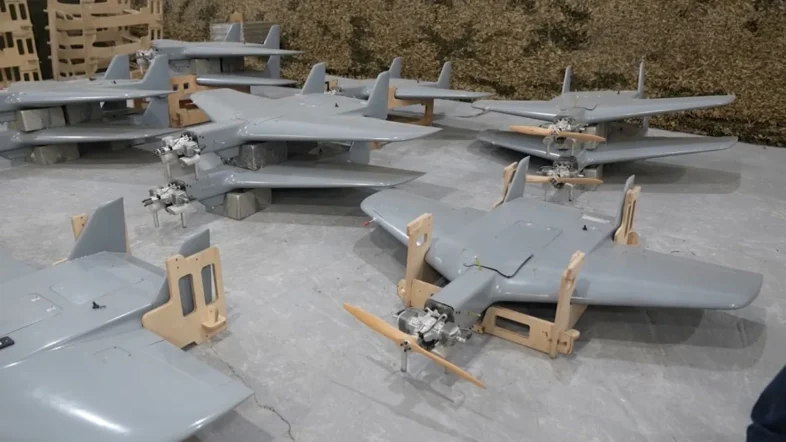
The Rubaka drone
At first, the campaign appeared to be the preserve of a handful of elite units carrying out a highly specialised mission. But by early 2026, that had begun to change. The Special Operations Forces, the Security Service of Ukraine (SBU) and other branches of the Defence Forces had joined the effort.
Today, at least 27 units from different services are involved in operations deep behind Russian lines. At the same time, production has expanded sharply. At the start of 2026, the Ministry of Defence increased procurement of mid-range strike systems fivefold. Between February and April 2026, the number of medium-range strikes quadrupled. By the end of May, the total number of confirmed strikes had surpassed 1,000, according to French OSINT analyst Clément Molin, who has been tracking the campaign since its earliest stages.
The initial focus was air defence. During the first year of the campaign, the Defence Forces reported more than 365 confirmed strikes, the overwhelming majority of them targeting air-defence systems. The effect proved to be strategic. Under sustained pressure, Russian air defences began retreating deeper into the rear.
Crews, wary of becoming the next target of a Ukrainian drone, increasingly fired expensive interceptor missiles even at small aerial targets, rapidly depleting already limited stocks of air-defence munitions.
The media impact was almost as significant as the tactical one. Russia ended up redeploying 43 additional Pantsir systems just to defend Moscow. From there, the focus began to shift.
What changed — and why now
One question often missing from reporting is why mid-strikes only really emerged in 2025–2026, rather than earlier. The 30–300 kilometre zone behind the front line has existed throughout the war. The answer is not about the number of drones, but about a technological leap that has reshaped the logic of electronic warfare itself.
Until 2025, the medium-range band was a real weak spot for Ukraine. Beyond roughly 50–70 kilometres, conventional radio control quickly became unreliable. Russia had built a dense electronic warfare environment that proved highly effective at jamming control signals, often reducing drones to little more than uncontrolled targets. Efforts to close this gap repeatedly ran into the same technical barrier: the need to maintain a stable, jam-resistant communications link over distances of hundreds of kilometres.
The breakthrough came through a combination of three factors.
The first was Starlink as a command-and-control channel. Unlike radio waves, satellite communications respond very differently to ground-based electronic warfare systems and are extremely difficult to jam using conventional methods. Starlink made it possible to extend effective control ranges to several hundred kilometres. It is worth noting that Russia was initially the one to exploit this capability, integrating Starlink terminals into its Molniya drones for strikes against Ukraine. But after SpaceX imposed restrictions on the use of terminals on the Russian side, that asymmetry shifted significantly in Ukraine’s favour.
The second factor was the use of radio-transparent airframe materials. Fire Point’s FP-2 drone is built largely from polystyrene and foamed polymers — materials that are not only lightweight but also largely transparent to the frequencies used by most electronic warfare systems. This makes both radar detection and electronic jamming considerably more difficult. The Hornet airframe, meanwhile, relies on a material with similar properties: expanded polypropylene.
The third factor is autonomous AI-based targeting. Even if the link to the operator is jammed or cut in the final stage of flight, the drone can still identify and hit its target on its own. That is the defining feature of the Hornet system, developed by US company Perennial Autonomy — formerly Swift Beat — founded by former Google CEO Eric Schmidt. According to the Kyiv Independent, Ukraine’s National Guard 1st Corps “Azov” played a key role in integrating Starlink terminals into the Hornet platform, significantly extending its range and improving its resilience to Russian jamming. The manufacturer supported the changes.
The result is that the so-called middle zone has effectively turned into a permanent strike space. At any given moment, dozens — and at times several hundred — systems of different types are operating there simultaneously.
The mid-strike “zoo” — the hunt begins
By mid-2026, the mid-strike ecosystem already spans at least a dozen platforms, each playing a different role and operating at different ranges. Fire Point’s FP-2 has become one of the main systems used against static and semi-static targets. It carries a 105-kilogram warhead and can reach up to 200 kilometres. Its designer, Denys Shtilerman, says work is now underway on a variant that keeps the same payload but pushes the range into what would effectively be deep-strike capability.
Robert Brovdi, commander of Ukraine’s Unmanned Systems Forces, has also publicly criticised the quality of warheads supplied by external vendors. He says destroying the command post of Russia’s 58th Guards Army in Kadiivka required six FP-2 strikes rather than two.
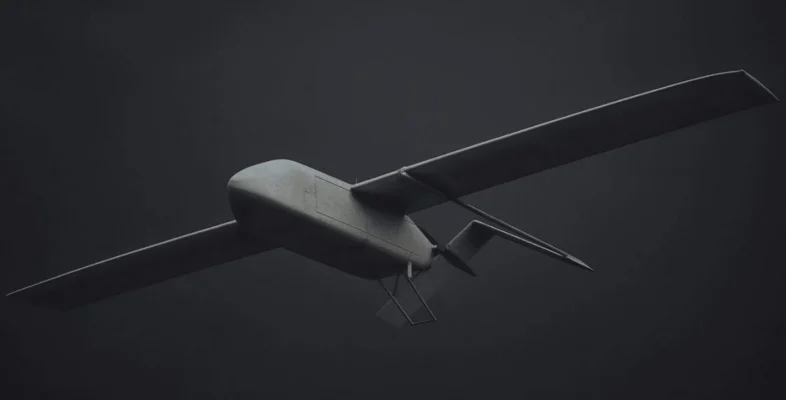
FP-2 drone by Fire Point
For mobile targets — above all transport columns — lighter platforms such as RAM-2x and Bulava are proving more effective at ranges of up to 120 kilometres, alongside the Hornet system operating at depths of up to 160 kilometres. Hornet itself is a compact platform, weighing around 15 kilograms, with a 2.2-metre wingspan and a cruising speed of 100–120 km/h. Its 4.5-kilogram warhead is sufficient to knock out light vehicles. It is also known for the quality of its imaging, even at 60–70 kilometres, which allows operators to identify targets accurately before impact. Also worth noting are the British-made Darts drones from Modini, which originally used standard radio control but are now shifting to Starlink-based connectivity.
The range of mid-strike platforms keeps expanding. Over the past six months, dozens of new models at different stages of serial production have entered service alongside existing systems. Since early March 2026, when the scale of drone activity became more visible on the battlefield, military transport has become the main target — fuel tankers, ammunition trucks and rotation convoys. In practice, anything moving along key supply routes of the occupying forces is now treated as a legitimate target by the Defence Forces.
A striking symbol of the campaign’s new phase came on 9 May 2026, when Ukraine’s National Guard 1st Corps Azov released footage of a Hornet drone flying over occupied Mariupol. The message was unmistakable: what had once been considered rear territory was no longer safe.
But even more telling than the overflight itself were the strike videos that followed. Azov operators recorded a Hornet hitting a truck on the road, followed by a second drone striking both the immobilised vehicle and a repair team that had arrived to assist it. A third strike then hit an evacuation vehicle. What emerged was a pattern of systematic targeting of any movement within the area under surveillance.
It is this iterative strike logic that defined the spring of 2026. Each engagement can now be assessed almost in real time through live feeds from follow-on drones sent in to confirm damage or finish off the target. That continuous feedback loop — and near-instant assessment of effectiveness — is something earlier generations of missile strikes simply did not provide.
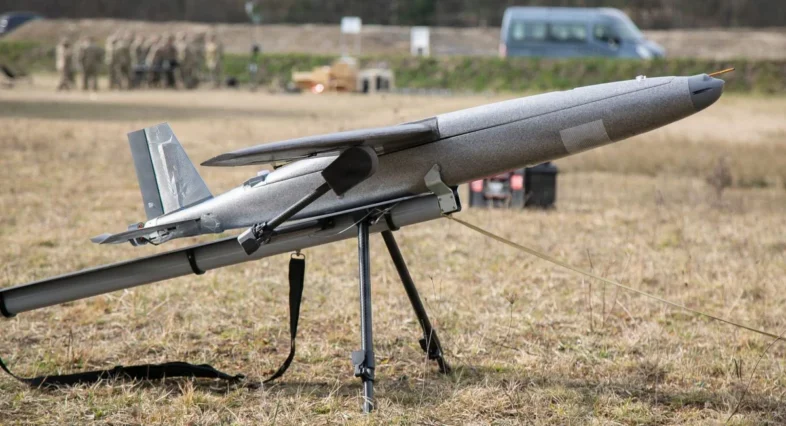
Hornet medium-range fixed-wing drone
According to analysis by Defense Express, the main “hunting corridors” for Hornet drones are the R-280 highway, running from Rostov through Mariupol and Melitopol to Crimea, and the Donetsk–Mariupol H-20 road. These routes account for the highest concentration of destroyed equipment. For Russia’s southern grouping, the road network effectively functions as a lifeline. Ukrainian commanders say traffic along these routes dropped by 71% within two weeks of intensified operations.
At the same time, bridges and rail lines used to move military cargo have also come under attack. The geography of strikes has expanded gradually: initially concentrated in the Zaporizhzhia region and Crimea, the zone under fire control later extended to roads in the Donetsk, Luhansk and Kherson regions.
The OSINT group Cyber Boroshno analysed the trend using the OchiAI platform, which processed more than 6,000 posts from chats and monitoring groups in the occupied territories. Mentions of drone activity on roads increased tenfold since the start of the campaign.
In effect, fire control now reaches across much of the border area with Russia. Data released by the Ukrainian Ministry of Defence for May 2026 shows the scale: 19 air-defence and radar systems destroyed in a single month, along with eight command posts and control centres, and 50 logistics and supply facilities belonging to Russian forces.
Physics of logistical pressure
To understand why disrupting logistics is strategically decisive rather than just tactically impressive, it helps to look at how the supply system of an advancing force actually works.
The US Army field manual FM 54-30 provides a useful benchmark: a single armoured division can consume around 1.9 million litres of fuel per day in active combat operations. Even taking a more conservative estimate for a mechanised brigade engaged in offensive action, that still amounts to several hundred tonnes of fuel each day just to sustain mobility — before ammunition, food, maintenance supplies and spare parts are even added.
According to RAND Corporation, each combined brigade typically carries enough supplies for three to five days and relies on continuous resupply to avoid depletion. The system only works if it keeps moving: a delay anywhere along the chain can slow an offensive long before troops themselves actually run out of resources. This is where the concept of the “logistical shoulder” comes in — the distance between a supply depot and the unit consuming those supplies.
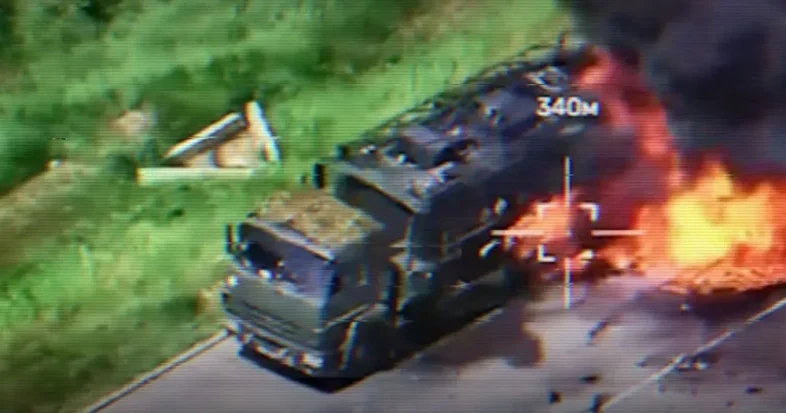
In May, Ukrainian forces set a record for the number of Russian vehicles destroyed — more than 8,600 vehicles and fuel tankers were hit
Under pressure from mid-strikes, Russian forces are being forced to look for alternative routes. According to Oboronka, these detours stretch the logistical “shoulder” by 1.5–2 times. In operational terms, a standard 150-kilometre supply route from depot to unit becomes 225–300 kilometres. Each truck then burns an extra 70–150 litres of fuel just to cover the added distance.
Travel time rises from two–three hours to four–six — in an area that is already under fire control. Every extra hour on the road increases the vulnerability of the convoy. Escort units that once covered a single route now have to secure one that is three times longer. That, in turn, increases demand for personnel, armoured escorts and, again, fuel for those escort vehicles.
The partisan network ATESH has observed another knock-on effect: Russian forces have started moving fuel by rail from deeper inside Russia, avoiding large depots because of strike risk. This significantly increases both the cost and delivery time of each litre of fuel compared with pre-war logistics.
The cost of logistics for the Russian occupying forces is rising even without direct equipment losses. As Danilo “Boroda” Novytskyi, deputy chief of staff of Ukraine’s 3rd Army Corps, puts it, the logic is simple: any system, even a mediocre one, beats any “wonder weapon” if it is applied consistently. The point is not a single strike, but sustained pressure that gradually breaks the system.
Russian forces are adapting
Fuel shortages are spreading beyond Crimea, affecting other occupied territories and even parts of Russia itself. Analysis by the partisan network ATESH shows Russian forces have already restructured fuel supply routes, avoiding the build-up of large stockpiles due to the risk of strikes.
A vivid illustration of the situation is a widely circulated image showing priests blessing the R-280 highway “against drones”. It is hard to find a clearer sign that technical protection is already falling short. Russian forces are trying to adapt. Civilian traffic has been banned on key roads. Mobile fire teams have been deployed along main routes to shoot down drones with small arms, along with so-called “Yolka” interceptor drones.
More unconventional methods are also being used. Russians are painting trucks in black-and-white “zebra” patterns in an attempt to confuse AI-vision systems. Movements are shifted to night-time, and routes are adjusted to avoid areas where drones have previously been observed.
So far, however, the effectiveness of these measures remains limited. At night, vehicles are still clearly visible to drones equipped with thermal imaging. The “zebra” camouflage designed to fool AI systems has shown little effect — a point even acknowledged by a Russian military-tech blogger known as “BPLA Developer”.
“Safe” alternative routes are usually identified by Ukrainian intelligence within days. As a result, the logistical “shoulder” often expands by 1.5–2 times. Every countermeasure demands additional resources and only further complicates the very logistics it is designed to protect. Clément Molin takes a cautious but clear view: on the southern front, where cover is limited, all logistics are exposed and become targets. By the time Russian forces adapt to one phase, Ukraine has already moved on to the next.
But analysts caution against inflating the scale of what is happening. Military experts warn against treating mid-strikes as yet another “game-changer” capable of shifting the course of the war in a single blow. Logistics, after all, retains a degree of resilience. Russian forces adapt, seek alternative routes, and reallocate resources. The Telegraph puts it bluntly in its analysis: “strangling Crimea from the air and sea” is unlikely, on its own, to mark a decisive turning point in the war. But this is not about a turning point.
Military commentator Yigal Levin puts it more precisely: the key measure of effectiveness is not the number of destroyed vehicles, but the reduction in the volume of cargo the enemy can deliver to the right place at the right time.
Degrading logistics does not require a “race” to destroy every truck. Just as an army is not defeated by killing every soldier, logistical pressure works through the accumulation of systemic disruption rather than isolated, high-profile strikes. The real question is not whether the campaign is working, but whether sufficient pressure is being sustained. So far, the answer appears to be yes.
Analysts are already picking up the first signs. In some areas, a decline in the intensity of attacks is being observed. Less fuel in the rear means fewer generators for charging drones. Fewer charged drones mean less intense strikes in a given sector. Less ammunition means less dense fire. And fewer rotation vehicles mean more exhausted units staying in position longer without relief.
One destroyed fuel tanker is not just a single line in a tally. It is a brigade spending several days dealing with fuel shortages instead of fighting.
So the key question this summer is not how many kilometres the front line shifts in either direction. It comes down to something simpler: can Russia deliver to the front what it needs to sustain the day-to-day functioning of its nearly 800,000-strong force, at the right time and in the right quantities?
For now, the answer is increasingly leaning towards “no”.
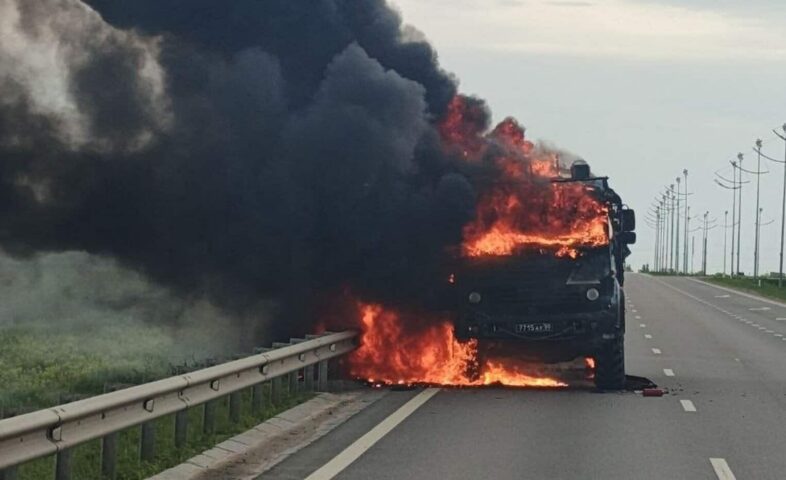
Destroyed Russian KAMAZ 5350 cargo truck (No. 7715 AY 50) near the settlement of Samsonove, Donetsk region. May 2026. Source: t.me/lost_warinua