A hero’s recovery isn’t about finding just one safe place — it’s about several. Places that pull you back to yourself, push you to act, fill life with love, and help heal both body and soul. Each one offers support and shows the way forward. This article follows seven such havens in the life of Oleh Buchko, a veteran of the Russian war against Ukraine and an instructor in Ukraine’s Naval Forces. Oleh has served in the Armed Forces since he was 19, taking part in fighting in Kherson and near Vuhledar. Today, he’s continuing his rehabilitation at the Superhumans prosthetics centre — far from his native Kherson region, but already a place close to his heart.
Haven one: the ‘Gentle West’, the Superhumans
14 November, 4:00 pm, 2025. Dusk is settling in. I step into the lobby of Superhumans, calm as it usually is on a Sunday afternoon. The quiet is broken by a greeting from a man with clear, bright blue eyes — this is Super Oleh (“super” is the affectionate term for Superhumans patients, — Ed.). He’s dressed in a black Superhumans fleece, soft flesh-coloured shorts, and trainers. A pair of crutches lies neatly beside him, a reminder that he is still waiting for his prosthesis.
Sunday is a day to rest, to take it easy, to catch up with friends he hasn’t spoken to all week. It’s also a time for films and TV series — lately, he’s been captivated by Netflix’s Frankenstein.
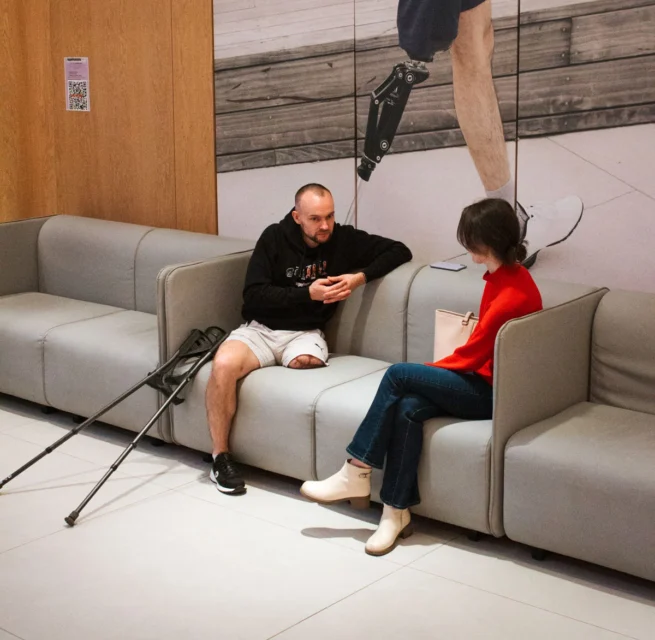
Oleh arrived at Superhumans in September this year. For two years, doctors had fought to save his leg, but in the end, amputation was unavoidable. Over the summer, he researched prosthetics centres across Ukraine, determined to find one of the best. From brothers-in-arms who had already received prostheses, he heard about Superhumans — the place that would ultimately become his alma mater.
Oleh hails from Kherson region, from the Beryslav district near Nova Kakhovka. Since his injury, he says he’s been “living everywhere” — Vinnytsia, Odesa, Mykolaiv region, and now Lviv — constantly on the move, carrying his life in a single bag.
I ask which of all these places has felt closest to his heart. He doesn’t hesitate. For him, it is still “here” — in Vynnyky, at Superhumans.
“In the south [of Ukraine – ed.], we’re used to this — to the wounded, to amputees. It’s like a conveyor belt. But here, you feel a kind of inner calm, and people are completely different. Western Ukraine has always seemed more soulful to me. More gentle. That goes for everyone — fellow soldiers and the staff at Superhumans alike. You even notice it when you go to the shop.”
The hall begins to buzz as other patients gather — it’s time to talk with loved ones, read, play chess, or watch TV series on the big screen. A rehabilitation centre is about more than prostheses, therapy sessions, or time spent in a ward. Recovery also happens through human connection, through relationships that, in this new space, begin to feel like family.
“We have an unspoken rule among brothers-in-arms,” Oleh says. “We might tease each other, but above all, we motivate one another, push each other forward. I’ve lost my left leg, but I still have the other one. There’s a guy here who’s lost both legs. The work he does on himself is incredible — you watch him, and you can’t help but feel motivated. You move forward. We support each other, but we don’t say it out loud.”
The cosiest place in the centre is the ward, where the brothers-in-arms he’s grown closest to gather. The day is spent constantly on the move, but at five o’clock, the ward is the unchanging meeting point — the place for conversations with those who understand you best. Oleh says that even the most despondent soldier won’t be allowed to sink into despair here. Fellow patients will prod him, draw him into activities, invite him for coffee. “Come on, brother.”
In Oleh’s ward is also a veteran from the Ternopil region, who has become a close friend. He has the same above-the-knee amputation as Oleh, but on his right leg.
“During training sessions, I tell him: ‘Old man, why are you sitting there? See how I’m walking? Come on, come on, come on.’ That’s our unspoken rule. Everyone knows it, but no one talks about it.”
Haven two: the Krynky, the injury
October 2023. The “Krynky operation.” The 30th Marine Corps launched a daring crossing of the Dnipro on Kherson’s left bank, aiming to seize and expand a bridgehead. During the evacuation of wounded comrades under fire, Oleh was hit. He and his fellow soldiers endured a relentless artillery barrage as they fought to get the injured to safety.
“It was 23 October 2023. A date you don’t forget. It’s burned into my memory.”
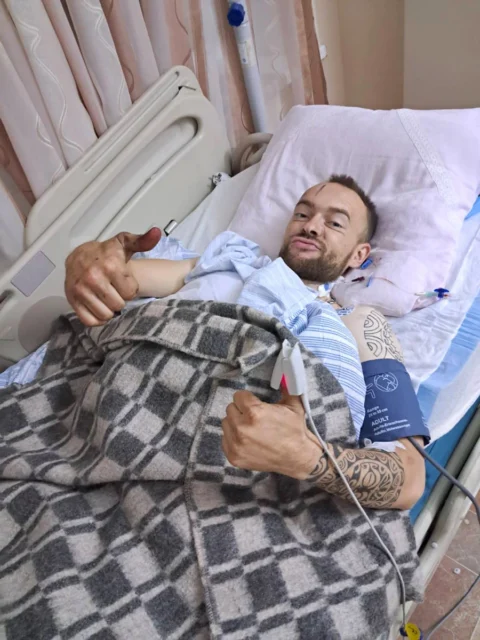
After that came nearly two years of treatment: shrapnel wounds slowly healing, repeated attempts to save the leg, and finally the doctors’ decision to amputate. Oleh’s entire left limb had been shattered — the knee joint destroyed, both tibia and fibula broken. Then came prosthetics.
Oleh spent the longest stretch after his injury in Odesa — eight long months without discharge. The severe shrapnel wounds took their time to heal. Rehabilitation followed again, this time in Vinnytsia, after the amputation. His final harbour is now Superhumans. “A modest but very intense journey,” he says with a smile.
Haven three: Ukrainian south and navy life
Oleh spent seven years at a Naval Forces training centre, serving as an instructor in both basic and specialised military training. He says his choice of this path is deeply rooted in his upbringing and personal background.
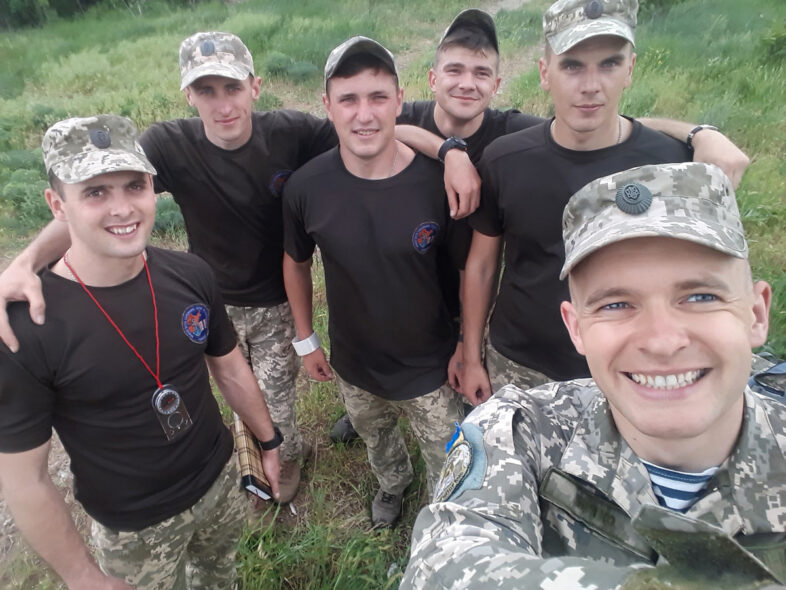
Kherson is home to many maritime colleges, and the sea had always called to Oleh. He enrolled at the Khodakovsky Academy, training as a ship’s electromechanical engineer. Even during his compulsory military service, he was already determined to join the Navy, imagining a future spent aboard ships.
Within six months, the service had truly captured him. There were regulations, order, a clear sense of structure. At the same time, the war in the east was already underway, further motivating Oleh to commit fully to the Armed Forces. His fellow conscripts made the same choice, signing up alongside him.
“I was a godfather to the daughters of two of my brothers-in-arms — and I was a witness at their weddings, too. We spent countless hours together on leave and faced so much side by side. Over the years, they became like family to me.”
After a while, the service became his routine. “I love this, I know how to do it, this is where I want to be,” he says. But in the beginning, he admits, there was also a certain romance to military life.
“Military service, the uniform, dress blues, the cap. And ours were beautiful: white shirts, gold epaulettes. Navy Day. We would march through Mykolaiv to the sound of drums. It was pure romance.”
Gradually, the line between service and work blurred. It became part of who he was. In every military unit where Oleh crossed paths with colleagues from the Navy, he saw familiar faces. “It felt like one big family.”
Haven four: finding solace
Veterans sometimes say the path of rehabilitation can be difficult — and at times utterly draining. It is not always easy to cope. I ask Oleh how one can overcome that sense of apathy.
“It’s important to realise that you will never function the way you did before the injury. The sooner you accept that, the easier it becomes to adapt to the new reality. I understand that I won’t be able to run anymore — and I loved running. After service, I used to go out in Mykolaiv and run 10 kilometres in the evening — just put on my headphones, turn on some music, and run. When that realisation finally comes, it becomes easier to live with it.”
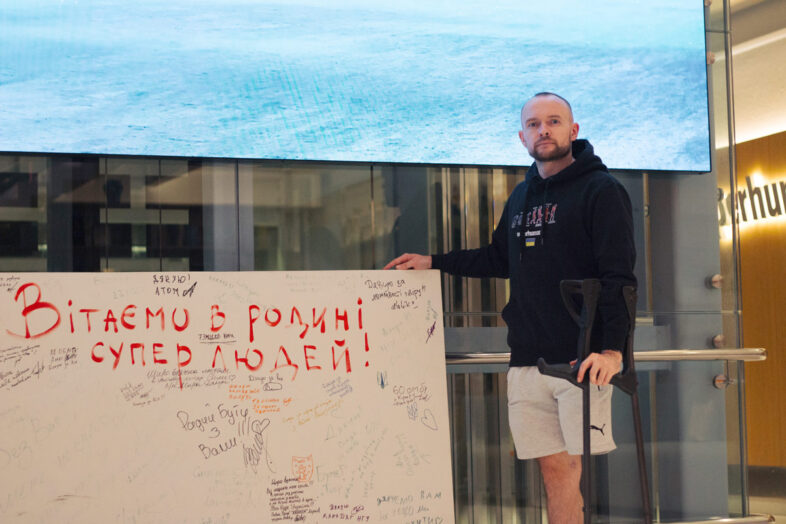
Oleh’s second wind on the road to rehabilitation has come from the support of his family and loved ones — those who are always near and always believe in him.
“I don’t want to devalue their support, to sink into sadness and do nothing. Who would I be then? I have to grow. There’s no other option. You either rise above yourself or you fall. Here, you have to sweat. You have to run, you have to push yourself, to do something. It’s hard now, but it will get easier later. Learning to drive was tough at first, too, but eventually it becomes routine. Everything follows its own course.”
Equally important, however, was Oleh’s own inner faith — in growth, in his strength, and in his own capabilities.
“I don’t care that I’m walking on crutches, that there are people around me, or that I’m standing in a queue. It doesn’t affect me at all. Because I know I’ll get on a prosthesis and everything will be fine. That’s my motivation — it makes it easier to push through. Accepting yourself is already 70 per cent of the adaptation.”
To avoid giving in, it’s important to keep yourself busy. Oleh remembers a saying from his time as a conscript: “A soldier with nothing to do is prone to foolishness.” For him, that lesson still resonates. I ask which activity has been most important for this “super” during his rehabilitation.
“You know, just going for a walk. Simply to get out and move, not to lie around. I like going to the car, even though I’ve already been there three hundred times — vacuumed it. I’ll take the vacuum again and do it all over. I always find something to keep myself busy.”
Walks and drives are Oleh’s way of taking his mind off things. He bought the car after being wounded, even before the amputation. Just a few days before his discharge, he began searching for a vehicle — and even managed to swap one car for another. Today, driving with a prosthesis (or without one) is no obstacle for him.
Haven four: progress even in war
When we talk about driving with a prosthesis, the “super” recalls the stories of other guys who have managed to adapt to driving after their injuries. Movement became possible thanks to a range of ingenious solutions.
“I like the way the guys adapt to driving a manual gearbox — with an amputation exactly like mine. They take a broom handle, tie it to their leg, and simply practice like that. The stick presses the clutch — and that’s how they drive. People drive without legs. Not driving with one leg? That’s just a poor excuse.”
Another striking example of adaptation is a sailor Oleh met in Odesa. He has amputations of both arms — above and below the elbow — and both legs — above and below the knee. Oleh’s first thought when he saw him step out of a car was: how does he drive? The answer is surprisingly simple. He shifts the gearbox into ‘drive,’ places one bionic hand on the wheel, and the prosthetic grips it. Then he drives.
“War is also a path to progress, to improvement,” Oleh says. “This is proof that even with such injuries, people can move independently.”
Innovation — even in how patients with different amputation histories are treated.
Oleh says that abroad, doctors would likely have recommended immediate amputation for his injury. In Ukraine, however, doctors “invest in the limb,” striving to save it and explore new treatment approaches.
At Superhumans, hope is always offered, even when doubts remain. After his injury, his tibia had healed slightly “crookedly,” and Oleh worried how much it would let him walk. But his first consultation at the centre gave him confidence — he could stand on that leg. He is now waiting for a permanent prosthesis.
Progress is not just physical. It’s also about changing perceptions — especially how society views veterans with disabilities. I ask how Oleh navigates the gap between himself and civilians. He points to an example with his nephew, Dania, after the injury: for him, understanding and acceptance begin with upbringing.
“When my nephew saw me after the injury for the first time, he didn’t have a dramatic reaction. He looked at me — and just fainted, as if pretending. He said he simply wasn’t used to the fact that his uncle didn’t have a leg. I told him, ‘Dania, get used to it — soon I’ll have a metal one.’ Then he wanted to give me a capybara — he had already seen that capybaras are often attached to prosthetics. He already understands that his uncle is like this now, walks like this. It’s part of his upbringing.”
Equally important is learning to get used to your new self. Oleh connects with the idea that once you truly start accepting yourself, the opinions of others — whether positive or negative — lose their power. He says that the wounded themselves play a key role in overcoming stigma. If you see yourself as a “handsome guy,” you remain one — even without a leg.
“I’ve fallen in front of people while on crutches. The sidewalk was slippery. But once or twice — I got back up, all good. Now I walk carefully. How I handle these situations is my responsibility. No one can ruin my mood. No one can shake my confidence.”
Haven six — love in the marines
Oleh served seven years at the Navy training centre. He had several deployments with the Marine Corps, including the 406th Artillery Brigade. But symbolically, his final posting became the 38th Marine Brigade.
It was here that he met his wife — also a servicewoman. Oleh had been her instructor at the training centre. “Spark, storm, love.” That’s how it all began.
“She joined the 38th Brigade, and I went after her.”
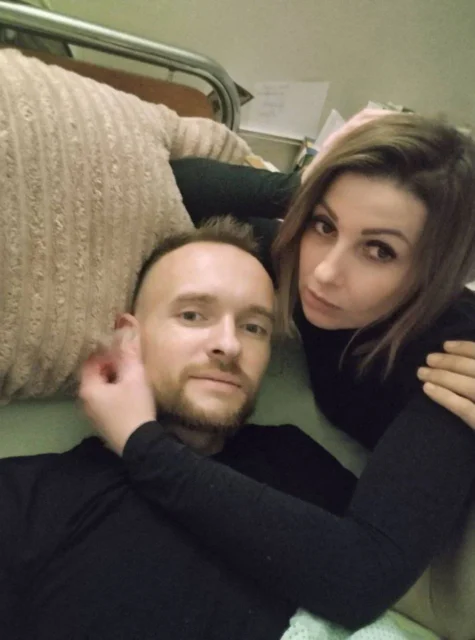
There are two ways to end up in a different unit — either transfer to a higher position or get married. Married couples can be stationed in the same garrison.
“But we’re not married! And I’m in love. I want to be with her. Let’s figure this out,” he says. Later, he tells her, “Darling, let’s get married.” She replies, “Well, that’s… radical!” — her excitement and theatrical flair clear.
March 2022. Oleh arrives in Mykolaiv at the civil registry office. He asks if it’s possible to get married online, explaining that his fiancée is in the Donetsk region while he’s in Mykolaiv — but that they need to tie the knot immediately. “In principle, yes!” comes the reply. He finds two witnesses — fellow servicemen for whom he had also served as a witness at their weddings. “They decided to return the favour,” he smiles. Oleh calls his fiancée to check if she’s ready. Finally, they get married.
That very same day, Oleh receives his marriage certificate, files the necessary report, and transfers to the brigade where his wife will be waiting. Two weeks later, the transfer is completed. He remains in the 38th Brigade right up until the day of his injury.
Haven seven — guitar within reach, a dream that brings comfort
Alongside love, there is another anchor — a source of comfort that keeps him grounded, restores him to himself, and offers a sense of calm: playing the guitar. Oleh shares as many as five guitars with his younger brother, Zhenya. At his current home, in the south of the Vinnytsia region where his wife lives (temporarily off duty and helping him), there is always a tuned, clean guitar with fresh strings ready to play. For Oleh, home is wherever the guitar and other cherished belongings are.
— I used to dedicate songs to my wife on the guitar. Just a few words for two minutes, simple chords. And she would cry tears of joy (he imitates crying). Even my wife’s mother would say, “Sweetheart, I’m so happy for you.” The song touched her too.
Oleh also loved playing army songs. When he liked a melody, he’d sit down and figure out the chords — it was like a challenge: would it work or not? When the pads of his fingers got raw from the strings, it hurt a lot. But it was a pleasant kind of pain — the pain of learning. And in his head, the thought: “If my younger brother learned to play, why shouldn’t I?”
The same goes for prosthetics.
— If a guy can walk on a prosthesis with the same amputation as mine, or even worse, how could I not learn? We’re no worse than anyone else. We just don’t know what we’re capable of until we try.
When you realise you can do more than you thought, courage comes — and so does dreaming. Oleh’s dream now is a small house by a river, a little “dock” where it’s peaceful. Not in the city, but nearby — like Vynnyky near Lviv. At home, there should be a space for a mini greenhouse by the garden — his wife loves flowers. And a gazebo where he can play guitar. Oleh’s harbor.