An art restorer from Kropyvnytskyi is bringing the past back to life — and, in doing so, slowly piecing himself back together after the war. Before Russia’s full-scale invasion, Dmytro Skoreiko lived a quiet life, restoring artworks despite not having a formal diploma. What he loved most was the feeling of holding history in his hands — returning something to life so others could see and feel it. Over the years, he worked on countless artefacts with meticulous care. And his creativity didn’t end there: he illustrated books, painted murals, designed interiors and, in his spare time, filled canvases with his own work. For Dmytro, creativity isn’t a job — it’s simply how he moves through the world.
The routine he once knew disappeared the moment he joined the fighting. The hum of a busy city, the crush of a crowded minibus, the quiet ritual of coffee by the river — none of it feels familiar anymore. The Russian war against Ukraine has left a mark deep inside him. Now, as a veteran, Dmytro is learning to restore not only the fragments of history he works on, but himself as well.
“You won’t know until you try”
Monday, 11 August, 12:00. I head to the art museum in Kropyvnytskyi, the city where Dmytro was born and raised, to meet him. In the foyer, I see a calm man in his fifties, dressed in pixel camouflage. He watches me quietly, his narrowed blue eyes studying me, then shifts slightly to make room. Short and slight, he carries himself with a reserved air, yet there’s a sense of deep focus in his presence. When I mention the word “hero,” he reacts with quiet scepticism, correcting me: the real heroes, he says, are already up there — in the sky. Still, he agrees to be the centre of my story. Slightly nervous, a little lost, he adjusts his glasses, then takes off his tactical boonie hat and, almost to himself, murmurs:
“You won’t know until you try.” He stretches his leg, then sets off with a steady gait, occasionally limping and shifting his weight. His arms are crossed in front of him, one hand resting on a small cross-body bag. As we make our way to his workshop, Dmytro slowly begins to open up, telling me about himself.
Born holding a pencil
“My mum used to joke that I was born with a pencil in my hand. Before I could even speak, I was already grabbing pencils and paper and drawing.”
By the age of five, Dmytro was sketching everything he saw — especially illustrations from books — and sometimes he’d place a typical Soviet toy soldier on the table in front of him to copy it. His parents nurtured his talent, buying more toy soldiers and books with beautiful illustrations.
At the Palace of Pioneers — in what was still called Kirovohrad at the time — Dmytro joined his first art club. By fourth grade, he had moved on to an art school. He describes it as genuinely professional and recalls how some of his works were chosen for city exhibitions, including an illustration he made for Shevchenko’s Haidamaky.
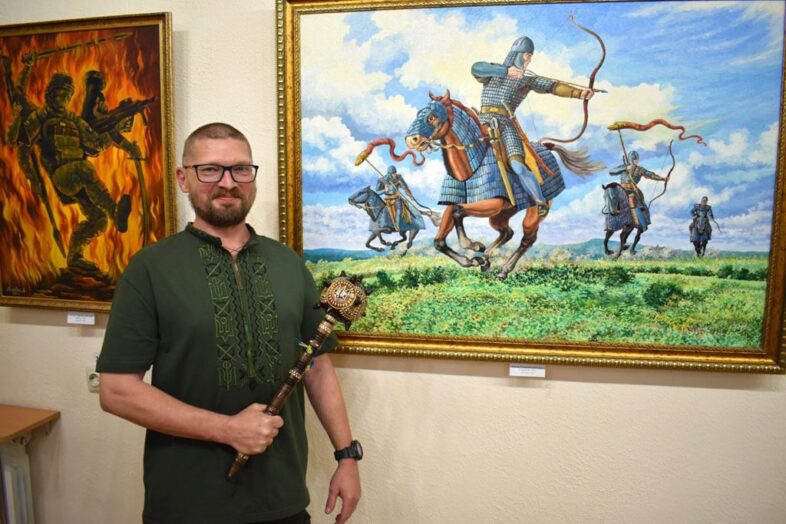
Dmytro at his solo exhibition, 26 June 2025
Meanwhile, we arrive at an old building that doesn’t immediately feel like a workshop — more like we’re stepping into someone’s home, about to be greeted by the owner. In the hallway, the scent of an old village house hits me: wooden furniture, patterned rugs, “Melodiya” vinyl records on the walls, and a box-style TV. This is the “guest room.” From there, we move into the next room — the real workshop.
Inside, Dmytro shows me his worktable: models of buildings, sandpaper, spatulas, and several five-litre bottles of water — a lot of water is needed for restoring artefacts. “This is my old workspace. The new one is still being set up, so there’s nothing to show yet,” he says.
To my surprise, there are no canvases, paints, easel, or any of the tools you’d expect a painter to have. Dmytro has always painted at home, in a small room, reserving this space solely for restoration work.
When art found its moment
Our next meeting takes place at the National Theatre Arts Festival Veresnevi Samotsvity, held at the Khortytsia Nadija reserve-museum on 27 September. Each year, a group of artists from Kropyvnytskyi heads here to paint and sketch outdoors. This year, Dmytro decided to join them, bringing his wife Valentyna along and inviting me to watch the process.
He sets up a small easel, squeezes a few drops of paint onto his palette, and begins work on a plein air piece. Meanwhile, Valentyna talks about their marriage and introduces me to Dmytro’s art. She recalls that from a young age, he was always part of the local artist community. It was at one of these creative gatherings that he met his future wife.
“For our first date, he suggested painting my portrait,” Valentyna smiles as she watches him. “A clever move — because that takes more than just one meeting.”
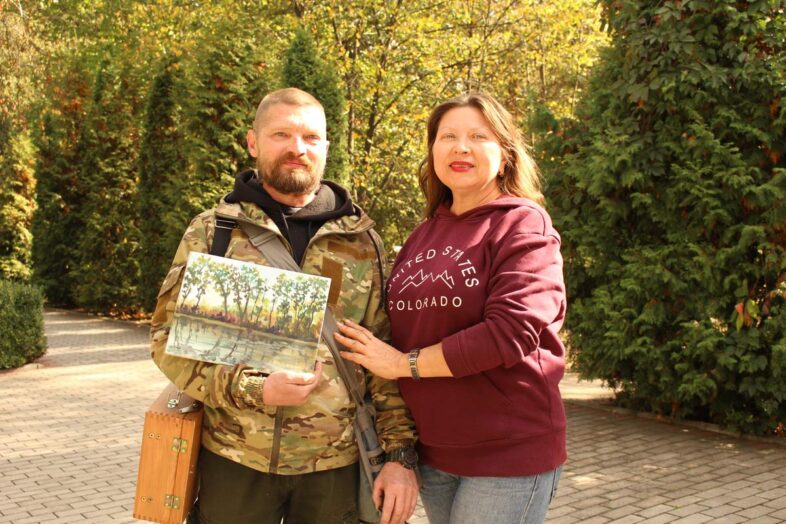
Dmytro with Valentyna at the Veresnevi Samotsvity festival, 27 September 2025
As the first outlines of trees and the lake take shape on the page, Dmytro recalls that he has always painted thematic works — historical, Cossack, mythical — all deeply tied to Ukraine. Creating the canvases is only part of the process; a lot of time also goes into research.
“Paintings need to be done carefully, so the viewer has no doubts about historical facts or the ‘logic’ of the work. That’s why, when I made Pokrova of the Third Regiment in 2015, I consulted with servicemen from the 3rd Separate Special Purpose Regiment named after Prince Sviatoslav the Brave.”
In 2022, Dmytro’s painting was gifted to Yuriy Drozd, head of the Kirovohrad Regional Council. The administration suggested including it in a memorial book honouring fallen servicemen from the region. Dmytro agreed, making a few adjustments, and the updated version — titled Berehynia — was born. As protocol demanded, the work had to be officially presented at the art museum, so Dmytro gathered all his earlier paintings and organised an exhibition dedicated to Ukraine’s defenders.
The exhibition, however, turned out to be an intensely emotional experience for Dmytro. The crowd, the attention, the buzz — it all felt strange after life on the front lines. “I couldn’t get a word out to anyone, only later, in private,” Dmytro says, folding up his easel. “Otherwise, I just watched, kept track of what everyone was doing.”
Luck in the infantry
Our third meeting takes place in central Kropyvnytskyi. We stroll towards a café along the alley at Heroes of the Heavenly Hundred Square, passing the portraits of the fallen — over 200 of them. Dmytro begins to share his military story.
It all started with volunteer work in 2014 for the 3rd Separate Special Purpose Regiment named after Prince Sviatoslav the Brave. Even then, he was thinking about joining the military, but his comrades gave him a gentle warning: if they saw him in uniform, they’d “smack him around.” They wanted him to keep focusing on his art — painting — while the army already had enough people to serve.
During the first six months of the full-scale Russian invasion, Dmytro went to the military enlistment centre every morning. At the time, there were too many volunteers and not enough places. But when the army finally needed extra hands, he started helping to build checkpoints around the city.
Soon, the situation on the front changed. More troops were needed, and a new wave of mobilisation began. In April 2023, the process was simple: update your information, and you were already mobilised. Destination — the Kupiansk region. Role — sapper in the infantry. When asked whether he could share details of his military experience publicly, Dmytro says that in the infantry, soldiers are free to tell whatever they want, because tomorrow they might not be there.
“Over there, soldiers live one day at a time, constantly paying the Russians surprise visits. Some guys don’t even last a full day. My comrade lasted three hours in the infantry. Or rather, he was my comrade for three hours.”
Dmytro himself survived holding a machine gunner’s position. He often talks about such “miracles”: clothes ripped by bullets, yet not a scratch on the body; a helmet smashed to pieces by a shell, but somehow the head stayed intact. He calls himself lucky, even noting a “bonus” birthday — 26 August. Many soldiers have similar stories. But alongside these “miracles” comes experience.
“In the infantry, the Russians don’t just sit around — they find out everything,” Dmytro says. He takes a sip of coffee, fishes a pack of cigarettes from his pocket and shrugs, as if it’s simply a fact of life out there.
That’s how they discovered Dmytro’s hiding spot — a small hollow behind a bush, where they’d left a kind of “gift” for him. “The explosives often lie ‘nicely,’ just under the surface. A lot of guys fall for it, excited to grab free weapons,” he pauses, taking a drag. “But there’s a catch that many don’t think about: while a soldier is picking up one of these, he can be caught off guard by another three or four buried shells.” Thanks to this knowledge, Dmytro saved not only his own life but also those of his comrades.
From time to time, his wife, Valentyna, sent him parcels. One arrived on their wedding anniversary — 24 September — so she decided to include a last-minute gift: a bar of dark chocolate. On the white part of the wrapper, she wrote in red ink: “My love!!! Happy anniversary.”
“That chocolate became a kind of talisman,” Dmytro says, lighting his second cigarette in a row. Two months later, in November 2023, Dmytro was wounded for the first time, and the chocolate went with him to a hospital in Kharkiv. When he returned to duty, he kept it tucked in his backpack, waiting for the right moment. Eventually, the couple decided to share it after Dmytro’s second injury.
When asked about his injuries, Dmytro grows uneasy. He immediately shifts the conversation to ethics, scratching his closely cropped head and his dark beard streaked with grey. “Nobody ever talks about this, nobody writes about it. It’s just not done among soldiers.” His neck tightens, his head tilts to the right, his face tenses. “What I had… well, concussions, broken ribs. But, like I said, people don’t talk about this. It wouldn’t be fair to other soldiers — some of them have worse, more serious injuries, amputations…”.
Later in the conversation, I learn that on one mission, Dmytro returned with a comrade: the other man was fully dressed and injured, while Dmytro came back unscathed, his clothes riddled with holes.
Valentyna recalls that she can at least share some details now about Dmytro’s most recent injury. After an FPV drone attack, he had to collect the remains of a fallen comrade in a bag — a task he would have to repeat, even with the bodies of Russian soldiers, for future exchanges. Dmytro himself survived with a ruptured eardrum, a concussion, and numerous burns.
“One missing piece”
In March–April 2025, Dmytro was discharged from service after a severe injury. But he admits that, in many ways, he still hasn’t truly come home.
“I don’t take buses. I barely sleep. I can’t stay long in the city centre — some civilians in the crowd make me feel uneasy. Out there (at the front — ed.) you become emotionless. A mechanism develops: ‘kill equals survive,’ and it feels impossible to switch it off.”
Dmytro is now undergoing treatment and rehabilitation in the psychiatric ward of the town of Nove. “The schedule is flexible. When you need it, you come in, get a calming IV, and then you’re free.” For him, painting and household chores are what truly help him switch off. His first work after leaving service was a portrait of Chornovil, but now he dreams of painting still lifes, flowers, or sketches from Crimea, where he and his wife travelled extensively before the annexation.
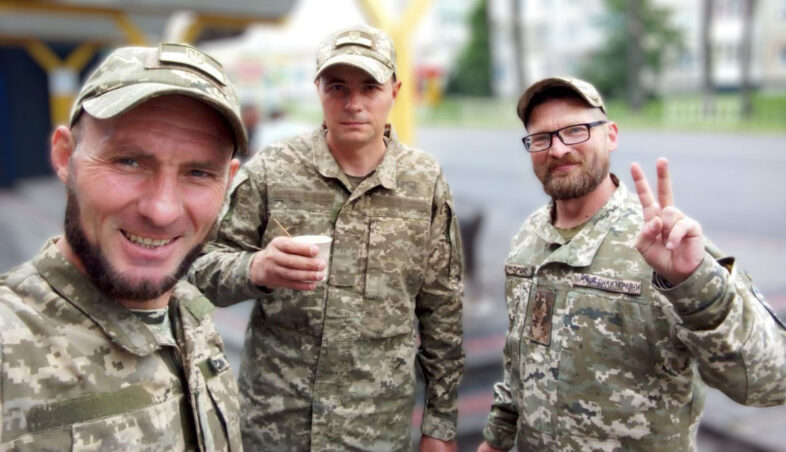
He rarely sees his friends — whom Dmytro now calls his “pixel comrades” (named for the pixel-like pattern of Ukrainian military uniforms — ed.) — because they are still serving. “There’s an unspoken rule between us,” he says. “If someone invites you for a beer, you can’t say no. You never know when you’ll get another chance to meet.”
Gradually, Dmytro is learning to live in this new reality. And now, “in the later years of life,” he says he’s preparing to go back to being a student. He plans to finally earn his diploma and master new skills and techniques as a restorer, as if piecing together the fragment of himself he’s been missing.