The full-scale invasion that began on 24 February 2022 marked a new chapter in the Russian-Ukrainian war, which has been raging since 19 February 2014. Over those years, Ukraine’s military underwent a profound transformation, giving the renewed army eight years of combat experience to draw on when facing a full-scale assault.
It’s easy to forget now, but in February 2014 Ukraine had no more than 5,000 troops capable of real combat. Units were understaffed, command structures sluggish, and equipment worn out. Tanks often had dead batteries and couldn’t even leave their bases — never mind defend Crimea or Kyiv. The army couldn’t even hold its own deployment points. In many ways, it existed only on paper.
By 2022, the situation was very different. Ukraine met the invasion with officers and sergeants seasoned by real combat, a command system already tested under wartime conditions, and a trained reserve force. If full mobilisation and preparation hadn’t been disrupted, I’m convinced the enemy wouldn’t have made the territorial gains it did in that first week.
The changes went beyond numbers. They reshaped the very principles of training, command, and coordination — the transformations that defined how Ukraine weathered the first months of a full-scale war. So how have the Armed Forces of Ukraine evolved, now ranked among the world’s twenty strongest armies?
2014: A defining moment for Ukraine’s armed forces
Back in that now-distant February 2014, it became clear: the Ukrainian state had no means to defend itself. As noted, Yanukovych’s actions had effectively dismantled the Armed Forces of Ukraine. The first months of the 2014 war were pure improvisation — volunteer formations, waves of mobilisation, aid from volunteers, and the urgent restoration of equipment from storage. The system did not function as a coherent mechanism; it was stitched together on the move. Yet it was precisely this period that became the starting point.
The full-scale war tore through illusions. A slim, formal peacetime army — the type most doctrines of the time envisioned — simply couldn’t respond to hybrid attacks that mixed regular forces with sabotage teams and information warfare.
2014 produced three things without which later transformation would have been impossible: combat experience, awareness of the scale of the problem, and, most importantly, the realisation that Russians were the enemy. By abandoning the notion of “one fraternal people,” Ukrainians became ready to fight and defend their country. It may seem strange now, but during those first months, soldiers and society were not prepared to see Russians as enemies. The Armed Forces were not ready to fire on them. In fact, the first real combat engagements did not take place until May 2014, by which time Russia had already occupied Crimea and parts of Donbas.
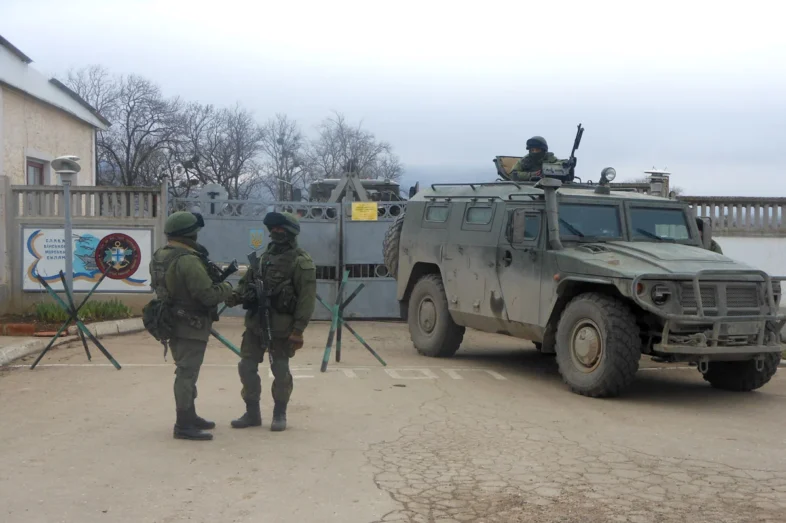
Russian troops block 36th Coastal Defence Brigade barracks in Perevalne, Ukraine, early March 2014
2015–2016: From spontaneity to structure
After the heaviest battles — when Ukrainian forces were crushed near Ilovaisk, followed by the Minsk agreements and a temporary ceasefire — a quieter but no less crucial phase began: the rebuilding of the Armed Forces of Ukraine.
The Minsk agreements and the positional war in Donbas gave the army breathing space to reorganise. As Putin himself later noted, the agreements became a lifeline, allowing the Armed Forces to be rebuilt almost from scratch. The mobilisation model was gradually supplemented with a professional, contract-based system. Pay rose, and the training of a professional NCO corps began. There was growing demand for real, hands-on exercises rather than formal routines. Command approaches shifted, giving junior officers more responsibility — in war, centralised decisions often cannot keep pace with events, forcing a rethink of the chain of command.
At the same time, cooperation with Western partners expanded. Training missions became regular. It was not just about new weapons but a new logic of operational planning, a new culture of staff work, and a redefined role for the sergeant. This was when the army truly began to think and operate differently.
An important financial boost for the defence sector came from the special confiscation of funds linked to Viktor Yanukovych’s entourage. Pushing through the relevant legislation sparked intense debate. Among the public advocates were then-Prosecutor General Yuriy Lutsenko, the head of the parliamentary committee on national security and defence Serhiy Pashynskyi, and MP Tetiana Chornovil. In 2017, around $1.5 billion was returned to the state budget, some of which was channelled into security and defence. This allowed for the purchase of new equipment, the modernisation of weaponry, and several programmes that had previously been delayed due to lack of funding.
Another focus was the revival and development of domestic missile programmes. After 2014, it became clear that without modern long-range strike capabilities, Ukraine would remain vulnerable. The push to restore missile potential was actively led by then-Secretary of the National Security and Defence Council, Oleksandr Turchynov. It was in this period that practical work began on new systems, including the Neptune anti-ship missile. The programme did not deliver instant results — it took years of testing, funding, and political support.
Yet it was between 2015 and 2019 that the foundations were laid for Ukraine to field its own modern anti-ship deterrent. By 2022, this capability demonstrated its practical value: it was these very missiles that, as we now know, struck Russia’s Moskva cruiser .
During the same period, cooperation with Western partners intensified. Training missions became regular, and the range of weaponry Ukraine could access expanded. It was not just about equipment, but about planning standards, logistics, and training systems. Procedures were systematically adapted to NATO standards, changing not only formal documents but the very logic of command. Operational planning became multi-layered and scenario-based. The military began to think beyond the immediate battle, several steps ahead.
Coordination between different branches of the armed forces also improved. The experience of 2014–2015 had shown that fragmentation came at a high cost. Gradually, integrated use of artillery, reconnaissance, mechanised units, and electronic warfare became standard practice.
The legislative framework evolved too. Responsibilities between civilian leadership and military command were clarified, strategic planning procedures refined, and medium-term defence planning developed. This laid the groundwork for a more predictable and resilient military.
During this period, another realisation took hold: the war with Russia was not a localised conflict in the east. It was a long-term confrontation with a state that had far greater resources. As a result, the focus shifted from one-off solutions to the gradual building of resilience.
By early 2019, the Ukrainian army already had a core of officers and sergeants with real combat experience, a reliable rotation system, and supply lines that were largely predictable.
2019–2022: Between readiness and self-deception
After 2019, the Ukrainian army entered a period that is hard to assess clearly. On one hand, combat experience had been accumulated, the structure was more or less stable, and missile programmes were underway. On the other, many decisions remained half-measures. Publicly, the war was increasingly framed as a “localised conflict” in the east, while within the system there was little real preparation for a full-scale scenario. The army did not always receive the financial backing it needed.
A major challenge was the failure in defence procurement. Against the backdrop of Russia’s sweeping modernisation, Ukraine was falling behind. In 2020–2021, some contracts were delayed, others weren’t delivered on time. Equipment and ammunition often arrived in insufficient volumes. The problem was not just bureaucracy—it was the overall pace of decision-making. As Russia built up forces along the borders, the system was moving more slowly than the security situation demanded.
It’s also worth noting that in these years, more than a million anti-personnel mines were disposed of. As the threat grew, the pace and scale of that work became increasingly controversial. After 24 February 2022, the army had to quickly rebuild its mine and explosive capabilities on a much larger scale.
Air defence was one of the trickiest areas. High-profile cases saw weapons and equipment seized as part of criminal investigations, sparking debate among experts about balancing legal oversight with keeping the country’s defences ready. Even if technically these were just procedural moves, taking parts of the air defence system right before a large-scale escalation added tension and exposed weaknesses in how things were managed.
The idea of territorial defence had been discussed since 2014, but it wasn’t formally enshrined in law until late 2021. On the ground, the system was still far from operational. The 2021 budget didn’t allocate enough funding to build a full Territorial Defence force, leaving most units existing only on paper or as small, isolated structures without proper equipment or training.
The full-scale rollout of territorial defence only kicked off after 24 February 2022. It happened fast and on a remarkable scale, but if the system had been properly funded and set up earlier, regional readiness in those first weeks of the invasion could have been much higher.
In 2021, Valerii Zaluzhnyi was appointed Commander-in-Chief of the Armed Forces—a move that proved a major turning point. Zaluzhnyi came from a generation of officers shaped by the post-2014 war. Under his leadership, the focus shifted to decentralising decision-making, giving commanders on the ground more authority, and actively bringing NATO standards into command and control. Crucially, in the lead-up to the invasion, exercises rehearsed scenarios of large-scale aggression, some of which directly informed the first critical decisions in February and March 2022.
February–March 2022: putting system to test
The full-scale invasion put all previous decisions to the test. The enemy’s plan relied on quickly paralysing command structures, isolating the capital, and seizing key airfields and logistical hubs. They counted on the state not having time to mobilise. That didn’t happen.
The command system held in the first hours. Mobilisation kicked in fast. Territorial defence units deployed across the regions, and reservists were given real tasks, not just formal summonses to enlistment offices. Crucially, commanders on the ground were able to act autonomously. Years of experience allowed decisions to be made without waiting for detailed instructions from the centre. In many cases, it was initiative at the lower levels that slowed the enemy’s advance.
The role of international partners was also vital. Established communication channels allowed Ukraine to receive support quickly — from ammunition to intelligence. Repelling the northern offensive wasn’t the result of a single decision, but of a combination of changes that had been building since 2014.
2022–2026: The army that reshaped Ukraine and the world
The full-scale invasion pushed the army into a completely new reality. Before 2022, preparations had focused largely on the east; after February, it faced total war. A thousand-kilometre front, constant missile strikes on the rear, mass mobilisation, and the need to fight while rebuilding at the same time. It was in 2022–2026 that the changes came which finally set the Ukrainian military apart from the 2014 model.
Scale as the new reality
If 2014–2021 had been about building a professional core, after 24 February 2022 scale became everything. The Defence Forces swelled to unprecedented numbers for modern Ukraine — nearly two million personnel. Mobilisation became systematic and long-term. It was no longer about a few waves, but the continuous renewal of personnel. That required a different logistics setup, a different medical system, and an entirely new approach to training.
The army was no longer a relatively compact professional force. It became a mass wartime organisation where career soldiers, mobilised troops, reservists, volunteers, and units with varying levels of training coexist. Running such a system is a challenge on a completely different scale.
War goes high-tech
2022 marked the start of a technological leap. What had once been important but supplementary — drones and precision weapons — became central to tactics. Drones reshaped the very structure of combat. Reconnaissance, fire correction, targeting vehicles, strikes on rear positions — increasingly, all of this is carried out by unmanned systems of various kinds. The front became transparent, turning into a continuous 20–25 km kill zone. Infantry have nowhere to hide, nowhere to survive. It is a domain dominated by drones and robotic systems. At the same time, electronic warfare advanced in parallel. Countering drones, controlling frequencies, and protecting communications became challenges in their own right.
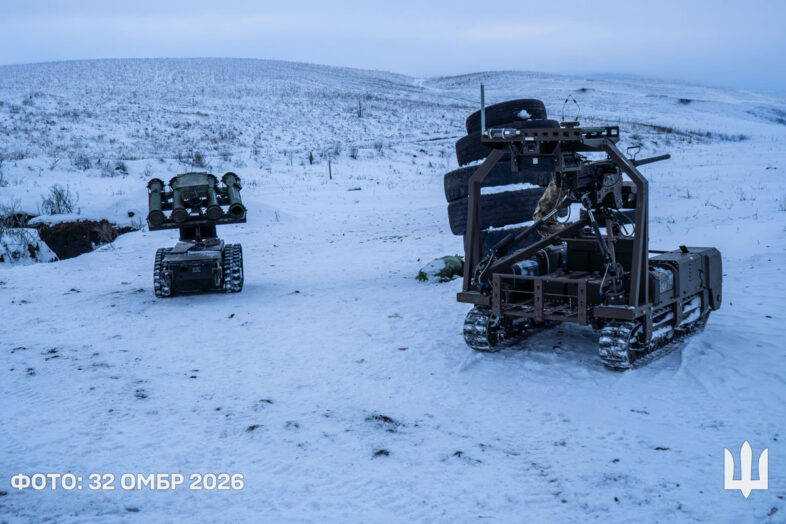
In the 32nd Separate Mechanised “Steel” Brigade, a unit of ground robotic systems (GRS) has been established
Artillery redefined
Artillery took on a completely new role. Precision systems gave Ukraine the ability to systematically strike at enemy logistics. Hits on depots, command posts, and river crossings became part of a deliberate strategy of attrition. The Ukrainian missile programme reached an entirely new level — though it’s clear none of this would have been possible without the restart that began back in 2015.
The war evolved into a constant technological contest. Advantages lasted only a few months before the enemy adapted, forcing the Ukrainian army to continually update tactics — and, of course, its communications systems. In recent weeks, Starlink has shown the world just how crucial reliable military communications are, and how their absence can shape the battlefield.
Digitalising the battlefield
One of the least visible but most critical changes has been the digitalisation of command. Data sharing between units, the use of electronic maps, integrating intelligence from multiple sources, and rapid transmission of coordinates for fire missions — all of this slashed the time between spotting a target and striking it. Where the cycle once took up to an hour, by 2023–2025 it was often down to minutes. It changed the rhythm of war: decisions came faster, and mistakes became far more costly as speed increased on both sides.
International support as a force multiplier
After 2022, international support was no longer just an add-on — it became a structural part of Ukraine’s defence. Weapons deliveries, overseas training, intelligence sharing, and joint planning all became woven into daily operations. The Ukrainian army learned to adopt new systems quickly, often while under fire. At the same time, this created a dependency on the pace and decisions of its partners. Operational planning increasingly factored in not just Ukraine’s own resources but also supply schedules. The army became part of a broader security architecture, rather than an isolated national force.
Institutional change under fire
Unlike in previous years, reforms were no longer postponed “until the end of hostilities.” They happened alongside the war. Command structures were overhauled, new headquarters and corps-level systems established, and responsibilities between levels clarified. Training shifted too: shorter courses, intensive programmes, and role-based specialisation. At the same time, the war exposed weaknesses: uneven workloads across units, personnel shortages, complicated rotations, and bureaucratic inertia. Some of these challenges have been partially resolved, while others remain. But fundamentally, the biggest change is this: today’s army evolves continuously, even as it fights.
Sustaining through war
The prolonged war has tested more than equipment and tactics — it has been a trial of endurance itself. After 2023, the challenge was no longer simply deploying forces, but sustaining them over the long haul. The army had to simultaneously replace losses, maintain combat readiness, train new units, and preserve command and control across vast scales. This is a different kind of war, one defined by long-term confrontation, where the logic had to shift from seeking quick results to building lasting resilience.
By 2026, the Ukrainian army had undergone two profound transformations: the first after 2014, when it was learning to fight, and the second after 2022, when it mastered combat on a massive scale while reshaping itself in real time. Over these years, a force that once numbered only a few thousand combat-ready troops grew to nearly two million, now ranking among the world’s top 20 militaries. Yet the true achievement lies not just in size, but in the adoption of modern command principles, advanced weapons systems, tactics admired — and studied — worldwide, and a high level of training and coordination. It is precisely this period — 2022 to 2026 — that has defined the army as it exists today: large, technologically advanced, integrated into the international security system, and capable of waging a sustained war of attrition.