On September 19, a guided Russian bomb struck the ground between the school and the kindergarten, leaving a crater two metres deep, according to Valentyna Pukhliy, the school’s headmistress. The explosion shattered the roof and forced plywood over the corridor windows. But the building has been empty of students for over four years, its halls silenced first by the COVID-19 pandemic. Valentyna Andriivna, who has spent 23 of her 42 years in education as the headmistress, now leads us to the new school—a remarkable space built entirely underground.
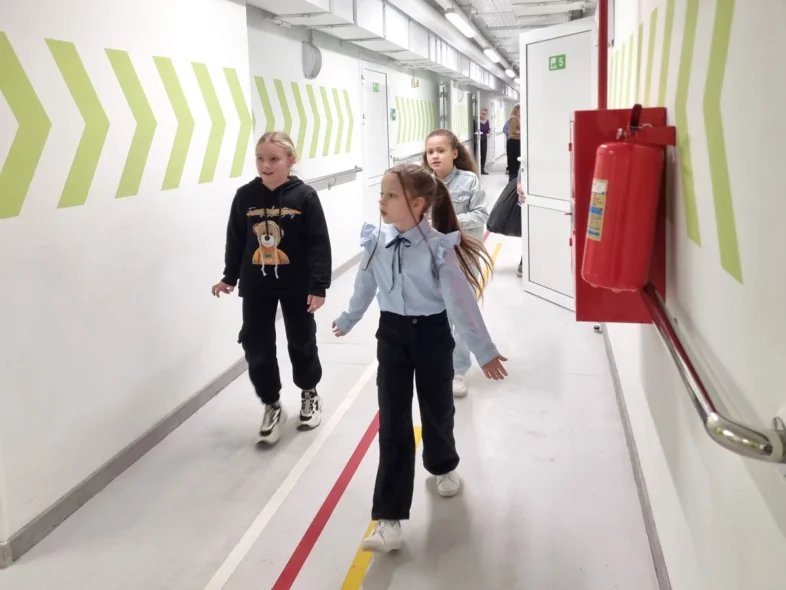
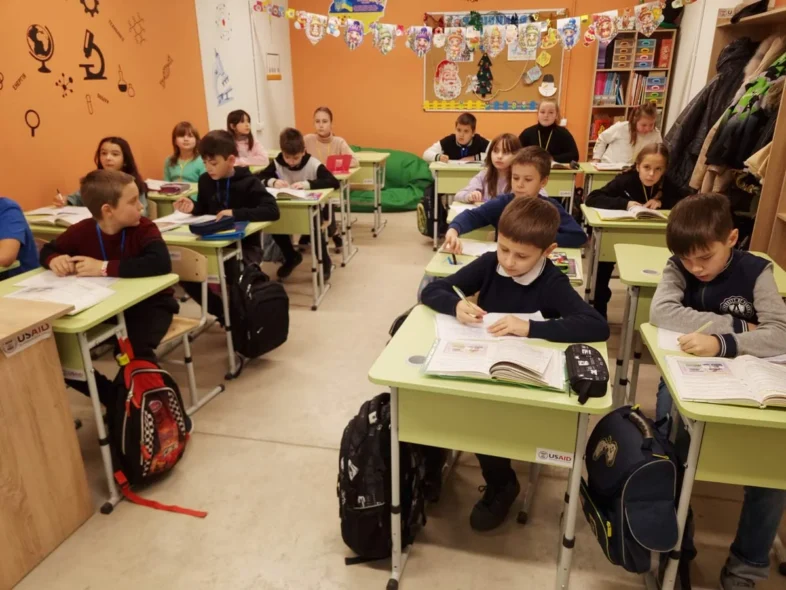
The underground school was built in record time—from September 2022 to March 2023—thanks to an initiative by Kharkiv Mayor Ihor Terekhov. By May 7, 2024, the school welcomed its first students from the Industrialnyi district. Just a few months later, by September 1, 2024, it was home to 1,100 students, ranging from first to eleventh grade, all preparing for national exams. “The demand was enormous, and we had to use all twenty classrooms, with up to 23 children in each,” says Valentyna Andriivna, stressing that both education and meals are provided free of charge.
Students attend in two shifts: younger children up to grade five come in the morning and stay for lunch, while older students attend in the afternoon. Two days a week, they study from home. Currently, Kharkiv has two underground schools—the second one is housed in a metro station—bringing the city’s total capacity to 3,000 students in 2024, according to Olha Demenko, Head of the Kharkiv City Council’s Education Department, during a recent briefing. She also highlighted that 53,000 students are enrolled in Kharkiv schools this year, a 2,000-student increase compared to the previous year. The Kharkiv Anti-Corruption Centre has estimated the cost of the school at 60 million hryvnias (approximately 1.5 million EUR – ed.), which is half the budget of a new construction project in Saltivka.
“This is an incredible and precious opportunity to work offline in these times,” says Alina Kholodova, the school’s deputy head and an English teacher who has been with the school since 2014. “When the children arrived in September, they were emotionless, frightened. But now, just three months later, they’re smiling, their eyes are shining.” She admits, however, that the workload is overwhelming.
The school’s pristine, white corridors are lined with posters titled “The Rules of a Ukrainian,” offering simple yet powerful messages: “Be honest,” “Support the Armed Forces of Ukraine,” and “Take pride in Ukrainian things.” Signs point the way to the cafeteria, restrooms, and exits. Just past the security guard’s desk is the safety room. Its walls feature a mix of posters—some focusing on mine safety, others on digital threats, air raid protocols, and precautions for water and fire hazards. Beneath a chest model, a small CPR training device stands ready for practice. Nearby, shelves display a child-sized bulletproof vest, tank replicas, and LEGO sets with police cars, all bearing the USAID logo—the main sponsor of the initiative.
Classes are led by doctors, representatives from the State Emergency Service, school police officers, and charitable organisations like FSD (Fondation suisse de déminage, the Swiss Foundation for Mine Action), among others. “What do I feel when I see these posters?” Valentyna asks. “The feeling is the same for everyone, but children need to understand that these threats exist and that they should never touch them. When we present these replicas and models, we don’t let the children handle them—only look—so they don’t develop the wrong habits,” she explains.
In the conference hall nearby, preparations for the New Year celebrations are in full swing. Gifts are being arranged under the Christmas tree.
At the onset of the full-scale invasion, the school above ground transformed into a hub, with its staff stepping in as volunteers, distributing humanitarian aid—baby food, clothing for displaced families, and more.
“There wasn’t a single day when we didn’t show up for work. At first, we helped with aid efforts, then we continued teaching children remotely, and now everyone is back to work,” says Valentyna, who had to recruit half of the 80 teachers needed for the underground school.
In the resource room, 25-year-old school counsellor Ihor Shtankevskyi waits for his students. He works with children who have special educational needs—seven students with autism spectrum disorders are integrated into regular classes—as well as those with developmental or musculoskeletal challenges.
The room is equipped with the latest tools to support these students. There’s an interactive floor and a sandbox that help engage children in various activities to develop their cognitive functions, perception, attention, imagination, memory, and motor skills. The sandbox allows students to excavate treasures and uncover artefacts, like amphorae, or use it as a tool to learn about geography, biology, and history. Meanwhile, a busy board simulates everyday actions, such as opening a door or turning on a light, helping children practice essential life skills.
A graduate of the Kharkiv Humanitarian and Pedagogical Academy explains, “Teachers bring a child here if they notice any issues during class or if the child seems anxious—like today, after the morning shelling—to help relieve psycho-emotional tension. The child can walk on the interactive floor to calm down, with specially selected music and colours. Even the fish respond.”
Valentyna adds, “Children who stay here in Kharkiv have grown used to the air raid alarms, which is deeply concerning. When the alarm sounds, they just carry on playing outside. There’s no way to stop it. In the basement, it’s hard for them—they need to move.” On August 28, six children from the school lost their homes in a nearby strike and had to relocate. One teacher had their windows shattered and their car destroyed.
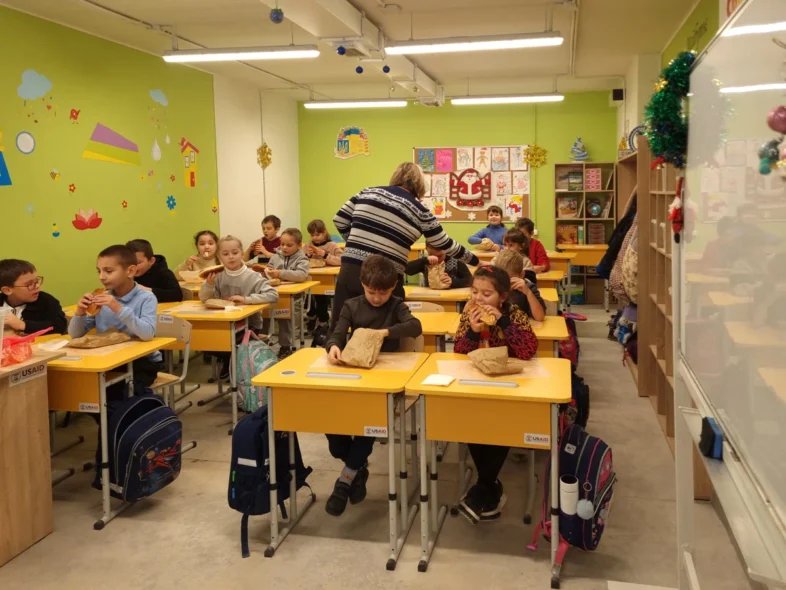
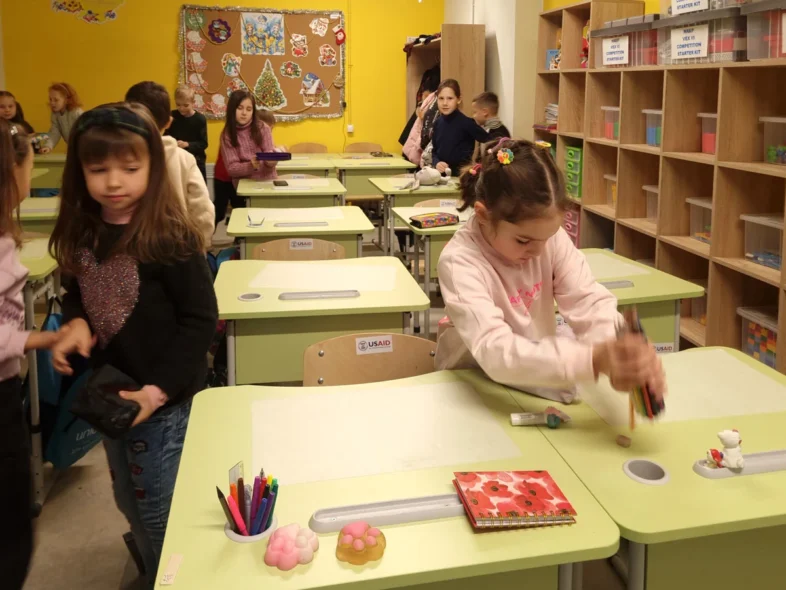
In a second-grade Ukrainian language lesson, the teacher finishes dictating a sentence. Dressed in various shades of yellow—the colour of the day—the children start running around the classroom.
“Put away your notebooks and books, please,” the teacher says.
One girl speaks up, “It’s reading time now.”
“What reading? It’s breakfast time!” another girl protests, looking annoyed.
“We’ll eat first, then do reading,” the teacher reassures them.
“This is the last lesson!” a boy at the back of the class shouts with excitement.
The bell rings. Today’s favourite meal is burgers.
“I like a proper lunch—rice porridge, vinaigrette, and a meat cutlet,” says Sofiika from 4-B. She came here with friends from her old school, and for her, the lessons and tests seem easy.
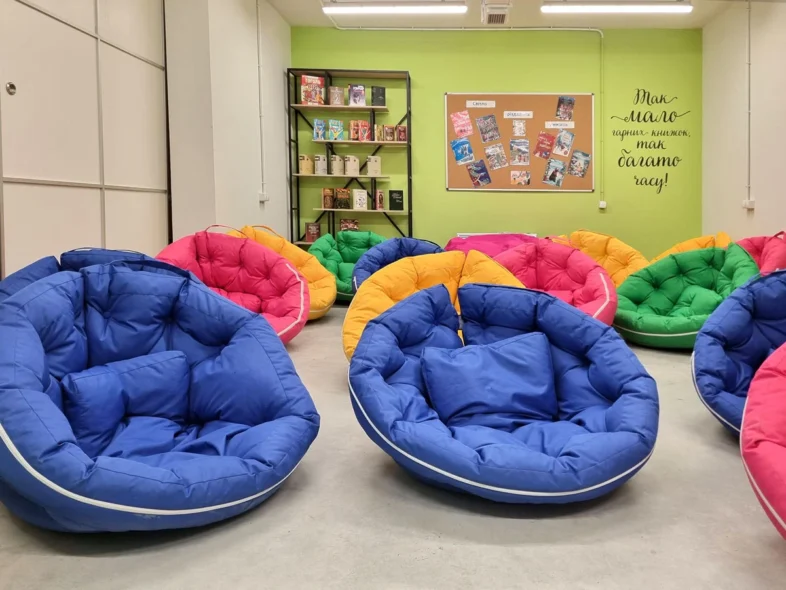
In the alternative room, where students can read or chat face-to-face—phones strictly prohibited—a stress resilience session with a Polish humanitarian organisation is about to begin. After a few warm-up exercises, the children will be shown images, like a mountain, and their responses, along with their emotional states, will be analysed. Later, they’ll have a go at making origami. “The condition of children from the occupied territories, like the ones we visited yesterday in the village of Vasylenkove, is much worse,” says the workshop moderator.
In the computer science classroom, alongside the computers, there’s also a 3D printer. The students proudly took home their first creations—a set of red hammers—to show their parents.
“The children feel very comfortable here. There’s a high demand for this school. Even during the holidays, students come for programming and robotics clubs, to catch up on subjects they need help with, or to prepare for national testing,” explains the headteacher.
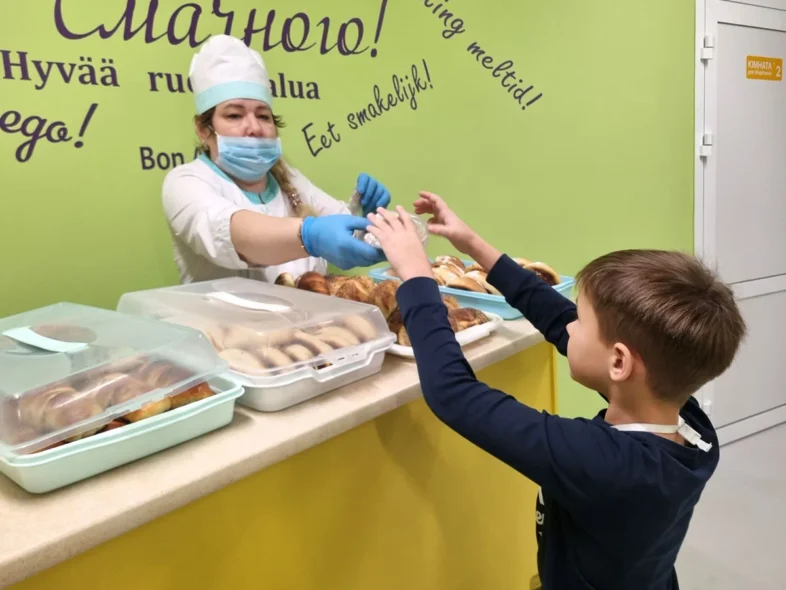
In the cafeteria, just past the medical office, a boy buys a pastry, unable to wait for lunch.
“I’m grateful that my teachers and I have the opportunity to interact and conduct lessons in person, as online lessons limit communication with the children. Here, everything feels just like it used to—we don’t even notice that we’re underground. The only difference is the lack of windows,” concludes Valentyna Andriivna.
***
This report was written during a residency at the “Slovo” House of the Kharkiv Literary Museum.