In a resolution adopted on October 2, 2024, the Parliamentary Assembly of the Council of Europe indicated that 65,956 servicemen and civilians have been registered as missing or captured to date, although the actual number is believed to be much higher. The Assembly demanded that prisoners of war and civilians held in Russian captivity be treated in accordance with international humanitarian law, pledging to “remain involved until the last captive is released”.
A United Nations report published in February 2024 stated that while the Office of the United Nations High Commissioner for Human Rights (OHCHR) had no access to Ukrainian prisoners of war (POWs) held in Russian captivity, interviews with released detainees revealed that ”torture and ill-treatment of Ukrainian POWs in Russian internment is widespread and routine”. Another UN official, speaking in October 2024, declared that 95% of Ukrainian POWs have experienced torture on a daily or weekly basis.
***
Petro Yatsenko, a 46-year-old journalist and author of a dozen books published in Ukraine and translated into Polish and German, has taken on a vital role as spokesperson for the National Coordination Headquarters for the Treatment of Ukrainian Prisoners of War in 2022. This organisation is chaired by Kyrylo Budanov, chief of the Main Directorate of Intelligence of the Ukrainian Ministry of Defence. Since the onset of the invasion, 3,672 prisoners of war have been released from Russian detention centres, including 178 civilians (adults only; the situation regarding children in captivity is addressed separately) and 3,504 military personnel. Among those freed were 252 women, comprising 209 military and 43 civilians.
When asked about the overall situation, Petro Yatsenko remarks:
“Since the onset of the Russian invasion, the treatment of civilians and prisoners of war has been appalling. What distinguishes this war is the fact that Russia has captured numerous civilians, subjecting them to treatment as POWs, in clear violation of the Geneva Convention. Their fundamental human rights—including the rights to life, health, and food—are being egregiously violated.
We know of up to 150 confirmed detention sites in both the [Ukrainian] occupied territories and in Russia. These locations weren’t created specifically to hold prisoners of war according to the III Geneva Convention [relative to the Treatment of Prisoners of War, Geneva, 12 August 1949]. Russia was accommodating these detainees in pre-existing facilities together with Russian criminal convicts. Only after some time, Russian authorities started separating POWs from criminal convicts, yet this separation doesn’t mean that the requirements of international humanitarian law were met.”
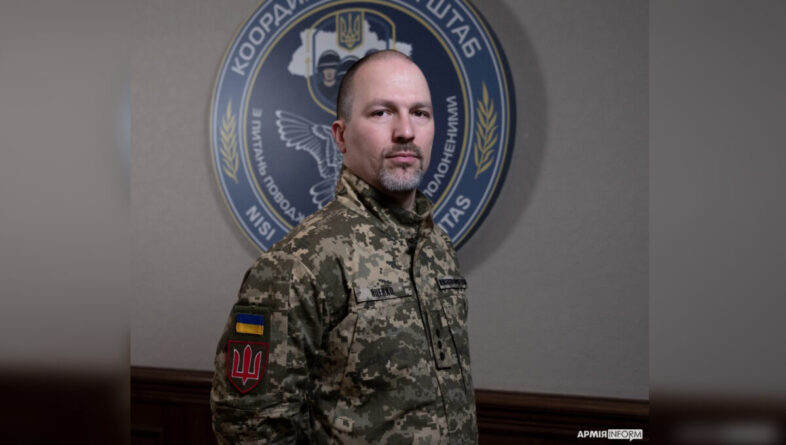
Petro Yatsenko. Photo: Ukraine’s Coordination Headquarters for the Treatment of Prisoners of War
What is the prevalence of the tortures experienced by the prisoners of war?
– The prisoners endure daily torture; these are not isolated incidents but part of Russian policy within its penitentiary system, supported by the Russian government and President Putin. Women generally endure slightly less severe conditions. They don’t have enough space, they are kept naked, they don’t have bath amenities and access to hygiene, but in general, they are less tortured than men. They are under threat of rape or are being raped. If they have a patriotic tattoo, Russians can try to erase it with boiled water.
There are also cruel practices related to food and its consumption. For example, one POW in Olenivka reported having only 2 minutes for breakfast, 3 minutes for lunch, and 2 minutes for dinner. This limited time includes both eating and returning dishes, and food is often so hot that prisoners face the choice: either burn their stomachs or stay hungry.
POWs were forced to move around in stressful postures: they were not allowed to stay straight, and they were forced to keep their hands high and their heads low – in this pose, they had to go around. It’s very stressful.
What other types of torture are being applied?
Besides physical abuse, prisoners are also subjected to psychological torture. Russian authorities attempt to erase Ukrainian prisoners’ national identity by prohibiting them from speaking Ukrainian, punishing any violations with more severe tortures. Ukrainian POWs are also forced to learn and recite Russian patriotic songs, the Russian national anthem, “Russian chanson”, songs like “Father combat” (“Batyana kombat”), and even Russian poetry. Mistakes in recitation lead to collective punishment of the entire cell.
POWs are told that Ukraine no longer exists, that the country is divided between Russia, Poland, and Hungary, or that their government abandoned them. They are told that if they are exchanged, they will be immediately thrown to the front. Therefore, there’s a gap between [two opposing messages]: Ukraine was divided, and Ukraine is still fighting.
Ukrainian POWs are brainwashed every day. They receive proposals to join Ukrainian battalions in the Russian army, such as the so-called battalion of Bogdan Khmelnytksy. So-called because a battalion is a unit of 1000 people, and this group is 100 people only, and we don’t know if all these people are former POWs. We know that this so-called battalion was created in 2022 for propaganda purposes to counter Russian battalions fighting on the Ukrainian side, like the Siberian battalion, with the goal of showing that Ukrainians are uniting to fight against Ukraine, as well. It took Russians one year to gather a small number of people, and we don’t have information on where this battalion is based. We have thousands of Ukrainians in Russian places of detention, and it is incredible that even under constant pressure and torture, they resist such kind of proposals.
People who are supposed to be exchanged are also offered to stay in Russia. Another form of torture occurs when Russian forces gather a group of POWs, announce that they will be exchanged, and at the last moment tell them that Ukraine has refused the exchange.
Is contact with relatives generally allowed?
– In general, POWs are completely isolated from the outside world and are unable to contact their families and loved ones. This isolation is itself a form of torture, as families endure an ‘indefinite loss’ without knowing the fate of their loved ones. They don’t know if their husband is alive or not. They have no certainty in their life and put it on hold. Sharing details about harsh conditions often leads families to pressure the government, so Russian forces seek to manipulate these families, adding to their pain.
In Ukraine, Russian POWs are permitted phone calls with their families, but in Russian detention centres, even letters are rare, heavily censored, and take up to six months to arrive through the International Committee of the Red Cross (ICRC). We permitted the transfer of parcels to Russians held in Ukrainian detention facilities and attempted to send packages with essentials—like cookies, cigarettes, warm clothing such as socks, and non-perishable food. However, many of these items were either expired or never delivered.
What are the physical tortures applied to these POWs?
– Russians use a so-called “invitation procedure”, a kind of death corridor or “priyomka” as they call it, when about 70 people are standing in a narrow corridor on both sides and POWs newcomers have to go through. Everyone hits them with wooden or steel sticks, or hammers to break their bones. If you fall down, they beat you even more. We know cases when people were killed during this ‘procedure’.

Photo: Ukraine’s Coordination Headquarters for the Treatment of Prisoners of War
How many deaths in detention are you aware of?
– We are aware of 177 reported deaths in detention, including 55 POWs of Olenivka detention centre killed in what is a war crime. Russians staged a barracks explosion, gathered pieces of Himars from other territories and said that these POWs were killed by Ukrainians using an American weapon. It was a war crime.
These are not official numbers: out of these 177 deceased, we know from different sources (people who were freed and other confidential sources) that they were killed, but we don’t have their bodies to prove, and we don’t have official information from the Russian side.
In a briefing to the UN Human Rights Council on Tuesday, October 8th 2024, UN rights chief Volker Türk expressed grave concern over the mistreatment of prisoners of war (POWs), particularly Ukrainian soldiers. He reported “widespread and systematic” torture of Ukrainian POWs by Russian forces, based on documented accounts from 174 Ukrainian POWs, nearly all of whom described consistent experiences of torture during captivity. “Instances of torture are taking place on a daily or weekly basis. Minimum safeguards which are meant to help prevent torture – such as allowing prisoners to communicate with the outside world, access by independent monitors, or routine medical exams – have been absent or ineffective,” he said. “The evidence gathered also suggests involvement of facility supervisors, and significant coordination among various entities of the Russian Federation – such as the Federal Security Service and the Federal Penitentiary Service.” He further voiced concern over the dehumanising rhetoric from Russian public figures calling for inhumane treatment and even the execution of Ukrainian POWs.
Do Ukrainian POWs work in detention?
– Usually, Russians don’t have any work for our POWs. From what I hear, they’re more often forced to stand upright for up to 18 hours a day. They are not allowed to sit or lay down. That’s why, when they return, we often face significant issues with their legs.
We call it a “penguin walk”: former POWs can’t move their legs properly because of the problems with their muscles and locomotor system. If they could work, it would have been better for them. They could have moved around, exercised, and communicated with each other.
Are there any facilities among the 150 that are notably worse than the others?
– Yes, we are tracking all these places. A lot of places in Mordovia and Taganrog have much worse treatment and torture.
There also exist unofficial places of detention. For example, the Wagner group has its own places of detention. The situation here is even worse: these are often basements with electric light from where POWs don’t have the sunlight or the right to go for a walk.
How can it be worse?
– When many people are kept in a confined place without sunlight… In Russian places of detention, they force POWs to cut their hair and beards. In Wagner detention places, POWs weren’t allowed to do that and were freed with long beards. They have poor hygiene conditions and lack fresh air.
Sometimes, in Chechnya, conditions could be better than in Russian detention places. We had a case when a heavily wounded Ukrainian soldier – he lost his legs and arms – was sold by the Russian army to Chechens with another POW, his friend, who helped him to survive. He said that in Grozny city, conditions were better than in Russian places of detention.

Photo: Ukraine’s Coordination Headquarters for the Treatment of Prisoners of War
Is there any explanation for this treatment?
– It is hard to explain. Russian tradition of POWs’ treatment historically comes from the times of the tsarist and the Soviet era. I read a book by a British author about medieval Russia where he mentioned that the treatment of POWs by Russians in the 16th century was horrible. The POWs were held in bad conditions, and when the British tried to give them some money, the POWs were beaten, and the guard was punished because he allowed the diplomat to give them money. The conditions were terrible everywhere at that time, but this diplomat said that Russian prisons were the worst. We also know about the conditions in Stalin’s prisons, in the Gulag. Russia’s modern system is a heritage of the Soviet era. In general, the conditions everywhere in Russia are not even close to the III Geneva Convention requirements. That is why Russia doesn’t allow ICRC (International Committee of Red Cross) and UN representatives to visit at least some of their places of detention.
How many visits were made since the beginning of the invasion?
– ICRC doesn’t share this data. In Ukraine, the visits are conducted by the ICRC, and they have one-on-one conversations in a separate room in the absence of the prison administration. In Russia, POWs are gathered in one big hall and ICRC talks to them collectively. We know of a case when a Ukrainian POW said: “You are representatives of the ICRC. Why don’t you have parcels for us?” People who were freed from this place of detention said that he was tortured afterwards and committed suicide three days later.
Are there a lot of suicides?
– We often don’t know about the reasons for the deaths of POWs. From Russian documents, we gather that a person had a heart attack. However, when we receive the body, sometimes the heart and other organs are missing, which is likely done to prevent the identification of the cause of death. Also, the bodies are not always kept in cold temperatures, but we see signs of torture, such as broken bones and other signs that this person was beaten. Russians frequently use electricity as a form of torture, making it difficult to determine the cause of death if a person is killed by electrocution. They use electric shocks and Soviet-era phones – tapic in Russian [author’s note: TA-57, army corded telephone] – it’s very painful and generally leaves no marks on the body.
We are aware that there is sexual violence as well…
– Yes, it’s very painful. Our estimation is that more than half of the POWs experienced sexual violence. Of course, it’s very painful for them to talk about it. It is difficult for a 50-year-old man, for example, who is a father, has children, who was a manager in everyday life, to share his experience of being violently raped by Russians. Women who were not raped could have witnessed men being raped: they could hear their cries. When Russians start playing loud music, they know that the tortures begin, which is a torture itself.
Is there evidence that this treatment is part of Russia’s official policy?
– Overall, Russian propaganda depicts Ukrainians as “Nazis and fascists,” fostering hatred that trickles down to prison guards and others in contact with POWs that those who are freed have difficulty explaining. Russian society is misinformed about the war.
Russian propaganda originates from the government, which has a hierarchical power structure that transmits orders from the president down through the ranks.
Russians want to show they respect the Geneva conventions, but it is enough to give a few orders for the detention regime to work in the opposite way. For Russians, it is important not to treat Ukrainian POWs well, as Ukrainians are not a nation, according to Putin. Therefore, they try to erase POWs’ national identity, and this can’t be done without torture, force or mistreatment. For Russian society, Ukrainians are a dangerous enemy despite the fact that it was the Russian army who invaded Ukraine.
Though we lack direct evidence of formal orders for mistreatment, the high prevalence of torture suggests a deliberate policy. Russian authorities’ goal appears to be the erasure of Ukrainian POWs’ national identity, which can’t be exercised without sustained abuse and psychological torment.
Could this explain why some battalions are treated worse than others?
– Russians try to divide our POWs. If you are a mobilised soldier, you will be less tortured. If you are a professional military, you can be beaten or tortured more. If you are a member of the Ukrainian battalions that are very effective on the battlefield, such as Azov, [it is worse]. We have proofs from released POWs that they were mistreated and tortured more than others because Russians see them as a dangerous enemy. When the first important POWs exchange of 215 persons, including ten foreigners, took place on 21 September 2022, the images clearly showed the drastic weight loss they had suffered after just four months of detention.
Aiden Aslin, a British citizen who was a member of the Ukrainian National Guard, was tortured and was supposed to be killed according to so-called ‘death sentences’ handed out by the so-called ‘Donetsk republic’. He was forced to record propaganda videos and lost a lot of weight. Just four months of this mistreatment can lead to significant health damage. Each day spent in Russian detention poses a serious threat to their lives.