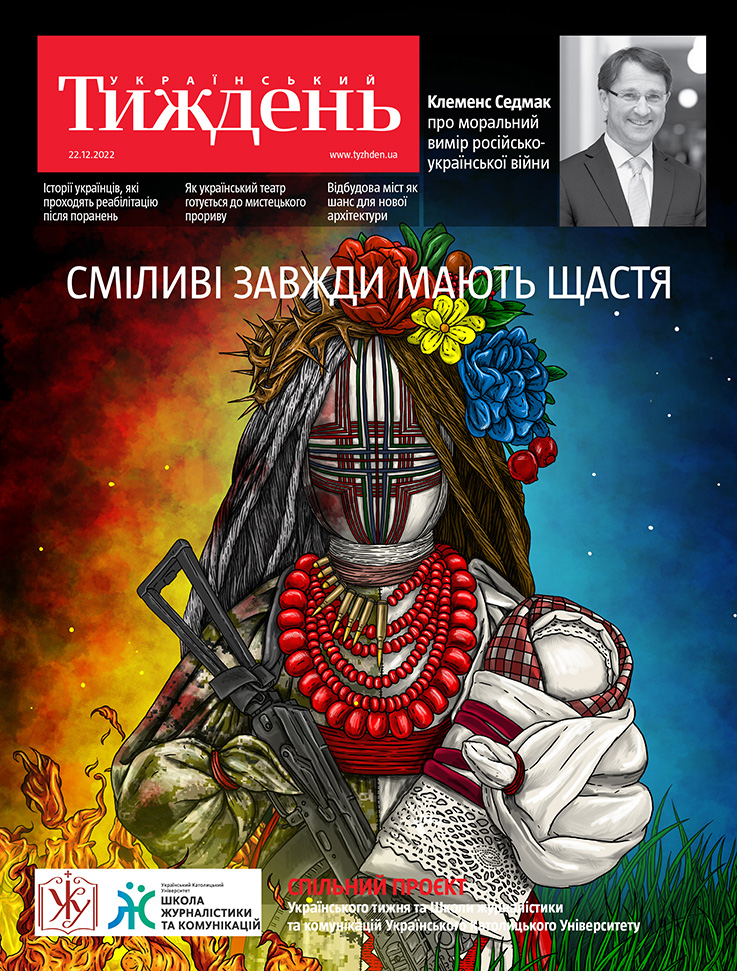
The work of veteran, actor and director Oleksa Kravchuk is anything but ordinary. With a rich theatrical background and firsthand combat experience, he now leads Lviv’s municipal puppet theatre, People and Puppets, after his demobilisation. It’s the smallest theatre in Ukraine—with the smallest director’s office, as Oleksa often says with a smile. The Ukrainian Week spoke with him about how theatre can help heal trauma, why puppets sometimes tell the truth better than people, how eastern Ukraine has changed, and how to navigate themes of grief.
***
– How did you decide to apply for the position of theatre director?
– Since 2012, I have been working as the chief director of the Luhansk Puppet Theatre, gaining experience with several productions. Then, in early 2015, when the Russians entered Luhansk, the guys told me I had to get out. They helped me because having Lviv license plates and registration made things difficult.
As I was leaving, a man put a gun to my head, calling me a banderivets (a term derived from Stepan Bandera’s surname, used in occupied territories to label Ukrainians as ‘dangerous’). But then someone mentioned I was a director, and he let me go.
I had to leave through Russia and re-enter Ukraine via Kharkiv, crossing through the Belgorod region. At the Kharkiv border, one of our border guards started berating me: “What right did you have to leave through uncontrolled territory?”
– Like there was some other way I could have done it…
– I snapped back: “Captain, I’ll start the car right now—why don’t you show me the right way to leave?” That shut him up. I made it to Lviv, and since the previous director had passed away, I was invited to apply for the position through a competition. Puppets had already been a part of my life, and I have no regrets—I love this work immensely.
– It’s interesting how eastern Ukraine keeps drawing you back.
– When I first arrived in Donetsk, I didn’t like the city at all. If not for Ihor Anatoliyovych Kozlovskyi, I might never have warmed up to it. Looking back, I realise meeting him was a gift—he became my mentor and friend.
In Donetsk, I felt like I lacked a cultural foothold, something solid to stand on. There were remarkable individuals, of course, but overall, the cultural landscape felt vague, blurred. Ukrainian culture—especially in theatre—often seemed like a cheap imitation, something plastic, just for show, without real depth.
Luhansk, on the other hand—especially between 2013 and 2015—still had something genuine breaking through. I remember when Serhiy Zhadan visited. He was working on a project near Luhansk, and since we already knew each other, I suggested hosting his poetry reading at the Luhansk Puppet Theatre. He came, and the audience listened to him in a single breath.
At one point, a journalist asked, “Tell me, do the separatists read your works?” From the back row, two men in camouflage stood up and answered in Russian: “We’ve read him, we read him now, and we’ll keep reading him. Seryoga, here’s 200 hryvnias—we downloaded your works for free.” Later, he wrote about parts of that evening in Luhansk Diary.
Then Pikkardiyska Tertsiya came to perform. People welcomed authenticity with open arms.
I continued working at the Luhansk Theatre, where we staged Hamlet in Yuriy Andrukhovych’s translation. Yurko himself came to see it. Back then, there was no doubt—Luhansk was a Ukrainian city.
– Puppets are powerful archetypes. How do they shape people’s consciousness? And what kind of audience comes to your theatre?
– Puppet theatre is unique in its archetypes—there’s no doubt about that. It resonates most deeply with two kinds of people: children and adults who have been through a lot. When you strip away ego-driven fixations, you reach something fundamental—an archetype, a metaphor with a precisely defined form.
A puppet itself is a form that never deceives. It simply is. And when you look at it, your own associations emerge—you return to your childhood room. That space is warm, familiar, and that’s the true power of theatre.
We have a play directed by a student called Fox Sky. The plot is simple: an old fox, protecting a young one from a poacher, sacrifices his life. Death arrives and says, “Come, it’s time.” But the young fox protests: “No, Death, I won’t let you take him just like that—I need to see how he will live now.” Death replies, “You’re not supposed to go yet.” But he does.
– Profoundly adult meanings…
– We created this play because there was a deep need for it. Today, many children are left orphaned as their parents die in the war. This story resonates with both children and adults.
I remember one woman who couldn’t bear to stay through the performance—she stood up and left. It was too painful for her. But another woman kept coming back, saying, “It’s important for me. It helps me believe.”
This connection to archetypes is incredibly powerful. There’s something almost mystical about it. When you look at a puppet, it pulls you back to childhood—to your grandparents, to something far older, reaching deep into the past.
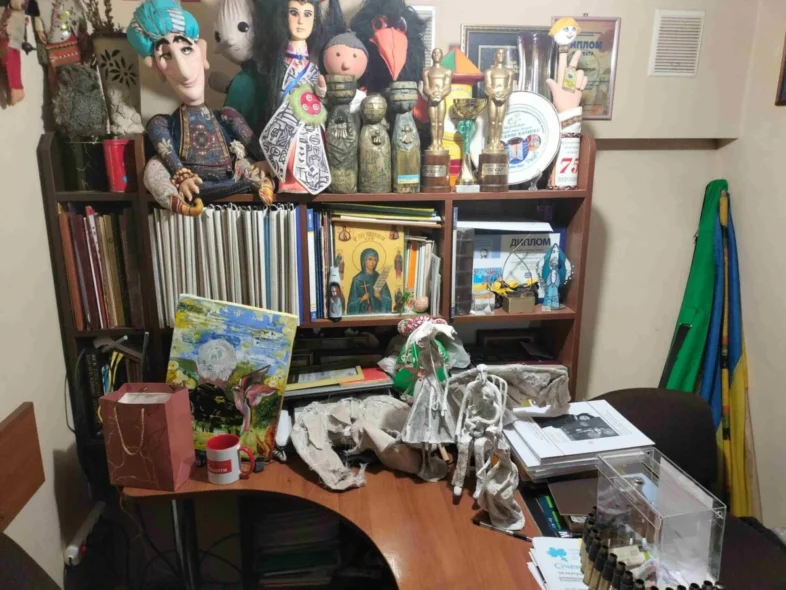
– The intimate atmosphere of the theatre feels like a vertep—a traditional Ukrainian puppet theatre—or a dollhouse. Do you think this builds a deeper sense of trust? Do people stay after performances to talk or ask questions?
– Mostly, children love coming up to the puppets—touching them, examining them up close. But adults, too, sometimes discover something unexpected, something deeply personal.
For example, we have a play called A Snowflake for the Little Wolf. At its core, it’s about love—real love—knowing when to let go. A snowflake falls in love with a little wolf. For adults, this story stirs up emotions they may have buried long ago—things they suddenly allow themselves to feel again.
Some open up about a love they’ve kept secret. Others remember a time when they loved but no longer do. And some, paradoxically, realise they never truly loved before—but do now. This kind of revelation is rare. You don’t often see it in dramatic theatre, but with puppetry—it happens. Puppetry does something remarkable to the human psyche. It unlocks something. People begin to unpack what’s inside them. And honestly, I’ve started to feel like I don’t fully understand theatre anymore—and I love that (smiles).
Of course, social and patriotic themes are important. But right now, what matters most to me is PTSD, the wounds of society—not just veterans, but everyone. Dramatic theatre tries to tackle this, but it doesn’t always work. The problem is that dramatic actors, at least until a certain age, tend to be ego-driven. They step onto the stage and put themselves at the centre.
But puppetry—it has a kind of humanity to it. A tenderness, a vulnerability. And paradoxically, that’s an incredible strength.
– Do you bring puppetry to the military? How does that work?
– My friend Valerii Dzekh was the director of the Kharkiv Puppet Theatre before 24 February 2022. When the full-scale invasion began, he stayed to defend Kharkiv. Then one day, his commander told him, “Bring the puppets.” So he did. And with them, he created a unit that became part of the Cultural Airborne, led by Mykola Serha. Valerii staged several performances, and I was lucky enough to be part of it after my demobilisation.
We took the performances to my home unit, the 80th Brigade—to the scouts and other divisions.
At first, it seemed almost impossible—soldiers coming in after missions, dirty, exhausted. They sat down, and you wondered: Where do I even begin? You look into their eyes, they look into yours, and in that moment, you realise—you have to start with something real. And what is real? Real can be fear. Real can be the memory of childhood—that place where strength is born.
So you begin—telling a story with these puppets, building something, revealing something about yourself in the process. Real strength isn’t about being invincible; it’s in your vulnerability, in the child you once were, in that childhood room where everything was still whole and intact, and where you were that little son who could protect his mother. Where there was a father, and the world still made sense.
And it worked.
These performances were improvisational. There were set themes, but within them, real conversations unfolded. One of the most important moments was looking a comrade in the eyes—creating a space where he could speak about his fear.
– You were at war, wounded, and came close to dying. You’ve said two comrades saved you. Have you thought about this from a spiritual perspective? What does your second chance at life mean to you?
– I could’ve died. And that day, many of my comrades did. Many… But honestly, at that moment, my perception of death felt almost romantic. There was the unbearable pain and fire in my eyes, and I remember my first thought: “Thank you, God, for letting me live. If it’s my time to go, please let it be peaceful.”
That’s when Serhii Vasylovych, our sergeant major, showed up and pulled me out. “Oleksa, let’s go,” he said. I told him, “I can’t.” And yet, he carried me out.
They gave me painkillers at first, but they didn’t work. Then they gave me something stronger, which helped a little (laughs – ed.). I was first stabilised in a village and then taken to a hospital in Bakhmut. My guys came to visit and said I had this peaceful look on my face when they found me. They said it seemed like I had already accepted it. If it’s your time, it’s your time. No one knows how it will happen.
But I’ve noticed, both in myself and in my comrades—we always pray for the same thing: “If I have to die, let it be with dignity.” In civilian life, we often forget about that. This time, God spared me, and for that, I’m grateful.
– Why is Ukrainian history so cyclical? Every time something becomes stable and influential—a community, a phenomenon, an institution—a force seems to emerge that physically wipes it out. Then, it’s as if there’s an amnesia. One or two generations pass, and once again, passionate individuals emerge, rediscovering the past and trying to transform it—and then comes war and regimes, and once again, the most passionate are lost. Why does this keep happening?
– I don’t have an exact answer, but from my perspective, it’s the absence of deeper meaning in our cultural development as a people. The focus has always been on economic priorities, which were seen as more important. Unfortunately, since independence, Ukraine’s economy has been deeply divided—partly towards Russia and partly towards Europe. This ongoing struggle has been a constant throughout our history. We’ve seen how, at one point, the narrative was framed as “on one side is Bandera, on the other – the Young Guard.” This division was intentionally stoked to pit people against each other. Then, in the political sphere, parties emerged as polar opposites—like “Svoboda” and the “Party of Regions”—which created two extreme points, pushing society into internal conflict and making it a zone of confrontation.
Meanwhile, the meanings that should have been revealed through cultural studies, education, art, and culture were instead exploited for political gain rather than being truly understood and projected onto our future. And that’s why this cycle continues.
Now, with this war, once again, the best people have gone straight to the front.
– Yes, for them, it wasn’t even a question…
– The best ones went, and the best were lost almost immediately. Later, when I was there, that spark, that fire, those intelligent eyes—they were gone. Intelligent people were not liked. Why, for example, are certain individuals removed from their positions and replaced by others? Like what happened with Zaluzhnyy, who had the trust of the military—from the lowest-ranked soldier to the highest commanders. Why does this happen? Why is there such secrecy about how many soldiers have deserted? Why is there so much silence about how many have died? I think this is wrong. We need to know.
I look at many staff officers, and there’s nothing in their eyes. But when I look at my comrades who are actually out there fighting, their eyes still smile—though often with sadness. And they remain silent. Society is becoming increasingly divided.
– When you look at the active minority—those who often see themselves as thought leaders, more educated, or as the ones shaping public discourse—you sometimes notice so much ego, arrogance, and detachment that it seems simpler people understand life, its challenges, and others far better, without the same arrogance. Could the situation in our country also be a reflection of this minority’s role?
– I’ve noticed that my own experience—two higher education degrees and work in theatre—means very little. When I joined the army, my comrades, many of them much younger than me, were wiser than I was. So it’s better to learn from them—the wisdom of ordinary life and victory. This realisation is very important, and when it happens, meanings open up, and the world shifts. As for today’s elites, I feel like they are losing their sense of gratitude. They overlook the loss of meaning and responsibility. But responsibility is gratitude. When you truly understand that, you simply must thank the soldier.
– Our society often struggles with how to address the effects of war in everyday life—how to talk to someone with PTSD, how to react to soldiers who have lost limbs. So, how do we approach it? How do we start the conversation?
– At its core, it’s a matter of humanity. You can issue all the decrees you want, but what truly matters is how we treat each other. For example, every morning at 9 a.m., there’s a moment of silence. I park my car near the theatre, head to the gym, and sometimes, I’ll stand in the middle of the road, blocking traffic for that moment of reflection. Today, I didn’t block the road, but apart from pedestrians, no one else stopped. These moments need to be highlighted. The same goes for the media.
I’ve also worked with military personnel from the Department of Moral and Psychological Support (MPS). In the early days of the full-scale invasion, things were simpler. We were in Voznesensk and other areas, and our company commander would gather comrades with solid combat experience, ask for their opinions, and then make decisions on who would go on missions. It was straightforward. But as time passed, military bureaucrats started appearing, and that created problems. It’s harmful because, even within the MPS, there are people who don’t know how to communicate with others. You need to understand how to talk to someone, as everyone has their own strength and dignity, and you can’t just take that away. Everything should be built upon that, and that requires a personal approach. The state can help, can guide—but no more than that.
– What are your thoughts on grief? How do we handle it in our time, especially when there’s so much of it? How do we talk about it? And can theatre play a role in supporting us through it?
– Yes, it can, but the paths to that are varied. Sometimes, a simple song plays, and out of nowhere, you find yourself crying. Recently, Nadya (Oleksa’s beloved) and I went to the opera. It was the Dialogues of the Carmelites. I felt calm before it started. The scenography was beautiful, but something else moved me. When, in that magnificent opera house, an incredible orchestra played the Ukrainian national anthem before the performance, I was overwhelmed. Tears welled up in my eyes. The sound was vast, and in that moment, everything that is happening now—and everything that has happened before—appeared before me. Emotionally, I was torn apart. It was such a powerful moment because so many of my comrades—brothers and sisters—have died.
We visit Marsove Pole, the field where graves are growing, and I realise these are young lives lost. I watch the women—one brings a toy, another leaves flowers, and someone else places an energy drink. A group of guys simply lights a cigarette at a fallen comrade’s grave. We go through this. It’s the price we pay, one that, paradoxically, makes us both stronger and more tender.
– Among other things, the war has made room for the legitimisation of tears—especially men’s tears, but really, human tears in general. They are deeply intuitive and natural.
– It seems to me that our society is living in a state of collective PTSD right now. This war will last a long time, and it’s not just about territory—it’s about an attempt to destroy an entire culture. That’s why, for me, it’s so crucial that today’s Armed Forces of Ukraine identify and nurture talented young military leaders. And it doesn’t even matter if they’re young—what matters is that they’re talented: officers, soldiers, sergeants. They need to be given the opportunity to realise their potential. Because only through the open improvisation of the mind, intellect, soul, and heart can victory be achieved. Victory won’t come through rigid forms alone. And the same must happen in art. Art cannot become a means of profiteering, especially when it comes to war.
Part of our society is becoming indifferent. There’s this idea that because the war has entered its third year, people are tired. However, I believe these themes should be addressed through the lens of culture.
And what are the Russians doing? They’re being very cunning. They’re pouring colossal amounts of money into the development and visibility of their culture. And what happens? The same thing as always: there’s this so-called “great Russian culture,” and once again, we are merely reflecting in its shadow. The practice of grieving gives a certain strength, but it’s a strength for the future.
– Should we simply make space for this experience and move forward?
– It needs to be acknowledged somehow, given room to exist. Again, this is a question of cultural development tactics and strategy. Because this is what the war is about. The border regions that have been destroyed or occupied since 2014—mostly Luhansk and Donetsk—were, for the most part, pro-Russian territories. And unfortunately, Ukraine was only present there in the form of “plastic wreaths.”
Take Kharkiv, for example. It has its own history—the 1920s and 1930s—its literary, artistic, architectural, and theatrical heritage. And yet, Kharkiv didn’t allow itself to be captured. I deeply respect the people of Kharkiv for the way they clean and restore the city after every shelling.
But I do have serious questions for the governor. Theatres aren’t being funded, even though cinemas, bars, and restaurants are open. Right now, we should be investing in theatres and museums, especially since the occupiers are just 30 kilometres away. This is something we must understand.
I’ve witnessed moments when I speak to someone, realise they’re Russian-speaking, and then see them switch to Ukrainian, trying to respond in Ukrainian. This should be encouraged.
– I also remember a time when some local residents criticised the grave of writer Mykola Khvylovyy (one of the leaders of the 1920s generation), questioning who he really was. But times change.
– I remember 1988 very well. My friend and godfather, Stepan Pasichnyk, the chief director of the Shevchenko Theatre in Kharkiv, was among the first, along with his father, to place a cross on Mykola Khvylovyy’s grave in Kharkiv. Back then, Stepan even took me along to guard the cross. The police would come to harass him for it. Why? His father was practically considered a dissident. And I’ve met many actors in my life who didn’t appreciate or recognise the significance of Les Kurbas (the innovator of theatre in the 1920s). They’d say he destroyed traditional Ukrainian theatre. What can you even say to that?
In Soviet times, there was a moment when the word “art” disappeared from the dictionary, and the term “culture” took its place. And that became a very broad concept. Culture could even refer to something as simple as toilet paper.
– How do you feel about the influence of officials on theatre, both during Soviet times and now?
– In Soviet times, the arts and theatre were overseen by party committees. I grew up in that environment—I remember my parents were actors. The first and second secretaries would attend performances and decide whether they should be allowed to continue. The party committees handled all of that. Today, this function has been taken over by regional state administrations. They no longer manage censorship, but they still control funding. So now, certain expectations arise. You have to produce a specific number of shows, generate a certain amount of profit, and report specific figures. But when a director or artist takes on a play, every artistic work has its own gestation period. And you never know how long it will take.
When I worked at Les Kurbas Theatre, Volodymyr Kuchynskyy (a director) could spend a year on a production. That’s how it was with The Praise of Eros, and then he would create a beautiful piece.
For Beckett’s Waiting for Godot, we once spent nine months working on it. But when the management of theatre plans came into play, the process began to fit into specific frames rather than being guided by the meanings. And those frames started to change the meanings themselves.
– Is it easier to control this way?
– Yes, absolutely. I have a wonderful friend, my comrade Nazar Pavlyk, who went straight to fight. His brother passed away over a year ago, and Nazar was demobilised. His brother is buried in Lviv. But when Nazar returned to Zankovetska Theatre, he couldn’t stay. They put on beautiful productions, but he could no longer perform.
Now he’s at First Theatre, writing music. He’s working on a play by Nadia Krat, The Journey of the Tiger and the Bear to Happiness. It’s a moment of healing, both for him and for all of us. When you begin to talk about something entirely different, about things that have been forgotten. A different language.
– Tell me more about this play; it’s a children’s fairy tale, right?
– Yes, a writer and poet, Nadia Krat, have adapted many texts for the theatre. She has this incredible gift. She wrote this story, read it to me, and then we read it together at the theatre and decided to bring it to life. Elia Basovych, our artist, is the one making the puppets.
In creating the fairy tale, no one knows exactly what the final result will be. There’s always a certain danger in knowledge. When you start something, you inevitably confront your own clichés.
– And children feel this so deeply…
– Oh yes! Working with scenographers, with texts, and in the creation of the performance itself, there’s this fear because you don’t know what will happen. But it’s also a blessing. There are no guarantees, whether it will succeed or not. And when the piece starts to come alive, when it stands on its own feet, that’s when it begins to speak to you. You’re open in your ignorance. It’s like good literature: if you approach a book with preconceptions or expectations based on what you’ve read before, it feels tight and uncomfortable. You read it superficially. Most likely, you’ll want to force your own vision onto it rather than allow the meanings to unfold. But as soon as you open up, the work starts to communicate with you. And very often, there’s a mystery to it that you can’t even explain to anyone.
– How are the puppets created for your theatre?
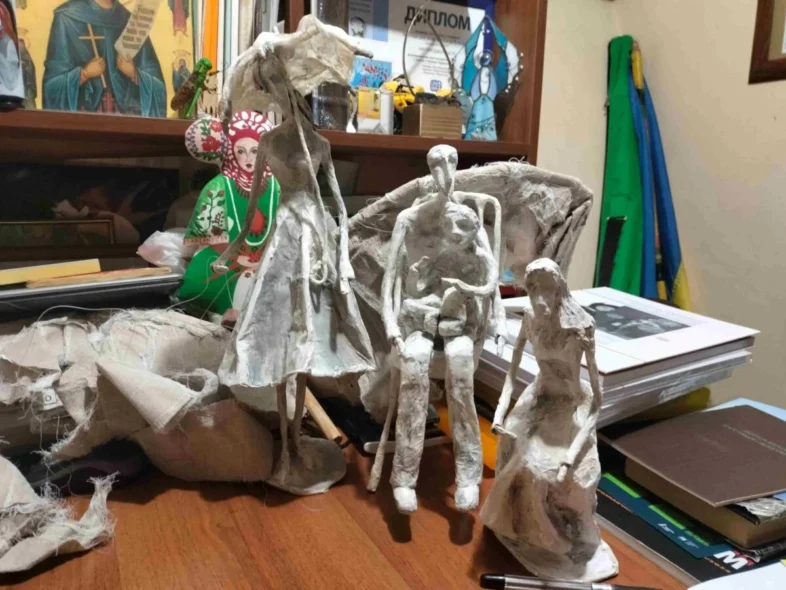
– Puppets are always made by artists. A dramatic actor might play 300-400 roles over their lifetime, and that’s their tragedy because they can end up being the same everywhere. The puppet’s happiness, on the other hand, is that it’s made specifically for one performance. Its tragedy, though, is that it can’t play in another one. For me, it’s a mystical territory. There are performances we haven’t done in a long time, but the puppets remain—hidden in suitcases or cabinets, silent witnesses, waiting for their time. Perhaps it will come, perhaps not.
The artist creates it without knowing what the final result will be, even though they pretend to know. The director pretends to know. The playwright pretends to know. The courage here lies in not being afraid of not knowing. You try to create it, and maybe something will come of it. Just be thankful for what emerges and let it go.
– You spent many years as a friend and student of Professor Ihor Kozlovskyy, an outstanding religious scholar and spiritual practitioner. I’ve heard that for many years, you held joint retreats in Crimea, where the spiritual component was combined with acting training. How did this experience influence you? Did you have spiritual questions or searches at that time?
– The development of Ukrainian theatre, particularly at our Kurbas Theatre, was strongly influenced by two people: Grotowski in the 1990s when some of our actors attended his training while he was still alive. That experience became a form of theatrical fitness. And then there was Ihor Kozlovskyy.
From the very first meeting, he carried a certain mystery with him, sharing incredibly important things, and I just wanted to be around him. At the time, I understood very little. I would tell him, “Ihor, I’m a slow learner, I take a long time to grasp things.” He would always smile at that. I began attending his classes, which started with separate lectures and later included kung fu and yoga sessions. I took notes and practised. Even now, I still practice today.
The training he offered in yoga and kung fu influenced many theatrical practices across different theatres. Ihor passed on knowledge in such an amazing way that it became a necessity to attend his kung fu sessions to explore this culture and to understand how it impacted both theatre and life in general. Over time, you come to realise that theatre itself is not as important. It’s just a tool. Perhaps later, you’ll be given another tool that speaks something entirely different.
The retreats in Crimea included lectures, martial arts, yoga, musical evenings, and various activities—all in the teacher’s living presence. It was a unique experience. Ihor Kozlovskyy paid much attention to balance. When you left his presence, you’d find yourself breathing deeply, feeling truly alive.