Being a teenager is hard enough. It becomes something else entirely when childhood and adolescence unfold under a full-scale war, in a city just kilometres from the front line.
For children and teenagers in Kharkiv, life looks nothing like it does for their peers in Europe. They can tell the difference between types of explosions, react instinctively to air raid alerts, and slip into shelters without hesitation. Remote schooling has become their second nature, along with a whole set of skills no child should need to learn just to get through the day. Some of them have never known what a peaceful childhood feels like. Many have already lived through loss — of homes, and, for some, of loved ones.
And yet, their lives are still recognisably teenage lives. They fall in and out of friendship, fall in love, doubt themselves, argue with parents, and try to figure out who they are and who they want to become. They are still, in their own way, exploring the world around them.
Valeriy Leyko is central to that effort — the founder and director of the Museum of Childhood, historian, collector, lecturer, and a familiar figure to much of Kharkiv’s younger generation and beyond.
The Ukrainian Week spoke with Leyko about what sets children of war apart, and what it means to try to give childhood back under such conditions.
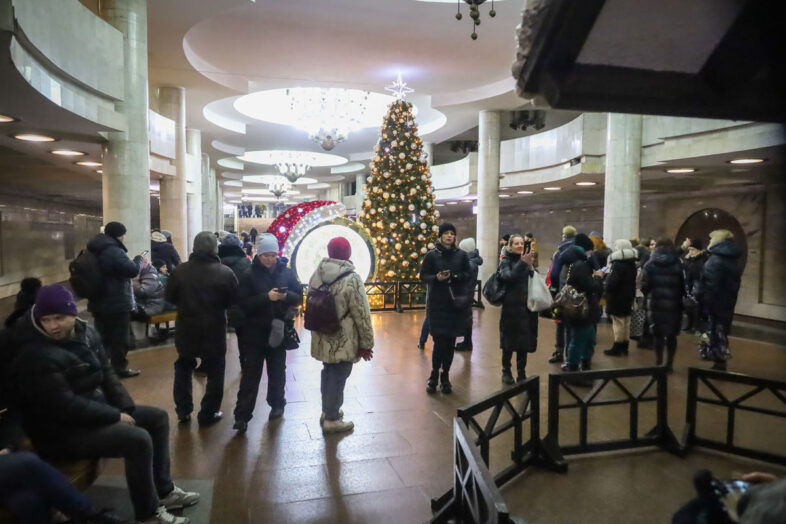
The sounds of Kharkiv are a relentless soundtrack of sirens and explosions. Over time, they have become part of the city’s background noise — as ordinary, in a grim way, as the hum of traffic.
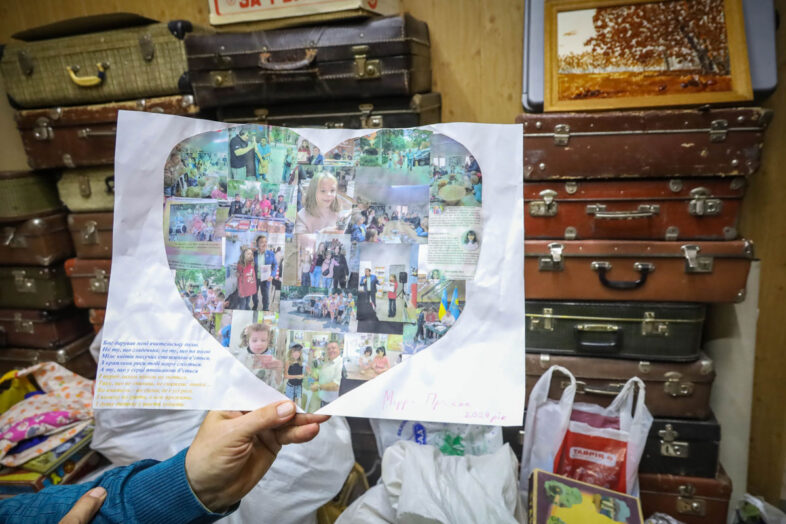
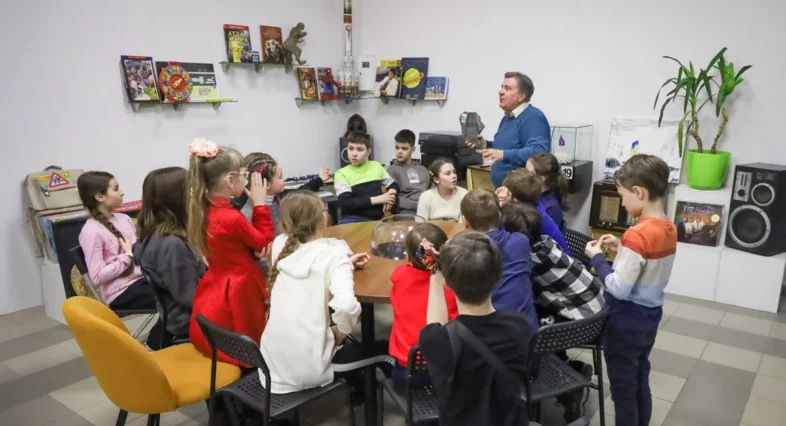
At the entrance to the Museum of Childhood hangs an exhibition of works by Veronika Kozhushko, an 18-year-old artist and poet killed in one of the city’s shelling attacks. Inside, the museum feels like a cabinet of curiosities: fragments of Trypillian pottery sit alongside one of the first computers, Transformers toys, old banknotes, a mammoth tooth, replicas of medieval swords and armour, a cowboy revolver, and countless other artefacts.
The museum itself is only just settling into this space. Its previous home was destroyed when three Shahed drones struck the building. Some exhibits — mostly paper items — could not be saved. They were soaked while firefighters battled the blaze.
“The children really wanted to help,” Leyko recalls. “I came to the school with the wet items from the museum, and they helped wipe them down and dry everything. Some were crying, others kept saying, ‘Let us help you with something.’”
History at your fingertips
“The main feature of our museum is that you can actually touch everything — that’s one thing,” says Valeriy Leyko. “And secondly, people — adults, students, and children — begin to understand what Ukraine is all about. This pottery is about five or six thousand years old.”
Leyko is a history teacher, but that hardly captures what he does. It is less a profession than a calling. His lectures spill far beyond the classroom: into the Museum of Childhood, the metro, school corridors, even open-air sites across the city and beyond. They are not lectures in any traditional sense, more like interactive journeys — a shifting kaleidoscope of stories and artefacts that pull students in and hold them there.
Children, he says, often listen in near silence, and afterwards many come up to hug him.
He scrolls through his phone and shows a photo from his birthday — celebrated underground in the bomb shelter of the Palace of Children’s Creativity, without electricity or heating, but with around 60 guests gathered anyway.
“Yesterday we had a city tour,” he says, flicking to another set of images. “And when I go into schools, I pick a topic. Recently, we had a lesson on Sikorsky, and after that, a child said they wanted to go to Kyiv just to touch the monument to Sikorsky.”
“They hate us — because they’ve never had anything like this”
Leyko has been doing this work since before the war, which means several generations of children he once inspired are now adults. Some are serving in the military, some have left the country, but many still return to Kharkiv whenever they can — dropping by to see their former teacher and often bringing back objects for his ever-growing collection.
He is also convinced that the museum’s activity does not go unnoticed by the other side. He reads it, in a way, through social media metrics.
“When you post a video on TikTok, for example, about some insect, 500 people watch it. But a video about Trypillia gets 25,000 views. That means they [the Russians – Ed.] see all of this. And it bothers them. When we were under heavy shelling, I even posted a video on TikTok asking: ‘Why do they hate us so much? Because they never had anything like this [the Trypillian culture, — Ed.].’ And TikTok blocked me immediately.”
Leyko links the shelling of the museum’s former premises directly to this educational work. For him, it fits into a much broader pattern: Russian attacks on schools, museums and other educational spaces are not random, but part of an effort to stifle learning and culture — leaving behind, as he sees it, a population cut off from knowledge and pushed to the margins.
Leyko came up with the idea for the Museum of Childhood back in 2007. “The goal was to preserve a beautiful childhood — my own, a modern one — and show it to children. That is, all the best things from back then and from today.”
Now and then, guests drop in to meet the children — among them writer, musician and, more recently, soldier Serhiy Zhadan. Another visitor was Marco Rodari, an Italian clown and grandson of writer Gianni Rodari, who has made it his life’s work to travel to conflict zones with performances designed for children.
For Leyko, these encounters are not just entertainment. He sees them as a way of offering children a measure of comfort in difficult times, and helping them process stress. He also believes that under pressure, children often absorb information more intensely, developing a deeper attachment to the subjects that capture their imagination.
Looking back at the impact of the war on children, Leyko notes that it did not begin in 2022 but in 2014 — and even if it felt distant at first, children sensed its approach. “And when it all started, for the first six months or so — there was fear, very intense fear. But then they got used to it. So, we are walking down the street, something is flying somewhere overhead, and we are like, it is okay, a completely normal thing.”
The full-scale invasion, he adds, also shifted how children relate to material heritage. One clear change, he says, is a rejection among today’s children of anything associated with the Soviet past.
Stronger now — not seeking revenge
According to Leyko’s observations, children growing up during the war have become noticeably more resilient. They show a strong drive to create, restore and rebuild. At the same time, he says, there is little sense of revenge among them.
The war, he adds, has also exacerbated another issue — dependence on gadgets. For children in Kharkiv, phones and tablets are not just a source of entertainment and communication, but also of education. During the pandemic, schooling moved online, and with the start of the full-scale war, it shifted entirely into remote learning.
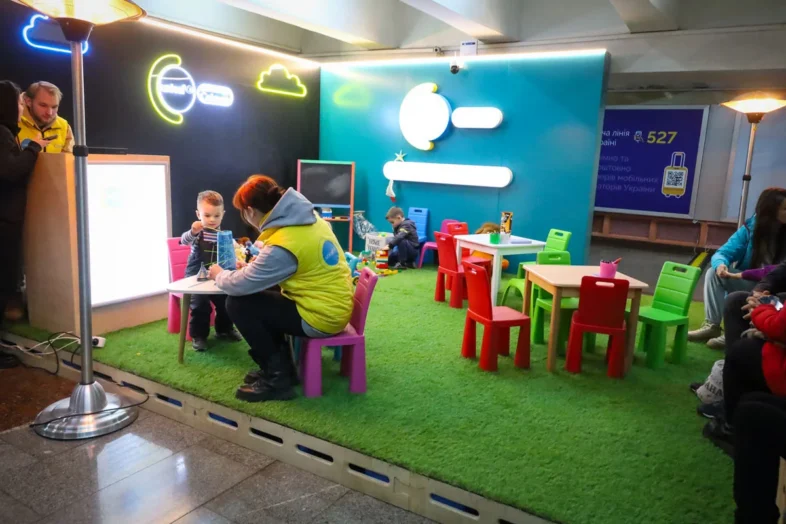
The city is now trying to bring children back into face-to-face learning wherever possible, while still maintaining safety measures. More and more underground schools are being opened — some of them large enough to replace several above-ground ones. Children attend in-person classes in shifts, two or three times a week, while continuing online lessons on other days. Still, Leyko says, even this hybrid model is far better than permanent remote learning.
“It is a big problem, well, that… they are all here,” Leyko says, pointing to his phone. “That is why we organise field trips and excavations so they can get out and about…”. He says he hopes there will be no need to build any more underground schools — that the aggressor country’s economy will eventually collapse, and that the war will come to an end.
Childhood in a frontline city forces educators into difficult trade-offs. Mobile phones can seriously disrupt learning, yet they are also a lifeline — a way for children to stay in touch with their families, and for parents to check, in the event of shelling, that their children are safe. Still, Leyko says, Kharkiv schools ultimately put education first. Before lessons begin, children leave their phones in designated lockers and collect them again at the end of the school day.
On the second floor of the building that once housed the Museum of Childhood there was a kindergarten. When the building was struck, parents went through agonising hours unable to reach their small children.
Leyko does not dismiss modern technology — quite the opposite.
“This technology is helpful right now, and it is necessary. But what am I doing? Through touch, a child realises: is this mine or not? In other words, does the child like it or not? For example, you can see how pearls are harvested from the sea. And then you go up to the child, turn it over, and there is a pearl!”
As he speaks, he pulls out a large shell, holding a pearl nestled inside.
Final treat
Speaking about education, Valeriy Leyko says the learning process itself has changed almost beyond recognition. The new underground schools, he adds, are surprisingly modern — even stylish.
“First of all, the classrooms are very bright. Secondly, all classrooms have modern desks, chairs, and plenty of interactive whiteboards. All the information is presented in a really cool way. And what is nice is that I have seen many teachers — and they are just great. Most importantly, they love children. I think everything will be fine.”
Among what he sees as positive shifts in the education system, Leyko also points to the growing presence of men in teaching. In his view, that male role model was something the system was missing for years. There are also many young teachers coming in. Still, he adds, age is not always a reliable indicator of mindset — “Soviet-era thinking,” as he puts it, can persist regardless. He even mentions young people who never lived in the Soviet Union but still ask for prices in rubles at the market.
When asked how he himself, despite his age, moved away from that Soviet mindset, Leyko is blunt: “Look, 15 years ago I was a Soviet-minded person too. I have transformed because my environment changed. I was pickled by the Soviet Union like a cucumber in a jar, and then I said: ‘No, no, thank you.’”
He adds that both the Orange Revolution and the Revolution of Dignity played a major role in that shift.
Leyko has also written and self-published a documentary book, “The Price of a Smile: Chronicles of the Museum of Childhood” — a record of the children of Kharkiv and the people who pass through the museum’s doors. With support from donors, it has been translated into English.
He is clearly proud of its reach. “It is already in the US Library of Congress, as well as in European countries and in Israel.”
As the war goes on, Leyko keeps returning to the text, adding updates so the story reflects the present as fully as possible. New editions are published along the way. He takes out a mock-up of the upcoming one.
Valeriy is convinced that the war will not stop children from developing or finding their path to success. “I think in your childhood and in mine there were children who wanted to achieve something in life, and those who did not. War or no war — there will still be children who grow up to be scientists or athletes, while others will be ordinary people. I have one child who goes to tennis in the morning, then to swimming, then on my tour… Meanwhile, there is a child who just wanders around his neighbourhood, doing nothing.”
For him, the range of interests that can capture a child’s imagination is almost endless — history, archaeology, biology, space, music. The director of the Museum of Childhood sums up his aim simply:
“To help children love life in all its forms.”