In frontline Kharkiv, a 71-year-old woman with a disability is raising her young grandson, who has lived through Russian occupation and psychological trauma. Their story shows how the war affects the most vulnerable lives — and what it takes to keep going.
“A Russian was firing from around the corner as people queued for bread”
“Artem will come down and show you the way,” Tetiana says over the phone. We wait by the entrance of a high-rise in one of Kharkiv’s sleeping districts. A minute later, we’re riding the lift together up to the ninth floor.
“Were you at school today?” we ask our young guide.
“Yes — two lessons. The rest are online,” Artem replies.
“Do you go to school in the metro?”
“Yes. Twice a week. The other three days I study from home.”
A smiling, welcoming woman opens the door and ushers us in — her hair neatly done, light make-up on.
“I got myself ready, I was expecting guests. Just didn’t quite finish in time,” she laughs, pulling a thin curler from her hair that had somehow gone unnoticed. The small two-room flat is cool, the light dim and muted. Ms Tetiana moves with the help of a walking frame, barely able to get around on her own.
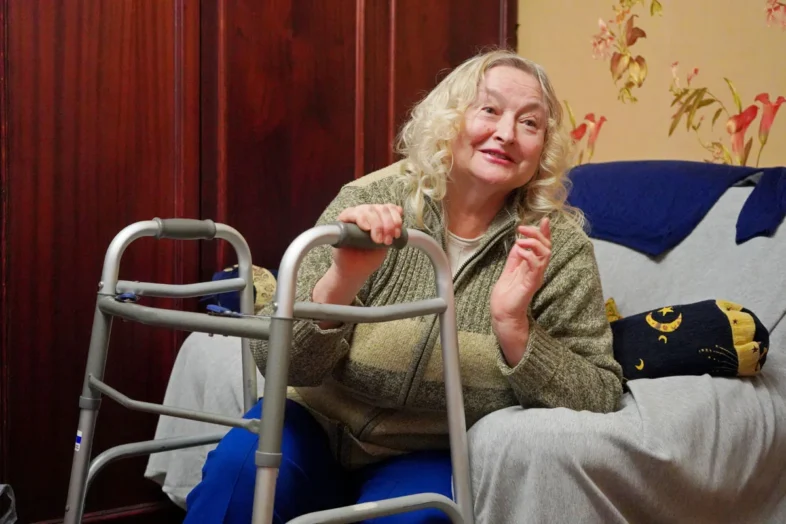
Tetiana is 71 and has lived in Kharkiv all her life. She has two sons; eight-year-old Artemko [affectionate term for Artem – ed.] is her younger son’s child. Before the full-scale war, he lived with his parents in Balakliia.
“When the war began, Kharkiv was bombed heavily — it was terrifying. Russian Grads [missiles – ed.] were flying overhead; once I counted 24 shells,” Tetiana recalls those first days of February 2022. “They came one after another, with these fiery tails… A frightening, almost unreal sight. I just stood there, watching, as if spellbound. I knew it was dangerous, but I couldn’t tear myself away from the window. The next day a Russian bomber came. It flew so low you could read the markings on its wings. It dropped a bomb three streets from our building — destroyed a school, damaged homes. The blast wave threw me so hard I ended up under the sofa. It literally ‘wedged’ me into a narrow gap between the floor and the couch. I could never have got in there on my own.”
And then the occupation began. Russian tanks were already positioned right outside our windows. I saw with my own eyes how one of the occupiers, dressed in civilian clothes, was gesturing at a crossroads. I was downstairs by the building entrance, waiting — the lift wasn’t working, and I couldn’t get back up to my flat. People were standing in a queue for bread.
Then I saw a Russian soldier walk up to a car, take out a rifle, and from around the corner fire three bursts towards the road, so that no one could see him. To intimidate people. But the queue didn’t move. People kept standing there for bread… They didn’t disperse.
“When people talk about the war of 1941, about standing for hours in line for bread — it was the same for us. And there was no bread… He was firing, a tank thundered past, and still people stayed in line. They didn’t move. It was horrifying. That image has never left me.”
“I became disabled at work – my husband nursed me back to health”
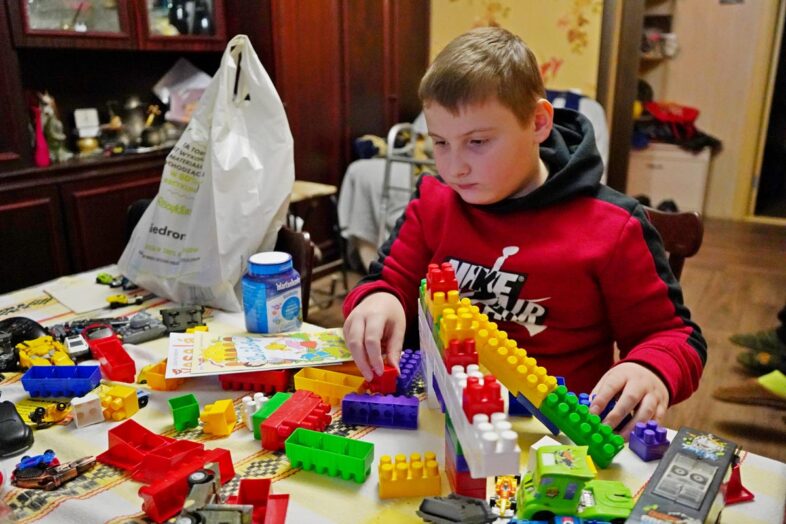
We speak in the living room. Artemko is busy assembling a construction set and isn’t following the conversation. But when his grandmother grows anxious, he immediately asks how he can help and brings her a glass of water. For Tetiana, revisiting those days remains deeply painful.
“No one knew what to do, where to run. I called my sons: take the children out. But Balakliia was already under occupation. The Russians took my son ‘to the basement’. How he got out, how they managed to leave — I don’t know… They don’t tell me, so as not to upset me,” she says, with a sigh.
“They came to Kharkiv to take me with them. I said I wouldn’t go anywhere — I can barely walk, I felt unwell, I wouldn’t have made it to the car. So they left with the children for western Ukraine and stayed there for a while. What happened to them afterwards — whether they argued or separated — I don’t know… But a year ago they brought Artemko to me — he was so small, so thin… He wasn’t going to school; for some reason he hadn’t been enrolled in first grade. And my son, Artem’s father, was mobilised. They stopped him on the road while he was driving the child to Kharkiv. It’s a heavy, complicated story — I don’t fully understand it all…”
“In short, it’s just the two of us here now. Artem is my greatest helper, my comfort and my support.”
Tetiana worked for many years as a systems engineer at the Khartron plant.
“Now I can speak about it — back then, the whole enterprise was classified. No one knew what the others were doing. Everything was secret, tied in some way to the space industry. Did I like my job? That wasn’t the question in those days. In the 1970s, there was one word: you must. That’s how we were raised.
My father was very strict. He came back from the war with shattered nerves. If we disobeyed, he would beat us with a soldier’s belt. It’s hard to even think about now. He was a staunch Stalinist. But I was lucky with my husband… We lived in complete harmony.
When I fell at work and badly injured my leg, I kept coming in regardless — they wouldn’t give me sick leave, refused to recognise it as a workplace injury. I carried on like that until I became disabled. I was paralysed, spent five years bedridden, unable to stand. My husband brought me back to life… He never left my side.
At the end of December 2014, he finally brought me home from intensive care. That evening, just before New Year, he went out to buy bread and said he’d warm up the car at the same time. He stepped outside, crouched down by the car — and that was it. Sudden death. Just a few seconds — and he was gone. For me, it was a shock I’ve never recovered from.”
“It was like a horror movie: you step outside — and bullets fly overhead”
Tetiana describes the support they received through a charitable initiative as something “truly extraordinary — the most remarkable thing that has happened to me during the entire war, because so many people are in need now…”.
With the money, she bought winter shoes for herself and Artemko. “They’re right there, in the hallway,” she says. She also bought warm clothes and paid the utility bills — above all electricity — so that “they wouldn’t cut us off”. She was determined to clear the debt as quickly as possible, knowing that in winter, without heating, it’s impossible to manage.
She also bought medicines for her grandson and some for herself. Artemko is currently undergoing examinations at Okhmatdyt, Ukraine’s largest children’s hospital, and a psychiatrist has recommended treatment.
“The child has a nervous tic. After the shelling, he was so frightened that he stopped speaking,” she explains. “He spent three days sitting under a blanket in the cellar. He can’t forget it. Doctors examined him, a speech therapist worked with him. The psychiatrist prescribed medication, but when I saw the price, I was frightened. I just let it go. It’s too expensive for us. Artemchyk, show the little card that helps us!”
The boy brings over a small card with the Lord’s Prayer. “One of the men who was helping us gave it to him,” the woman explains. “He told Artem: when you’re very scared or sad, take this card and read it. I didn’t even know about it — they spoke between themselves. One night, when it was very loud and frightening, my grandson said: ‘Grandma, where is my card?’ Four months had passed — and he still remembered it…”
We turned on the light. I read the prayer once, then again. Then I said: now you read it. You know… I may not go to church often, but I believe there is a great force above us, that Jesus helps and protects us. For Tyoma, this little prayer card is a kind of talisman. He reads it — and he’s no longer afraid.
When drones or missiles are flying, the chandeliers in our flat tremble. I slightly open the windows so the blast wave doesn’t hit us directly. Once an ambulance came and asked me: how do you live here, when the building shakes from explosions? “You get used to it,” I said. It’s a terrible thing, getting used to it, I know.
Five days ago, it was especially frightening. Explosion after explosion. I went out into the corridor and stood there, ready for whatever might come. In moments like that, you don’t think about money, documents, or clothes — you don’t think about anything at all. You just want to get out of this hell alive.
That time, a reconnaissance drone was flying overhead and was shot down right near the building. It feels like a horror film here. Step outside, look up — and you see everything: drones being intercepted, bullets streaking across the sky — red and white.”
“We want to go to a Catholic church with Artem. We really do… But I don’t know if I can manage it with my walking frame. Only God can give hope. And I need that hope — to raise Artem and give him an education. As long as I have the strength, I will give it all to him.”
Before we leave, we take a photo together and talk about dreams. “What do I dream of?” Tetiana sighs. “The sea… I dream so much of seeing a warm sea. Or maybe going to a sanatorium. Just to have a little time when I don’t have to stand in the kitchen, not to cook, but to go for massages instead. Doctors told me: we don’t understand how you are walking. After such paralysis, people don’t get back on their feet. But as you can see, it happens. I have someone to walk for. And someone to live for.
What troubles me most? The war… And the fact that there are hardly any people around. You see… I’m not someone who talks a lot or socialises much. But when you live as if in a desert — you step outside and there is no one. That is frightening.”
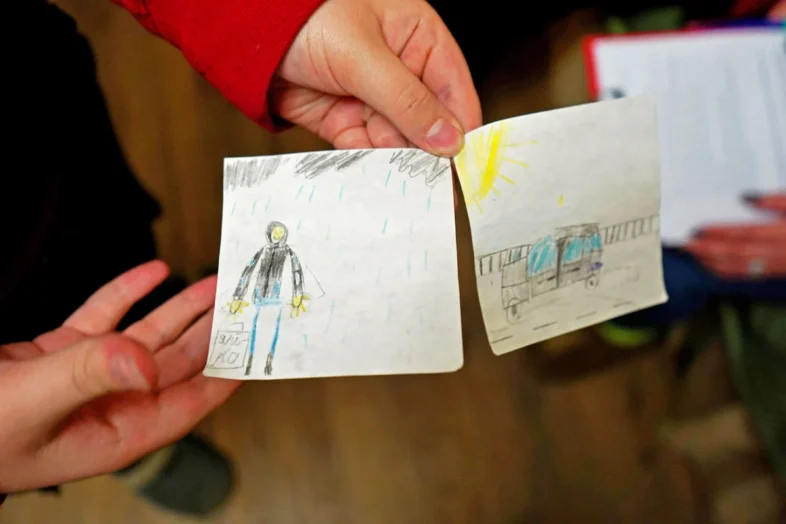
Artemko says he loves drawing. He shows the pictures he has made for his father, which he is waiting to give him when he returns from the war. When he gets a little older and draws even better, he says he will make a portrait of his grandmother — smiling and beautiful, just as she is today.