For Ukrainians, food is social glue — a simple way of showing love and solidarity.
I’ve been thinking about food a lot since the start of the full-scale Russian invasion. My family’s story is, unfortunately, a familiar one for many Ukrainians: the Holodomor [the famine orchestrated by the Soviet regime in 1932–33 – ed.], Second Wold War, post-war famine, life in a city where you couldn’t buy much of anything, then a move to the capital where shortages persisted — to the point that people would take so-called “sausage trains” to Moscow to buy meat. Then came the difficult 1990s, when children were taken along to stand in long queues just to get hold of the same food products that were always in short supply.
I remember very clearly the first imported food shop that opened in our neighbourhood. It was right next to the music school and called “Delicatessen”. Sometimes, if I got top marks at a music school concert, I was allowed to buy myself a tiny piece of blue cheese there. It felt almost miraculous — pure joy — as if the French caves of Roquefort had somehow moved closer to Berezniaky, my district on the left bank of the Dnipro in Kyiv. Most of the time, though, I’d just go in to see what had arrived that week, without buying anything. Later, in English class, I learned there was a word for it: “window shopping”. That, really, was my childhood – window shopping.
Soon after, a McDonald’s opened near Livoberezhna metro station — a place you went to celebrate a child’s birthday, provided, of course, you were invited. I don’t remember the queues outside Kyiv’s first McDonald’s near Lukianivska station, but I agree with writer Olena Stiazhkina, who described the American fast-food chain as “one of those stories that created a barrier between the Soviet past and our present life”.
For the Bu-Ba-Bu literary group [a writers’ collective founded in Lviv in 1985 – ed.], the Chrysler Imperial became a symbol of the Americanisation of Ukraine. For me, it was something much simpler: a hot cherry doughnut, fried until crisp. It felt deliberately excessive — nothing like home cooking — and that was exactly the point. It meant rebellion, leaving home, being with friends instead of family. Above all, it was abundance, not scarcity.
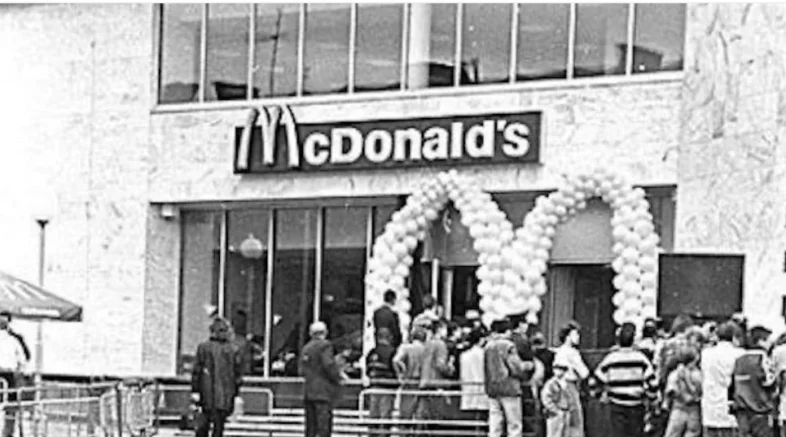
A queue outside Kyiv’s first McDonald’s in Lukianivka
McDonald’s was for friends, a few times a year. Sundays were for family. On the one day we had off together, we’d start with coffee in the morning, and in the afternoon my father would cook pilaf — properly, with all the spices, in a heavy pot. It marked a pause, however brief, from everything else going on in our lives. Food was social glue — and it still is.
It’s also a simple way of showing love. Even now, at family gatherings, my grandmother cooks far more than anyone could possibly eat, just so we can take some of that love home in plastic containers. For years, we shared whatever someone had made in excess. At one point I even thought about ordering individual healthy meal plans, but quickly dropped the idea: food for one person, in neat little portions, strictly measured out — is that really what love looks like?
Easter is a time of renewal, forgiveness and togetherness. But it is also, without doubt, a time for sharing food. Even if a family isn’t fasting, coming together and exchanging what each person has brought in their basket is still a way of sharing love. Brian Wansink, a researcher of consumer behaviour, analysed 52 paintings of The Last Supper and found that the amount of food depicted gradually increased over the course of the millennium: what began as a relatively modest spread eventually became a far more lavish feast. Food shapes art — including sacred art. After all, isn’t it striking that Jesus gathers everyone for an important meeting — forgive the phrasing — not in the Garden of Gethsemane or by the city gates, but around a table?
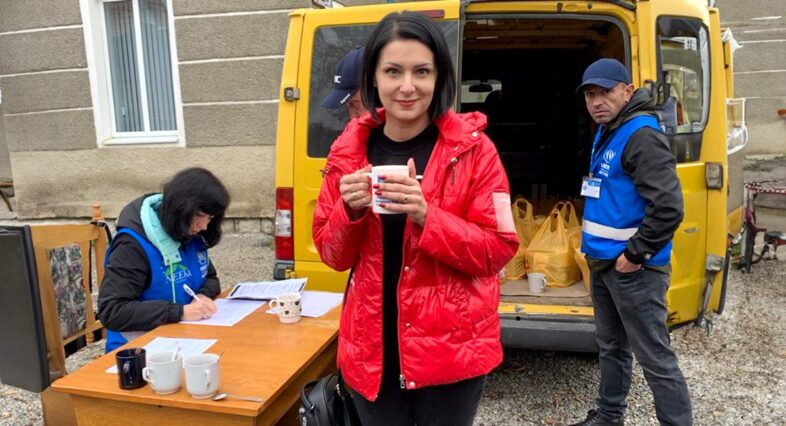
My first act linked to the full-scale war was also tied to food. Near the railway station in Lviv, we prepared and handed out sandwiches, doughnuts and sweets to people displaced by the war. We used whatever we could get hold of — mountains of cheese, sausages and cheap Polish pâté. That pâté has since become my own madeleine, instantly taking me back to the spring of 2022.
Every historic era has its own madeleines. Sometimes it’s easier to say “We are here, we are with you, you are safe” with a pâté sandwich than with words. Later, once things had settled a little, I ordered a delivery of cheese from Zakarpattia. And when I started paying attention again to what I was eating — when food stopped being just fuel and regained its taste — I realised I was beginning to adjust.
Photos: Kateryna Bortniak
Whenever I watch footage of prisoners being reunited with their families, I find myself thinking about hunger as a form of torture. The way they hold an apple in their hands, smell a loaf of bread — it speaks to the stripping away of basic human dignity in captivity. I later saw a report about Russian prisoners held in Ukraine, where prison staff stressed the importance of a diet containing all the necessary vitamins. The footage showed men carrying trays and being served full meals of meat, vegetables, bread and compote.
The way we treat food, I think, says something fundamental about our humanity. When you deprive someone of food — when hunger is used as a form of torture — a line is crossed. For Ukrainians, whose ancestors quite literally died of starvation, that line is not abstract. It’s something we cannot afford to forget.
That memory feels like something carried in the blood. When the long power cuts and bombardments of the capital began, the first thing I did was stock up on canned food and grains. Even if I never end up needing them, I feel calmer knowing the cupboards are full. The same unease comes back when the fridge starts to empty — a kind of visceral panic. I’m generally a rational person, but I can still lose my composure and head to the nearest supermarket if I feel food might run out. It doesn’t matter that I’m just a few clicks away from having almost anything delivered to my door, including the most exotic dishes. Without reserves at home, I feel exposed.
Even people close to me don’t always understand this habit — in the age of supermarkets, it can look irrational. But memory carried in the blood tends to outweigh logic, and I’ve simply learned to live with it. The same instinct shows up whenever I travel: if a journey is going to last more than three or four hours, I take food with me. It doesn’t matter that there’s a buffet car on the train, or that the conductor sells Artek wafers, or that I’m unlikely to get hungry at all. The buffet car might be closed, the queue might be endless, or the wafers might already have been bought up by the band Zhadan i Sobaky travelling in the same carriage — there are always ways things don’t go to plan. Being able to feed yourself feels like the most basic kind of preparation.
Borshch, for me, has become another symbol of love. And no, this isn’t some folkloric gesture or an attempt to lean into stereotypes. It’s simply that very few dishes carry as many associations — or as much gratitude — as this one does.
My father used to cook his signature borshch for the recruits he trained, no matter where they came from. It’s a reminder that even far from home, you can still feel cared for; that strangers can become a kind of family; and that something as simple as a shared pot of borshch can bring people together. The dish itself is a precise balance of sour, sweet, salt and umami, plus something harder to define. Sharing it has always felt like a quiet, almost canonical image of trust and belonging.
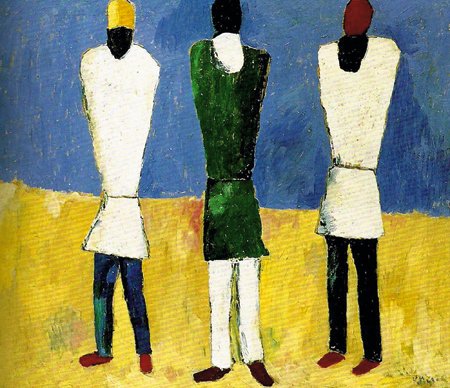
Kazimir Malevich, “Enslaved Ukraine”
Kazimir Malevich created a series of paintings that contemporary art historians link to reflections on the Holodomor. In Enslaved Ukraine, three armless peasants stand against a field and sky that together resemble the Ukrainian flag — at least, that’s how I see it. In The Running Man, a peasant is caught between a red cross and a sword. In the background, between the houses, sits a sack of grain, perhaps suggesting the confiscation of food supplies.
The works keep circling the same idea: the impossibility of cultivating your own land, harvesting your wheat, grinding your flour — the basic chain that leads to food. To harvest, to cook borshch, to dip a hot doughnut into it. There is no blood, no obvious drama here, and yet they feel deeply unsettling. The figure of Tantalus frightens me far more than Sisyphus. As the existentialists suggested, Sisyphus can still find meaning in labour itself, in the act of pushing the boulder rather than its end point. There is no such meaning in the torment of hunger and thirst.
In the spring of 2022, students at Taras Shevchenko University carried out a socio-anthropological study on how food practices changed and were reinterpreted after the full-scale Russian war began on 24 February 2022. Alla Petrenko-Lysak, who supervised the social research internship, later wrote about it for the Їzhakultura project. In autobiographical essays, participants described the difficulty of adjusting to food abroad — not knowing which products to use, or how to navigate unfamiliar tastes. And without exception — whether they stayed in Ukraine or were forced to leave — they spoke about the comfort of familiar, home-cooked food. Food became not just a gateway to memory, but, quite literally, a sense of home.
The study found that, in wartime, the value of “simple, ordinary food” rises. On the one hand, many people feel uneasy about indulging themselves, constantly aware that soldiers on the front line often don’t even have the chance to choose what they eat — or sometimes even to heat it. On the other, there’s a renewed appreciation for locally grown food, for food produced with your own hands.
It brings to mind the “victory gardens” of the First and Second World Wars — vegetable plots planted in public parks across Britain, the United States and elsewhere. Back then, growing food at home, even in cities, helped ease pressure on stretched supply systems. Today, people in Ukraine’s rear cities are no longer as afraid of running out of food. But in difficult times like these, the ability to make something tangible with your own hands carries a different kind of weight.
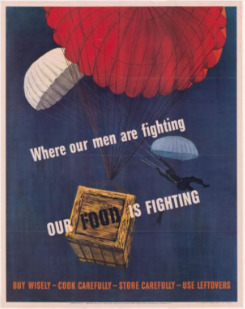
In the United States during the Second World War, a popular poster read: “Where our men are fighting, our food is fighting” — the idea being that money saved on food supplies could be redirected to weapons production. Eleanor Roosevelt, the president’s wife, even planted a vegetable garden at the White House to set an example.
In our case, growing food at home doesn’t quite serve the same purpose it did in Europe and America in the 1940s. Yet, the habit of sending canned goods, homemade pastries and Easter cakes to the front — along with jars of nuts and dried fruit prepared at home — is still widespread. It’s a tangible gesture of care, a way of showing gratitude to soldiers.
Food has never been just about sustenance in human culture. It carries care, connection, memory, emotion — a link to where we come from. And above all, it’s another way of saying: “I love you”. Sometimes, it’s the most important one.