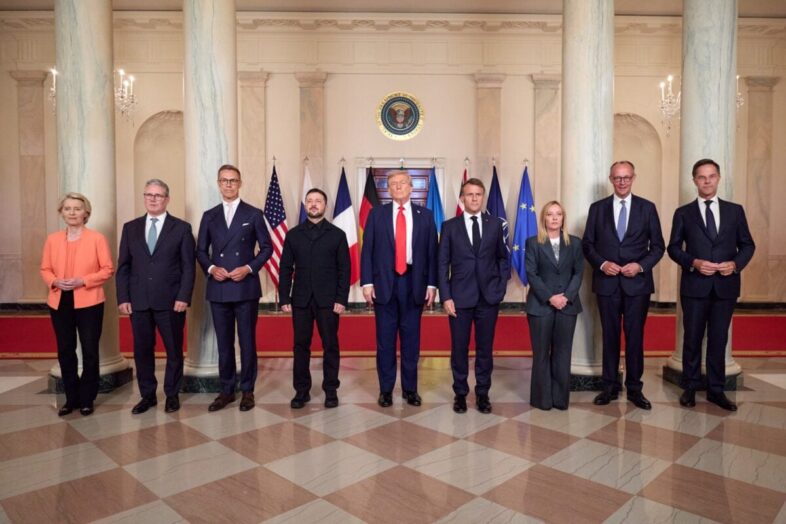
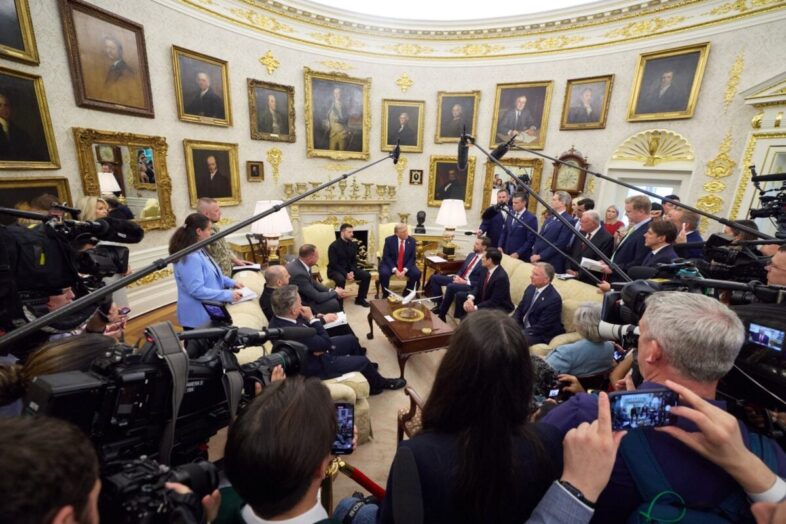
Volodymyr Zelensky met with Donald Trump at the White House on Monday, backed by a high-profile European delegation demonstrating strong support for the Ukrainian president. Attending the talks were European Commission President Ursula von der Leyen, UK Prime Minister Keir Starmer, French President Emmanuel Macron, German Chancellor Friedrich Merz, Finnish President Alexander Stubb, Italian Prime Minister Giorgia Meloni, and NATO Secretary General Mark Rutte.
According to Trump, the talks focused on security guarantees for Ukraine, with European countries expected to provide support in coordination with the United States. Mark Rutte said that over the past several months, a group of 30 countries — including Japan and Australia — had been working on developing the framework. The Wall Street Journal, citing European officials, reported that the proposed guarantees would be built around four key components: a military presence, air defence systems, provision of weaponry, and mechanisms to monitor the ceasefire.
After the talks, Trump called Putin to start arranging a meeting between the Ukrainian and Russian presidents. A trilateral meeting is expected to follow, with the American leader joining.
The discussions also sparked a wave of coverage in the Western press. The Economist ran a piece on the outcome under the headline, “Zelensky survives another episode of the Trump show.” Politico noted that “the transatlantic alliance holds as Trump backs security guarantees for Kyiv,” while The New York Times highlighted that Ukraine’s fate may hinge on whether “Zelensky can trust Trump.”
German media also weighed in on the meeting between Trump, Zelensky, and European leaders. Die Welt framed it as “Hope in Ukraine — decisive weeks for war and peace,” whereas Frankfurter Allgemeine Zeitung summed it up as “Good mood, few results.”
The Ukrainian Week spoke with diplomat Volodymyr Ohryzko, Ukraine’s foreign minister from 2007–2009 and head of the Centre for Russian Studies, about the course of the talks, the prospects for the trilateral meeting, and Europe’s role in securing peace.
— What are the key takeaways for Ukraine and the international community from yesterday’s talks between Zelensky, Trump, and the European leaders?
— Compared with what we heard a few days ago in Alaska, the signals as of last night and this morning are more positive for Ukraine. The clearest message is that Europe has demonstrated its unity and resolve — and it seems Trump has finally taken notice. Secondly, we’re seeing some shifts in Trump’s stance in Ukraine’s favour: for the first time, he officially said the U.S. would participate in developing a system of security guarantees for Ukraine. That’s unprecedented.
The third point is that while the issue of territorial changes may come up, the underlying message is clear: it’s not something that can be decided. Taken together, these are developments that genuinely offer grounds for hope, and I’d approach the coming weeks with cautious optimism.
— In the wake of Monday’s meeting, can we say European leaders are playing a more strategic role in the peace process?
— It shows that Europeans, seeing the potential for some sort of direct interaction between Trump and Putin, realised that sitting back and waiting for deals about their security to be made behind their backs wasn’t a smart strategy. So within a day, they organised themselves, crossed the ocean, and spoke to Trump as a united team, presenting their vision for security in one voice.
I see this as a very positive signal. Without Europe’s input, there can be no lasting peace in Europe. And now I think Putin must be kicking himself, because he likely expected decisions to be made along the Putin–Trump line and then handed down to the Europeans. Instead, it’s Ukrainians, Europeans, and Trump shaping the outcomes — and Russia that will have to implement them. And that’s a good development.
— How likely is a trilateral meeting to happen? Might Putin try to stall, and will Russia even agree to this format?
— First, there has to be a bilateral meeting, and there are already plenty of question marks there. Putin has declared Zelensky illegitimate; in Russia, he’s been branded the “spawn of hell,” the embodiment of a fascist regime, along with a host of other derogatory labels. Now imagine having to explain to the Russian — as I call it — “lout-population” how the “great” Putin, who only yesterday was talking to the “great” Trump and supposedly deciding the fate of the world, is now stooping to meet the “Kyiv junta,” the “Kyiv regime,” and its so-called illegitimate leader.
For Putin, this is a major psychological drama he now has to explain to his followers. I think his apparent agreement is likely the result of pressure from Trump. Whether the meeting will achieve anything, however, is another question. In my view, it won’t—both sides have taken firmly opposing positions, and that much is clear. So, whether a trilateral meeting makes sense—though in reality it should be multilateral—brings us back to Europe. Through Macron and Merz, European leaders have made it clear: no, this process will now include Europe, and it is not for Putin to dictate who sits at the table.
Honestly, I don’t believe a bilateral meeting will accomplish much. But if a multilateral format does come together, with Putin on one side and everyone else against him, while Trump maintains what one might call a constructive neutrality, then Putin would be in a very weak position—and it’s far from certain he would agree to such a meeting.
— On Marco Rubio’s statement that countries from other continents may be involved in providing security guarantees for Ukraine: could this mean China, since the Russians mentioned it after Alaska? And if so, could our war shift into a US–China format?
— Absolutely not. Russia can say whatever it wants, but Ukraine must hold a clear and consistent position. We already had guarantees from China, which later joined the Budapest Memorandum—so where are those guarantees now? Meanwhile, China is actively helping Russia stay afloat.
If guarantees are to come, they will likely come from Japan, perhaps Australia—in other words, from the civilised world. Definitely not from countries that are effectively siding with the aggressor and aiding it. That’s why Ukraine doesn’t need guarantees from Russia or China. What we need are guarantees from our Western partners and from the Ukrainian army—these are the two key safeguards that can prevent any future Russian attacks.