
Autonomous underwater vehicles are quickly becoming one of the most closely watched developments in naval warfare. Once largely limited to the world’s biggest maritime powers, underwater drone technology is now being pursued by countries with much smaller military capabilities as they look for new ways to gain an edge beneath the waves. The ability to operate in the depths of the oceans could become a major advantage in what is shaping up to be a new front in maritime competition.
One of the biggest shifts in recent years has been the emergence of one-way attack autonomous underwater vehicles (OWA-AUVs), or kamikaze underwater drones. These systems combine long-range, autonomous operation and an onboard warhead. Unlike traditional torpedoes, they are not built to chase down fast-moving targets. Instead, they are designed to hit fixed or relatively stationary targets, such as ships in ports and anchorages, as well as key maritime infrastructure.
Underwater drones have moved from the realm of military speculation into a fast-developing reality. Advances in materials, electronics, energy systems and artificial intelligence — combined with quieter and more compact propulsion technologies — are allowing a new generation of vehicles to go farther, stay underwater longer and take on missions that were once considered out of reach. Unlike drones operating in the air or on the surface, underwater systems are not built around sheer numbers. Their biggest advantage is the ability to remain unseen, operate quietly and strike at a time and place of their choosing. Capable of staying submerged for long periods and travelling far from shore, these drones can collect intelligence, map the seabed and secretly place mines along key naval routes — potentially even before a conflict begins.
China is currently leading this race. Its push to develop underwater drone capabilities is part of a broader effort to expand its naval reach and strengthen its position in contested waters. By contrast, British defence analyst H. I. Sutton argues that other major naval powers — and the West more broadly, led by the United States — are struggling to keep pace.
China’s underwater drones
China is moving quickly to expand its autonomous underwater capabilities, developing a new generation of unmanned systems for a wide range of missions. It is also experimenting with platforms that could operate across multiple environments — beneath the surface, on the water and even in the air — capabilities that currently have few, if any, equivalents elsewhere.
At the centre of Beijing’s effort are extra-large ocean-class unmanned underwater vehicles (XLUUVs). The People’s Liberation Army Navy is already believed to operate at least five different types of these systems. Their rapid development is being closely watched in Washington and across the region, with the United States, its allies and countries in Southeast Asia and the Pacific viewing them as another sign of China’s growing ambitions at sea.
Some of China’s largest underwater drones are comparable in size to conventional submarines and can carry a range of weapons, including mines and heavyweight torpedoes. Western intelligence assessments suggest they could also be used for covert transport of military equipment, reconnaissance, mine warfare and other specialised missions.
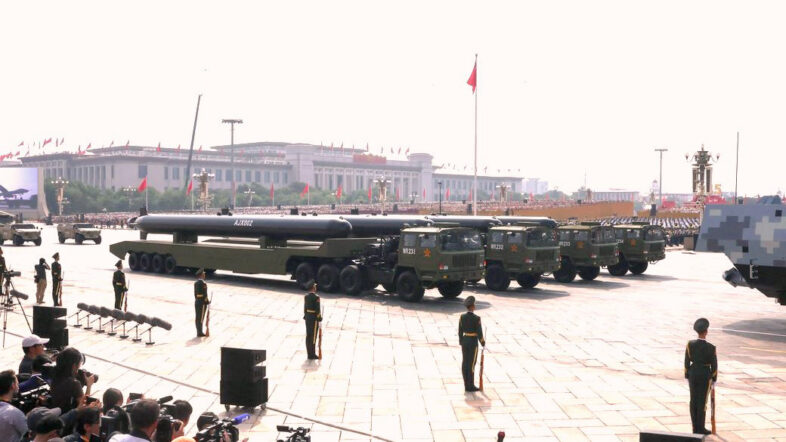
At a military parade in Beijing in September 2025, China put one of its most closely watched naval ambitions on display: a growing fleet of large autonomous underwater drones. The parade, held to mark the end of the Second World War, featured eight extra-large unmanned underwater vehicles (XLUUVs), including two models unveiled for the first time. The line-up included five AJX002 autonomous mine-laying vehicles and three HSU100 drones — giving China a lead in XLUUV numbers that no other navy currently matches.
The AJX002 vehicles are 20-metre-long modular platforms designed for autonomous mine-laying missions. They have hull diameters of 1.5 and 3 metres and were displayed at the parade shortly after entering comparative trials that began in January 2026. The strongest-performing design is expected to move into production, with the vehicles set to be equipped with new AQS003A deep-sea mines.
The push fits into a broader effort by Beijing to modernise the People’s Liberation Army Navy and expand its ability to operate beneath the waves — with Taiwan looming as the main strategic focus.
In the years ahead, large numbers of extra-large underwater drones could take on some of the roles traditionally performed by submarines, giving China new ways to operate farther from its shores and potentially threaten key maritime routes. Because these systems are far cheaper than conventional submarines, their widespread use could change the way China approaches naval warfare.
The US and Australia are also racing to develop their own large autonomous underwater drones, including the US Orca programme and Australia’s Ghost Shark. Their goal is to build systems that can monitor strategically important waters and carry out a range of missions, from reconnaissance and tracking underwater threats to mine warfare and other specialised operations.
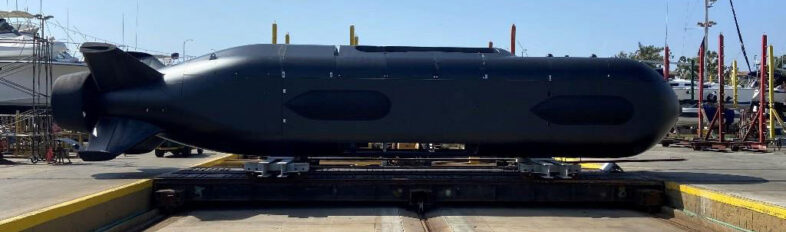
At the heart of the US push is Orca, a large autonomous underwater vehicle designed to extend the Navy’s reach beneath the surface. Washington plans to build four of these systems, with the first 25-metre prototype now undergoing a series of extensive trials in California. The programme is part of a wider effort to ensure the US retains its technological edge in undersea warfare as China rapidly advances its own capabilities. Powered by a diesel-electric propulsion system, Orca is designed to cover distances of up to 6,500 nautical miles. A key feature of this platform is its 10-metre detachable payload module, which gives the vehicle the flexibility to carry different equipment and weapons depending on the mission.
Another US programme is the Snakehead Large Displacement Unmanned Underwater Vehicle (LDUUV), a heavy autonomous underwater drone being developed for the US Navy. Unlike larger XLUUV platforms, Snakehead is designed to be deployed from and recovered by submarines, giving the Navy greater flexibility in how it uses unmanned systems beneath the surface.
Other countries are also developing or already operating large-class LDUUVs, although on a far smaller scale and with more limited capabilities. They include France, Japan, India, the United Kingdom, North and South Korea, Iran, Ukraine and Norway.
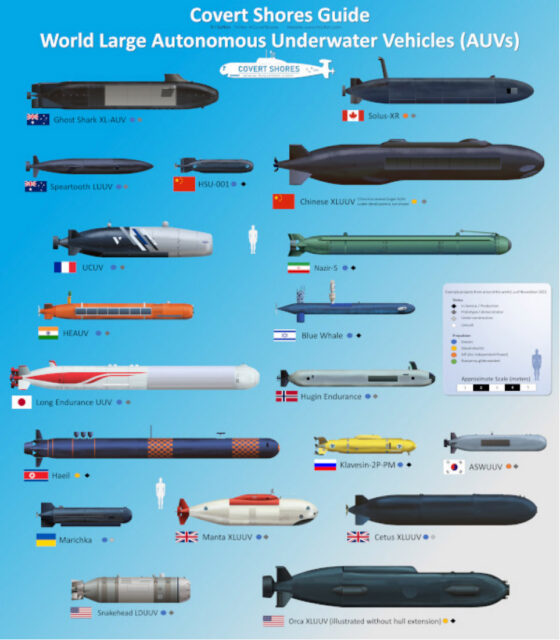
The British are getting into the underwater drone race, too. Their CETUS (also known as XV Excalibur) vehicle, developed by MSubs for the Royal Navy, is designed to give Britain a new tool for operating beneath the waves. At 12 metres long and weighing 25 tonnes, the experimental vehicle is the largest of its kind in Europe. It is designed for a range of missions, including patrolling key waters, protecting critical undersea infrastructure, gathering intelligence and testing new technologies. Its modular design allows it to be adapted for different roles, including reconnaissance and anti-submarine warfare.
Iran has developed the Nazir-5 combat underwater drone for the naval branch of the Islamic Revolutionary Guard Corps (IRGC). Powered by an electric motor, the system reportedly has a range of up to 500 km and is intended for missions including reconnaissance, surveillance and potentially one-way attacks.
North Korea has also been expanding its underwater drone programme. It unveiled the Haeil-1 in 2023, followed by the Haeil-2, both designed to strike fixed targets along the coast. The systems are essentially large, torpedo-like drones that travel at shallow depths and use guidance technology to locate their targets. Pyongyang has presented the 16-metre Haeil-2, with a reported range of up to 1,000 km and a diesel-electric propulsion system, as a potential North Korean counterpart to Russia’s nuclear-capable Poseidon system.
Ukraine enters underwater race
While Ukraine is fighting a full-scale Russian invasion on land, it is also opening a new front beneath the surface. The country has rapidly developed and deployed autonomous underwater systems in the Black Sea, gaining battlefield experience that few — if any — other countries can now match.
Several operations have demonstrated the growing role of these platforms. In June 2025, Ukrainian forces used underwater drones to strike a support structure of the Kerch Bridge. Six months later, another operation saw a drone penetrate Russia’s naval base in Novorossiysk.
The Novorossiysk attack marked a first: the Sub Sea Baby drone became the first underwater system to strike and severely damage a Russian Project 636.3 missile-carrying submarine, the Kolpino.
Ukraine’s expanding underwater drone portfolio now includes projects such as Marichka and Toloka, reflecting Kyiv’s push to develop new ways of challenging a larger, more powerful naval enemy with smaller, cheaper and harder-to-detect systems.
Marichka, developed by AMMO Ukraine, reflects Kyiv’s broader effort to build cheaper, harder-to-detect weapons that can challenge a much larger naval opponent. Designed as a multi-purpose platform, Marichka can be used against surface and underwater targets, as well as for reconnaissance, attacks on port infrastructure and covert transport missions. The six-metre drone has been built for long-range operations beneath the surface, with a design focused on reducing its visibility and allowing it to operate in deep waters. It can reportedly carry a warhead of up to 1,000 kg, travel up to 1,000 km and use a low-noise propulsion system to make detection more difficult.
Another Ukrainian project is Toloka, a family of underwater drones developed by the Brave1 defence technology cluster. The idea behind the platform is flexibility: the drones can be adapted for different roles, from carrying out strikes and gathering intelligence to supporting other naval operations.
Depending on the mission, Toloka systems can be fitted with different sensors and equipment to help detect targets, map minefields, and identify areas where enemy electronic warfare systems are operating. The developers say the drones can remain in a chosen location for up to three months, waiting for the right moment to be used.
By contrast, another underwater drone, Sub Sea Baby, remains largely a mystery. Developed by Ukraine’s Security Service (SBU), the system’s capabilities and design have not been publicly disclosed.
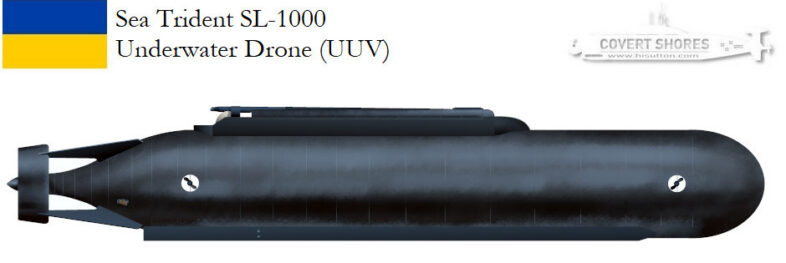
Ukraine’s expanding underwater drone programme also includes the Sea Trident SL-1000, a heavy autonomous vehicle developed by the private company Global Mark. The prototype was unveiled for the first time at the Eurosatory defence and security exhibition in Paris in June 2026, putting Ukraine’s growing ambitions in this field on display.
Designed to operate quietly and with a high degree of independence, the Sea Trident can continue its mission even when communications are limited or lost altogether. Its autonomous navigation and low-noise electric propulsion allow it to follow pre-set routes without constant input from operators. This drone is built to strike fixed targets at long distances and to counter enemy underwater systems, including drones and submarines. It can also serve as a covert underwater transport platform, with its compact size making it possible to move it discreetly inside a standard ISO shipping container.
The fact that Ukrainian underwater drones are now reaching the export market shows just how far the country’s defence industry has come. Systems like Sea Trident are beginning to change the way navies think about what is achievable beneath the surface, and the use of those drones is likely to expand — potentially changing the way military operations are fought, not only at sea but on land as well.