At just 23, Pontus William from Sweden is already on his third contract with Ukraine’s Armed Forces. Today, he serves with the Arei Regiment as an FPV drone pilot.
He ended up in Ukraine for the first time at the age of 18. His call sign came easily — no one spent much time thinking about it. “Shved”, meaning “Swede” in Ukrainian, was an obvious choice, and it has stayed with him ever since. The young man signed his first contract after hearing about the atrocities committed by Russian forces in Bucha in 2022.
When Shved first arrived in Ukraine that year — before the full impact of the war had settled into what has since become Ukrainians’ everyday reality — it was the contrast that caught him off guard. Russian missiles were raining down on Ukrainian cities, yet people still got up in the morning, went to work, met friends, queued for coffee and carried on with their lives. It wasn’t indifference to the war that surprised him, but the quiet determination to keep living despite it. Back in Sweden, his parents could not understand why he had chosen to come to a country at war. His friends thought he had lost his mind. Even so, they understood why he had chosen to come.
His first deployment came near Kharkiv, where Shved served as a machine gunner. Later, he moved into drone operations, becoming a pilot of Mavic drones. More than a year ago, he joined the Arei Regiment, where he found himself alongside other foreign volunteers who, like him, had made the decision to leave their old lives behind and defend Ukraine.
“When I spoke to the other foreign fighters in Arei, I just felt they were good people. I had the same feeling with the Ukrainians over there. That’s what made me choose Arei,” he says.
Last year, he briefly returned to Sweden. But it did not take long for him to realise that he had left part of himself behind in Ukraine. “Everything I was doing back home just felt meaningless. It felt like I wasn’t doing anything useful. And I missed Ukraine — your people, your traditions, the way of life here. So I decided to come back – and here I am.”
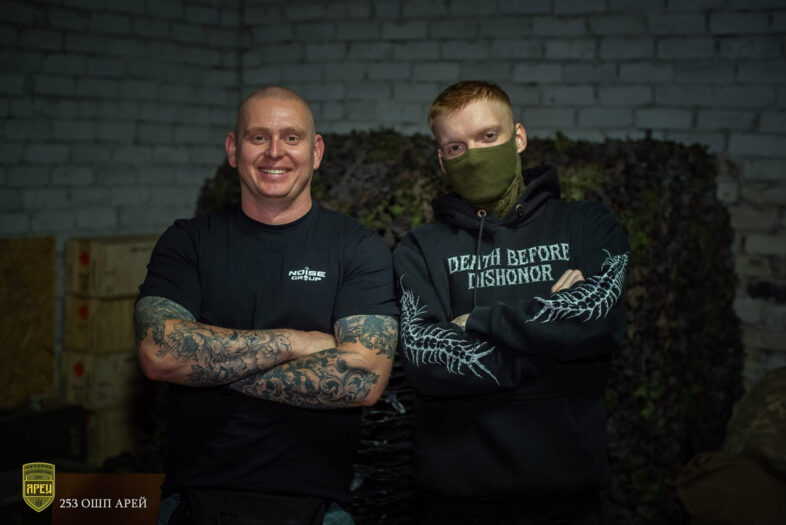
Dmytro Liutyi, the drone pilots commander, says Shved is always eager to return to the frontline, asking almost every day when his next rotation will come. But there is a process to follow, and he has to wait his turn. For someone like Shved, sitting idle is not easy.
Looking back at his previous deployment, he remembers long days, little sleep and a constant stream of work: “We destroyed two Russian artillery units, dugouts, a vehicle, antennas, and Russian soldiers on quad bikes. We also carried out reconnaissance missions. We knew the enemy was only a few hundred metres away from us. Things are going very well for us in the Zaporizhzhia region. The Russians are managing to get through far less often.”
“I’m impressed by his determination and professionalism,” says Liutyi. “This is our first experience of having foreign volunteers among our drone pilots, and it’s gone very smoothly. We’ve never had any communication problems. One of the lads spoke some English, and Shved has learnt some Ukrainian. We’d like to see more foreign volunteers join us. Another one is on the way, and we’re already in talks with someone else. It’s a real pleasure serving alongside people like them.”
Shved has also found another personal connection in Ukraine — he met his girlfriend there, and they have been together for two years. So when he eventually returns home, he may not be going back alone after all.
He plans to become a farmer. But before that, he still wants to help Ukraine.