A 30-metre mural runs along the wall of a narrow alley in Lviv. Step by step, as you move deeper into the passage, the images unfold — fragments of a city’s life and its tragedy. Mariupol. A hero city. One of the first to meet Russia’s full-scale assault on 24 February 2022.
Each section pulls you back to those days. The sky burns with a fiery glow. At the Azovstal steel plant, Ukrainian defenders hold out — 86 days in the last patch of Mariupol still under Ukrainian control. White doves sweep over a mined field, recalling the birds that once decorated Freedom Square. Columns of civilians walk on with white scarves raised, even as Russian artillery shells fall around them. The Mariupol Drama Theatre comes into view, marked with a single word: “Children.” Residents wrote it on the asphalt outside on 14 March 2022, a desperate attempt to show Russian forces that the building was a shelter, not a military target. Two days later, Russian bombers reduced it to rubble. The theatre became a mass grave for nearly 600 civilians.
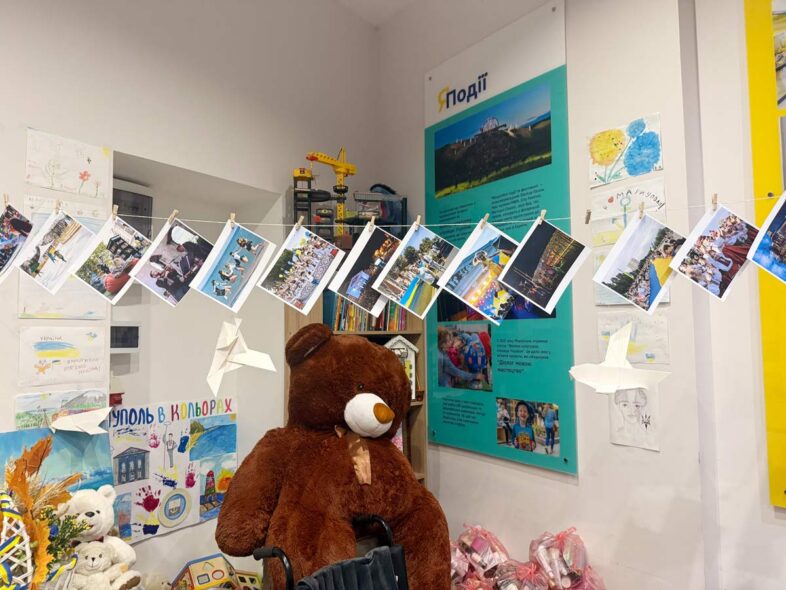
The mural guides visitors straight to the “I Am Mariupol” support centre. Push open the heavy wrought-iron doors and you step into a warm, softly lit room alive with conversation. Children’s drawings cover the walls, alongside photographs of Mariupol and delicate origami doves that stir slightly as the door closes. Bright posters stand out. One reads: “The heart of Mariupol continues to beat in each of us. Our city has been destroyed, but hope lives on.”
Mariupol remains under Russian occupation, but its city council operates in exile. Across 22 support centres in 21 Ukrainian cities, residents work daily for their own community. Here, the city endures — in everyday tasks, in shared memories, and in the quiet determination to keep it alive.
“The destruction and siege of Mariupol began on 24 February 2022. The whole world went through that tragedy with us, and similar tragedies are still unfolding in other Ukrainian cities. But Mariupol was the first to face such horror,” says Valentyna Boiko, who heads the Lviv-based “I Am Mariupol” centre. In Lviv, she carries a piece of her native city with her — kept alive in memory, in her work with the city council, and in the steady rhythm of everyday effort.
After 15 March 2022, Mariupol residents were finally given a chance to leave the besieged city. But evacuation offered no guarantees. Russian forces continued shelling, and the road out was as perilous as staying behind.
In those first chaotic weeks of the full-scale invasion, the Mariupol City Council — operating in evacuation — began building a network of “I Am Mariupol” support centres. The first opened in Dnipro in April 2022. After that, new hubs appeared across Ukraine every two weeks. The Lviv centre began work in July 2022. Since then, 65,000 Mariupol residents have turned to these centres for help.
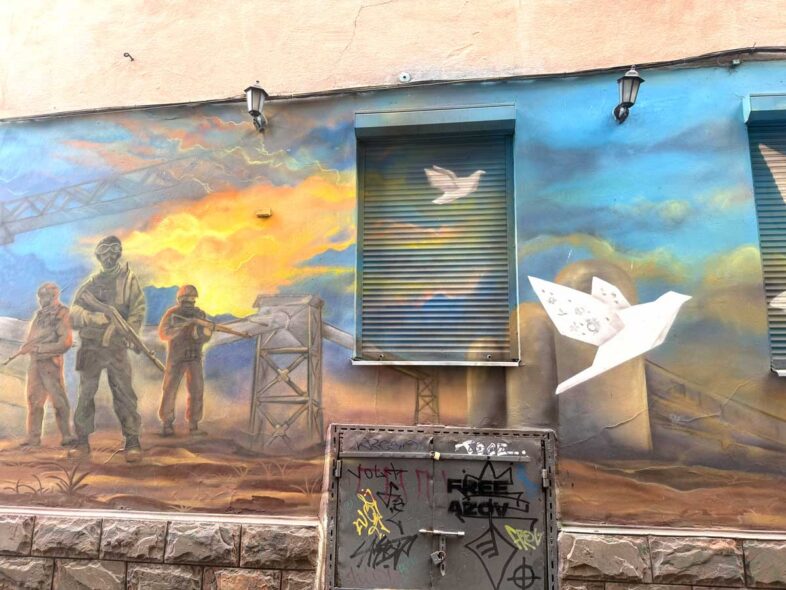
86 days of resilience. Ukrainian defenders of Mariupol in the mural near the “I Am Mariupol” centre
“At the time of the full-scale invasion, Mariupol was home to half a million people. Some have since left Ukraine, some remain in the occupied city, and many thousands were killed. Our task now is to bring together Mariupol residents wherever they are — in Ukraine or abroad. We want to help everyone, to know where our people are, to unite and support the Mariupol community,” Valentyna Boiko says, her voice steady.
These centres are more than humanitarian hubs — they’ve taken on the full range of services once provided by the Mariupol City Council. Through the city’s budget, displaced residents receive monthly food packages. But just as often, people come simply to talk: to sit with fellow Mariupol residents, revisit happier memories, or share the pain of loss. Staff and visitors describe the space as one big family, united by shared experience. In Lviv alone, more than 4,000 Mariupol residents are officially registered with the community.
At the “I Am Mariupol” centre, lawyers help residents navigate everything from paperwork to complex legal disputes. A Centre for Administrative Services — the same type that once operated in Mariupol — now works inside every “I Am Mariupol” hub across 21 Ukrainian cities. Lately, administrators and legal advisers have taken on a new task: helping residents submit claims to the International Register of Damage.
“This is crucial for us,” says the head of the Lviv centre. “It’s the only mechanism we hope will actually work in the future. Through it, we expect to receive compensation for lost property and for the war crimes committed by the Russian Federation — through reparations.”
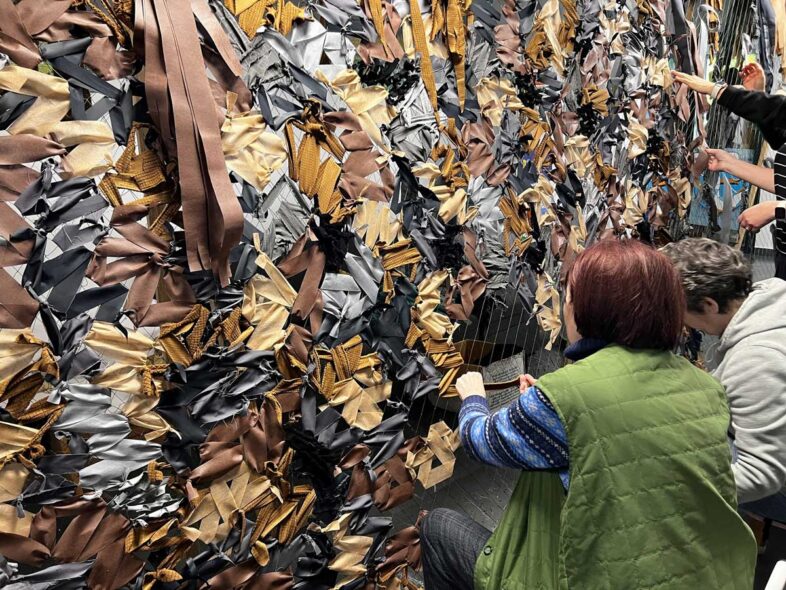
Helping Ukrainian defenders and their families is another key focus. The centre has a veterans’ support officer who assists service members as they transition back to civilian life. Meanwhile, Mariupol residents pitch in to support the Armed Forces in practical ways — weaving camouflage nets, making trench candles, gathering supplies, and sending them to the front.
Many also volunteer at the “I Am Mariupol. Care” centre — one of 11 such everyday support hubs across Ukraine, including one in Lviv. There, displaced residents can see a doctor, get a haircut, mend clothes, do their laundry or even have a manicure. The list of those eligible for assistance is wide: pensioners, pregnant women, people with disabilities, children under 18, veterans and their families. “About 70% use the services free of charge,” Valentyna Boiko says. “The remaining 30%, those who are economically active, pay for them.”
A careers adviser works one-on-one with Mariupol residents, helping them find jobs or retrain for new professions. With around 3.7 million internally displaced people now registered across Ukraine, many have had to start over from scratch in unfamiliar cities. For Mariupol residents in particular, the search for new work is often the first step toward rebuilding a sense of stability — and having a professional guide can make all the difference.
The centre also employs a qualified psychologist who holds both individual and group sessions. Each week begins with a morning meditation, alongside art therapy workshops designed to help people steady themselves emotionally. A cultural projects coordinator oversees another vital strand of work: integrating Mariupol residents into Lviv’s cultural life. They attend exhibitions and concerts organised by locals specifically for the displaced community.
“We’re incredibly grateful to concert organisers and cultural institutions in Lviv for giving our Mariupol residents the chance to attend events free of charge,” Valentyna says, smiling. “Many tell us that even in Mariupol we never saw the kind of cultural diversity we’re experiencing here in Lviv.”
The “I Am Mariupol” centre doesn’t just provide services — it launches projects of its own. There’s an educational programme on Ukrainian history and culture, preparatory classes for Mariupol preschoolers about to start school, and even computer and financial literacy courses for older residents. Updates on all of it — and on the centre’s day-to-day work — are shared on social media, run professionally by two staff members.
One of them is Andrii, a journalist at the Lviv centre. With his thin-rimmed glasses, neatly buttoned shirt and mechanical watch, he carries himself like a university lecturer. It’s not far from the mark. Andrii studied history and law at Luhansk Taras Shevchenko National University and worked as a history teacher before serving in the army.
In 1992, Mariupol’s local TV channel Sigma became the seventh media outlet in independent Ukraine to receive a broadcasting licence. Andrii joined the station in autumn 1994 and stayed for more than 25 years. He worked as a correspondent, presented the news programme Dzerkalo, hosted talk shows, served as executive editor — and eventually became editor-in-chief.
“Oh!” — Andrii’s eyes lock onto a poster across the room. It shows a photo of the building that once housed the Continental Hotel. Before the full-scale Russian invasion, it had served as the Youth Palace of Culture. “On the third floor, there were the offices of Sigma TV and Donbas TV. Right in the middle of the third floor, that little window — that was our newsroom. Sadly, the whole building was destroyed during the siege and bombardment,” Andrii says, lingering over the photo.
The Russian siege of Mariupol began on February 24, 2022. By March 2, the city had lost all communication, gas, and electricity. The gentle lapping of the sea waves was drowned out by the roar of Russian ships attacking from the Sea of Azov. Russian forces shelled residential neighbourhoods with artillery and launched airstrikes across the city. One March morning, a bomb landed just 30 metres from Andrii’s family home.
“It blew out everything — windows, doors. Somehow, we managed to cover them with plywood and cardboard. And this was early March… temperatures were three to five degrees below zero. But when buildings go days without heating, they cool down fast,” Andrii recalls, his voice slowing as he drifts deeper into the memory.
On the night of March 16, another Russian bomb fell from a plane, landing just outside the apartment windows. The blast tore through the makeshift cardboard barriers again, leaving the window openings wide open. That’s when Andrii made the decision to leave Mariupol with his wife, his mother, and their cat Marta, heading for relatives in Lviv.
He had managed to fill the car with fuel in the first days of the war, after waiting for hours in line at a gas station. He had also reinforced the wheels with metal plates. So, even though the car was struck by shrapnel from the attacks, it stayed operational. The journey to Lviv took three days, passing through Zaporizhzhia, where Russian forces shelled a convoy of civilians in one village. Leaving Mariupol was almost as perilous as staying.
Fortunately, Andrii and his family reached Lviv safely, where he began working at the “I Am Mariupol” centre from its opening in July 2022.
According to the Mariupol City Council, about 90,000 residents remain in the Russian-occupied city, most of them elderly. In October 2025, the city saw a sharp rise in deaths — roughly 600 a month. Much of Mariupol’s infrastructure was destroyed by the occupiers, leaving people without reliable access to clean water, heating, or medical care.
More than 5,000 apartments have been seized and effectively taken over by the Russians. On the sites of demolished buildings, they are putting up decorative facades, hiding the destruction behind superficially attractive apartment complexes. The Mariupol Drama Theatre is also being rebuilt, with plans to stage New Year performances on the very site of the tragedy.
Once a vibrant city of half a million, full of life, opportunity, and pre-war architectural beauty, Mariupol has been reduced by the Russian occupiers to a landscape of mass graves, rubble, and a refuge for packs of stray dogs.
Andriy admits openly that the longing for his hometown never fades. Yet at the center, Mariupol residents are helping fellow residents. Staff and visitors alike have walked the same path. “Every employee here is also a displaced person. Each of us, like all Mariupol residents, lived through the city’s siege, the bombings, and the evacuation. It’s hard, but we do everything we can,” Andriy says, his voice carrying quiet optimism.
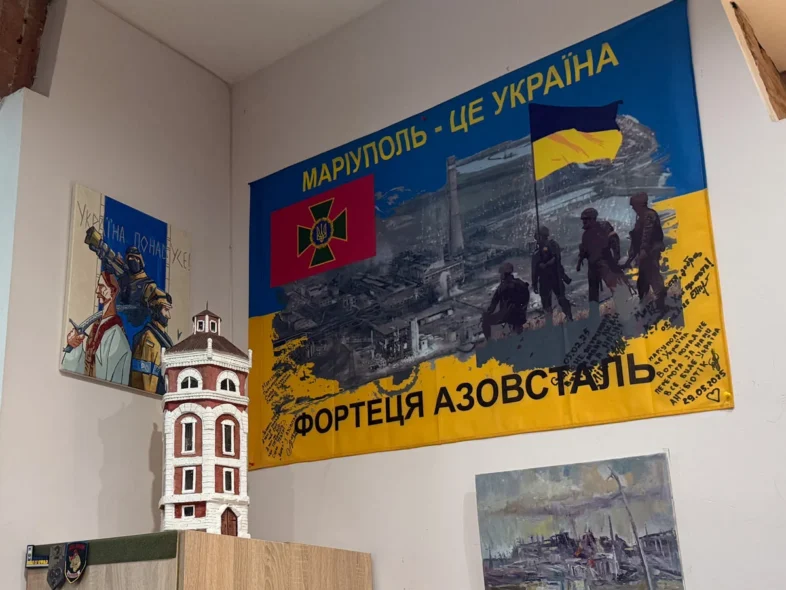
The walls are lined with photographs and paintings of Mariupol’s landmarks. Among them are images of the Spired Houses, an oil-painted canvas of the Azov Sea, and a model of the Water Tower, designed by architect Viktor Nielsen in 1910, standing proudly atop a cabinet. Andriy points out a softly lit niche where an installation hangs—a wooden frame with curtains attached to a canvas, creating the illusion of a window. Behind it, watercolor-blue skies reveal the familiar, deeply cherished Water Tower.
“When Mariupol residents come into the centre, they see these buildings—it reminds them of the city. As they say: ‘We come here like to a little corner of our Mariupol,’” Andriy adds with a smile.
For Mariupol residents living in remote towns and villages, the initiative “I Am Mariupol. Close to You” is in operation. Each month, a mobile team travels to six towns across the Lviv region, where staff provide familiar services. According to Valentina, since August 2025, the Lviv centre has been expanding the project.
Since then, centre employees have been reaching out to Mariupol residents abroad—registering them, offering legal consultations, and providing access to administrative services (CNAP) via messenger apps and phone. The centre also hosts virtual Zoom meetings to connect the community and address common questions.
“So far, we’ve received feedback from Mariupol residents in 27 countries. The most common are Germany, Poland, and Bulgaria. There were even some far-flung countries where we thought, ‘Wow, our Mariupol residents really ended up there,’” Valentina laughs.
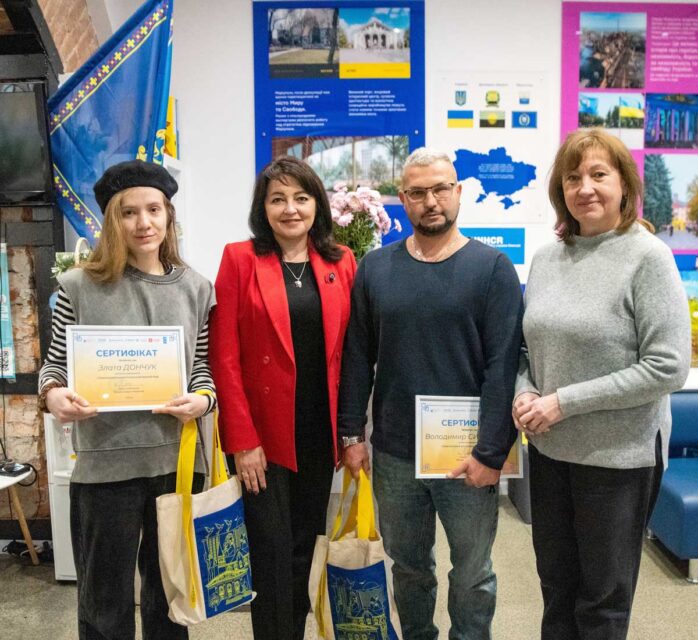
On the day of my visit, Mariupol defender Volodymyr and student Zlata were finishing a two-week internship with the Mariupol City Council. Both hope to dedicate their careers to public service and local government. Veteran Volodymyr particularly values the centre and council’s direct communication with each citizen. For Zlata, it matters that Mariupol residents are working to support fellow Mariupol residents. “I want to build my life around the public sector and help people. This internship showed me where to start and how to map out my path forward,” she says.
Meanwhile, the centre buzzes with activity. It is in this everyday, hands-on work that the resilience of Mariupol residents truly shows. As I step outside, my eyes land on the next section of the mural, where a sense of hope begins to emerge. Mariupol artist Dmytro Vovk has completed a graffiti piece showing Ukrainian soldiers and a family with suitcases, finally returning to their hometown. Stepping into the alley for a break, Andriy pauses, gazing thoughtfully at the mural as if lost in the city’s distant skyline, and finally says, “The title of the graffiti is ‘Returning Home.’ The main goal, after all, is to get back to Mariupol.”