“He was circling that nut like children around a Christmas tree,” laughs mortar man Serhiy Pysmennyi of the 32nd Separate Mechanised Brigade. He recalls his close encounter with an enemy FPV drone with a touch of humour, though at the time, there was little to laugh about. Luckily, the situation ended well: the drone got caught in the branches of a tree and exploded at a safe distance from our fighter.
We’re sitting in a cramped cellar, its shelves piled high with jars of preserves, on the outskirts of Pokrovsk. The sounds of explosions and the hum of drones are barely audible underground. While the Russians are still trying to maintain fire control over the city, the artillery fire continues unabated. Just down the street, more than a dozen homes have been reduced to rubble by cluster munitions, but many locals remain. They approach the soldiers, asking if they can charge their phones and flashlights using the generator. The soldiers don’t refuse, though the occasional curse can be heard in response — the blast from their 120mm mortar has shattered windows in a nearby house, and a shepherd dog trapped in one of the yards is howling in distress.
Serhiy, the senior gunner, pauses for a moment before continuing his story, remembering how he was struck by the sight of a board game set up in the children’s room of the house, which has now become their position. Back home, his daughter waits for his return.
“What emotions do I have, you ask? Very strong ones,” he says. “It’s the third year of war, and I still can’t get used to seeing people, forced to flee in a hurry, leaving behind everything—just what they were wearing. They had to abandon the homes they’d renovated, the lives they’d built, the futures they’d planned for their children. But then came the ‘Russian world’…”
“I was born on 17 August 1991, so I caught the tail end of the Soviet era, and trust me, I have no desire to go back.”
When he joined the 32nd Brigade, his mindset was simple: whatever position he was given, that’s where he would fight. “I like the mortar unit,” he continues. “It’s fun, I’d even say, though sometimes you really have to work hard. Well, like everywhere in war. We make sure everything is done precisely, because we know the lives of the guys depend on it. The battery commander says: ‘An artilleryman’s sweat is the infantry’s saved blood.'”
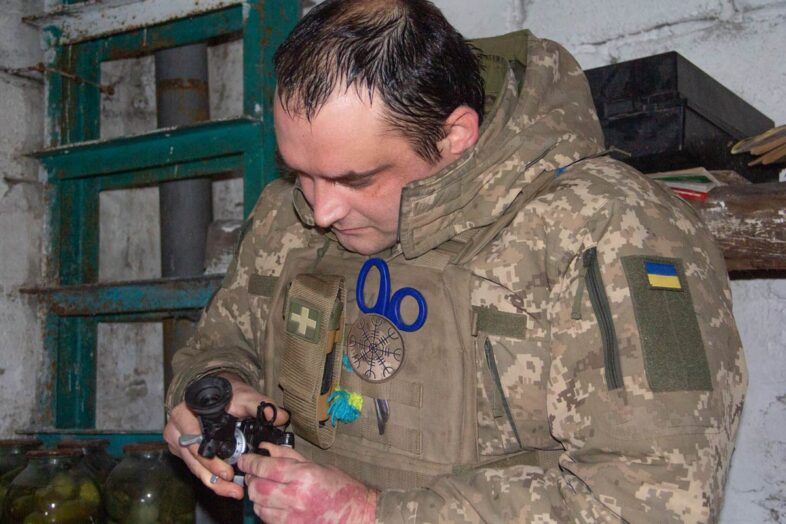
The mortar men joke among themselves that their work is “landscape design.”
“A comrade from another crew, a former paratrooper, says that for him, every shot feels as emotional as a parachute jump,” Serhiy continues. “I can’t compare, as I’ve never jumped from a plane. But yes, even the vibration from a mortar shell hitting the ground is a unique sensation. It’s hard to describe. Before the war, I never experienced emotions like this. I wasn’t into extreme sports; life was calm. Unless, of course, when I was a kid, running away from my grandfather to avoid a smack on the neck after he caught me with a cigarette. But now, I feel like I’ve developed an adrenaline addiction. After just a week of recovery, I’m already itching to get back to the front. I miss that vibration—it’s what gets my blood pumping.”
I ask him about his most vivid memory.
“The first combat sortie stands out the most,” he says, adjusting his glasses with a finger. “It felt like the biggest exam of your life. You feel more like a robot, doing everything by the book, moving mechanically, with your mind filled with formulas.”
“I understand, of course, that the rules of war are written in blood,” Serhiy adds. “But now, from experience, I know where I can bend the rules, find a way around things, and still get the job done.”
The first time you take return fire is something you never forget. The months of instructors’ stories are one thing, but when your body feels the impact, that’s a whole different experience. The key is not to panic. Panic only creates more problems for you and your comrades. You know where the shelter is, so you run there, making sure everyone gets in. You wait it out, then check in to make sure everything’s okay.
Outside, the sound of explosions continues to echo.
“Grad rockets—there’s nothing like them. They’re unpleasant, but they strike with such chaos. You never know where they’ll land when you hear that rumbling,” Serhiy comments. “We listened more closely to the impacts: while they’re still adjusting the aim, and before that, they’ve already fired a rocket pod. It’s quite far from us, though, because when they’re close, you really feel the pressure, especially on your jaw.”
What keeps him going? “When the commander gets a voice message from the battalion commander: ‘Boys, we’ve hit the coordinates perfectly.’ That means the enemy’s gone. No one’s moving anymore.” What fuels him further is the knowledge that his family doesn’t hear the artillery, the Grad rockets. They don’t witness the devastation—how, just 300 metres away, a KAB bomb reduces a nine-storey building to rubble, taking everyone inside with it. What drives him is the relentless need to keep the invader as far from his home as possible—at any cost.
“We’re doing everything we can to push the enemy out of our land,” he says. “It’s been three years since I joined the military. I’m surprised I’m still alive, still somewhat healthy. But I’m mortally exhausted.” He wipes sweat from his forehead and neck.
“But don’t even get me started on those sitting on their couches, saying, ‘We’re tired of hearing about your war, let’s just end it.’ I can’t even find the right words to express what I think of those ‘tired’ people. My parents didn’t bring me into this world with a helmet and a rifle. And those who say, ‘I wasn’t born for the trenches,’ are the ones who’ve never felt this reality. When I go home to Horishni Plavni on vacation, where we haven’t had a single strike throughout the war, I can’t walk down the streets. The laughter, the music everywhere, people partying and fishing—here in Poltava, there’s no war. You feel like you’ve been abroad, working overseas. Actually, it’s not even like that—it’s like stepping into another reality altogether. I try to find peace in my parents’ village, just so I don’t have to hear, ‘You’re earning 100,000 there.’ I tell them, ‘Go ahead, try it. See what that 100,000 costs. Trade places with me.’”
Recently, Serhiy Pysmennyi was awarded the Commander-in-Chief’s Cross of Honour by the Armed Forces of Ukraine, recognising his bravery and his successful execution of combat missions.