The basic tactical medicine course at the Hospitallers volunteer training centre lasts 21 hours over three days and blends theory with hands-on simulations. Expect plenty of artificial blood and a constant undercurrent of tension that, for the overly sensitive, might even trigger hallucinations. In this gonzo-style narrative, the author dives headfirst into the experience, exploring what unfolds when participants fully commit to the course.
***
Finding my role
Kyiv greeted me at six in the morning with fog, chill, and darkness. I had three hours until the meeting, and all I had was a Telegram contact, whose profile picture featured a blonde woman. I stepped into the nearest ATB supermarket, quickly scanning the shelves and picking up what seemed essential at the moment: two cans of stewed meat, kids’ gloves (the only option), socks, a lighter, and a small juice pack. Then, I was off to the metro.
At the meeting spot in Osokorky district, a few people were already hanging around. A girl with dreadlocks approached and said she was there for the course, too. Faces began emerging from the fog, one after another. We shuffled about, trying to keep warm, until he finally appeared—a figure straight out of a ’90s Norwegian black metal band. No, it was Vovkulaka, the course instructor. And, as it turned out, he was also the blonde from the Telegram profile. Long light-brown hair, a sharp nose, and a piercing gaze.
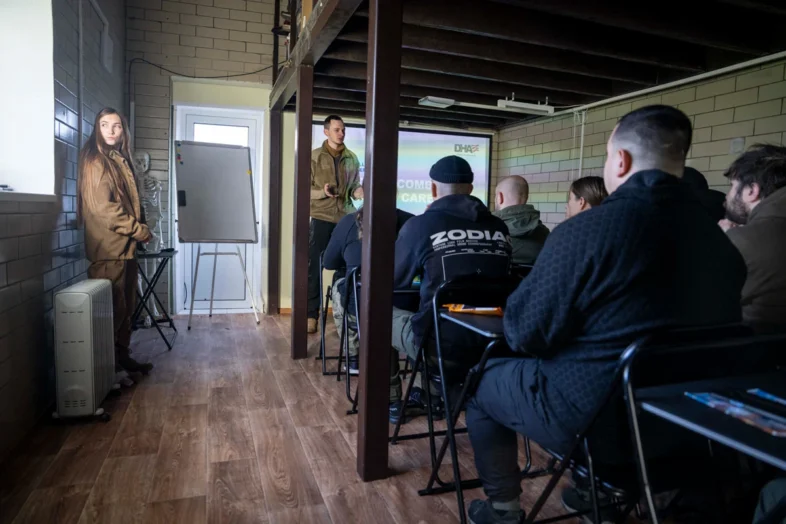
“Let’s do roll call. I must’ve come to the right crowd, right?” he said, pulling out his phone. The list had about twenty names. Naturally, mine wasn’t on it.
“I’m a journalist—I messaged you yesterday,” I said, my voice slipping into a barely audible rasp.
“Don’t worry about it,” he said, waving me off with a smile that could’ve meant anything. But in that moment, it felt like it might mean I wouldn’t have to eat the stewed meat from ATB. That was the first pleasant surprise of the morning.
Meanwhile, Kyiv was slowly waking up, with office drones and hipsters on e-scooters zipping through the streets—darting around like ants on a caffeine high, dragging their tired selves from coffee shops to the glass towers of business centres. Is everyone busy? Is everyone this important? Each in their own little world? All is in order. Above, air raid sirens occasionally howled, but no one seemed to care. When you’re deep in the matrix, those little distractions barely make a dent.
I took a drag of my cigarette and scribbled in my notebook: “The city devours its foster children. Or maybe I’m just an outsider here?” A moment later, I reread it and added beneath: “God, I really need to stop watching shows for 15-year-old teenagers.”
“Don’t worry…” Did he really say that, or had I imagined it? The thought doesn’t fully hit me until six hours later. There I am, kneeling in front of a bloodied mannequin, carefully stuffing it with bandages. Vovkulaka stands above me, watching as I jab my fingers into the rubber hole, like a smuggler at the Polish border next to his split-in-half Volkswagen, trying to quickly pull a carton of cigarettes out of his ass while the Polish officers are busy dealing with a truck driver.
The mannequin suddenly spits blood with renewed ferocity. “He-e-ey!” Vovkulaka suddenly exclaims, his voice soft but charged with approval as I hit the right pressure point.
“I don’t quite get it—what’s your role in all this?” he asks as I tear open another pack of bandages with my teeth.
“Don’t do that,” he warns immediately. “Blood could get in your mouth.”
I freeze.
“I’m here as… well… a journalist,” I mumble, pushing my finger deeper into the wound. “But also as a participant. You know, so I can achieve full immersion…”
The mannequin starts spurting blood with renewed intensity. Vovkulaka keeps pumping, or maybe this is some kind of twisted ritual—painted water instead of blood, an instructor instead of a priest, with the look of someone from Darkthrone but the voice of those guys who try to sell you vape pens when all you want is a regular pack of cigarettes.
“Journalists usually just take a few photos and leave,” he says, his tone casual. “The main thing is to keep it truthful.”
By six in the evening, after the training has wrapped up, the base feels like it’s been lifted straight out of a post-apocalyptic film—quiet, dimly lit, with only the distant hum of the Dnipro below reminding you that you’re still in Kyiv, not some limbo-like nowhere. I sit on the bed, my eyes fixed on my notebook, trying to coax words from it for the report. What can I even write? “Today, I learned how to stop bleeding, but I’m not sure I could do it again”?
On the edge of reality and absurdity
“Alright, now we’ll practice a simulation,” Vovkulaka’s voice echoed through the room as I stared at the skeleton in the corner.
We were split into teams—five, five, five… and four. Of course, I ended up in the four. One of my teammates seemed to exist in some parallel reality, where neither the instructors’ instructions nor our confused glances could reach him. The hearing aids in his ears looked less like tools for staying connected with our world and more like devices picking up signals from another dimension. That’s certainly how it felt every time we tried—again and again—to explain his role and the plan we were supposed to follow.
Then there was the girl, her phone permanently glued to her hand, looking as though someone had just told her Instagram was being shut down forever. And the guy who silently watched everything, probably wondering if he would’ve been better off at a meditative alpaca-grazing retreat in the Carpathians.
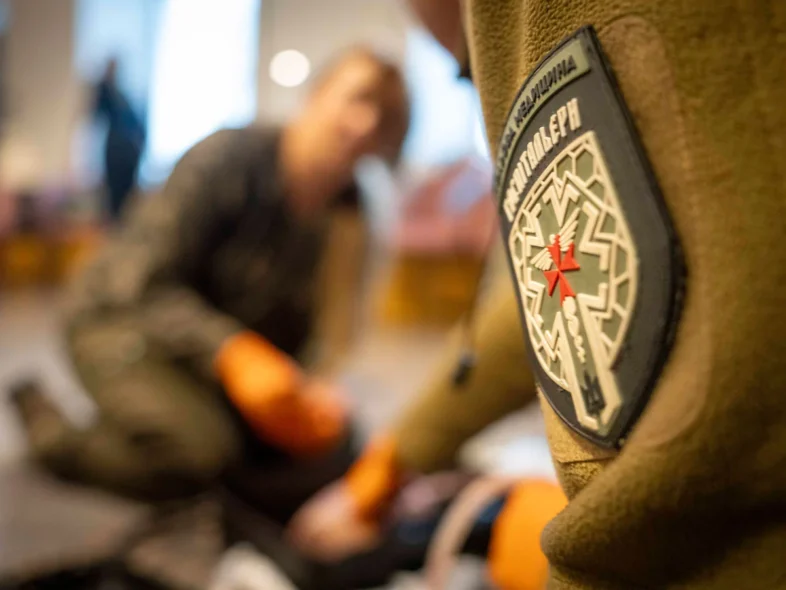
“Raccoons in the field,” Vovkulaka’s voice buzzed over the radio. That meant it was time to shuffle to a small room in another building and wait while the instructors smeared fake blood on the actors and plastered on their wounds. So we sat there, silently sweating.
I try to figure out who these people around me really are. What demons brought them here? Forget motivation—everyone carries their own personal hell. Take that girl glued to her phone. Maybe she’s scrolling through pictures of bison, trying to avoid facing the reality of what she might do if things get real. Will they even get real? Or maybe she’s some kind of marketing agent, recording our every move and reaction to sell us courses like “How to Stop Fearing Blood in Three Days,” or books titled Medicine for the Self-Doubting.
In a week, our phones will probably explode with spam about webinars like “Level Up Your Tactical Skills” and Facebook will nudge us toward a lesson series called “Become a Combat Medic Without Leaving Your Couch: The Method Trusted by Losers Just Like You.”
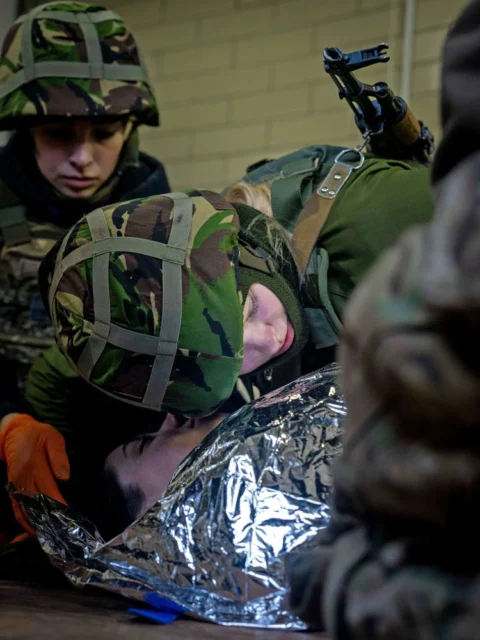
It all kicks off with us rushing out of the building like rats fleeing a sinking ship. On the ground—there’s the injured. One woman has a silicon hole glued to her side, from which something resembling intestines dangles. I know it’s fake, but there’s something inside me that refuses to believe it. Especially when she starts screaming, “God, it hurts! Help!”
Tourniquet. Tourniquet. Tourniquet—ah yes, this sadistic invention that turns ordinary people into enthusiastic torturers. I press my knee against the femoral artery, or at least I hope that’s where it is, while someone struggles to tighten the damned thing. “Tighter! Tighter! Tighter!” I yell, like some steroid-fueled fitness coach. But I don’t care. If that tourniquet isn’t tightened until it feels like you’re trying to saw off a limb, it’s just a trendy accessory for blood loss.
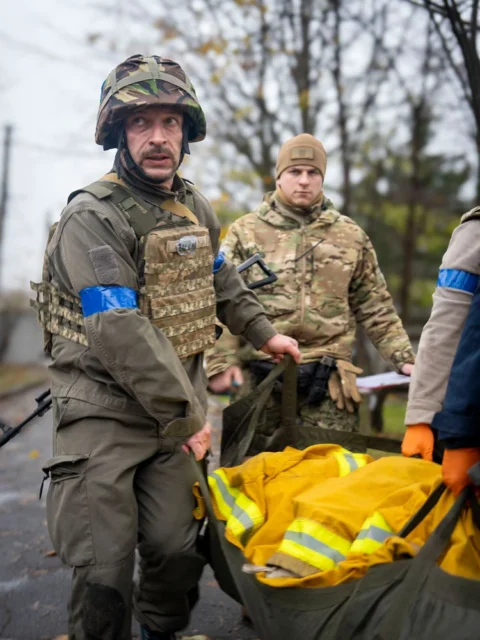 “Report,” someone barks at me. Right, I’m the commander now. I grab the radio and press the button. Or maybe I press the wrong button. Or maybe I didn’t press a button at all. This damn thing refuses to work. On the other side, there’s nothing but silence.
“Airways!” someone yells, their voice sounding like a drunken vocalist from a band called Tragic Snowflake, just hit by a tractor. Right, MARCH. Massive bleeding, airways… damn, what’s next? I lean over the “injured” person’s face, trying to hear her breathing. But all I get is the smell of fake blood—something like a weird mix of strawberry syrup and toilet cleaner. Her lips move. She’s whispering something. Maybe a prayer. Maybe telling us to go to hell. Either way, it means her airways are clear.
The girl with the phone rolls her eyes so hard I can almost hear them creak. God, what are we all doing here? Are we playing some sick game where nobody knows the rules but everyone acts like they do? Or is it just me pretending?
Time to check for other injuries. My hands glide over the “injured” body, feeling something squishy—silicone wound pads. Then, I hit something hard in her pocket—a grenade. Damn it, we were supposed to check pockets first. Basic procedure. Elementary stuff. Or maybe it’s real? Maybe this is some twisted experiment? Maybe we’re all going to be blown to pieces right here, and the news will report, “Accident at tactical medicine course: victims were not tactical enough.”
“The injured person has a grenade in her pocket,” I whisper, trying to keep my voice steady.
“What?” The man leans closer, his hearing aid’s battery clearly dead.
“A GRENADE!” I shout, and for a moment, the whole room seems to freeze.
“Ah, a grenade,” he says, nodding calmly as if I’d just mentioned she had a pack of cigarettes in her pocket. “Well, get it out.”
“The injured is losing heat!” Of course, the thermal blanket. Where is it? Oh, right, it’s in that first aid kit we lost somewhere along the way. Perfect. Just perfect. “Cover her with something!”
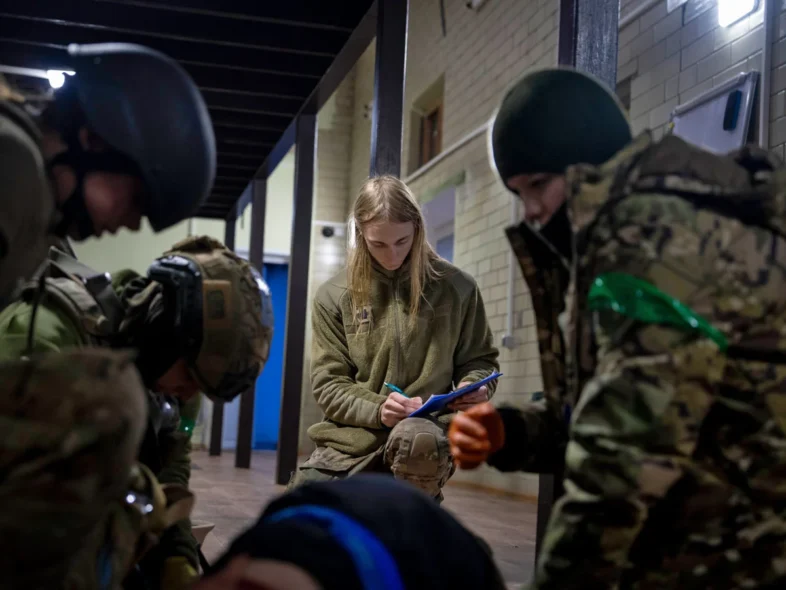
“Stop the simulation!” Vovkulaka suddenly calls, pulling out a piece of paper for a post-mortem analysis. It feels like the aftermath of a botched amateur satanic ritual—where, instead of summoning the devil, you accidentally invited the wrong demon. Everyone nods, pretending to know what they’re doing. I nod too, but in the back of my mind, one thought keeps circling: How do I write about all this without coming off as a complete psychopath? Though, honestly, what’s the point? We’re all a little crazy here. Some just hide it better. Right?
***
The reportage was prepared as part of the master’s project “The Path of the Warrior” — a series of artistic reportages about military training.