“Everything’s as close to real combat as it gets,” says 30-year-old Junior Sergeant Mykhailo, an instructor with the 32nd Separate Mechanised Steel Brigade, his voice steady and composed.
The training ground rings with gunfire, explosions, and shouted commands. Mykhailo is in charge of the tactical medicine station, where newly arrived soldiers, fresh from basic combined arms training, are honing their first aid skills. “They need to get it right at least 90 per cent of the time,” he says. With over a decade in the Armed Forces, he knows full well — mistakes on the front line come at too high a price.
A native of Brovary, Mykhailo signed up as a volunteer in late 2014, barely out of his teens. He started out as a regular infantryman near Debaltseve.
“The war back then was nothing like it is now,” Mykhailo recalls. “It wasn’t as intense. Our main job was to stop enemy sabotage and reconnaissance groups from slipping through. But then I realised I had to grow — not just stay where I was, but move into units I actually cared about.”
Mykhailo had a natural knack for marksmanship, tactics and movement. He signed a contract and joined the special forces. “I never slacked off. I was always learning, always listening to my commanders,” he says. “That’s why I can say with confidence now that I’m a professional soldier. I’ve even got an officially certified sniper qualification. But at heart, I’m an assault trooper. My experience, my wounds — they speak for themselves.”
He met the full-scale Russian invasion head-on, when a missile struck the barracks in Brovary. “After that, we switched to defence — the Russians were already right on our doorstep,” he says, describing the battles for Kyiv region. “We had to clear our land.” What he witnessed once the Russians pulled back has stayed with him ever since.
“What they did, those bastards, in Kyiv region… they’ve already paid for it with their lives,” he says, quietly but with steel in his voice. He remembers Irpin, Bucha, Borodianka — the villages in Brovary district where he grew up. “And I’m not talking about soldiers — I mean ordinary people, civilians. Even animals wouldn’t do what they did.”
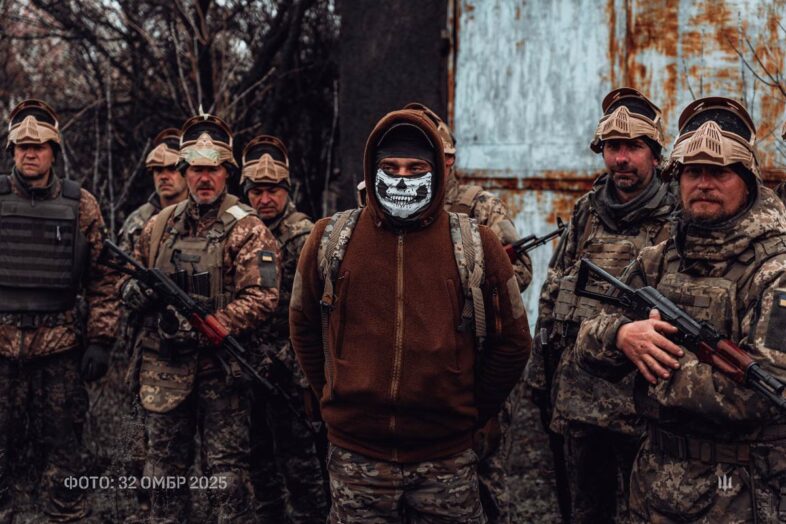
Mykhailo saw men, women and girls tortured — not just broken physically, but shattered mentally. “You walk into a house — there’s a man lying there with a metal pipe shoved up his rectum. A pool of blood underneath him. You can see where he clawed at the floor with his nails — the paint’s been scraped off. He must’ve been about 65. Another local had his collarbone and leg shot through, and they forced him to watch while they raped his wife and daughter. The women are alive, physically healed — but mentally, they’re wrecked. And it wasn’t just one or two cases. The Russians did that in nearly every house. Until we got there.”
That experience only deepened his resolve. “Why did you come to Ukraine, you f@#%ing bastard? What right do you have to do this — to shoot at me just because I’m Ukrainian?” he says, the question left hanging in the air.
“You have to stand up for Ukraine, for your country. I’m 30. I’ve been fighting since the end of 2014. Because I don’t want to live like they do in Russia — where everyone’s a slave.”
The toughest stretch, he says, was in the Serebriansky Forest near Kreminna. “That was one of those times we really dealt the occupiers a serious blow. In return, they hit us with everything — Grads, Smerches, airstrikes. Planes dropped bombs six times a day, and helicopters came in twice with unguided rockets. It went on like that for a full week. They didn’t even let us poke our heads out of the dugout.”
At times, they held their positions for as long as 80 days. “We endured. Somehow, we kept everything tight, everything coordinated,” he says, describing what got them through.
Each soldier dug their own firing slot — aimed at the enemy, shielded from bullets and shrapnel, with a clear field of vision. Eventually, they pushed the Russians back. “They could feel it — that we were beating them on grit alone. That’s when they started to run, even though they were only 150 metres away — maybe less. Those bolting across the field were cut down by supporting mortar fire. And one of our lads turned a captured grenade launcher on them — wiped them out. They [Russians – ed.] lay there, bleeding, some still alive — but they’d made their choice.”
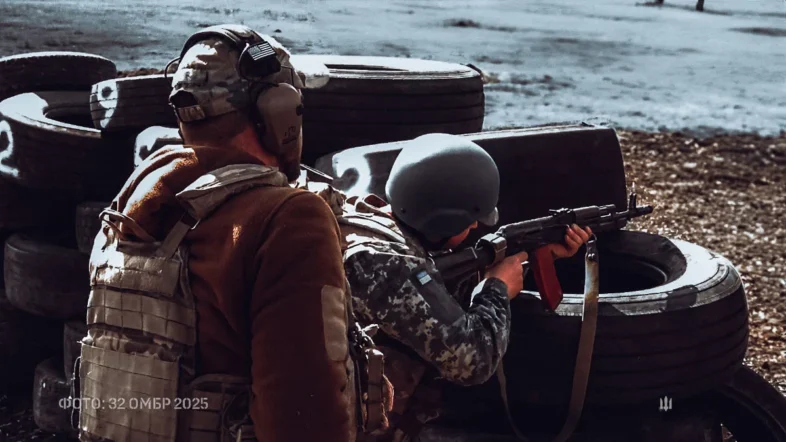
These days, Mykhailo is passing on his knowledge to the new recruits. He transferred to the 32nd Separate Mechanised Brigade a year and a half ago. “It’s a good brigade. Solid people, all capable. If someone doesn’t know how to do something — we’ll teach them. If they don’t know something — we’ll make sure they learn.”
The training ground is set up with stations for weapons handling, medical skills, tactics, mine-laying and clearance, and even RPG drills. “We do about 20 minutes of theory,” he says. “Then we talk things through. The lads can say what isn’t working for them, what they’re struggling with.”
But the goal isn’t just to train them to shoot straight or dig trenches. “It’s about understanding the importance of communication, mutual support, mental resilience. I try to teach them to be kind to one another. Because if there’s no support from your brothers-in-arms, you start turning inwards, eating yourself up.”
For Mykhailo, life outside the military no longer feels like an option.
“I took up arms to defend my country before I even had the chance to finish my studies — I once dreamed of working in a bank. Now my biggest dream is Victory. I’ll stay a soldier, and after the war I’ll probably go abroad to share what I’ve learned. I want all Ukrainians to live in peace, harmony and prosperity. To have the freedom to choose their own path, to see an open world full of opportunities, and to shape our future with their own hands. As for me — I’d like to meet the right woman, start a family, have children.”
“Children calm me down,” Mykhailo adds, with the faintest smile. “I play with them — and I feel lighter straight away.” That small smile, breaking through the weight of his stories about war and training, is a quiet reminder of what Mykhailo and thousands of others are holding the line for.