Are Western medical standards relevant in the context of the Russian war in Ukraine? What changes are needed in the military healthcare system? Why is integrating civilian and military healthcare so important? How are medics adjusting to the constantly changing realities of the battlefield, and how can society prepare for life under continuous threat? The Ukrainian Week spoke with Viktoriya Kovach, head of the medical service for Ukraine’s 3rd Separate Assault Brigade.
***
– What motivated a fifth-year medical student to leave everything behind in 2014 and join the front lines as a military medic?
– The war did. The war changed everything. At the time, I wasn’t preparing for war per se, but the reality of what was happening in the country—the threat to our statehood, our territories, and our people—left me with no choice but to act differently. Just yesterday, we were discussing what freedom really means and when we truly begin to experience it. Perhaps the clearest sense of freedom comes when you’re on the brink of losing it. That was the first time I truly felt that I might lose my freedom. It was that feeling that drove me to change my life and step into roles I had never imagined taking on before.
– What was the medical service like in the volunteer unit back then?
– Back then, there was almost nothing. As people often say, there were plenty of open windows—but what was missing were the people to close them, fill the gaps, and get things done. There were no training centres, no equipment, no supplies, and no specialists who could provide medical assistance or serve as combat medics under those conditions. Almost everything was absent, but there was a powerful drive to act. That’s what makes the difference between then and now.
The situation began to shift with the first tactical medicine training centres in Ukraine. They changed everything—replacing Esmarch tourniquets with modern ones, swapping out basic dressings for bandages, and upgrading standard gauze to hemostatic dressings. These improvements demonstrated that it wasn’t just possible to move mountains but to completely reshape them.
Today, we’re in a much better place. Of course, challenges remain, but compared to 2014, we’ve made significant strides—in training for tactical medicine, in resources, and in the public’s awareness of where and how to acquire the necessary knowledge.
In different units, practices varied depending on the available personnel. Where trained medics were present, they worked alongside infantry on the front lines. In areas lacking trained medics, help came from whoever was nearby—or they simply had to wait for a medic to arrive. The effectiveness of the response often came down to whether the right personnel were available and properly prepared to carry out their duties.
Ideally, the system functioned much like it does today, but without stabilisation points or advanced medical aid stations. A wounded soldier would typically receive initial care from a combat medic, who would then pass them on to a medical evacuation team. These teams would transport the injured to the nearest healthcare facility, whether it was officially designated for such treatment or became a makeshift one by necessity.
It’s important to note that, back then, the number of wounded was far lower than it is now. This meant that smaller frontline hospitals weren’t under the same intense pressure they face today.
– What stands out most from that time? Any particularly difficult situations or injuries that left a strong impression?
Injuries themselves don’t tend to leave a lasting mark on medics. It’s the stories, the people, and the things they share during evacuation or while waiting that stay with you. I can’t recall anything that deeply shocked me, but every story was unique, shaped by the person’s life experiences. There were artists, athletes, people who talked about books they’d read, and even those who begged, “Please make sure my backpack is taken—my favourite book is in it.” It’s moments like these that stick with you the most.
In a sense, people entrust you, as a medic, to provide the necessary care, believing that the doctors will take it from there. However, the emotional and psychological support often goes unaddressed. If you don’t tend to that, it makes it much harder to provide effective medical aid.
– Who were your comrades back then, and how did they compare to the volunteers of 2022?
– No, they weren’t all that different. They were students from various schools and fields of study. Many came from fan communities, and they had a wide range of interests and experiences. There were also a lot of athletes, both professional and amateur. Most of them were young, many around my age—20 to 25 years old.
— Why did you decide to return to civilian life after a year of war?
– At that point, we were stationed at the outermost defensive line, and there wasn’t an immediate need for medics. So, I weighed my options and decided it made more sense to return to medical school and finish my education. I knew the war wouldn’t end there, and I’d be better prepared if I returned with more knowledge and skills rather than staying at the same level. While there were opportunities for growth within the unit, formal education offered something deeper—a better understanding of how to make a real impact.
So, I made the decision to go back to school, finish my degree, and prepare for the next phase of the war. But I never could have imagined it would escalate to this scale.
– How did the full-scale invasion in 2022 begin for you? Were you prepared, expecting it, and knew where to go?
– Given the overall situation, I did expect the war, but what took me by surprise was the sheer scale with which it unfolded. Still, the enemy’s actions made it clear they were committed to proceeding. Everything leading up to the full-scale invasion—the speeches, the press conferences—made it obvious that it was just days away. There was no turning back.
When it came to deciding where to go, in moments like that, you naturally turn to those closest to you, those you’ve shared experiences with. I reached out to the people I had been with during 2014-2015, the ones I knew I could rely on—those I could count on for support if things became too much to handle. So, my decision was both intentional and well-considered.
— At that time, was your brigade already formed?
– The brigade was formed in Kyiv on the first day of the full-scale Russian invasion as part of the Territorial Defence Forces and gradually grew. Eventually, we transitioned to the Special Operations Forces, and by autumn, we had solidified our identity as the 3rd Separate Assault Brigade, drawing heavily from veterans and former members of the Azov Regiment. Many of our personnel, from the leadership to the rank-and-file soldiers, had roots there.
Most of those who joined in the early days had prior combat experience. They knew what to do, and this proved invaluable. Their presence gave those with less experience a clear sense of direction and a framework for action. Everyone quickly rallied together, made decisions, and took action. That collective experience was crucial—it made all the difference.
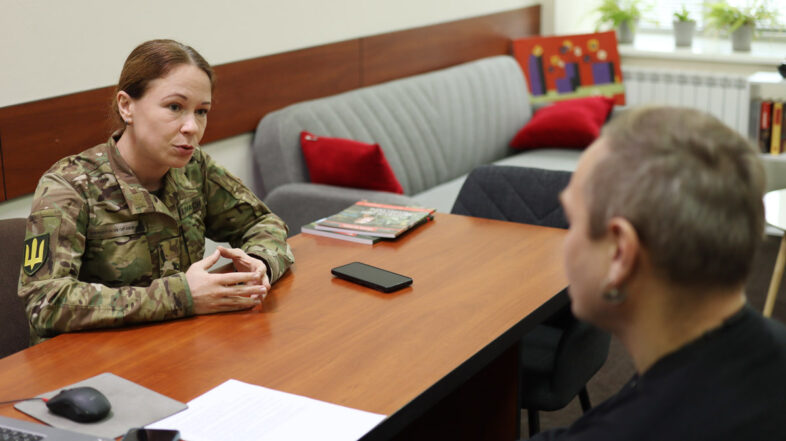
– What was your work like in the first days, weeks, and months of Russia’s 2022 invasion? How did it differ from your experience in 2014–2015, aside from the scale?
– We witnessed the full-scale invasion during the Kyiv campaign. Anyone who was there understands how chaotic things were in the area. It felt… I’d say uncontrolled, though I’m not sure that captures it entirely. You’d set out on a mission without knowing where the enemy might be. A two-hour reconnaissance could easily stretch into several days of duty. That was the level of planning for military operations at the time, especially in terms of medical support. There was a severe shortage of medical personnel and transport. Essentially, we had nothing.
The situation with medications was equally dire. Pharmacies were closed, and getting supplies into Kyiv seemed impossible. People were fleeing the capital in droves, yet we still had to find a way to bring supplies into the very place everyone was trying to escape. That added a whole new layer of logistical challenges. Back then, it wasn’t as simple as relying on Nova Poshta’s network or easy delivery routes. We were getting medical supplies from Vinnytsia, Lviv, and Zakarpattia, but the real challenge was finding someone brave enough to get those supplies to places where it wasn’t clear if you were about to cross into enemy lines or already in occupied territory.
At the start of the full-scale invasion, the pressure on civilian healthcare in Kyiv was immense. Without their support, I don’t think the central military hospital could have handled the volume of wounded. We all remember what happened in Irpin—one hospital solely focused on military care just couldn’t manage the flood of casualties in the region. This really proved that civilian healthcare and military care can’t be separated. Everything needs to operate as one unified system to produce any kind of meaningful result.
We ended up evacuating soldiers to hospitals all over Kyiv and its outskirts. Many of these hospitals weren’t equipped for the kind of urgent polytrauma care we were facing. I remember taking wounded soldiers to places like “Leleka,” a maternity hospital, and “Dobrobut,” a private clinic. It was remarkable how even private institutions stepped up, adapting quickly to the situation and supporting each other. Looking back, it might seem like everything fell into place, but at that moment, it took an enormous amount of effort to make it all work.
– The war dynamics are constantly changing, with each month bringing something different. How does your work change in response to these shifts?
– Let’s break it down step by step. Those of us with experience from 2014 entered 2022 with a different set of challenges. Aviation was a huge factor—there was a constant focus on the skies. But unlike today, there weren’t drones providing real-time intel. This made the situation much more difficult. The number of wounded shot up, and we had to quickly adapt our skills in sorting, triaging, and reallocating resources. You made use of whatever civilian resources were available—anything that could transport a stable patient sitting up.
During the Kyiv campaign, the challenge was that you could have one medical evacuation but end up with 15 people needing help. You couldn’t take everyone. Out of those 15, maybe two or three needed more intensive support, while the others were less critical. You’d focus on the more severe cases, sort through the rest, and then flag down any passing civilian vehicle. You’d give the location, they’d take the wounded to the hospital, and you’d head back to your comrades. The communication was poor, so if you weren’t in position, no one could really track where you were. You had to keep the initial information flowing, staying connected with whatever support was available.
Next, we moved to the South. The situation there was complicated by aviation, but no drones yet, and a steady flow of wounded. By then, we had somewhat adapted to the challenges, but the downside was the long evacuation routes, particularly with poor roads. This became a major issue, as human resources were limited, particularly the medical evacuation crews. A vehicle that took someone away would disappear from the scene for a significant amount of time, and during that period, there needed to be someone to replace it. If there was a large influx of casualties, several vehicles would be out of commission at once. They would reappear after a while, but the gap created pressure on resources. This is when we had to set up small sorting points, where we could not only sort the wounded but also stabilise their condition temporarily. These weren’t full-fledged stabilisation points as we know them now, but small, makeshift locations where we could regroup while waiting for the next available vehicle. There would be a surgeon and an anesthesiologist present, monitoring the patients and performing any necessary procedures when the situation required it.
Then came Bakhmut. At that point, there were still no KABs, and we were facing a period of relentless artillery fire and tough geographical challenges. Bakhmut, being a city, presented its own unique combat dynamics. When we moved to the outskirts, the terrain became even more treacherous—ravines and gullies made the situation even harder. The problem here wasn’t just about evacuating the wounded but about evacuating them from the front lines. It was a gruelling process, often requiring foot transport or whatever other means we could find. The evacuation times were stretched out significantly. We didn’t have the capability to evacuate from the front lines quickly, and the enemy had complete superiority in weaponry. This meant we couldn’t evacuate during daylight hours, so it became even more critical to have a casualty collection point where a combat medic, paramedic, or another trained individual could monitor the wounded’s condition. If necessary—and this was still becoming a recognised challenge at the time—they would perform a tourniquet conversion to help stabilise the patient and preserve their life and limbs.
Avdiivka—by this time, there were drones and KABs. There were many drones, which posed a problem because they could observe and clearly pinpoint where they would strike. The issue with KABs is that they destroy everything. There’s no way to provide assistance in a building hit by a KAB or at a location where it lands. This created additional challenges. These were very severe injuries, and while we tried to fight against them, saving lives in such cases was much harder. There was also a large number of blast injuries, which sometimes didn’t involve visible damage to the skin’s integrity. I’m referring to mild and moderate traumatic brain injuries—so-called concussions. The flow of casualties in this category was very high.
The mass use of drones has added a new level of complexity to evacuation efforts, especially in places like Avdiivka, where they’ve become widespread.
Drones are incredibly cheap weapons, and Russians don’t hesitate to use them, making any location—whether a casualty transfer point or a medical evacuation site—vulnerable, even if it’s not visibly military. The constant surveillance and the threat of strike drones have made evacuation not just difficult but incredibly complicated. It’s no longer a simple task to bring in vehicles for evacuation; the risks have reached an entirely new level.
— But you still go? You don’t refuse to enter a potential strike zone?
– Absolutely. There’s coordination at every level of assistance. The combat medic knows their role, the battalion knows theirs, the medical unit has its responsibilities, and the specialists at the stabilisation points are clear on what they need to do. When everyone does their part, the outcome is positive. If any link in the chain is missing, it creates difficulties at the next stage. The goal is always the same: saving lives and giving people the chance to recover, return to duty, or regain their physical and social capabilities. It all comes down to coordinated teamwork. That’s why we never refuse an evacuation, but everyone is clear on their role. The combat medic’s job isn’t to evacuate to the frontline surgical group—that’s not their responsibility. Their job is to carry out what’s been planned for them. When everyone knows their responsibilities, effectiveness increases. Yes, sometimes evacuation is genuinely impossible, but that’s not because anyone is refusing; it’s because we’re weighing all the pros and cons. Our goal is always to minimise the cons, but with the enemy’s advantage in drones, decision-making becomes more complicated. But no matter what, we don’t refuse evacuation—these are our people.
— How was the brigade’s medical unit created, how did you select people, and build the working model?
– The medical unit was built from scratch, or rather, from a deficit. Normally, when you arrive, you have everything you need, but in our case, we arrived and found that much of what was necessary had already been taken. We were formed from a military unit that came from the Special Operations Forces (SSO), and as a result, we started with what you might call “debts”—unsupplied equipment from that unit. So, our service began in a state of scarcity, with a small group of people—just two teams—who joined at the start of the full-scale invasion and stayed with the SSO.
In the summer, we launched a small recruitment campaign and began selecting people, though we couldn’t officially bring them on board right away due to some bureaucratic delays. Their enrollment only began once the brigade was officially established as an independent military unit. We recruited drivers, paramedics, medical orderlies, nurses, and doctors from various specialities. The second wave of recruits included those who were already aware of the brigade’s formation and wanted to join, as well as those who were mobilised through territorial recruitment centres and came to us for selection.
We interviewed everyone, focusing on their motivation to join and making sure they understood what they were getting into. This wasn’t a cushy job in a spotless, well-lit hospital with lots of assistants. The conditions were tough—often resource-strapped and complex—where decisions had to be made on the spot. You had to figure out what tools to use and what to set aside because there might be someone else coming in with the same kind of injury.
Motivation was key, but so was training. We wanted to make sure people had the right skills, so we brought in our own specialists to do the interviews. Surgeons spoke with candidates for surgical roles, anesthesiologists with those interested in anesthesiology, and therapists with those applying for therapeutic roles. I trusted my team to make those professional calls. A candidate might have the right motivation, but if their approach to treatment didn’t align with evidence-based medicine, that would be a problem. We even had candidates who made it to the final stage only to reveal they believed in alternative medicine—one claimed he could heal COVID and injuries with just his touch. So, specialists were in charge of assessing specialists.
The final requirement was alignment with the values we upheld in the brigade, especially within the medical service. We evacuate everyone and provide care to all, not just those assigned to our unit. We fight for every life, to the very end—not just until the last person is standing, but until there’s no more chance to save them. When people shared these principles and values, that’s when we started processing and supporting them through the steps of joining our unit.
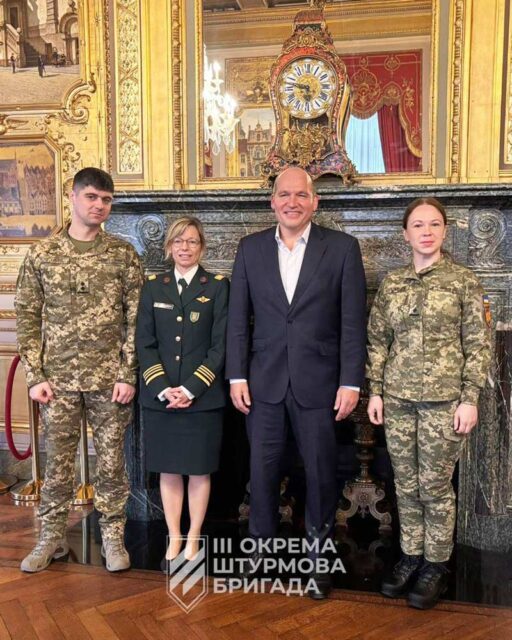
Photo: Viktoriya Kovach, chief medical officer of the brigade, meets with the mayor of Brussels.
— Do you train them, considering the experience they might not have yet?
– For the surgeons, we aim to direct our staff to damage control surgery courses. While Ukraine doesn’t have a basic course for this, we’re fortunate to have specialists from abroad who come here to provide training. Anesthesiologists, on the other hand, refresh their skills through courses like ALS and ITLS. Ongoing education is a must.
All medical personnel, regardless of their rank, education, or category, undergo tactical medicine training. This is essential. Everyone, including the drivers, must have these skills. Drivers play a crucial role in the evacuation process and in organising the overall operation.
We also offer additional training within the brigade. For example, we run courses for heads of medical points in battalions, as well as senior combat medics in units that don’t have designated medical points. These courses focus on organisational and managerial aspects—what the head of a medical point in a battalion should be doing, their functions and responsibilities, the regulations they follow, and their overall role in the unit.
Unfortunately, the system often requires that both the chief medical officer of the brigade and the battalion medical officers hold primary officer ranks along with medical education. While this combination is beneficial, it’s not always the best fit for managerial roles. In reality, chief medical officers need strong managerial skills and, at the very least, a clear understanding of what lies ahead. We introduced this course after gaining some experience in service to address that need.
Within the medical service, we’ve also designated specific roles for various responsibilities. Some people handle the medical commission, others are responsible for injury reports for military personnel, and some focus solely on medical supplies, working with volunteers to manage property. There are also people dedicated to logistics—tracking, balancing, and ensuring proper management. In addition, we have staff working on the analytical side, collecting and processing data. These individuals serve as communicators with battalions and units, helping to streamline operations and simplify the work.
— Does the volunteer component still play a key role in supply, or has the state already taken over this mission?
– I’ll break this down into a few key areas: first-aid kits, equipment, vehicles, and medications. This is the simplest way to explain it.
First-aid kits come to us centrally from the medical forces command, but the kits provided aren’t quite up to standard, so we end up reassembling them. We also receive backpacks from volunteers, and we’re fortunate to work closely with Tatyana Kepler, who puts together these backpacks based on our specific needs. I can’t even begin to imagine the effort it takes to gather such a large amount of expensive tactical gear, but they manage it, and we’re deeply grateful for all their hard work.
When it comes to equipment, we rely entirely on volunteers. For vehicles and medical evacuations, we get unarmored transport from volunteers, while armoured vehicles come through the state from the central supply. There’s a shortage, but it’s the state that provides these. As for medications, most of them are supplied centrally by the state, although we also get a smaller amount from volunteers.
It would be wrong to say we don’t use state-provided resources—because we do and in large quantities. However, given the current demands of the military, the state unfortunately can’t fully meet all our needs.