Tucked away in the heart of a sprawling, grass-covered training ground, a base hums with activity—soldiers, instructors, and aspiring drone operators moving in a steady rhythm. Beyond the sea of camouflage, a solitary brick building rises like a monument on the horizon. Known as “The Fortress,” it is the nerve centre for aerial reconnaissance meetings and theoretical training sessions.
Emerging from the fortress is a confident UAV instructor, her presence commanding attention as though she were the undisputed master of this domain.
“She kicks the guys’ butts,” her colleagues say, introducing her with clear admiration.
She’s not crowned with a diadem but instead sports a military boonie hat that casts a shadow over her face, obscuring her features. Dressed in camouflage fatigues, she blends seamlessly into the environment, her personality hidden beneath the uniform. Yet, a flash of individuality peeks through—neon-green socks with tiny Christmas trees poke out from her combat boots, a subtle splash of colour that hints at the unique spirit of this UAV operator.
A practical exercise is about to start, so the instructor, her broad-shouldered, burly partner, and I pile into an off-road vehicle and head toward a hidden spot deep in the field. We cruise through the barren steppe, the road lined with wild, untamed grass swaying in the breeze. At one point, we slam on the brakes to avoid two surprisingly domestic-looking chickens straying far from their coop, like curious children on a stroll. The vehicle bumps along, the sound of jokes and laughter filling the air from the two pilots—the instructor and her hefty companion.
The instructor, who has requested that her call sign remain anonymous, began her service in a reconnaissance-assault group back in 2022. She lived in a barracks with 24 other soldiers and trained in the forests for eight hours a day. Among them were also soldiers learning the ins and outs of operating drones.
“Those born to fly won’t crawl,” she says with certainty, recalling her first experiences with drone piloting.
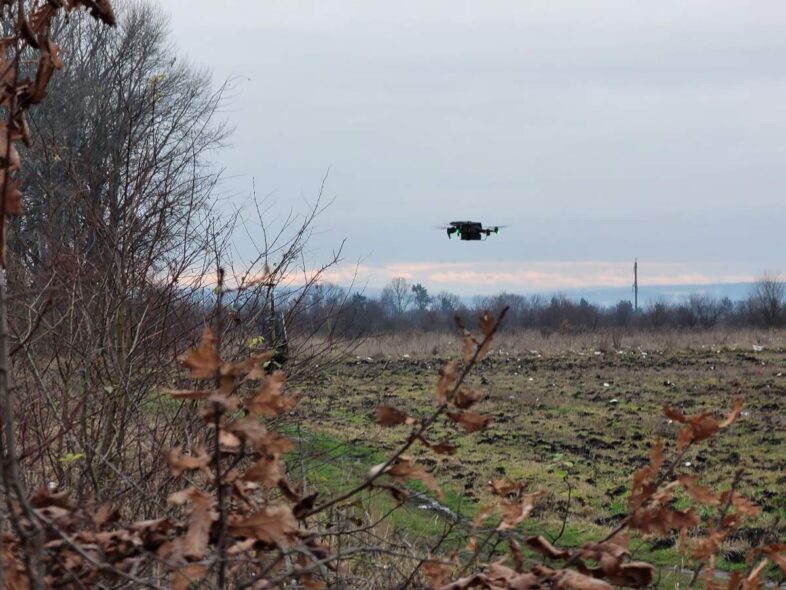
A quadcopter in the sky. Photo provided by the UAV operator school
Then, the servicewoman approached her commander and asked to be sent for training in UAV operations. She aced the course at the very base where we’re standing now. After two weeks of intense training, she was invited to join as an instructor for the first drone. She accepted and has been here ever since, working as an instructor for the past year and a half. Now, she trains others to operate every type of UAV used by the Armed Forces of Ukraine—from quadcopters and FPVs to wings, kamikaze drones, Mavics, and Matrices.
“We don’t have every model out there, but the control methods are mostly the same,” she says. “Right now, the reconnaissance wing is my favourite—it can fly farther and hit more interesting targets.”
Despite her role here, the instructor is set on getting to the front lines and is actively working towards that goal.
First comes strategy—the brain of aerial reconnaissance
The SUV’s rumble was soon joined by an unexpected mix of sounds, forming a unique techno-orchestra. The hum of the engine fused with the buzzing of drones, each one like an oversized, buzzing “bee,” expertly controlled by human conductors. Meanwhile, nature played its own tune—tits and nuthatches chirped in the background, and the May leaves rustled in a gentle breeze.
We arrived at the site for the training exercise—a small cluster of bushes in the middle of an otherwise tranquil field. The trainees were preparing to launch quadcopters, tasked with locating a van on the map and tracking its movements.
For UAV operators, planning is the most time-consuming part of the job. When they arrive at a designated spot near the front lines, their first flight typically doesn’t take place until three or four days later. They begin by getting a feel for the terrain and collecting vital information, like identifying mined areas. For drone operators, communication is key—without it, the job becomes nearly impossible, and sometimes, tragically, lives are lost.
“They arrive, jump into a vehicle, and immediately start looking for a place to fly. Then one comes back wounded, while the other doesn’t return at all—all because they set out without asking questions or checking if it was safe,” the instructor recounts, her voice tinged with emotion.
“First, you need to talk and gather as much information as you can. Find out which areas are off-limits for flying because anyone can take down your drones with electronic warfare systems. No one will tell you what’s going on in a specific spot—it could even be our own artillery. Of course, they’ll bring down anything in the air over them; they won’t know whose drone it is.”
Amid the twisted, thorny branches of hornbeam, oak, maple, and beech, an opening appears—a green archway that leads into the wild expanse of the field, where a drone is being prepped for a reconnaissance mission.
“Twenty minutes until departure,” the instructor says, her tone firm as she approaches her trainees.
“We know,” they respond calmly, carefully placing the drone on a flat surface to calibrate it before takeoff.
“How are you planning to locate it? Why aren’t your drones in the air yet?” Her initial expectation shifts into sharp, pointed questions.
Beep-beep-beep—the controller powered up. Tu-ru-ru tu-ru—the signal confirmed the connection to the copter.
The trainees went to work launching the drone. To anyone listening, it might have sounded like they were pulling the starter cord on a chainsaw—one quick rev, another short pull, then a final, steady hum as the copter ascended, buzzing loudly like a swarm of bees.
Cartography and piloting: the eyes and heart of UAV operators
The instructor watches intently, explaining the role of a drone operator on the front lines. Once aerial reconnaissance teams find a safe spot to launch, they begin plotting flight routes and identifying key reference points—specific coordinates or landmarks essential for navigation and route planning. A solid understanding of cartography is crucial for operators. It’s not just about reading maps; it’s about having strong orientation skills. Without them, knowing where to fly becomes nearly impossible.
“Flying effectively and keeping track of Mavics without map-based orientation and clear communication is almost impossible,” the instructor says.
Missions are typically carried out in pairs. The smallest operational unit consists of two people, so a crew usually includes two pilots, though more may be involved depending on the task. In this exercise, three roles need to be filled: managing the antenna, monitoring the Kropyva map, and piloting the drone.
“It would be ideal if three people handled this,” the instructor comments, frustration creeping into her voice as she describes the exercise. “I watch the pilot-navigator abandon the ‘Kropyva’ map, rush over to adjust the antenna, then scramble back, only to realise they need to place markers or guide the route.”
The trainees began searching for the vehicle, following four reference points. The field’s image was streamed to a tablet used to control the drone.
“Ascend and gain altitude. From up there, you’ll spot the reference points you need to follow. But remember, no flying over villages, alright?” the instructor directs.
“Got it,” responds the focused trainee.
“Don’t jerk it like that!” she snaps, her tone sharp.
“I’m on a high zoom; it’s moving really slowly,” the trainee explains.
“You need to try finding it without the high zoom,” the instructor corrects. “Don’t press like that,” she demonstrates, “and guide your finger slowly.”
“Have you found anything?” asks another pilot, approaching the group.
“One point so far,” the trainee replies, still focused on the tablet.
“Did the other units report anything?” the newcomer asks.
“And were you authorised to communicate with them?” the instructor interrupts, clearly annoyed. “I forbid it. Did you think you could skip preparation and just wait for others to figure it out? That’s not how it works,” she says firmly.
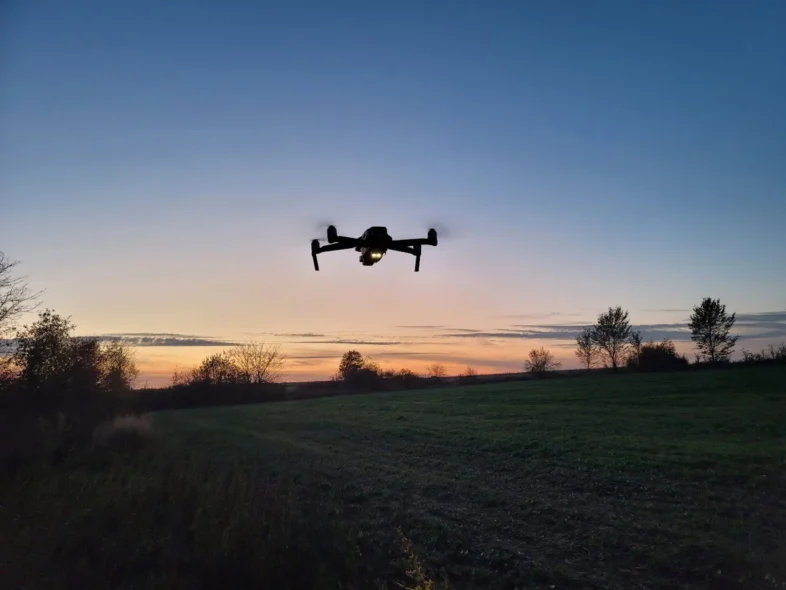
A drone in the sky. Photo provided by the UAV operators school
Muscles and neurons in action: tactical medicine and readiness
The instructor decided to throw in a more advanced task, reasoning that solid training in the rear was key to being ready at the front. She pulled out a training grenade, ripped off the activation ring, and tossed it at the group’s feet.
“Grenade! Grenade!” the trainees shouted, sensing the imminent threat. The grenade hissed as it primed to detonate.
“PSSH!” The grenade went off with its harmless pop.
“Aaah!” the trainees yelled, not quite mastering the challenge, feeling as though they’d been metaphorically caught in the blast.
“I’m alive,” one trainee said, letting out a relieved laugh.
Future operators are trained to always be ready to spring into action—to drop to the ground, grab a tourniquet, and apply it to their arm or leg. They have just thirty seconds to act before losing consciousness. In the case of severe injuries or amputations, complete blood loss can occur in as little as three minutes—or even faster, depending on the person’s build.
“No one will make it to you in those three minutes,” the instructor explains. “The medic first has to report to the commander that you’re wounded, and only then will they get permission to help. That’s why everyone needs to know how to apply a tourniquet fast, on their own. You have to tighten it enough to stop the pulse. And when it really starts to hurt, twist it harder—like this: whoosh!” she mimics the action. “After training, your arms and legs will be bruised and blue from all the tourniquets.”
For the instructor, tactical medicine isn’t just crucial for UAV operators—it’s a skill everyone should know, even civilians. With the air threat looming over all of Ukraine and rockets travelling so fast in frontline cities that there’s no time for an air raid siren, it’s a matter of survival.
After the exercise, the operators guided the drone in for a landing—but things didn’t go as planned. It touched down in a thick field of grass, and the tablet lost connection with the copter. The search was about to get long and frustrating.
“We need to know if we’re hitting the target or not,” one of the operators says, frustration creeping into his voice. “We can’t afford to lose another one. The Russians are setting up decoy tanks just to waste our resources.”
The soldiers set off to search for the drone, some visibly disappointed, others more frustrated. In the combat zone, this kind of mistake could easily mean losing a drone for good.
“No one will be spared by this war,” the instructor states flatly, her tone unwavering.
She advises men, particularly those liable for military service, to start preparing ahead of time. Buy an FPV controller, set up the software on your computer, and practice flying on a simulator at home.
“Being a pilot is a more comfortable military job than most,” she continues. “You’ll be in charge of charging all the batteries and equipment. You’ll sleep wherever there’s light. And where there’s light, there’s warmth.”
The instructor has little patience for those who don’t contribute to the war effort.
“Thousands of people have left the country [illegally, disregarding the martial laws and draft – ed.], each paying ten thousand dollars in bribes. That’s a lot of money, you know. Why not put that to use?” she says, her tone sharp. “The state should create favourable laws letting those people walk freely in the street. You’ve paid for this, you’re helping—and that money goes to the army. You shouldn’t be hiding in your house, gasping for fresh air through a narrowly open window, never stepping outside. And men who don’t want to fight but have a child should take in two orphaned kids whose parents died on the front.”
After a long and exhaustive search, the drone was finally found, and the exercise came to a close. The operators returned to base, packing up the drones, training weapons, helmets with ghillie covers, and camouflage nets into the off-road vehicle.
***
Upon arrival, the instructor was welcomed by her friends for a quick chat and a smoke. “The military is a completely different family, a much closer family because you spend 24/7 with them,” her words echoed in her mind. Every two weeks, as a new training course begins for piloting a specific drone, she meets fresh faces. Over the past year and a half, she’s built a network of meaningful connections. She dreams of throwing a big celebration once Ukraine claims victory.
“I’ll be doing my first stand-up,” she shares, a hint of excitement in her voice. “I promised my friends, who are stand-up comedians, that I’d perform. But only those who fly drones will really get it—the whole routine will be about that.”
After the break, the personnel gather for a private, confidential UAV operator meeting. The instructor bids her friends goodbye and walks confidently toward the entrance. Her shadow stretches against the thick brick wall of the building, which holds both drones and the private conversations of their pilots. Behind her, the cadets and fellow instructors trail. The camouflage patterns of their uniforms blur as they move toward the fortress-like structure, evoking the visual static of a television screen slowly fading to black, signalling the close of the scene.