Perhaps the first thing that catches a Ukrainian arriving at Indira Gandhi International Airport in New Delhi is an RT advertisement. It is hard to miss: the billboards on the way to passport control are impossible to ignore. But what’s visible on the surface is only part of a much wider effort.
Russia has spent years rebuilding and fine-tuning its image in the region, partly through networks that go back to the Soviet era, and constantly adjusting its messaging to fit shifting political realities and local sensitivities. That leaves Western countries with ground still to cover. Ukraine, too, faces a similar challenge if it wants to raise its profile in the region — and that will require a clearer, more consistent information strategy.
At the same time, even in parts of South and Southeast Asia where Russian presence is most visible — as in India, for instance — and in countries where it is trying to gain more influence but remains less of a factor, such as Indonesia or the Philippines, it is not usually seen as a standout superpower. More often than not, it is treated as one of several levers in balancing relations between bigger players. Culture, arms exports and energy resources are still among the main areas that allow the Kremlin to maintain a foothold in the region.
To prepare this article, The Ukrainian Week spoke with experts and journalists based in South and Southeast Asia, as well as others who have long studied the region, to understand how Russia is adapting its information tactics in response to the pressures of its war against Ukraine.
RT and Sputnik key to Kremlin’s overseas media network
Over the past year, the Russian propaganda channel RT has stepped up its push across the Global South—but nowhere is that drive more visible than in India. During a visit in December, Vladimir Putin, alongside chief propagandist Margarita Simonyan, launched RT India with considerable fanfare. A Hindi-language version followed soon after. The channel has leaned on high-profile names to build its presence. Former foreign minister Salman Khurshid hosts one of its programmes, while politician and public intellectual Shashi Tharoor has co-hosted the ten-part series Imperial Receipts. The show revisits the legacy of the British Empire; in its first episode, aired in autumn 2025, Tharoor reflects on the “special” ties between Russia and India while walking through Red Square in Moscow.
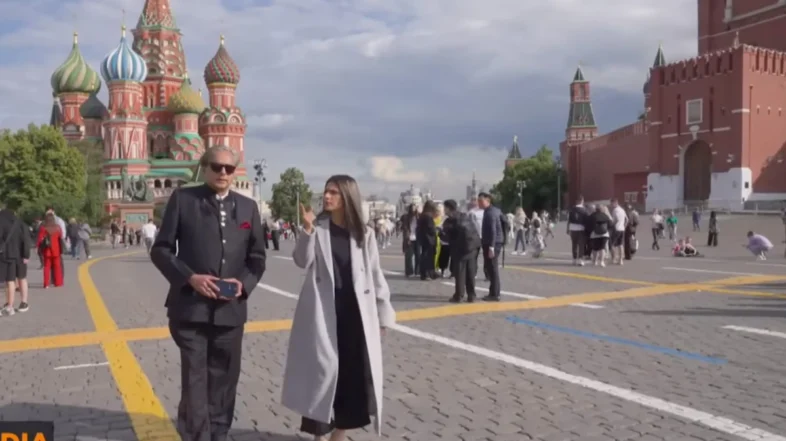
Screenshot from the programme Imperial Receipts featuring prominent politician and public intellectual Shashi Tharoor
In New Delhi, RT’s presence is impossible to overlook. Billboards line the route from the airport, and ahead of the channel’s launch Russia even sponsored a branded metro train, billed as a “Russia–India friendship” line and carrying RT logos throughout. But the visibility doesn’t quite translate into reach. Despite the heavy spend and steady push, the channel’s direct audience remains limited. Much of its traction comes second-hand, when content is picked up elsewhere. The first episode of Imperial Receipts, for example, has drawn more than 500,000 views on Shashi Tharoor’s own YouTube channel.
RT’s programmes are also finding their way onto India’s public broadcaster, Doordarshan (DD). During Putin’s December 2025 visit, RT signed a memorandum of understanding with Prasar Bharati, which oversees the network. Doordarshan no longer competes with private channels in sheer numbers, but it still reaches a wide audience—especially in rural India—making the partnership an obvious play for the Kremlin.
So far, though, the impact looks modest. “In India, just pushing foreign content doesn’t really work,” one Indian journalist told me. In his view, RT still hasn’t made much of a dent in the country’s information space.
“RT and Sputnik barely register in Southeast Asia,” says Ian Storey, a senior analyst at Singapore’s ISEAS–Yusof Ishak Institute. “They don’t broadcast in local languages—which really matters. It’s all in English. You might come across RT in hotels, but that’s about it,” he told The Ukrainian Week. Storey is one of the few researchers to take a close look at Russian influence in the region. His 2025 book, Putin’s Russia and Southeast Asia: The Kremlin’s Pivot to Asia and the Impact of the Russia–Ukraine War, maps out how Moscow is trying to expand its footprint—and where those efforts are falling short.
Youth programmes used in propaganda efforts
At the same time, RT is trying to reach younger audiences through so-called “educational” projects under the RT Academy brand. The format shifts slightly depending on the region. Launched in April 2024, the initiative initially targeted youth in ASEAN countries (Malaysia, Indonesia, the Philippines, Singapore, Brunei Darussalam, Thailand, Vietnam, Laos, Myanmar and Timor-Leste) before expanding to China, Africa and India.
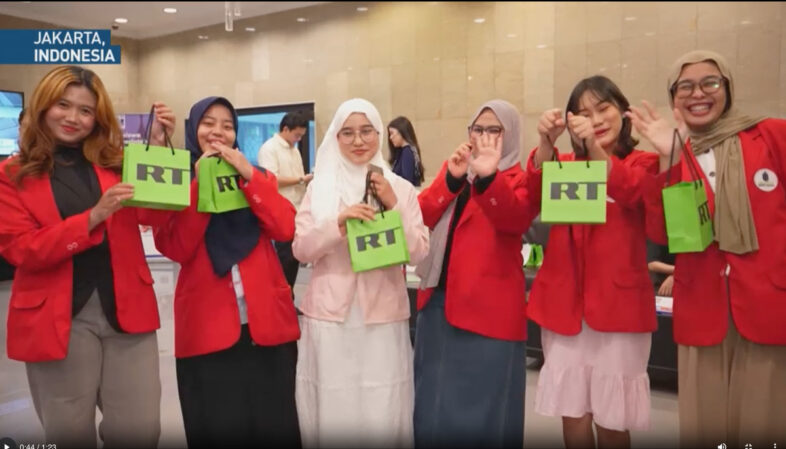
RT Academy now runs both online and in-person programmes. Its main offering is a video course in international journalism aimed at young professionals across the region. The courses are promoted through the social media channels of Russian embassies and “Russian Houses”, with the project funded by Rossotrudnichestvo [Russian federal agency – ed.]. Alongside the online training, RT also organises offline events hosted at these “Russian Houses”. In December 2025, one such event was held in Jakarta, Indonesia, which RT Academy says brought together 500 participants from Indonesia, Malaysia, the Philippines, Cambodia, Thailand and South Korea. A month earlier, the project also ran a series of lectures at universities in India.
RT Academy is far from the only vehicle Moscow is using to court young journalists, bloggers and influencers abroad. Another key platform is SputnikPro. According to the Institute for the Study of War (ISW), by 2025 roughly 12,700 participants from across the globe had passed through the programme, which analysts describe as part of a broader propaganda push. Much like RT Academy, SputnikPro formalises its presence by signing agreements and memoranda of understanding with universities across different regions. In 2025, it struck such deals with universities in Bangladesh, following similar agreements reached in Indonesia in 2024.
ISW analysts note that the Kremlin’s efforts to cultivate media figures receptive to its narratives — and to build its own global media ecosystem — began well before Russia’s full-scale invasion of Ukraine. Since 2022, however, those efforts have picked up pace and expanded in scope. In the wake of the invasion, Moscow has identified three priority countries for strengthening its media presence: India, Iran and China.
Alongside the expansion of RT’s activity and youth-oriented initiatives such as RT Academy and SputnikPro, Russia has also been steadily deepening its ties with local media at the state level. “Russia has signed a number of media cooperation agreements with Vietnam and the Philippines, which essentially give it a platform to spread its propaganda about the war and other issues. But this is not especially widespread. In this region, Chinese propaganda is a much bigger concern,” Ian Storey told The Ukrainian Week.
Beyond Vietnam and the Philippines, Moscow has also signed memoranda and cooperation agreements with Indonesia — including a 2024 arrangement between RT and the Indonesian public broadcaster TVRI. In 2022, the Russian propaganda outlet Sputnik also entered into an agreement with Myawaddy TV, a channel operated by Myanmar’s military junta.
At the same time, Storey — like several other researchers of Chinese propaganda — argues that the two ecosystems often overlap and reinforce each other, particularly in this region.
“Many Russian narratives about the war — such as the claim that the West provoked Russia into attacking Ukraine by offering it NATO membership, or that the West is using Ukraine and Zelensky as a puppet — are widely circulated by Chinese-language media in this part of the world,” he says.
History, culture, Soviet legacy: long-term tools of influence
In his book, however, Storey focuses mainly on the economic and military dimensions of Russia’s cooperation with countries in the region — and draws several important conclusions. While Russia does not have real economic weight there (unlike the United States or China) and is not widely seen as a major influence, the Kremlin still remains a significant player. Ian Storey sets out four reasons for this.
First, he points to how Russia is still seen in parts of the region as a global power — a perception shaped in part by the Soviet legacy. Second, he looks at Russia’s exports to the region. Compared with China or even the EU, the volumes are relatively small, but in some countries they still matter in strategic areas such as arms and nuclear energy. Third, he notes the relatively positive image of Russia — and of Vladimir Putin personally — which often contrasts with views of the West. And fourth, he highlights Russia’s role in regional geopolitics.
Storey argues that even if Russia is not seen as a major economic power, countries in the region still use it as a “hedging tool” in their relations with more influential players.
At the same time, Russia does not pursue a single, coherent strategy for the region. Instead, its approach tends to be opportunistic, involving investments or offers in sectors that the West either cannot or does not wish to cover — nuclear energy being a key example. Countries in Southeast Asia have shown particular interest in small modular reactors (SMRs), a field in which both Russia and China are actively competing. Vietnam, Indonesia and Myanmar are among those most engaged with the Kremlin in this area.
The Kremlin also directs investment where it sees a more immediate payoff for itself. “I have documents showing that they are trying to cooperate with certain companies here in the Philippines and are looking to acquire stakes to secure a foothold in the market — possibly even through full buyouts. I don’t have exact figures, but I know they are showing interest and presenting themselves as investors,” Filipino journalist Monsi Serrano told The Ukrainian Week.
In its engagement with countries across the region, the Kremlin does not seek to push them into choosing sides. Instead, it consistently emphasises the importance of neutrality — particularly in relation to Russia’s war against Ukraine — and the need to resist Western influence. Much of this messaging is effectively a reframing of long-standing narratives, often advanced by so-called “friends of Russia” — commentators who have studied or worked in Russia, or otherwise maintain ties to it. In practice, this type of messaging within regional media environments is often more effective than the direct promotion of propaganda outlets such as RT or Sputnik.
As Ian Storey notes, British media organisations such as the BBC, The Economist and The Financial Times already have wide reach across Southeast Asia, and since Russian propaganda outlets in the region also operate primarily in English, they are unlikely to displace established sources. That said, over the past decade Russia has also attempted to enter regional information spaces in local languages. For example, Sputniknews previously operated Korean and Indonesian-language versions, although these were later shut down.
“There isn’t really a strong Russian information presence in Korea. Local media tend to rely more on Western sources,” East Asia expert and Korea specialist Natalia Butyrska told The Ukrainian Week. At the same time, she notes that Russia still maintains influence through other channels in the country, especially cultural ones.
“Koreans really love theatre, classical Western music and opera, but these genres are not as developed locally, so their easiest access to them has traditionally been through Saint Petersburg and Moscow. That’s why this cultural influence — through music, performance, and translations of Tolstoy or Turgenev — is still present,” the expert explains.
Indeed, Korean media can often be found reporting, for example, on the success of two Korean ballet dancers who joined the Mariinsky Theatre in Saint Petersburg — Jung Minchul and Kim Kimin.

Butyrska also notes that Russia actively develops cooperation with local universities. In this way, the Kremlin operates not only in Korea, but across other countries of the Global South as well. Engagement through educational projects helps build a more durable foundation for influence, allowing certain narratives to take root gradually over time.
Across the region, Russia leans not only on the Soviet legacy but also on earlier historical ties. In Thailand, for example, this includes links between Tsar Nicholas II and King Chulalongkorn of Siam. As Ian Storey notes, Russian and Thai narratives often point to the idea that Nicholas II used his influence with Britain and France to discourage them from annexing Siam, helping the kingdom avoid colonisation.
Natalia Butyrska adds that there is also a royal connection between Ukraine and Thailand: the Ukrainian Kateryna Desnytska was the wife of Chakrabongse Bhuvanath, a son of King Chulalongkorn. Their difficult love story has later been explored by their granddaughter, Narisa Chakrabongse.
Another dimension the Kremlin actively exploits in Southeast Asia — and one highlighted by both Storey and Butyrska in comments for The Ukrainian Week — is Russia’s positioning as a “defender of Muslim interests” in contrast to the United States. In parts of the region with Muslim-majority populations, particularly Indonesia and Malaysia, the US is sometimes viewed as less sensitive to Muslim concerns, or even as anti-Muslim, in part due to its invasions of Afghanistan and Iraq. Continued US involvement in tensions in the Middle East further reinforces these perceptions.
It is also notable that, despite Russia’s relative international isolation since 2022, senior leaders from Indonesia and Malaysia have continued to visit the country. Indonesian President Prabowo Subianto travelled to Russia twice — once in 2024 and again in April 2026. Malaysian Prime Minister Anwar Ibrahim also made two visits, in 2024 and 2025. During his meetings with Anwar Ibrahim, the Kremlin has also drawn on religious themes: the Malaysian leader met with Russia’s religious communities during his visits.
What Ukraine can do to respond
In reality, Ukraine also holds — to use the current US president’s terminology — cards to strengthen cooperation with countries in the region, though playing them requires both resources and sustained effort. Recently, Ukrainian Indologist Olena Bordilovska presented research on the contribution of Ukrainian Georgiy Meshcheryakov to the creation of one of India’s leading technical universities, the Indian Institute of Technology Bombay (IIT Bombay). There are many similar examples of engagement with countries across the region. Ian Storey also points to the importance of reminding regional audiences of Ukraine’s role during Soviet times. At the same time, not all chapters of this shared history are easily received in these countries.
Natalia Butyrska recalls that when certain Korean media want to produce a “critical” report on Ukraine, they visit the exhibition dedicated to pilot Ivan Kozhedub at the National Museum of the History of Ukraine in the Second World War. “Koreans point out that Ivan Kozhedub led a squadron of Soviet pilots who took part in the Korean War and bombed their country,” she says. Historians, however, note that Ukrainians fought on both sides of the Korean War. Ultimately, all of this points to a simple reality: each country requires its own approach.
Diplomatic presence is another area that still needs work. South Korea, for instance, has been without a Ukrainian ambassador since September, while Russia has been noticeably more active. In India, a single embassy covers six countries — India, Bangladesh, Nepal, Sri Lanka, Bhutan and the Maldives — together home to almost 1.7 billion people.
Russia does have a visible diplomatic and cultural footprint across the region. Yet, it’s the Western culture — along with that of regional players like South Korea and Japan — that still sets the tone. Despite offers to study Russian through courses run by Russian cultural institutions, interest remains limited. As Ian Storey notes: “Since younger generations learn languages for practical reasons, they choose English, Korean, Japanese or Mandarin.” Even in Vietnam and Laos — where ties with Moscow are among the strongest in Southeast Asia — Korean is still more likely to be studied than Russian. “Many Vietnamese learn Korean because South Korea is a major investor in Vietnam. This allows them to get jobs in Korean companies, work there and earn good salaries, something Russia cannot offer,” he says.
Food culture tells a similar story. Chinese, Korean and Japanese restaurants are common across the region, while Russian ones are almost impossible to find. So even as familiar narratives keep circulating, it’s getting harder to sell the Kremlin’s appeal to younger generations. Ukraine, meanwhile, still has room to reconnect in places where ties were never fully developed — and to try building new ones where it makes sense.