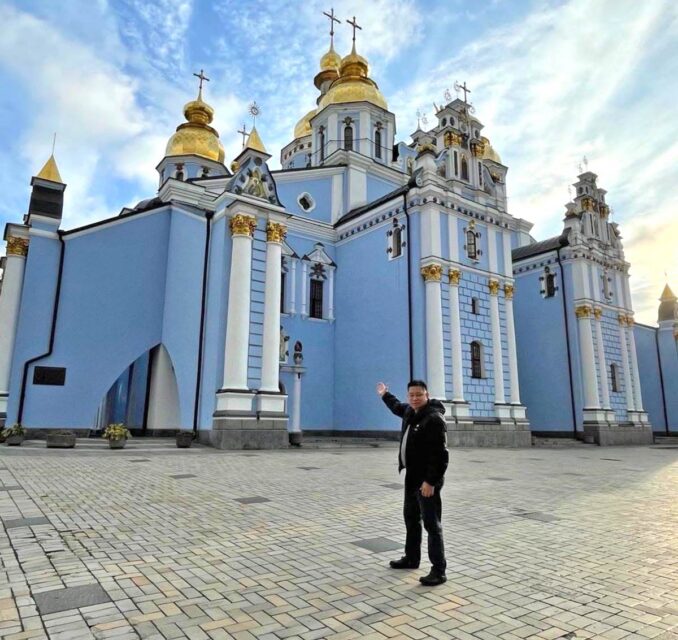
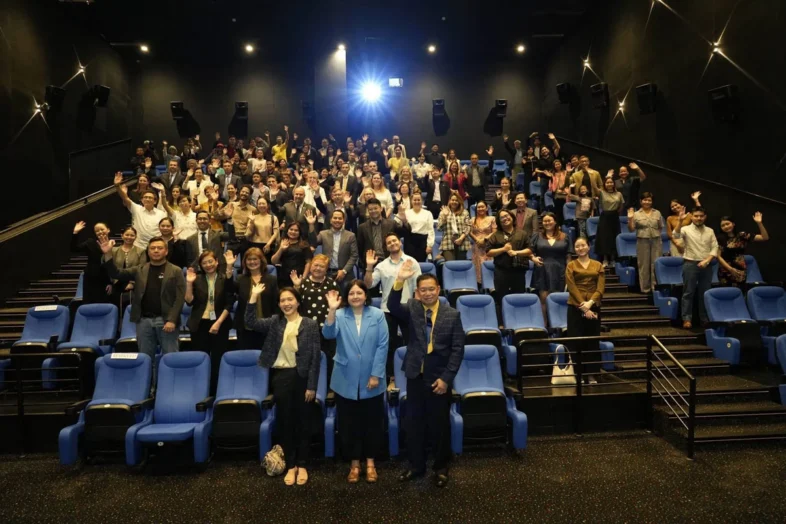
Filipino journalist Monsi Alfonso Serrano has premiered his documentary Hope for the Dawn to Come in Manila. The film follows Ukrainian children growing up and going to school under the shadow of war. Serrano says he struggled to hold back tears during his conversations with them. For him, the project shows how even small journalistic efforts can still change how people understand events — especially how Russia’s war against Ukraine is perceived in his home country, the Philippines. He is now preparing to publish 100 Faces of Ukraine, a photo book, and hopes the documentary will reach as many people as possible.
The Ukrainian Week spoke with Serrano, founder of The Philippine Business and News, about the making of the film, how Filipinos perceive Russia’s war against Ukraine, and the parallels he draws with the growing threat China poses to his own country.
— Your film Hope for the Dawn to Come has just premiered — the only documentary about Ukraine by a Filipino journalist. How did this project first come about?
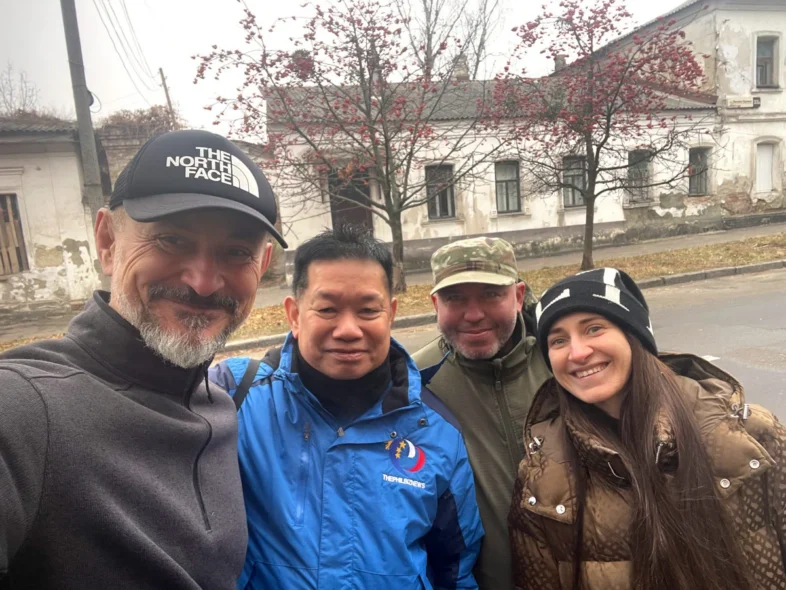
— I didn’t plan to make a documentary at all until I was invited to the Czech Republic and Poland in 2022. By then, thousands of Ukrainians were already on the move, fleeing their homes and heading to neighbouring countries like Poland, the Czech Republic and Hungary.
Once I was there, I realised I couldn’t just pass through as a tourist — I felt a moral and professional responsibility to understand what was happening to these people. Speaking with Ukrainians, I was struck by the stories of those who had survived bombings and killings. As a writer, I’ve always had the habit of filming — I want to capture the emotions behind the words — and that instinct is what led me towards the idea of a documentary. I told myself I had to do it.
Even though Ukraine is thousands of kilometres away from the Philippines, I felt a responsibility to tell the story — especially to audiences in Southeast Asia — about what is really happening on the ground. We know how actively Russia pushes its false narratives, and that only made me more determined to finish the film, no matter what.
The reality is that, for many Filipinos, Russia’s war against Ukraine doesn’t really register. We have our own pressing concerns, especially when it comes to China. But at the same time, I felt that if we’re afraid to talk about what Russia has done in Ukraine, we could one day find ourselves facing a similar kind of brutality from a more powerful country like China.
When I shared the footage, it helped raise awareness among many people in the Philippines about what is happening in Ukraine. I kept going back over the past three years, up until April 2025 — when the documentary was finally completed.
— How many times did you visit Ukraine while filming?
— Three times. I also went to Donbas.
— What struck you most during filming?
— When I stepped inside one of the destroyed schools in Donbas, I broke down in tears. The person accompanying us didn’t want to let me in because there could have been mines, but I went anyway. The Russians really are insane — they even lay mines in playgrounds, so our guide was worried about our safety. But as a journalist, I can’t just film a building from the outside — it wouldn’t carry the same weight. How would people in our countries understand the scale of destruction Russia has brought to churches, schools or pharmacies if I didn’t show what was inside?
So I took the risk and went in. Inside, there were clothes, toys — the everyday things that suddenly felt like remnants of a life interrupted. It was heartbreaking. I couldn’t hold back my tears while filming. Even earlier, in Prague in 2022, during interviews with Ukrainian children, I was crying. I just couldn’t stop — I couldn’t imagine what they’ve had to go through just to survive. And I kept thinking: what if this happened in the Philippines?
That thought stayed with me. What struck me most was the Ukrainian children we met — and Ukrainian children more broadly — their determination to still think about the future, to build it, their resilience.
— You mentioned thinking, “What if this happened in the Philippines?” There are clear parallels between Ukraine and the Philippines, especially given tensions in the South China Sea and pressure from China. How much does that comparison actually come up in public debate back home — both in relation to Ukraine and to your own situation?
— I try to explain those parallels in conversations with military friends, with some colleagues in the media, and in articles I’ve written over time. And, as you’d expect, trolls often appear under those pieces or discussions, trying to dismiss or undermine the argument.
But I usually ask them: “Have you been to Ukraine?” I end up arguing with them online, because if you haven’t been there, then don’t tell me how things are. What right do you even have to speak?
I draw parallels between what is happening between China and the Philippines, and Russia and Ukraine. And this is not some abstract comparison — it is already unfolding, slowly, step by step, through what is often called the “salami slicing” or “cabbage strategy” (two approaches China actively uses in the South China Sea to expand control in the grey zone — Ed.).
Look at Crimea. This war didn’t start in 2022 — the annexation happened much earlier, in 2014. That’s why I sometimes get frustrated with people who try to dismiss all of this as a Western narrative. It isn’t a Western narrative.
— In Ukraine today, there’s a lot of talk about the war in postcolonial terms — as a kind of resistance to Russia’s imperial policy. Do you think that framing would resonate in the Philippines?
— We’re in a somewhat different situation. In the case of Russia and Ukraine, that framing may work. But with the Philippines, we can’t really use those terms, because China never colonised us. In fact, during the Battle of Yultong, we fought alongside the Koreans and defeated Chinese forces.
For us, it’s more a question of sovereignty. National security and sovereignty are the key issues. In my view, colonialism isn’t a framing that really resonates in the Philippines, especially when we’re talking about China and the Philippines.
— In March, Chinese naval forces carried out several aggressive actions against Philippine vessels in the West Philippine Sea. Do you think Russia’s war in Ukraine has fed into China’s more assertive behaviour?
— I think both Russia and China are becoming more aggressive because they see the United States, under the Trump administration, taking a different direction. One of my concerns is that they may see this as an opportunity — and push things even further.
— And my final question is about your film. Since it only premiered recently, have you had any invitations from festivals yet, or plans for future screenings?
— We haven’t received any invitations yet, but we’re open to screenings. This month, I’m also presenting my book 100 Faces of Ukraine. It’s a gift-format photo book about Ukraine. It covers everything — children, churches, banks, tourism, culture. We also include the story of the Crimean Tatars. It’s all about helping people better understand Ukraine.