
Naval component of Russia’s nuclear triad
Nuclear weapons remain one of the Kremlin’s favourite tools of coercion — a constant instrument Vladimir Putin uses to intimidate the West and push his expansionist ambitions in the war against Ukraine. Within Russia’s nuclear triad, the naval leg plays a particularly strategic role: nuclear-powered ballistic missile submarines armed with intercontinental nuclear missiles. Their importance is easy to understand. Russia’s land-based missile launchers — the core of its Strategic Missile Forces — are under nonstop surveillance by U.S. reconnaissance satellites. In the event of war, they would be among the first targets for NATO’s vastly superior aerospace strike capabilities.
The situation isn’t any better for Russia’s fleet of strategic bombers. All three main bomber airbases — along with their weapon stockpiles and fuel infrastructure — would be exposed and vulnerable to a pre-emptive NATO strike. The air component of Russia’s nuclear triad has also been steadily shrinking: the Kremlin has been losing Soviet-era strategic bombers and lacks the industry and expertise to build new ones. In 2025 alone, Russia lost more than 40 bombers in Ukraine due to the SBU’s “Web” sabotage operation.
Unlike the other two legs of the triad, Russia’s submarine force has one decisive advantage: it can hide. Yes, satellite surveillance tracks shipyards, bases and repair facilities — but once a nuclear submarine slips underwater and heads to sea, finding it becomes a near-impossible task. The only reliable way to shadow one is with another submarine operating in the same patch of ocean.
During the Cold War, anti-submarine warfare revolved around that cat-and-mouse game. Nuclear attack submarines would secretly lurk near enemy bases, training areas and patrol routes, waiting to pick up the trail of a missile sub and stay with it — ready to strike if the order ever came. Both Washington and Moscow mastered this dangerous routine.
Everything changed when the Soviets introduced the R-29 and later generations of sea-launched intercontinental ballistic missiles. Suddenly, their missile-carrying subs no longer needed to slip past NATO defences into the deep ocean to threaten U.S. targets. From the 1970s onward, Moscow began keeping its most valuable subs close to home, patrolling inside heavily protected maritime “bastions” in the Barents Sea and the Sea of Okhotsk — zones guarded by surface ships, aircraft and other submarines to keep NATO hunters out.
After the Soviet Union collapsed in 1991, Russia’s navy shrank rapidly. Ships were scrapped, crews were disbanded and submarines stayed tied to the pier. The Kremlin simply no longer had the money — or the capacity — to challenge the U.S. and NATO at sea. With the fleet in decline, the old Cold War routine of tracking each other’s submarines quietly faded.
By the late 1990s, as Moscow’s rhetoric grew sharper and more assertive, the game was back on. Western navies resumed patrolling near the key bases of Russia’s Northern and Pacific Fleets, tracking a submarine force that was slowly coming back to life. After years of inactivity, Russia had restarted combat training for its submarines, signaling a renewed commitment to nuclear posturing beneath the waves.
Russia’s nuclear submarine fleet development
Despite economic strain, a grinding war, and the pressure of international sanctions, Russia is still building submarines. All nuclear submarine production has now been consolidated at a single shipyard — the Northern Machine-Building Enterprise in Severodvinsk, in Russia’s Arkhangelsk region. In Soviet times, there were four.
On 24 July 2025, the navy received delivery of its fifth Borei-A class ballistic-missile submarine, K-555 Kniaz Pozharsky. With this addition, Russia now fields eight of these strategic nuclear carriers. Each submarine is armed with 16 Bulava submarine-launched intercontinental ballistic missiles. Every missile carries a multiple-warhead payload — six warheads with a yield of up to 100 kilotons each. In other words, a single submarine can unleash a volley of 96 nuclear warheads.
Five Borei-class submarines are currently assigned to the Pacific Fleet, with three operating in the Northern Fleet. Two more — Dmitry Donskoy and Kniaz Potemkin — are still under construction, and Moscow plans to add at least two additional units. If those timelines hold, Russia could field as many as 12 Borei-class ballistic-missile submarines by the mid-2030s, split evenly between its Northern and Pacific Fleets.
Alongside them, Russia continues to operate five ageing Delta IV-class submarines (Project 667BDRM). Each carries 16 Sineva intercontinental ballistic missiles, with four warheads per missile — also up to 100 kilotons apiece. In total, the naval arm of Russia’s nuclear triad controls up to 700 nuclear warheads.
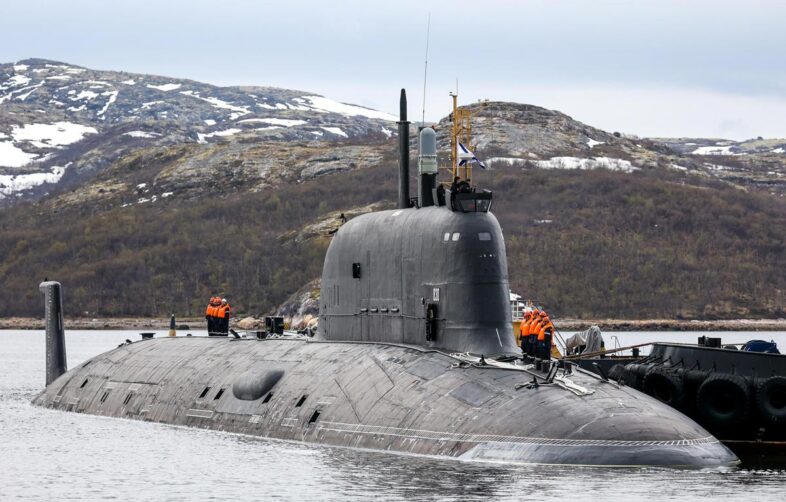
Russian fourth-generation multipurpose nuclear submarine Project 08551 (Yasen-M)
Another priority for the Russian Navy is expanding its fleet of multipurpose submarines — both nuclear and diesel-electric. Moscow is building Yasen-M–class nuclear attack submarines (Project 08551) and Varshavyanka-class diesel-electric boats (Project 636.3), intended to shield its “bastions” and hunt enemy submarines and surface ships. Five Yasens are already in service, out of ten planned. The next boat in the series, Perm, was launched on March 27, 2025, and is expected to enter service in 2026. These submarines carry a mix of weapons: ten 533 mm torpedo tubes and eight vertical launch cells capable of firing Kalibr, Oniks, or the hypersonic Tsirkon cruise missiles.
Russia has also invested heavily in more exotic systems — most notably the Belgorod, a nuclear-powered submarine that serves as a launch platform for the Poseidon nuclear torpedo, a weapon hyped relentlessly in Russian propaganda. A second submarine built to carry Poseidon, Khabarovsk, was launched on November 1, 2025. The purpose of Poseidon is chilling: to detonate a massive nuclear warhead off the U.S. coastline and trigger a radioactive tsunami. There is no analogue to this system anywhere in the world.
Beyond these newer platforms, Russia still relies on 21 older multipurpose submarines. Their combat value, according to most Western naval analysts, is minimal.
Test of strength
Usually, anything to do with the covert activities of the American submarine force remains secret for a long time — all the more so when it concerns operations inside Soviet (and later Russian) submarine “bastions”. One of the few known cases is the unique, highly classified joint operation of the US Navy, CIA and NSA, “Ivy Bells”.
The operation involved placing specialised devices on undersea communication cables to intercept Russian military communications, including transmissions from bases on Kamchatka. As part of the mission, operatives penetrated the Soviet maritime “bastion” in the Sea of Okhotsk to install a covert listening device on the strategic cable connecting Vladivostok, the Pacific Fleet’s headquarters, with Petropavlovsk‑Kamchatsky, the base of the Kamchatka flotilla and nuclear submarines.
The marine section of the cable ran between the western shore of Kamchatka and the northern shore of the Sea of Okhotsk in Shelikhov Bay.
Because of the mission’s extreme secrecy, not even the full crew of the USS Halibut — the submarine assigned to carry it out — knew its true objective. Officially, the operation was described as a dive into a Soviet naval missile range to locate and recover the wreckage of the then-new P‑500 “Bazalt” anti-ship cruise missile. The missile was indeed found, brought aboard the submarine, and later handed over to specialists for analysis.
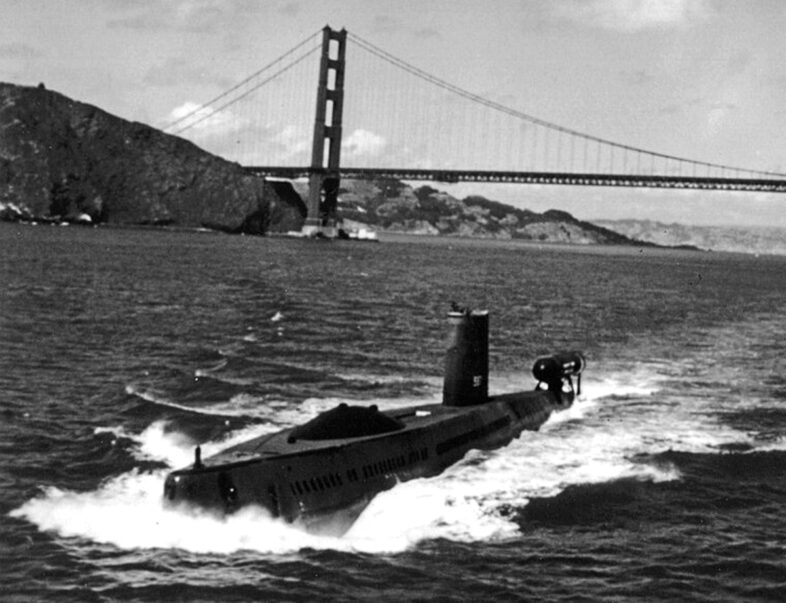
US Navy nuclear-powered special-purpose submarine USS Halibut (SSGN-587), San Francisco, 1975
In October 1971, the specially equipped USS Halibut slipped covertly into the Sea of Okhotsk via the First Kuril Strait. Divers located the target cable at a depth of 120 meters in Shelikhov Bay, about 40 miles from the northern shore. They installed a roughly one‑meter-long recording device on the cable, powered by a lithium battery, capable of running for several days and recording multiple communication channels simultaneously.
By August 1972, the Halibut returned to replace it with a more advanced six‑meter automated listening device — nicknamed the “cocoon” — developed by Bell Labs and powered by a radioisotope source. This new system could continuously monitor dozens of communication lines without damaging the cable, recording everything onto magnetic tape. Because it could not transmit data, American crews had to periodically retrieve the tapes and install fresh ones. When the now‑obsolete Halibut was decommissioned at the end of 1975, other submarines took over the mission, including the USS Seawolf, and later the USS Parche, the latter believed to have deployed yet another “cocoon” on the Sea of Okhotsk cable.
Although the intercepted data reached the NSA with some delay — depending on when the submarine returned to swap out the magnetic tapes — it was both original and invaluable. American intelligence gained unprecedented access to the secrets of the Soviet Pacific submarine fleet, and U.S. officers unofficially referred to the source as a “goldmine.”
The information covered everything from operational and strategic deployment plans for Soviet missile submarines to combat training, measures to reduce acoustic signatures, crew morale and political reliability, and the timing of RPKSN patrols. With this intelligence, the U.S. Navy could plan the movements of its own multipurpose nuclear submarines in advance, ready to shadow Soviet nuclear subs as they departed Avacha Bay on patrol.
The Ivy Bells operation in the Sea of Okhotsk ran for a full decade, until 1980, when Soviet intelligence learned of it through a recruited source — former NSA employee Ronald Pelton, stationed in Washington. But because Pelton didn’t know the exact locations of the American equipment, it took the KGB some time to track it down and neutralise it.
The KGB, determined not to compromise its source, moved cautiously. The search was conducted under the cover story of inspecting a supposedly damaged military cable — allegedly harmed by a fishing vessel. Eyewitnesses report that not even the commander of the cable ship Tavda, assigned to the mission by the Pacific Fleet, knew the operation’s true purpose. Instead, a counterintelligence officer accompanied the crew to oversee the operation.
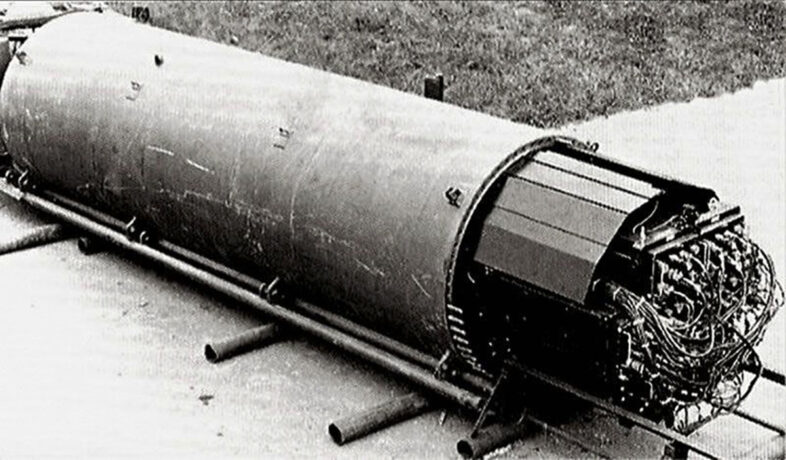
American submarine listening device (“Cocoon”), 1981
He stepped in when, one day in October 1981, the submarine’s captain spotted not one but two of the same “cocoons” being lifted from the cable and, mistaking them for mines, prepared to toss them overboard. The American listening device components, “accidentally” discovered in Shelikhov Bay, were later sent to Moscow for detailed study.
Another phase of the Ivy Bells operation focused on intercepting communications from an undersea cable in the Barents Sea — the Severodvinsk–Murmansk–Severomorsk line. In September 1979, the nuclear submarine USS Parche secretly installed the first “cocoon” there, followed later by a second. The submarine periodically retrieved the intercepted data from both devices, which was highly prized by the NSA.
The intelligence in particular shed light on the organisation of Soviet maritime “protected combat zones,” or “bastions,” the command structure for strategic missile submarines, their alert levels, and the military‑political leadership’s approach to using RPKSN as a strategic reserve for retaliatory strikes.
American and British submarines continued to patrol near Russian “bastions” even after the Soviet Union collapsed. It was these NATO subs that, on August 12, 2000, detected the catastrophic explosions aboard the Russian submarine Kursk during exercises in the Barents Sea. NATO submarines continue to maintain a constant presence in the Arctic today.
“Bastions” in new reality
Moscow’s return to aggressive rhetoric and a more assertive Arctic posture has pushed the U.S. and its allies to take the region more seriously. The Pentagon’s current Arctic strategy, updated annually, calls for a stronger American presence to counter rising Russian and Chinese activity. That means expanding intelligence operations, investing in advanced communications and reconnaissance technologies, and deepening cooperation with allies.
Meanwhile, since 1991, Moscow has drawn its own lessons and moved to bolster the security of its maritime “bastions,” a cornerstone of its strategic defence. A key element of this effort was a large-scale intelligence operation to acquire modern hydroacoustic equipment abroad, aiming to create an acoustic barrier akin to the U.S. SOSUS system deployed in the Atlantic during the early 1960s.
The plan centred on creating a covert acoustic surveillance network called Garmoniya (“Harmony.”) It was designed to include hydroacoustic sensors and other monitoring devices along the approaches to Russia’s submarine “bastion” in the Barents Sea — stretching from Murmansk, the control centre, to Novaya Zemlya, and further north to Franz Josef Land. The system’s purpose was twofold: to complicate NATO submarine operations while giving Russia a decisive edge in detecting underwater targets.
A key player in the operation was Mostrello Commercial Ltd, a Cyprus‑registered front company that has been under U.S. sanctions since 2024. German sources report that it was set up as a cover for the Moscow-based firm Upravlenie Perspektivnykh Tekhnologii (“Management of Advanced Technologies”) and was long used to advance Russian intelligence interests. For the Kometa concern, which oversaw the “Harmony” project, Mostrello procured sanctioned Western equipment between 2013 and 2024.
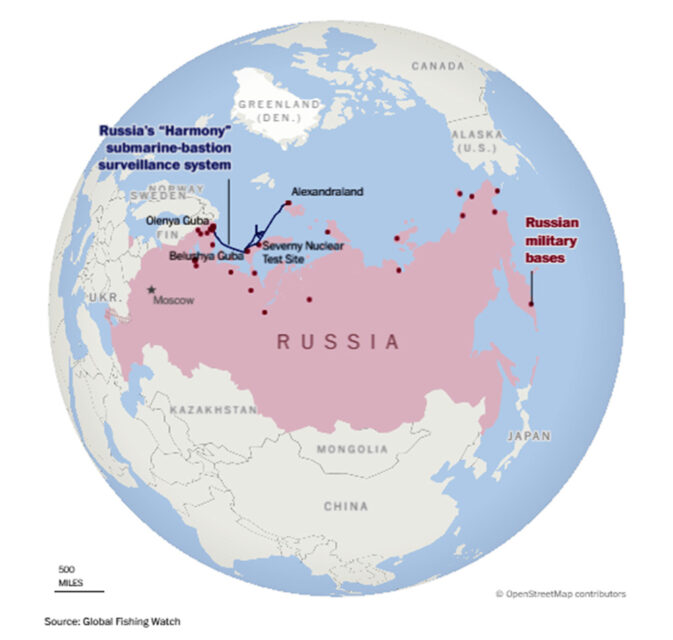
Location of Russia’s “Harmony” acoustic sensors
Investigative journalist reports indicated that alongside Mostrello, the procurement network included roughly a dozen front companies registered in the Seychelles, Belize, and the British Virgin Islands. Through these entities, Moscow was able to bypass export controls and sanctions for more than a decade, acquiring high-tech equipment and other restricted products from the U.S., Japan, Canada, and ten European countries.
For example, in 2013, Mostrello bought telecommunications cables from the German firm Norddeutsche Seekabelwerke, and in 2015 acquired advanced hydroacoustic systems from the U.S. company EdgeTech. That same year, the German company Innomar GmbH sold Mostrello a powerful hydroacoustic complex, which was installed on one of the specialised vessels purchased by the firm. Additionally, in 2015 and 2017, the American company R2Sonic supplied Mostrello with hydroacoustic devices intended “for surveying cables in the Baltic.” In other countries, Mostrello also acquired complex underwater antennas and a variety of acoustic sensors, hundreds of kilometres of specialised cable, and at least three specialised vessels built for precise deployment of acoustic sensors and deep‑water cable-laying.
To conceal the ultimate recipient, much of this equipment was initially routed through Germany, reducing oversight by the original suppliers. There were also obvious mismatches: for instance, Mostrello ordered the Mohican underwater robot from the British company Forum Energy Technologies, designed to operate at depths of up to 3,000 meters — clearly overkill for the shallow waters of the Baltic.
Ultimately, the Russians were never able to complete the “Harmony”. It was exposed and compromised during implementation, with several key Mostrello orders blocked by the security services of countries including Norway and Sweden. As a result, the full array of equipment needed was never assembled. Even with the sensitive hydroacoustic sensors that were installed, the northern maritime “bastion” remains only partially secure — a fact U.S. intelligence is well aware of.
At the same time, the possibility of a similar acoustic barrier being deployed in the Kuril Straits, along the approaches to the Sea of Okhotsk “bastion,” cannot be ruled out. Activity by specialised vessels in the North, Northeast, and Russian Far East suggests they may be installing acoustic sensors in the region. German expert Benedikt Strunz recently shared this assessment with Deutsche Welle.
Russia has also deployed acoustic spying equipment in its inland seas — the Baltic and the Black Sea. In the Baltic, this happened alongside the laying of the Nord Stream pipelines, pointing to a network being set up to monitor underwater activity and track NATO submarines.
In the Black Sea, this goes back to at least 2013, when the Russian fleet illegally installed hydroacoustic gear in Ukraine’s waters to spy on NATO warships entering Sevastopol. The Ukrainian Navy spotted it and even tracked its location, but couldn’t seize it. A later data leak alerted the Russians, and they managed to remove the equipment at the last minute, leaving only the cable on the seabed running to a Black Sea Fleet coastal base.