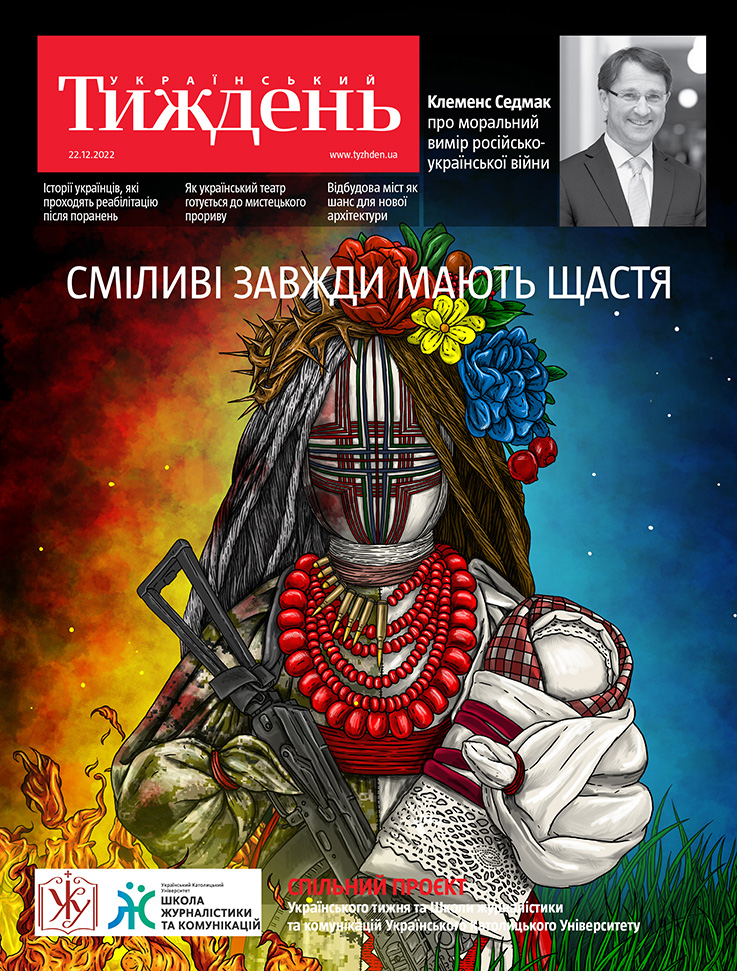
Does Ukrainian propaganda exist?
In an article published by New Voice on 19 July 2024, Andriy Kokotyukha reflects on why Ukraine lacks effective propaganda and sets out a way forward. He begins by invoking George Orwell’s 1984, a novel that exposes the mechanics of totalitarian propaganda but offers little solution beyond counter-propaganda—a strategy that itself risks becoming a means of manipulating public opinion. This deep-rooted distrust of propaganda, seen primarily as a threat to democracy, coupled with limited financial and human resources, helps explain why Ukraine has yet to build a credible alternative to Russia’s powerful information machine.
Kokotyukha goes on to argue that “it all comes down to the lack [in Ukraine] of consistency, continuity of tradition, experience, and understanding of where the line lies between crude, cheap agitprop and high-quality educational work”—qualities Russia has cultivated extensively. Since the fall of the Soviet Union, Russia has relentlessly expanded its propaganda arsenal, spanning popular special forces dramas, fantasy and pseudo-historical novels, films, and even Putin’s favourite band, Lyube.
Since we cannot confront Russian propaganda using the same tactics, the writer argues, we must respond with what it fundamentally lacks: an educational mission rooted in genuine values—truth, freedom, courage, resilience, and the defence of democracy—while celebrating patriotic heroes in the mould of Captain America or James Bond.
“Ultimately, the difference between Russian special forces and the exploits of James Bond and his ilk lies precisely in their values. The former legitimise violence and wars of conquest; the latter wield force to protect democracy. Once this distinction is fully understood in Ukraine, the Russian occupiers and their agents will be defeated by the heroes of books, films and television—those serving in the Armed Forces of Ukraine, the Security Service, military intelligence, or simply those fighting for our freedom and yours,” says Andriy Kokotyukha.
In other words, propaganda is not inherently negative—it depends entirely on its purpose. Yet for the “as-yet-non-existent” Ukrainian propaganda to take shape, Kokotyukha suggests we must abandon the idea that propaganda inherently threatens democracy—at least within the country, in times of war.
To put it another way: the term itself must be freed from the negative baggage (“ideology,” “totalitarianism,” “manipulation,” “lies”) it so often carries in the Russian context.
However, as Alexia Argoud’s research, “La stratégie de communication de l’Ukraine en guerre” (“Ukraine’s Communication Strategy During the War”), reveals, Ukrainian propaganda does exist—albeit under the broader, more neutral label of communication, which conceals key aspects of what “propaganda” truly means: “psychological influence through a system of mass media to spread ideas and views with the aim of shaping public opinion and influencing decision-making.” Thus, if we focus solely on the definition, there is nothing to prevent us from speaking of Ukrainian propaganda without prematurely attaching the usual negative connotations to the term.
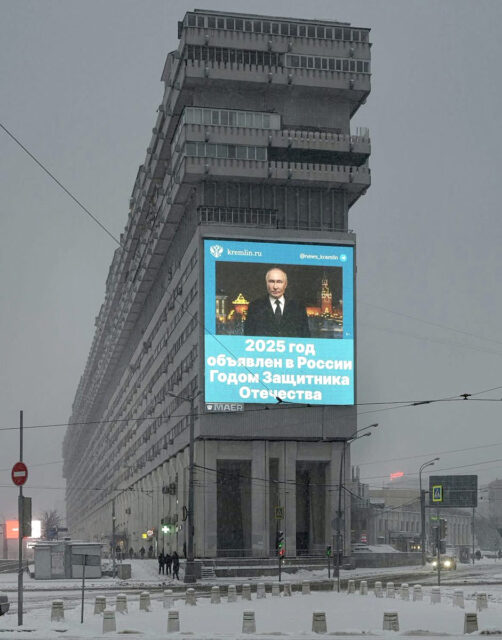
Moscow, 2025. Year of the “Defender of the Fatherland” in Russia. Photo: Oleksandr Hronskyi
George Creel’s propaganda playbook
Andriy Kokotyukha’s reflections on two contrasting types of propaganda—one that justifies imperial conquest, the other that champions universal human values—echo the insights of American journalist George Creel. Appointed by President Woodrow Wilson (1913–1921) to lead the Committee on Public Information (CPI), the United States’ first official propaganda agency, Creel’s work offers a valuable historical lens through which to view Ukraine’s current information efforts.
History professor David Colon dedicates a chapter of his book Masters of Manipulation: A Century of Mass Influence (2021) to Creel’s leadership of the CPI, illuminating lessons that remain relevant today. Established on 14 April 1917, shortly after America entered the First World War, the Committee’s mission was to “sell the war” to a public deeply hesitant about joining a conflict thousands of kilometres from home and posing no direct threat to U.S. soil.
Creel described this as “a battle for men’s minds”—a campaign to persuade Americans of the urgent need to fight. His strategy drew on the work of French psychologist Gabriel Tarde (The Opinion and the Crowd, 1901), who stressed the crucial role of communication in shaping public opinion. By flooding everyday life with a steady stream of factual war information—enough to inform, but carefully calibrated to avoid compromising national security—Creel sought to spark private conversations and build a united front behind the war effort.
In this approach, the methods of the CPI offer a compelling model for organising Ukraine’s own propaganda efforts today.
How wars are sold
The CPI united a generation of skilled communicators—journalists, writers, publicists, artists, filmmakers and scholars—organised into two main sections: internal and external. The internal section included the News Division and the Censorship Committee, which exerted indirect control over war-related information by supplying the press with free dispatches and ready-to-print articles blending factual content with propaganda. From May 1917, the Official Bulletin kept government officials, the media and key opinion leaders regularly updated with statements from civilian and military authorities. Creel also persuaded the army and navy to promptly report accidents and disasters, publishing the names of the dead and prisoners, while the Censorship Committee carefully filtered sensitive information that needed to remain secret.
Women were a key focus for the CPI. During its nine months of operation, the Women’s Work Department published over 2,300 reports and articles, often accompanied by photographs showcasing women actively engaged in the war effort. Central to Creel’s strategy was the “Four-Minute Men” programme—a network of 75,000 volunteer speakers who delivered brief, patriotic talks in churches, schools, union meetings and markets to galvanise public support for the war. Each week, these volunteers received bulletins with suggested speeches—titles like “Why We Are Fighting” or “Exposing German Propaganda”—which they tailored to suit their particular audiences.
The CPI campaigned for the necessity of America’s role in securing victory with an intensity unmatched in the country’s history, deploying every available medium to infiltrate the public’s consciousness: printed texts, radio broadcasts, conferences, posters, leaflets, songs, films and exhibitions.
Visual imagery was the campaign’s most potent weapon. “Printed words can be ignored,” Creel remarked, “meetings can be skipped, films can be avoided, but even the most indifferent glance cannot pass by a poster.”
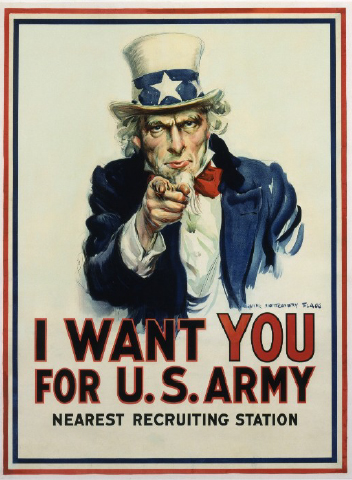
To that end, the CPI enlisted a team of volunteer cartoonists to create striking illustrations—most famously the iconic “I Want You for the U.S. Army” poster—while army artists produced paintings that toured exhibitions nationwide and appeared in newspapers. As historian David Colon puts it, “the Committee’s iconography forged a heroic image of the American forces and, by stark contrast, a terrifying, menacing portrayal of the enemy.” War-themed exhibitions, featuring photographs, staged battles culminating in American victories, and war trophies like captured German U-boats, drew millions of visitors. Collaborating with Hollywood’s biggest stars of the era—Charlie Chaplin, Douglas Fairbanks and others—the CPI produced a series of patriotic films. In the silent film era, the visual and emotional power of cinema enabled them to reach a broad and diverse audience, including immigrants.
CPI: shaping hearts and minds
In its early weeks, the Committee appealed to patriotism and democratic values to rally the American public. But following President Wilson’s Flag Day address on 14 June 1917, Creel recalibrated the CPI’s strategy. In that speech, Wilson depicted American soldiers bearing the flag into battle, dying on blood-soaked fields, and called on the nation to “help liberate the world” from the self-appointed masters—the German government—who sought to impose domination through sheer force.
From that moment, alongside so-called “white” propaganda—factual and transparent about its origins, such as photographs of French cathedrals destroyed by German bombs used in recruitment drives and exhibitions—the CPI began to deploy “grey” and “black” propaganda. This involved distorting or fabricating information and obscuring its sources.
“The purpose of grey and black propaganda was to discredit the enemy, accusing them of atrocities like cutting off Belgian infants’ hands, raping nuns, and even boiling soldiers’ corpses for fat. By portraying the enemy as a bloodthirsty beast in some posters, the CPI aimed to cast America’s fight as a battle for civilisation and justice,” writes David Colon.
The CPI’s war propaganda sought to shape perceptions, sway beliefs, and influence behaviour by appealing not only to reason but also to emotion—particularly by fuelling anti-German sentiment. Yet, as Nicholas J. Cull points out, Creel made efforts to temper this approach wherever possible. He insisted that all official Committee statements—especially those concerning German conduct—be backed by multiple local sources, softening the ethnic rhetoric. Crucially, the CPI aimed to secure the loyalty of millions of German and Austro-Hungarian immigrants by distributing publications in German, rather than persecuting them. This marked a clear departure from local private paramilitary groups, which called for firing workers from enemy nations, banning German music concerts, or outlawing the teaching of German in schools.
Foreign Department and cultural diplomacy
The foreign section of the CPI was tasked with circulating American news abroad, working to counter German propaganda and shape public opinion in both allied and neutral countries. To achieve this, it distributed a range of materials—brochures, leaflets, badges, posters about the war, portraits of President Wilson, paper flags, sheet music for the national anthem, and more. The Committee maintained offices in key cities across the allied nations, often staffing them with communication specialists drawn from American descendants of immigrants from those countries. In France, the CPI even took the bold step of operating behind enemy lines, collaborating with French military intelligence to produce and distribute German-language leaflets designed to stir unrest among enemy troops and civilians.
To stave off war-weariness, Creel pioneered a new approach: ‘cultural propaganda’. This involved sharing knowledge about America’s history, culture, economy, and way of life with foreign audiences, aiming to build a broader understanding and support for the U.S. war effort.
Beyond organising visits to the United States for foreign journalists and delegations, the CPI established numerous libraries and American reading rooms overseas, alongside running English language courses. It also produced a wealth of educational films depicting everyday American life—children at school, workers in factories and fields, beauty contests, seascapes, and sporting events. Creel went further, persuading foreign distributors to halt the screening of German films, effectively cutting Germany off from a vital market. At the same time, he pressured the American film industry not to sell movies to companies that continued to buy films from enemy nations or to refuse screening propaganda shorts commissioned by the CPI.
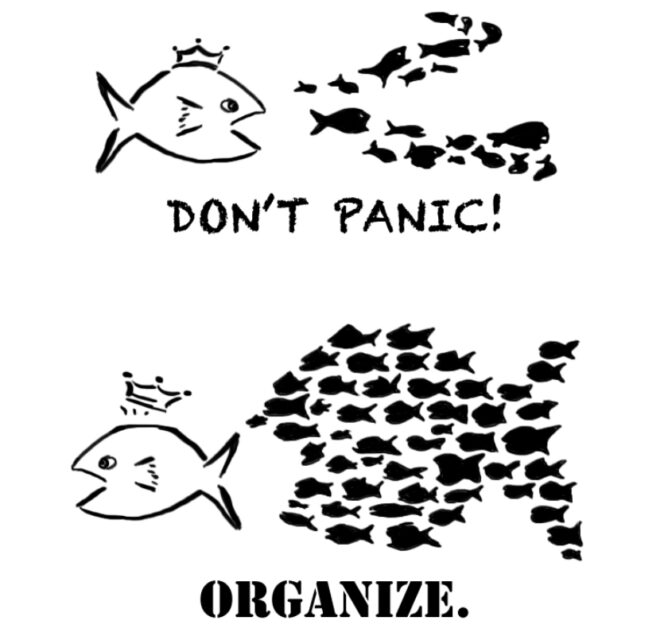
“Organised Fish” symbolises the core idea of the Ukrainian Maidan (2013–2014): spontaneous self-organisation of responsible citizens, all committed to a common cause and working together for the greater good, each doing their part as best they can.
Ukrainian propaganda: a work in progress
If we take another look at Ukrainian propaganda today, it’s clear it’s not quite as “non-existent” as Andriy Kokotyukha claimed—though those were his words a year ago. We’ve already touched on Alexia Argoud’s research, which highlights Ukraine’s “effective” and “innovative” communication strategy in the information war, developed collaboratively since 2022 by government bodies, law enforcement, the Armed Forces, the Security Service, alongside citizens and civil society groups who voluntarily support Ukraine’s national security.
Take, for example, how the Security Service of Ukraine intercepted phone calls between Russian soldiers and their families in the early weeks of the invasion, swiftly making them public, and how Ukrainian-Canadian director Oksana Karpovich later used these recordings to create the Intercepted (2024).
Ukrainian propaganda does exist, then, and the American experience could offer valuable lessons: helping to systematise it, make it more effective and agile, while bringing together a broad range of players—both institutional and individual—at home and abroad. This is particularly vital in the external arena, especially in countries with traditionally strong Russian influence, such as France.
Finally, I’ll offer one example. Since the war began, artists from the National Academic Chapel “Dumka” and the Maiboroda National Bandurist Chapel have frequently toured European countries, including France, with powerful concert programmes organised by various associations. It would be far better if performances by ensembles of this calibre were held under the patronage of the Ukrainian state—not only in churches, but in concert halls—while involving the media and musicologists to shed light on the rich and noble tradition of Ukrainian choral culture. This is not only a unique intangible heritage of Ukraine but perhaps also a reflection of a deeper national characteristic, which was also evident in the “polyphonic” organisation of the Maidan.