“Everything’s fine here… it just isn’t our home.”
Denys loves cactuses. They remind him of the little hedgehogs in his favourite cartoon. Four of them — small, spiky and carefully tended — sit on the windowsill of his new room. He also loves boxing, heading to weekly training sessions, drawn by the thrill of travelling to competitions and fighting for first place.
He’s into football, too. And sledging with his dad in winter. And cycling in summer. And baking cupcakes with his mum. School, he admits, isn’t exactly a passion — though he studies diligently enough. What he really dreams of is returning to his old school. Of going home.
Denys is just 10, but he already knows more about loss and upheaval than most children ever should. He and his parents fled their village of Tomyna Balka, near Kherson, in April 2022, after the full-scale invasion. The war tore them from the life they knew — and left them waiting for the day they can return.
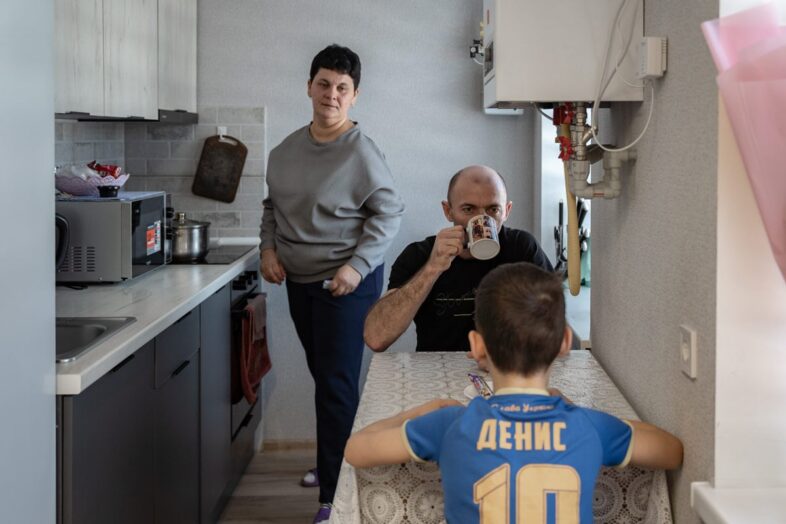
“When the war started, we were sleeping at home in our beds,” Denys recalls. “We heard explosions and at first didn’t understand what was happening. Then my sister called from Kherson and said Russia had attacked Ukraine — there was fighting.”
War is terrifying, he says — especially under occupation. That was their life for two months. They spent nights in the basement, sheltering from shelling. “I really didn’t want to leave, to leave my home and friends. I miss home so much…”
When they fled, Denys’s parents showed documents at the checkpoints proving he had a heart condition. That’s what helped them get through. They passed 30 Russian checkpoints. “I was really scared the soldiers wouldn’t let us go, or that we’d come under fire,” he says.
At every checkpoint, the Russian soldiers asked us for food. “I guess they were hungry,” Denys says. “They asked where we were going, why we were leaving. We told them we were going to a hospital. I was lying down, pretending I was very ill. Although, in all honesty, I really wasn’t feeling well…”
Only after they reached safety was Denys able to sleep peacefully again. There were no daily bombardments. “Although now there are attacks here too. Rockets, drones flying overhead. When the air raid siren goes off, I hide in the bathroom. It feels safer there.
“I’m okay here. But home… home was so much better.”
The place where we’re having this conversation is bright and cosy — a small bedroom, a studio-style living room, and a freshly renovated bathroom. In the village of Rubezhivka, in the Bucha district of Kyiv region, a Polish construction company restored an abandoned dormitory building, turning it into comfortable housing for families displaced by the war.
Denys’s family applied, submitted their documents, and moved in last December. “Everything here is perfect,” Denys says quietly. “But it’s still not home.”
“Kherson feels like a safari — people can’t even step outside safely to buy bread.”
In Tomyna Balka, a village in the Bilozerka district, Denys’s family had everything they needed — a sturdy house built by his parents, a farmyard, an orchard, and a thriving vegetable garden.
“My daughter was studying at university, my son was going to school, and my husband and I were working,” recalls Inna, Denys’s mother. “Then, all of a sudden, everything was turned upside down…”
Her husband Ruslan remembers the day the war began with startling clarity. “Our daughter called from Kherson at dawn on 24 February and said the war had started. I thought, ‘It can’t be…’ But just as she was speaking, powerful explosions shook Chornobaivka nearby. There’s an airfield and a military base there. And the Antonivskyi Bridge came under heavy fire — the noise was deafening.”
They lived under Russian occupation for two long months. Armed soldiers prowled door to door, aggressive and relentless, rifling through everything—from jacket pockets to garage interiors. “We knew there was no future for us there,” Inna recalls. “Leaving was so hard… but we gathered our courage. Our parents insisted the children had to be safe.”
The journey out took three days. They slept wherever they could — in fields, in strangers’ yards. “With God’s help, we made it,” she says. “When we reached the grey zone, there had just been an artillery strike — everything around us was burning.”
Crossing into Ukrainian-held territory, they finally saw their own soldiers. At first, they couldn’t believe it. “We all cried,” says Ruslan. “Me, my wife, the kids — all of us.”
One of the most emotional moments, Inna says, was the sight of white ribbons scattered across the ground.
“When we were leaving the occupied zone, we had to tie these ribbons to our cars… Only once we reached a Ukrainian checkpoint were we allowed to take them off,” she recalls, her voice trembling. “People tore them off in joy and threw them to the ground. They ripped them away and just tossed them… The road was covered — white with ribbons.”
The price of freedom, she says quietly, is unimaginably high.
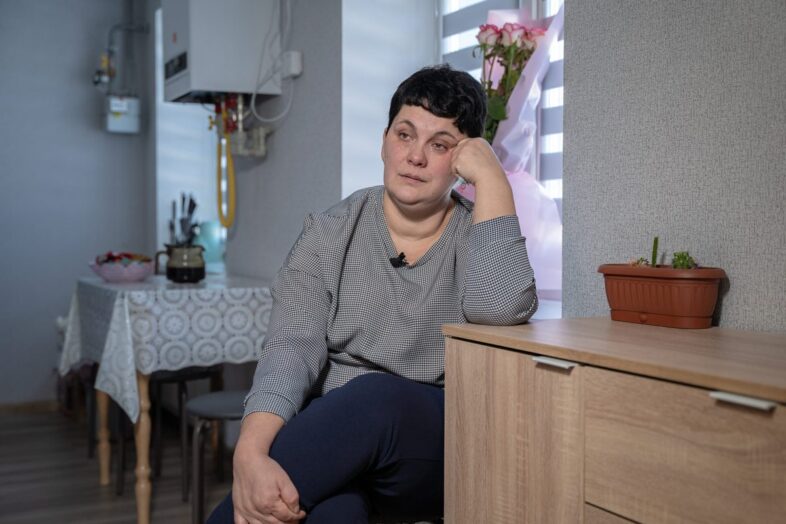
Inna’s mother was seized by occupying forces and held on suspicion of being “pro-Ukrainian.”
“There were lists,” Inna says. “The Russians came for people right in their homes, no explanation. My mother was taken simply because she’s a patriot. She took part in the Orange Revolution, stood on the Maidan. But in our village, some people were waiting for the so-called ‘Russian world.’ They betrayed us all. The occupiers used their tips to round up young men, former ATO soldiers — took them to the basements. When the Russians pulled back, all those traitors fled with them to the left bank of the Dnipro.”
Inna still doesn’t know how her mother was eventually released. “She was interrogated, held… and she’s ethnic Russian, you know,” she adds. “After we escaped the occupation, we went straight to relatives in the Zhytomyr region. We stayed there a while. My mother was taken there too, when they finally managed to get her out of captivity.”
After Kherson was liberated by the Ukrainian army, she went back to Tomyna Balka and still lives there. “My mother-in-law and my husband moved to the Mykolaiv region. We only talk to my mother via messenger apps — whenever someone manages to connect to Wi-Fi. But living there… it’s terrifying. She says drones are constantly flying overhead. You can’t even go outside. Bread is delivered to the shop once a week — people run for it, hiding along the way.”
Volunteers used to bring supplies, but after Russian drones started targeting people, they stopped. “There’s no work. No signal. No life. Kherson has become a kind of safari — only now, it’s people being hunted. It’s heartbreaking.”
“That morning, when Russian missiles hit ‘Okhmatdyt,’ we were meant to be there with my son for a check-up…”
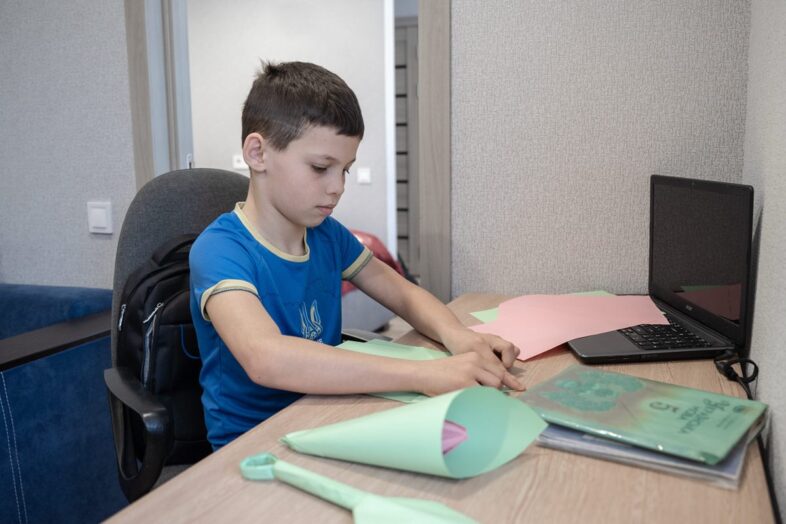
While we talk, Denys is folding paper planes. He loves making all kinds of paper crafts — flowers, vases, anything he can find tutorials for online.
“Back home, Dad and I used to make things out of wood,” he says. “And with my grandad — metal knives. We did it all in the garage. It was great.” He pauses. “But here… we don’t have those tools. And my grandad is far away now.”
Inna smiles gently as she talks about her son. He’s kind, serious about school, always responsible. When he set his heart on getting a bicycle, he saved up for it himself — putting away birthday money and spare change, penny by penny, until he could finally afford it.
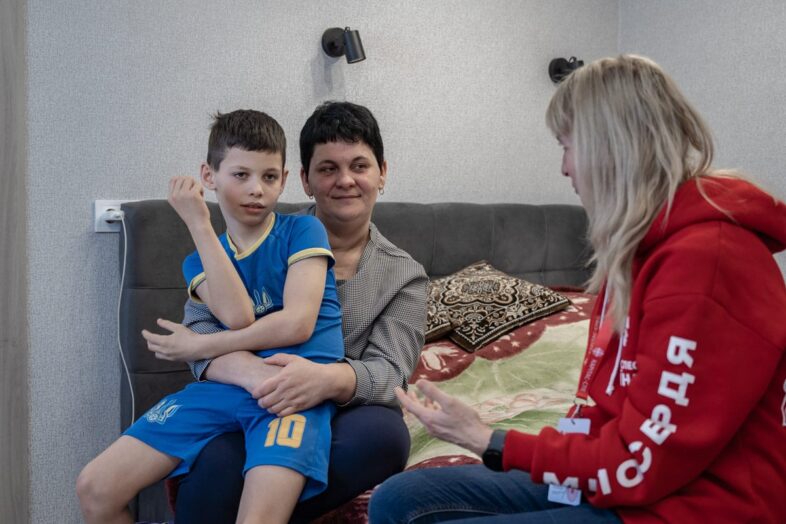
Denys is full of energy and loves sport — but his health tells a different story. He was born with serious congenital heart problems. “We often have to see doctors and go through treatment,” Inna says. “We were supposed to have another check-up at Okhmatdyt last July. It was scheduled for the very day the Russians struck the hospital.
It was a Monday. I remember waking up with this strange, uneasy feeling… like something was off. I told myself, ‘Maybe we shouldn’t go today. Something doesn’t feel right.’ Then I stepped outside and saw missiles heading toward Kyiv. They often fly over our village, right above our house. When I later found out what had happened, I couldn’t recover for days. I still get shivers when I think about it. We were meant to be inside that hospital when the missiles hit…”
On the windowsill, a large colour photograph catches the eye — it looks almost like a painting. “That’s our photo — the legendary one,” Inna says with a smile, picking it up. “My daughter was graduating. My son was starting first grade. It all happened to fall on the same day…”
The school in Tomyna Balka was a good one — the best in the district. It had been renovated not long before the war, with state funds: new insulation, a new roof, tiled floors. “And now… the school’s gone,” Inna says quietly. “It took three direct hits. There are no children left. And even if there were, who would send them to school under shelling? All the teachers have gone too…”
The couple’s eldest daughter now lives in Mykolaiv, working as a police officer after graduating from a specialised higher education institution. “That was her dream, and she steadily worked towards it,” Ruslan explains. “She studied in Kherson. When the occupation began, we were deeply worried — the Russians targeted anyone connected to institutions like hers first. Only after we managed to evacuate our children from the danger zone did we start to feel a little calmer…”
The family’s biggest challenge now is the constant search for work. “We have to earn money, keep living, raise the children. We don’t turn down any kind of job,” Ruslan says. “Before the war, I worked at a large factory with over 2,000 employees. I was a machine operator at Korabel, a company known across Ukraine and beyond for making door panels. The pay was good. But the war destroyed everything. Now I work for a developer — I retrained. We lay and level walls. We work wherever we can. I’ve hauled soil in wheelbarrows and chopped firewood.”
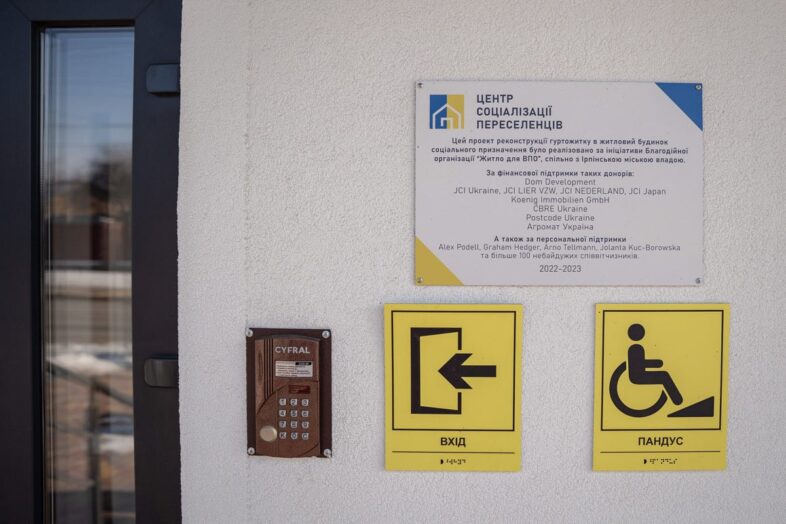
“It’s a relief that at least our housing situation is sorted: by the end of this year, we have a signed agreement and can live here,” Inna explains. “What comes next, we don’t know… After leaving the Kherson region, we stayed for three months with my sister in Zviahel, Zhytomyr region. We had a roof over our heads, but finding work was tough. We came here searching for jobs — housing remains a challenge. We rented an apartment in nearby Dmytrivka, but it was too expensive for us… Without your support, we wouldn’t have managed…”
The family received assistance through the Ukrainian-Polish project “Family to Family,” which supports Ukrainians affected by the war. “Thanks to this funding, we were able to resolve our housing problem. We’re incredibly grateful for this support. The kindness and compassion of people is truly moving. Polish families responded to the hardship Ukrainians face — that means a lot and is deeply appreciated.”
“I know many people need support right now. They’ve lost their homes, and not everyone can afford to rent elsewhere, so they often stay in their hometowns and villages, even though it’s dangerous because of the shelling. Many simply don’t have the means to leave and start over somewhere else.”
At the end, I ask about their dreams. “For the war to end, and for us to be able to return home,” Ruslan replies. “I really long to go back…” Inna adds how much she misses their household and the life before the war. She hopes their family home will survive. “Those were the happiest times, when we all gathered together, when the children were around. Our family was always full of laughter. We had many friends and godparents. We celebrated every holiday in big groups. Life was vibrant. Now everything has quietened, and there’s no energy left for anything…”
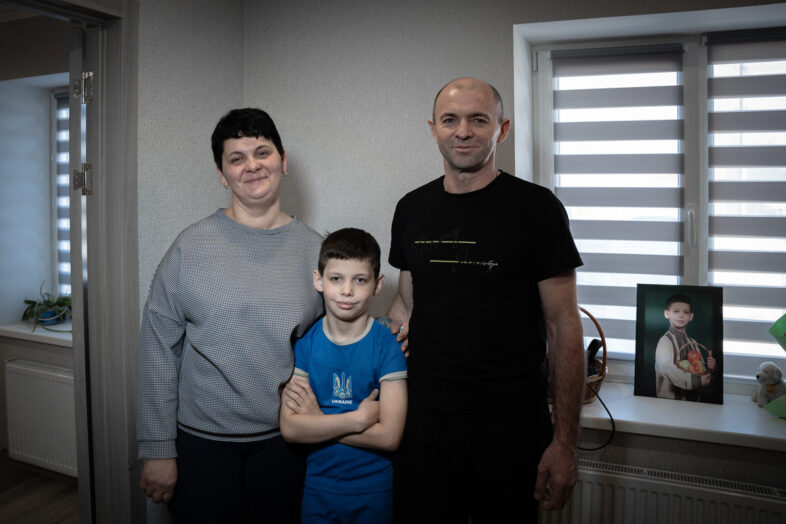
Denys smiles, pauses for a moment considering my question, then says simply, “When we left, I was really worried about whether I’d find anyone to be friends with in the new place. But I’ve found wonderful friends here who always support me. Still, I miss the ones I had in Tomyna Balka. I wish we could all be together again and everything could be like it was before…”